
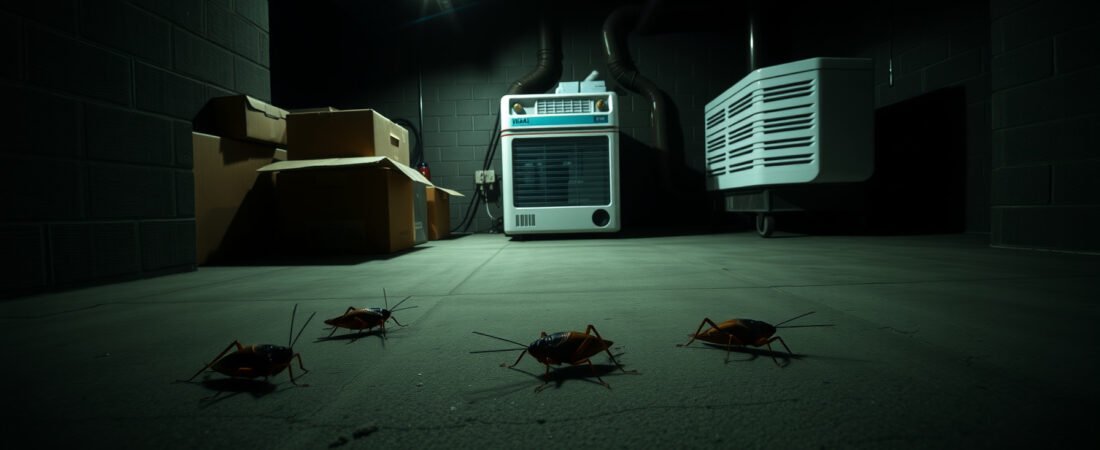
Glue traps don’t work on camel crickets — and that one misunderstanding is why most basements stay infested for months after the first treatment attempt. These insects are strong enough to tear themselves free from standard rodent glue boards, and because most people reach for whatever’s already in the garage, they end up reinforcing the wrong strategy from day one. The real fix is about moisture control first, exclusion second, and targeted killing last. Get that order backwards and you’re just relocating the problem.
Why Are Camel Crickets Taking Over Your Basement Specifically?
Camel crickets — also called cave crickets or spider crickets — aren’t actually true crickets. They belong to the family Rhaphidophoridae, and unlike field crickets, they don’t chirp, they don’t fly, and they’re drawn almost exclusively to dark, damp environments. A finished basement with a dehumidifier running regularly will rarely have them. An unfinished basement with exposed block walls, pipe condensation, and boxes sitting on a concrete floor? That’s basically a five-star resort for these things.
The biology matters here. Camel crickets are thigmotactic, meaning they instinctively press their bodies against surfaces — walls, cardboard boxes, damp insulation — to feel secure. A basement gives them all of that plus near-constant humidity above 75%, which is exactly the range they need to survive and reproduce. A single female can lay up to 100 eggs in loose, moist soil, and because basements often have expansion joints, drain channels, and utility penetrations that collect debris and moisture, there’s almost always a suitable egg-laying site within a few feet of where you’re seeing them.
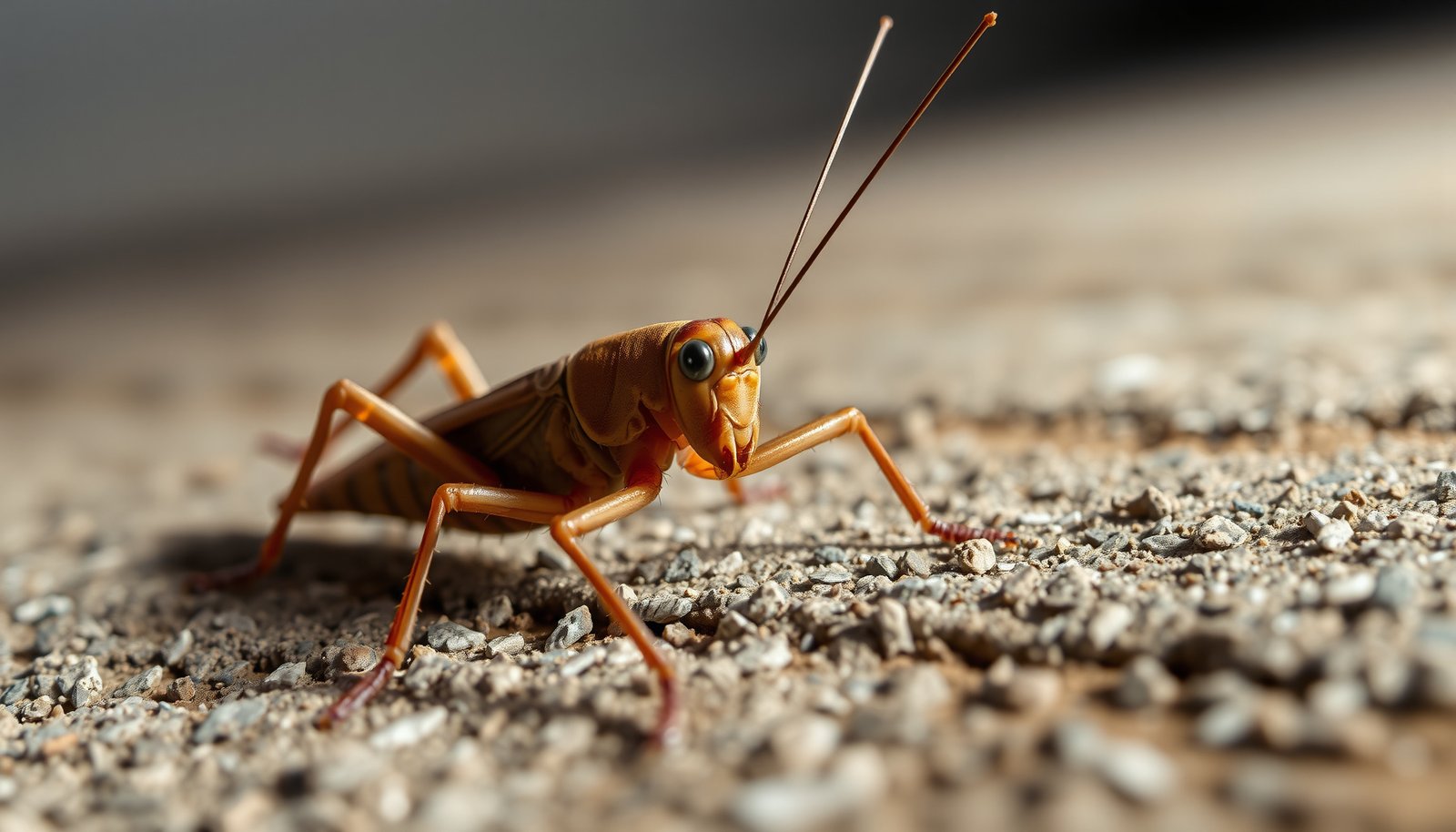
This close-up shows the characteristic humpbacked posture and extremely long antennae of a camel cricket — features that help you immediately rule out other basement insects like earwigs or silverfish before you invest in the wrong treatment.
The Moisture Problem Nobody Fixes First (And Why It Matters More Than Any Spray)
Here’s the counterintuitive part that most pest control articles skip right past: you can kill every camel cricket in your basement today, and within 3–4 weeks have just as many back — because the conditions that invited them never changed. Spraying insecticide on a humid basement is like bailing water from a boat with the plug still out. It addresses the symptom, not the leak. Killing adult crickets without solving the moisture problem just creates an opening for the next generation that already hatched in your floor drain or wall voids.
Getting basement humidity consistently below 50% is the single highest-leverage thing you can do. A mid-sized dehumidifier rated for 70 pints per day can drop a 1,000-square-foot basement from 80% relative humidity to under 50% within 48–72 hours. That alone won’t kill the existing population, but it will stop reproduction cold and make every other treatment dramatically more effective. Fix leaking pipes, seal the base of your water heater if it’s sweating, and pull cardboard storage boxes off the floor — they absorb moisture and give crickets exactly the dark, damp hiding place they want.
“Most homeowners treat camel crickets like a pest problem when it’s really a building envelope problem. The crickets are just the messenger. Solve the moisture and the entry points, and you solve the infestation — without relying on repeated chemical applications.”
Dr. Patricia Merrill, Urban Entomologist and Extension Specialist, Rutgers Cooperative Extension
How Are Camel Crickets Getting Into Your Basement in the First Place?
Picture this: you seal every window well you can find, lay down fresh weatherstripping on the basement door, and still wake up two weeks later to find a dozen camel crickets clustered behind your water heater. It’s not a failure of effort — it’s a failure of inspection. Camel crickets routinely enter through gaps smaller than 1/4 inch, including pipe chases, HVAC return voids, sill plate gaps where wood meets foundation, and floor drains that aren’t fitted with a proper drain cap. They’re also documented to crawl through crawl space vents and migrate upward through interior wall cavities.
The entry point inspection is where you’ll spend the most time, and honestly, it’s worth doing with a flashlight and a can of expanding foam in hand at the same time. Run a bead of foam around every pipe penetration you find, even small ones. Replace cracked or missing mortar in block foundation walls. If you have a window well that fills with leaves or wood mulch, that debris pile is acting as a cricket nursery — clean it out and cover the well with a polycarbonate dome cover. The same attention to sealing that stops rodents from entering also applies here; if you’ve read about how landlord vs tenant responsibility for mice in an old apartment building plays out in older structures, you’ll recognize that aging foundations and sill plates are the common denominator for multiple pest entry problems.
Pro-Tip: Use a moisture meter (under $20 at any hardware store) to check your basement walls near the floor before you start any treatment. Readings above 20% in wood framing or visible efflorescence on concrete walls tell you water is migrating through the foundation — and that’s a habitat condition no spray will overcome on its own.
What Actually Kills Camel Crickets — And What’s a Waste of Money
Let’s go through what works and what doesn’t, because the market for pest control products includes a lot of items that are actively counterproductive for camel crickets specifically. Standard rodent glue traps, as mentioned, are largely ineffective — crickets are strong jumpers (they can leap up to 3 feet vertically) and have enough leg strength to pull free from low-tack adhesive. Ultrasonic devices have no documented efficacy against camel crickets in peer-reviewed studies. And broadcast spraying the perimeter of a basement with a pyrethroid like permethrin will kill exposed crickets on contact but won’t penetrate the void spaces, wall cracks, or drain areas where populations actually hide and breed.
Here’s the treatment protocol that actually produces lasting results, in the order you should apply it:
- Deploy sticky traps designed for insects, not rodents. Catchmaster or Trapper MAX glue boards — the ones with a higher-tack adhesive — do catch camel crickets reliably. Place them flat against walls in corners and behind stored items where crickets rest. Check and replace every 7–10 days.
- Apply diatomaceous earth in void spaces. Food-grade DE dusted into wall cracks, expansion joints, and around floor drain edges kills crickets through physical abrasion of their exoskeleton — no chemical resistance is possible. Keep it dry or it stops working.
- Spot-treat with a residual insecticide concentrate. Deltamethrin or bifenthrin mixed per label and applied as a crack-and-crevice treatment to the base of walls, pipe penetrations, and around window wells creates a contact-kill zone crickets must cross. Don’t broadcast — target the paths.
- Use an insect growth regulator (IGR) like hydroprene or pyriproxyfen. This is the step almost nobody mentions. IGRs prevent juvenile crickets from reaching reproductive maturity, breaking the breeding cycle. Apply as a fine mist to floor drains and the base of walls once every 60–90 days.
- Boric acid bait stations along baseboards. Camel crickets are omnivores and will consume boric acid bait mixed with a food attractant like peanut butter. It works more slowly than sprays — 3–5 days to kill — but reaches crickets that never contact treated surfaces.
One honest nuance here: if your basement has significant water intrusion — actual pooling, efflorescence across large wall sections, or chronic flooding — no amount of pest treatment will provide more than temporary relief. That’s a waterproofing issue, and until it’s addressed, you’re creating ideal camel cricket habitat faster than any product can eliminate it. In those situations, a professional basement waterproofing assessment should come before pest control.
Which Treatment Method Is Right for Your Basement Type?
Not every basement has the same layout, and the method you choose should match your specific conditions. A finished basement with drywall and carpet needs a different approach than an unfinished utility basement with exposed block and a sump pit. Applying a heavy liquid insecticide treatment in a finished space can damage surfaces and void warranties on flooring or insulation — and the residual contact zones are also harder to create because there are fewer exposed cracks and voids to treat directly.
| Basement Type | Primary Method | Key Consideration |
|---|---|---|
| Unfinished / utility basement | DE + crack-and-crevice spray + IGR | Full access to walls and floor; treat all visible voids |
| Finished basement (carpeted) | High-tack glue traps + boric acid bait + dehumidifier | Avoid liquid sprays near carpet edges; focus on perimeter control |
| Basement with crawl space connection | Exclusion first, then DE and IGR in crawl space | Crawl space is the primary breeding zone — treat it, not just the basement floor |
The crawl space situation deserves special attention. Camel crickets thrive in crawl spaces the same way they do in caves — low light, high humidity, cool temperatures, and debris on the ground. If your basement connects to a crawl space through a door or open framing, you’ll never fully control the basement population without treating the crawl space too. Encapsulating a crawl space with a vapor barrier and installing a dedicated crawl space dehumidifier is expensive (typically $3,000–$8,000 professionally installed), but it eliminates the root habitat almost completely. A less expensive short-term fix is sealing the crawl space door with weatherstripping and applying a granular insecticide (like bifenthrin granules) around the crawl space perimeter before closing it off. Just as some pest issues in shared living situations require knowing where responsibility falls — much like understanding what termite wings look like after they swarm helps distinguish separate pest problems — identifying whether your crawl space or your basement is the primary breeding zone determines your entire treatment approach.
How to Keep Camel Crickets From Coming Back After Treatment
Maintenance is boring, but it’s the difference between a one-time fix and a recurring seasonal problem. Camel crickets are most active in late summer and fall when outdoor temperatures drop and they start seeking warmer, more stable environments — which is exactly when your basement becomes attractive. The fall window, roughly 6–8 weeks before your first frost, is when you want all your exclusion and moisture controls already in place, not the week you find them clustering behind your furnace.
Build a simple annual maintenance checklist into your fall prep routine:
- Replace or refresh DE applications in void spaces every 90 days — it loses effectiveness when it absorbs moisture
- Empty and inspect glue trap placements monthly, moving them if you haven’t caught anything in 3 weeks (crickets aren’t using that path)
- Inspect window well covers after heavy rain — debris accumulation can lift or displace them overnight
- Keep outdoor lighting near basement windows on motion-sensor settings rather than all-night timers — sustained light attracts the insects that camel crickets feed on, which draws them in secondarily
- Remove wood piles, dense mulch beds, and leaf litter from within 12 inches of your foundation wall — these are outdoor staging areas where camel crickets congregate before entering
- Reapply a crack-and-crevice residual spray around all exterior foundation penetrations before the first cool nights of fall each year
Something most people don’t consider: camel crickets are scavengers and will eat fabric, cardboard, fungi growing on damp wood, and even each other. That means a basement with a lot of organic clutter — old books, stored clothes, cardboard boxes — is providing them a food source in addition to shelter. Clearing that clutter and storing everything in sealed plastic bins removes both the food supply and the hiding spots simultaneously, and it’s entirely free. It also makes your glue trap placements far more effective because there are fewer alternative sheltering sites competing for their attention.
If you’ve done everything here — controlled moisture, sealed entry points, applied the right products in the right order, and cleared the clutter — and you’re still finding large numbers of crickets after 4–6 weeks, that’s the signal to call a pest management professional. Not because the DIY approach failed, but because persistent infestations at that level usually indicate a structural moisture problem or an undetected entry route that requires professional-grade inspection equipment to locate. A licensed technician can use a borescope camera to check inside wall voids and a thermal imaging camera to identify moisture migration that’s invisible from the surface. That’s information worth paying for — and it gives you a permanent solution instead of another round of products that treat the symptom instead of the source.
Frequently Asked Questions
What causes camel crickets in basement areas?
Camel crickets are drawn to basements because they need moisture and darkness to survive. Any humidity level above 50% combined with clutter, cardboard boxes, or stored fabric gives them the shelter they’re looking for. Fixing leaky pipes, running a dehumidifier, and sealing cracks in your foundation are the most effective ways to make your basement less inviting.
Are camel crickets in basement harmful to humans?
Camel crickets don’t bite, sting, or carry diseases, so they’re not a direct threat to you or your family. That said, they can chew through fabric, cardboard, and even drywall if the infestation gets large enough. The bigger concern is that a heavy infestation often signals a moisture problem that could lead to mold or structural damage over time.
What kills camel crickets fast?
Sticky glue traps placed along walls and in corners catch camel crickets quickly and let you gauge how bad the infestation is. Diatomaceous earth sprinkled around entry points and damp areas is a non-toxic option that kills them within 48 hours of contact. For larger infestations, a perimeter insecticide spray containing bifenthrin or deltamethrin applied around the basement floor and walls works reliably.
how do I keep camel crickets from coming back after treating?
The most important step is controlling moisture — keep your basement humidity below 50% with a dehumidifier and fix any water leaks. Seal gaps around pipes, windows, and your foundation with caulk or foam, since most camel crickets enter through openings smaller than a dime. Remove clutter like cardboard and old clothing from the floor, because those are the hiding spots they depend on to survive indoors.
how many camel crickets is considered an infestation?
There’s no official threshold, but if you’re consistently finding more than 5 to 10 camel crickets per week or seeing them in multiple rooms, that’s a sign of an established infestation rather than a few strays. Spotting them during the day is a red flag too, since they’re nocturnal and daytime activity usually means the population is large enough that they’re competing for space. At that point, trapping alone won’t cut it and you’ll want to combine chemical treatment with moisture and entry point control.
Disclaimer: This article is for informational purposes only and isn’t a substitute for professional pest control advice. Always read and follow the product label instructions exactly — label directions are legally binding and vary by brand and active ingredient. Keep all pesticides, baits and traps away from children and pets, ventilate treated areas as directed, and consider calling a licensed pest control professional if an infestation is large, recurring, or involves a structural pest like termites or carpenter ants.