

Carpet beetles are not eating your carpet. They’re eating your closet — and by the time you notice the damage, they’ve probably been living in your home for months. That’s the part most people get wrong: they assume the name tells you where to look, and while they’re checking the floor, a larvae-riddled wool sweater is quietly being reduced to holes in a dark corner of a shelf.
The real problem with carpet beetles isn’t finding them — it’s that homeowners keep treating the wrong places with the wrong products at the wrong time. A vacuum and a cedar block won’t stop an active infestation. Neither will a single spray of whatever’s under the kitchen sink. Getting rid of carpet beetles permanently means understanding where they actually live, what they’re actually eating, and why your clothes are the target — not an accident.
Why Are Carpet Beetles in My Clothes and Not My Carpet?
The name is genuinely misleading, and it causes people to waste weeks looking in the wrong places. Carpet beetle larvae — the stage that does all the actual damage — are attracted to keratin, the protein found in natural animal fibers. Wool, silk, cashmere, leather, down feathers, and even hair-fiber felt are all targets. Synthetic fabrics like polyester or nylon? Almost completely safe. The larvae couldn’t care less about them.
So if your closet is full of natural-fiber clothing — especially items stored seasonally, rarely disturbed, and kept in low-light conditions — you’ve essentially created a five-star breeding environment. A female carpet beetle can lay 25 to 100 eggs at a time, and those eggs hatch in 10 to 20 days depending on temperature and humidity. By the time you find a damaged sweater, you’re not dealing with a few beetles. You’re dealing with a population.
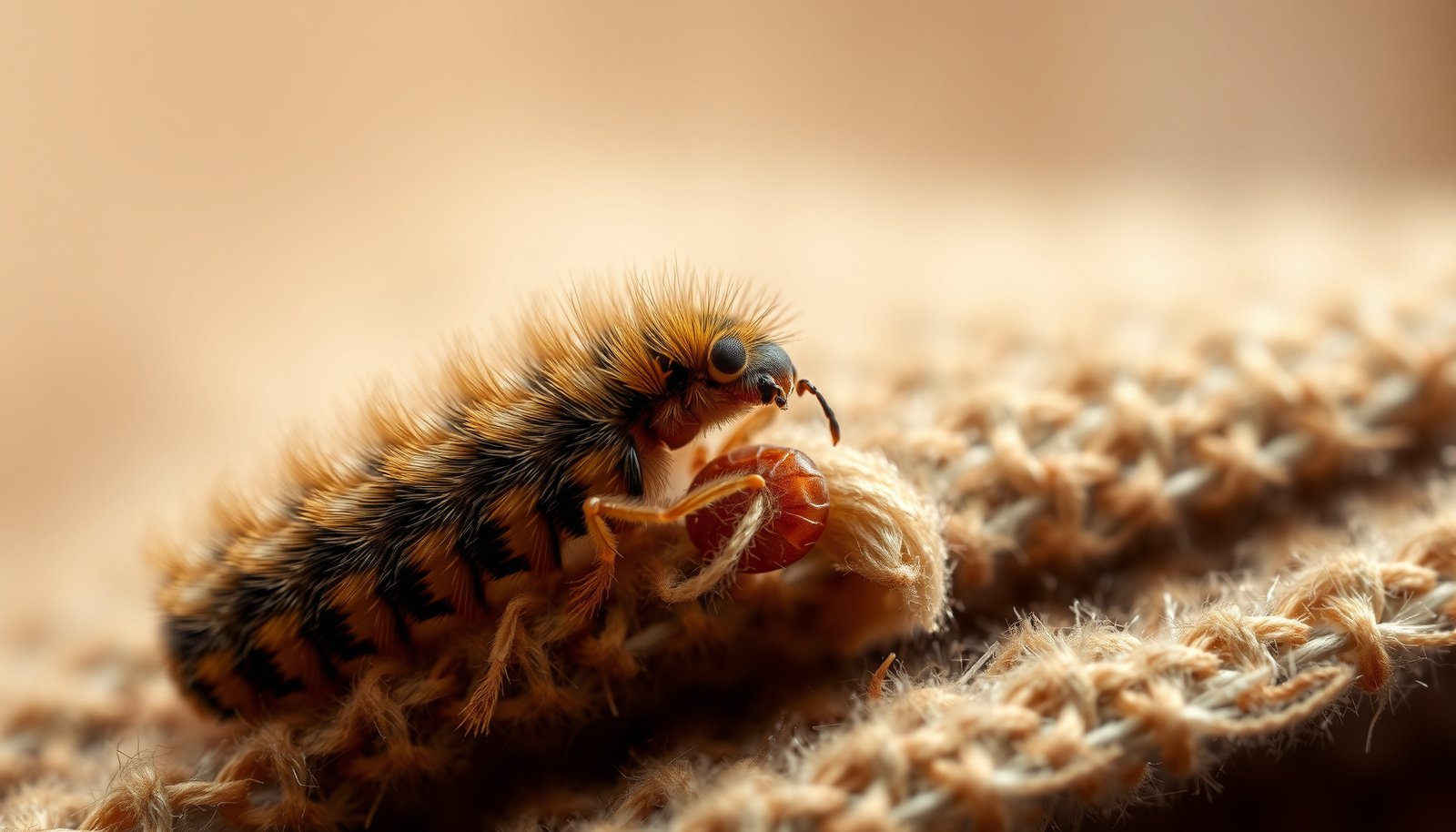
This close-up shows carpet beetle larvae alongside the telltale shed skins they leave behind — knowing what these look like in your own drawers and closet shelves is often the first real clue that you have an infestation rather than random moth damage.
How Do Carpet Beetles Get Into Your House in the First Place?
Adult carpet beetles are outdoor insects. They feed on pollen and nectar, and they’re genuinely good at finding gaps — gaps around window frames, door seals, ventilation screens, and any crack wider than a few millimeters. They’re drawn indoors during warmer months by light coming through windows, and once inside, they lay eggs near food sources. That’s when the damage cycle begins.
Here’s the entry point most people overlook entirely: cut flowers and dried botanicals brought in from outside. Adult carpet beetles frequently hitch rides on flower arrangements, wreaths, and bird nests near exterior walls. Homes with bird nests lodged in gutters or attic soffits are especially vulnerable — old nesting material is loaded with feathers, fur, and shed skin that larvae can feed on, and it sits just feet away from your living space. Inspecting and sealing around rooflines isn’t glamorous pest control advice, but it’s often the single most effective thing you can do to stop re-infestation.
How to Actually Get Rid of Carpet Beetles Step by Step
The treatment order matters more than the products you use. Most DIY attempts fail because people start spraying before they’ve eliminated the source — so they kill some larvae but leave the food supply and egg deposits untouched, and the population bounces back within weeks. Follow this sequence and don’t skip steps.
- Identify and remove all infested items first. Pull everything out of the affected closet, drawer, or storage area. Bag anything with visible damage or shed larval skins in sealed plastic bags immediately. Don’t shake items out in the room — you’ll spread eggs to new areas.
- Wash salvageable clothing at the highest safe temperature. Carpet beetle eggs and larvae are killed by heat above 120°F sustained for 30 minutes. For items that can’t be washed, seal them in black plastic bags and leave them in direct sun on a hot day — interior bag temperatures can exceed 140°F. Cold also works: 0°F for at least 72 hours kills all life stages.
- Vacuum every surface — thoroughly and repeatedly. Vacuum closet floors, baseboards, shelf edges, and the undersides of furniture. Use a crevice tool to get into corners where larvae hide. Immediately seal and discard the vacuum bag outside, because live larvae can crawl back out.
- Apply an insecticide to affected areas, not just the surface. Permethrin-based sprays or products containing bifenthrin are the most effective DIY options against carpet beetles. Spray baseboards, closet interiors, carpet edges (especially along walls), and under furniture. Diatomaceous earth applied along baseboards works as a longer-term physical barrier — it damages the larvae’s exoskeleton causing dehydration, without chemical resistance risk.
- Inspect and treat secondary harborage zones. Check area rugs, upholstered furniture seams, taxidermy, piano key felts, mounted animal trophies, dried flower arrangements, and any stored wool blankets or down pillows. These are classic overlooked sources that keep re-seeding your home.
- Seal and store clean items properly going forward. Use airtight plastic bins or vacuum-seal bags for seasonal clothing — not cardboard boxes, which carpet beetles can chew through. Cedar blocks repel adult beetles moderately but do not kill larvae in an active infestation. They’re a prevention tool, not a cure.
Repeat the vacuum and inspection cycle every 5 to 7 days for at least three weeks. Carpet beetle eggs can take up to 20 days to hatch, so a single treatment pass will miss the next wave unless you’re consistent.
Which Products Actually Work Against Carpet Beetles?
Not all insecticides perform equally against carpet beetles, and a few popular choices people reach for first are close to useless. Bug bombs and foggers, for example, rarely penetrate into the tight spaces where larvae actually hide — inside folded fabric, deep in closet corners, or between mattress layers. You end up coating open surfaces with pesticide while the actual infestation carries on untouched a few inches away.
| Product Type | Effectiveness Against Larvae | Best Use Case |
|---|---|---|
| Permethrin spray | High — kills on contact and residual | Baseboards, closet interiors, carpet edges |
| Bifenthrin spray | High — long residual activity | Perimeter treatment, under furniture |
| Diatomaceous earth | Moderate — physical kill, slow acting | Long-term barrier along baseboards and shelves |
| Foggers / bug bombs | Low — poor penetration into harborage areas | Not recommended for carpet beetles |
Pro-Tip: If you’re treating closet shelves and don’t want to spray near clothing, diatomaceous earth dusted lightly along the back edge of shelves and in the corners works well as a non-staining, residual option. Use food-grade DE and a small duster for controlled application — the powder version is far more effective than sprinkling it by hand.
When Should You Call a Professional for Carpet Beetles?
Picture this: you’ve vacuumed, sprayed, laundered everything you own, and three weeks later you find fresh shed skins in the back of a shelf you already treated twice. That’s a sign the infestation has a harborage source you haven’t located yet — often somewhere structural, like inside a wall void near a bird nest, inside an HVAC duct, or in an area rug under heavy furniture that was never moved. At that point, professional treatment isn’t a luxury. It’s just more efficient than continuing to guess.
Professionals have access to higher-concentration pyrethroids and can apply aerosol treatments into voids and ductwork where DIY products can’t reach. Heat treatment is another option some companies offer — raising room temperature above 120°F for several hours kills all life stages across an entire space simultaneously, including inside wall voids and upholstery. It’s expensive (typically $500 to $1,500 depending on space), but for severe infestations involving irreplaceable textiles or widespread structural harborage, it’s the most reliable single-treatment option available. Honest caveat: for a small, clearly defined infestation caught early, DIY is usually sufficient. The size of the affected area and how long it’s been going on are the two variables that tip the scale toward professional help.
“Carpet beetle infestations are almost always more established than they appear on first inspection. Homeowners see one damaged item and treat one area, but larvae disperse widely and hide in microhabitats — seams, folds, inside vents — that a surface spray won’t reach. A thorough inspection before treatment is the step that most DIY efforts skip, and it’s the reason so many re-infestations happen within 30 days.”
Dr. Ellen Marsh, Board-Certified Entomologist and Textile Pest Specialist, University Extension Program
How Do You Prevent Carpet Beetles From Coming Back?
Prevention is genuinely straightforward once you understand what you’re preventing against — adult beetles getting in and finding a place to lay eggs. Sealing entry points matters: caulk gaps around window frames and door trim, make sure window screens have no holes, and check that attic vents have intact fine-mesh screens. Adult carpet beetles are small enough (1/16 to 1/8 inch) to squeeze through surprisingly tiny openings, especially around older window frames that have shrunk seasonally.
What most prevention guides don’t tell you is that regular closet disturbance is one of your best defenses. Larvae thrive in undisturbed, dark environments. Clothing that gets worn, washed, and moved around regularly almost never gets infested. It’s the seasonal items — the winter coats packed away in spring, the wool blankets folded at the back of the shelf — that get destroyed. Rotating and inspecting stored items every two to three months is less exciting than buying cedar rings, but it’s far more effective. Also worth noting: if you’re a renter dealing with recurring pest infestations that your landlord isn’t addressing, Can You Break a Lease Because of a Pest Infestation? covers what your legal options actually look like in that situation.
Here’s a quick checklist of prevention habits that actually move the needle:
- Store all natural-fiber clothing in airtight bins or vacuum-seal bags — not cardboard or fabric storage boxes
- Dry clean or wash seasonal items before storing them, since body oils and food residue attract larvae
- Inspect cut flowers and dried botanicals before bringing them indoors
- Check for and remove bird nests from gutters, soffits, and attic areas annually
- Vacuum along baseboards and closet floors monthly, not just the open floor area
- Repair window and door screens, and seal gaps around exterior trim with caulk
One counterintuitive thing worth knowing: carpet beetles are also found in homes that are very clean and well-maintained. They don’t need food crumbs or dirty conditions — they need protein fibers and an entry point. A meticulously kept home with expensive wool rugs and cashmere sweaters is, from a carpet beetle’s perspective, an excellent destination. Cleanliness helps, but it’s not a shield. Proper storage and exclusion are.
And just as a side note on the larger world of household pest management: exclusion thinking — sealing entry points, removing harborage, managing the environment — is the thread that runs through effective control of almost every household pest. It’s why pest professionals who focus on structural vulnerabilities rather than just spraying tend to get better long-term results. This principle applies whether you’re dealing with carpet beetles or doing something unrelated like evaluating what subterranean termites look like underground before deciding on a treatment approach.
Carpet beetles are a slow, quiet infestation — the kind that costs you a cashmere sweater before you even know you have a problem. But they’re also one of the more controllable household pests once you stop treating the symptom (the damage) and start treating the actual population and its food supply. Get that sequence right, stay consistent for three to four weeks, and store your natural-fiber items properly going forward. The larvae can’t eat what they can’t get to.
Frequently Asked Questions
how do I know if I have carpet beetles or bed bugs?
Carpet beetles are oval-shaped and patterned with black, white, and orange or yellow scales, while bed bugs are flat, reddish-brown, and about the size of an apple seed. The biggest clue is the damage — carpet beetles chew irregular holes in wool, fur, and natural fibers, whereas bed bugs leave no fabric damage at all and instead leave small blood stains on your sheets. You’ll also often spot carpet beetle larvae, which are fuzzy and bristly, crawling near baseboards or inside closets.
what kills carpet beetles instantly?
Spraying carpet beetles directly with an insecticide containing deltamethrin, bifenthrin, or cyfluthrin will kill them on contact. For fabrics and clothing, heat is one of the fastest solutions — washing items in water at 120°F or higher and then drying on high heat for at least 30 minutes will kill both beetles and larvae. Boric acid powder dusted along baseboards and inside closets also works well, though it takes a few days rather than being truly instant.
can carpet beetles live in your bed?
Yes, carpet beetles can absolutely end up in your bed, especially if you have wool blankets, down pillows, or other natural-fiber bedding. They’re not parasites like bed bugs, so they won’t bite you while you sleep, but their bristly larvae can cause itchy, red welts if they make contact with your skin. If you’re finding damage or shed skins in your bedding, strip everything and wash it immediately on the hottest setting the fabric allows.
how long does it take to get rid of a carpet beetle infestation?
Most carpet beetle infestations take 2 to 4 weeks to fully eliminate when you’re consistent with treatment. You need to vacuum thoroughly every 2 to 3 days, launder all affected items, and apply an insecticide or boric acid to hiding spots like closet floors, baseboards, and under furniture. If the infestation is heavy or spread to multiple rooms, it can take closer to 6 to 8 weeks, and a professional exterminator may be the faster option.
what attracts carpet beetles to your house?
Carpet beetles are drawn inside by natural fibers, pet hair, dead insects, and stored pantry items like dried grains or spices. They typically enter through open windows and doors, gaps around utility pipes, or even on cut flowers and secondhand furniture brought inside. Once they’re in, clutter, infrequently vacuumed areas, and items stored in cardboard boxes give them the perfect place to breed undisturbed.
Disclaimer: This article is for informational purposes only and isn’t a substitute for professional pest control advice. Always read and follow the product label instructions exactly — label directions are legally binding and vary by brand and active ingredient. Keep all pesticides, baits and traps away from children and pets, ventilate treated areas as directed, and consider calling a licensed pest control professional if an infestation is large, recurring, or involves a structural pest like termites or carpenter ants.