
Traps alone will not solve a roof rat problem in your attic — and that’s the part most homeowners get exactly backward. They set a dozen snap traps, catch a few rats, declare victory, and find themselves back at square one six weeks later. The real fix is exclusion first, elimination second. Everything else is just pest control theater.
Roof rats — Rattus rattus, also called black rats or ship rats — are not the same animal as the Norway rats you’d find burrowing under a slab or raiding a compost bin. They’re climbers. They enter homes 10, 15, even 20 feet off the ground through gaps as small as half an inch around pipe penetrations, ridge vents, and where the fascia board meets the soffit. Treating them like ground-level rodents is the single biggest mistake people make, and it explains why so many attic infestations keep coming back after trapping.
Why Roof Rats Keep Coming Back Even After You’ve Trapped Them
Picture this: you hear the scratching above your bedroom ceiling every night around 11 p.m. You buy six snap traps, bait them with peanut butter, and catch three rats in a week. The scratching stops. Two months later it’s back, this time louder. What happened? You removed some rats but left the door wide open. Roof rats leave pheromone trails — urine scent markers — that actively attract other rats into the same entry points. New rats from the surrounding neighborhood follow the trail like a welcome mat was rolled out.
A female roof rat reaches sexual maturity at about 3 to 5 months old and can produce 4 to 6 litters per year, with 5 to 8 pups per litter. Do the math on an unaddressed entry point and you can see how a small problem compounds fast. The biology is working against you if you’re only trapping. Until you physically seal the building, you are managing symptoms rather than solving the problem.

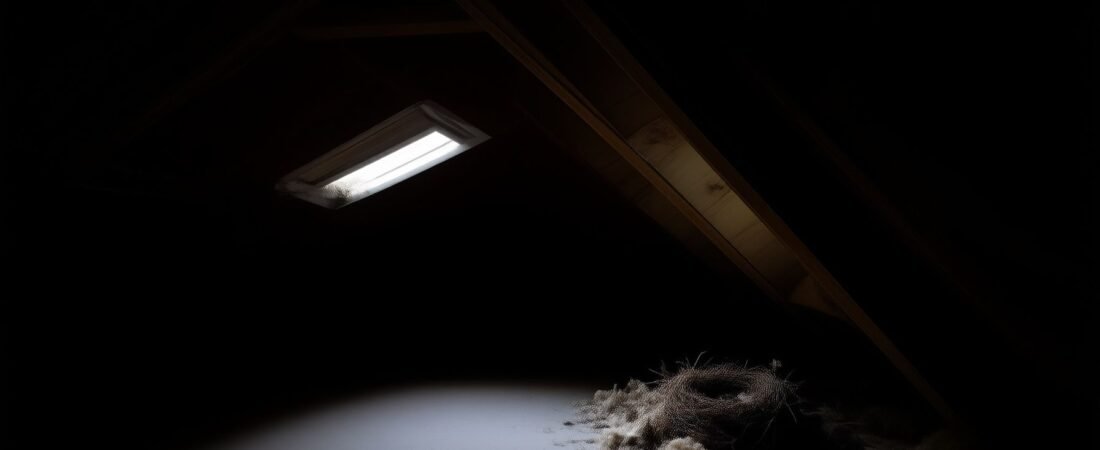
This image shows the kind of gnaw damage and grease rub marks roof rats leave on attic beams and insulation — the physical evidence that tells you how active an infestation is and where the rats are traveling most frequently.
How to Find Every Entry Point Roof Rats Are Using
Exclusion work is only as good as your inspection. Roof rats are creatures of habit — they use the same travel routes over and over, and those routes leave visible evidence. The most reliable way to find entry points isn’t to guess; it’s to follow the grease marks. Rats have oily fur, and wherever they repeatedly squeeze through a gap, they leave a dark smear. Check your roofline at dusk and watch where rats are actually entering — a flashlight and binoculars work well for this if you don’t want to be on the roof at night.
Interior inspection matters just as much. Go into the attic with a headlamp during the day and look for light bleeding in from outside — any pinhole of daylight is a potential entry point for a roof rat. Pay special attention to where plumbing vent stacks and electrical conduits exit through the roof deck, the junction between dormers and the main roofline, and any area where previous repair work left gaps in flashing or soffit material. Roof rats don’t create new holes the way carpenter ants or powderpost beetles damage wood — they enlarge gaps that already exist, so your starting point is always structural weakness, not gnawed-through solid wood.
The Right Sequence: Seal, Trap, Then Clean (Order Matters)
Most pest control guides tell you to trap first. That’s backwards for roof rats in an enclosed space like an attic. If you seal all entry points with rats still inside, the trapped animals will cause enormous damage trying to chew their way out — and they often succeed. The correct sequence has a specific logic to it, and skipping a step breaks the whole process.
Here’s the order that actually works:
- Audit entry points first. Walk the entire roofline and attic before touching a trap. Document every gap, crack, and penetration larger than half an inch.
- Set snap traps inside the attic. Place them perpendicular to walls and rafters along active runways — where you see grease marks or droppings. Use unscented gloves to avoid depositing human scent. Check traps every 24 to 48 hours.
- Trap actively for 7 to 14 days before sealing. The goal is to reduce the interior population before you close the building. When catches drop to zero for 4 or 5 consecutive days, you’re likely clear.
- Seal all entry points. Use hardware cloth (1/4-inch galvanized wire mesh) for vents and larger openings, copper mesh packed tightly into gaps before caulking, and metal flashing for roofline joints. Avoid using foam sealant alone — roof rats chew through it in hours.
- Clean and decontaminate the attic. Remove nesting material, contaminated insulation, and droppings wearing an N95 mask and disposable gloves. Spray affected areas with an enzyme-based disinfectant. This step eliminates the pheromone trails that would attract future rats.
- Monitor with one or two traps left in place. Leave active traps inside for another 30 days after sealing to catch anything you may have missed. If catches remain at zero, you’re done.
Pro-Tip: Snap traps consistently outperform glue boards and poison bait stations for interior attic use. Rodenticide bait left in an attic creates a secondary problem — poisoned rats die in wall cavities and insulation, producing an odor that can persist for weeks and is nearly impossible to eliminate without opening walls. Save rodenticides for exterior perimeter use in tamper-resistant bait stations only.
What Do Roof Rats Actually Sound Like — and When?
Knowing what you’re dealing with saves you from misdiagnosing the problem. Roof rats are nocturnal and most active in the two hours after sunset and the two hours before dawn. The sounds they make are lighter and faster than Norway rat sounds — a scurrying, skittering quality rather than the heavier thumping you’d associate with a larger rodent. You might also hear scratching near eaves, soft squeaking, or the sound of something rolling (nuts or seeds they’ve cached).
Squirrels are the most common misidentification, and the timing is your best diagnostic tool. Squirrels are almost entirely diurnal — if the noise stops completely after dark and starts again after sunrise, you’re probably dealing with squirrels, not rats. If the attic gets noisy after 10 p.m., roof rats are far more likely. This matters practically because exclusion timing, trap types, and legal considerations around trapping differ between the two animals. Unlike rats, squirrels may be protected under state wildlife regulations, which changes your options considerably — something worth confirming with your local wildlife agency before you act. For rodent activity in outbuildings, you might also find the approach outlined in the article on getting rid of deer mice in cabins and garages useful for comparison, since entry-point logic applies across rodent species.
“The attic is functionally a highway for roof rats — it’s warm, safe from predators, and close to their foraging routes. What homeowners don’t realize is that the scent environment in an attic that’s hosted rats is itself a recruitment signal. You can remove every rat and still have re-infestation within weeks if you don’t neutralize the pheromone residue left in the nesting material and along travel paths. Decontamination isn’t optional — it’s half the job.”
Dr. Marcus Ellery, Urban Wildlife Specialist and NPMA-Certified Pest Management Professional, Southeast Extension Pest Management Program
Which Roof Rat Control Methods Actually Work vs. Which Are a Waste of Money
The market for rodent control products is flooded with things that sound good and don’t work. Ultrasonic repellers are the most common example — they generate high-frequency sound waves marketed as intolerable to rodents, but independent testing has consistently shown that rats habituate to them within days, if not hours. The same applies to peppermint oil, predator urine products, and strobe light devices. None of these have controlled study data supporting their use against roof rat infestations in enclosed spaces. They’re not harmful to try, but treating them as a real solution costs you time while the population grows.
Here’s a practical breakdown of what’s worth your money and what isn’t:
| Method | Effectiveness for Attic Roof Rats | Notes |
|---|---|---|
| Snap traps (interior) | High | Best for population reduction before sealing; check every 24–48 hours |
| Hardware cloth / copper mesh exclusion | High (permanent) | Must be 1/4-inch gauge; foam alone fails within days |
| Rodenticide bait stations (exterior only) | Moderate | Useful for perimeter management; never use loose bait in attic |
| Ultrasonic repellers | None | No peer-reviewed evidence of sustained effectiveness |
| Glue boards (interior) | Low | Inhumane, inconsistent, and problematic in hot attic environments |
| Peppermint oil / essential oils | None | No controlled study data supports use against roof rats |
One counterintuitive thing worth knowing: bait placement inside the attic matters more than bait type. Roof rats are neophobic — they’re deeply suspicious of new objects in their environment. A trap placed in the open center of an attic floor will be ignored for days. The same trap set flush against a rafter, beam, or wall along an active runway — where the rat’s body will naturally brush it during travel — gets hit within the first night. Orientation is everything.
Roof rat control in different climates also plays out differently than most guides acknowledge. In warmer southern states, roof rats breed year-round with no seasonal die-off, meaning populations can recover from a partial elimination within 6 to 8 weeks. In northern regions with colder winters, there’s a natural population bottleneck that gives you a meaningful advantage if you execute exclusion work in late fall. The honest answer is that your timeline and urgency depend significantly on where you live — what works as a one-time fix in a Minnesota winter may need to be a semi-annual maintenance routine in coastal Florida or Southern California.
Here’s a quick checklist of exterior conditions that make a property significantly more attractive to roof rats — worth addressing alongside your attic work:
- Fruit trees or nut trees with dropped or unharvested fruit within 30 feet of the structure
- Dense ivy, bougainvillea, or climbing vines on exterior walls (roof rats nest and travel in these)
- Tree branches within 4 feet of the roofline — roof rats jump and use these as bridges
- Unsecured compost bins or chicken coops within 50 feet of the house
- Pet food left outdoors overnight
- Wood piles or debris stacked against the exterior wall within 18 inches of the foundation
Eliminating these attractants won’t evict rats that are already established, but it dramatically reduces the pressure on your exclusion work once it’s done. Every fruit drop left on the ground and every unsecured compost bin is actively recruiting more rats from the surrounding block. The attic is where they sleep — the yard is where they’re fed.
If you’ve done the trapping, completed the exclusion, decontaminated the attic, and addressed the exterior attractants — and you’re still hearing activity — that’s when calling a licensed pest management professional makes sense. Not because the DIY approach failed, but because at that point you likely have a structural gap you couldn’t find or a re-entry point introduced by roof repair or HVAC work you didn’t know about. A professional with a thermal imaging camera can identify active travel corridors through insulation in under an hour. The investment is worth it at that stage rather than repeating the same cycle indefinitely.
Frequently Asked Questions
How do I know if I have roof rats in the attic?
The most common signs are scratching or scurrying noises at night, since roof rats are nocturnal. You’ll also find dark, banana-shaped droppings about 1/2 inch long, gnaw marks on wood or wiring, and greasy rub marks along beams where they travel regularly.
What is the fastest way to get rid of roof rats in the attic?
Snap traps are the fastest and most effective method — place them along beams and walls where you’ve spotted droppings or rub marks, since roof rats stick to established pathways. Use peanut butter, nesting material, or dried fruit as bait, and set at least 6 to 12 traps to make a real dent in the population quickly.
how did roof rats get into my attic in the first place?
Roof rats are excellent climbers and typically enter through gaps as small as a quarter — about 1/2 inch — near rooflines, soffits, vents, or where utility lines enter the house. Overhanging tree branches within 3 feet of the roof give them an easy bridge right to your attic.
is it safe to use poison bait for roof rats in the attic?
Rodenticide bait blocks do kill roof rats, but there’s a real risk — rats often die inside wall cavities or insulation, causing a serious odor problem for weeks. There’s also a secondary poisoning risk to owls, hawks, and pets that might eat a dead rat. Snap traps are a cleaner, safer choice for attic infestations.
how much does it cost to get rid of roof rats in the attic professionally?
Professional roof rat extermination typically runs between $200 and $600 for a standard treatment, though costs go up if exclusion work — sealing entry points — is included. Exclusion alone can add another $300 to $1,500 depending on how much of the roofline needs sealing, but it’s worth it to prevent re-infestation.
Disclaimer: This article is for informational purposes only and isn’t a substitute for professional pest control advice. Always read and follow the product label instructions exactly — label directions are legally binding and vary by brand and active ingredient. Keep all pesticides, baits and traps away from children and pets, ventilate treated areas as directed, and consider calling a licensed pest control professional if an infestation is large, recurring, or involves a structural pest like termites or carpenter ants.