

Blood stains don’t prove you have bed bugs — and that’s the mistake that causes people to either panic over nothing or miss an infestation entirely. The real diagnostic evidence isn’t the red smears most people fixate on. It’s the dark, ink-like fecal spots that bed bugs leave behind every single night, whether they fed or not. Once you know what those actually look like and where to find them, the guesswork disappears.
Why the “Blood Stain” Test Is the Wrong Thing to Look For First
Here’s the thing most people get backwards: they strip the bed looking for red or rusty blood spots, find none, and assume they’re in the clear. But blood stains on sheets are actually the least reliable indicator of an active infestation. They happen when a fed bug gets crushed — which requires you to roll over it at exactly the right moment — and they fade, smear, or get mistaken for other things within hours of drying.
Fecal staining, on the other hand, happens every time a bed bug digests a meal, regardless of what you do in your sleep. A single adult bed bug produces fecal deposits within 1–2 hours of feeding, and since a mature colony may contain anywhere from a dozen to several hundred individuals all feeding every 5–7 days, the accumulation is relentless. If you’re looking for evidence of bed bugs, train your eye on the dark spots first — the blood smears are secondary.
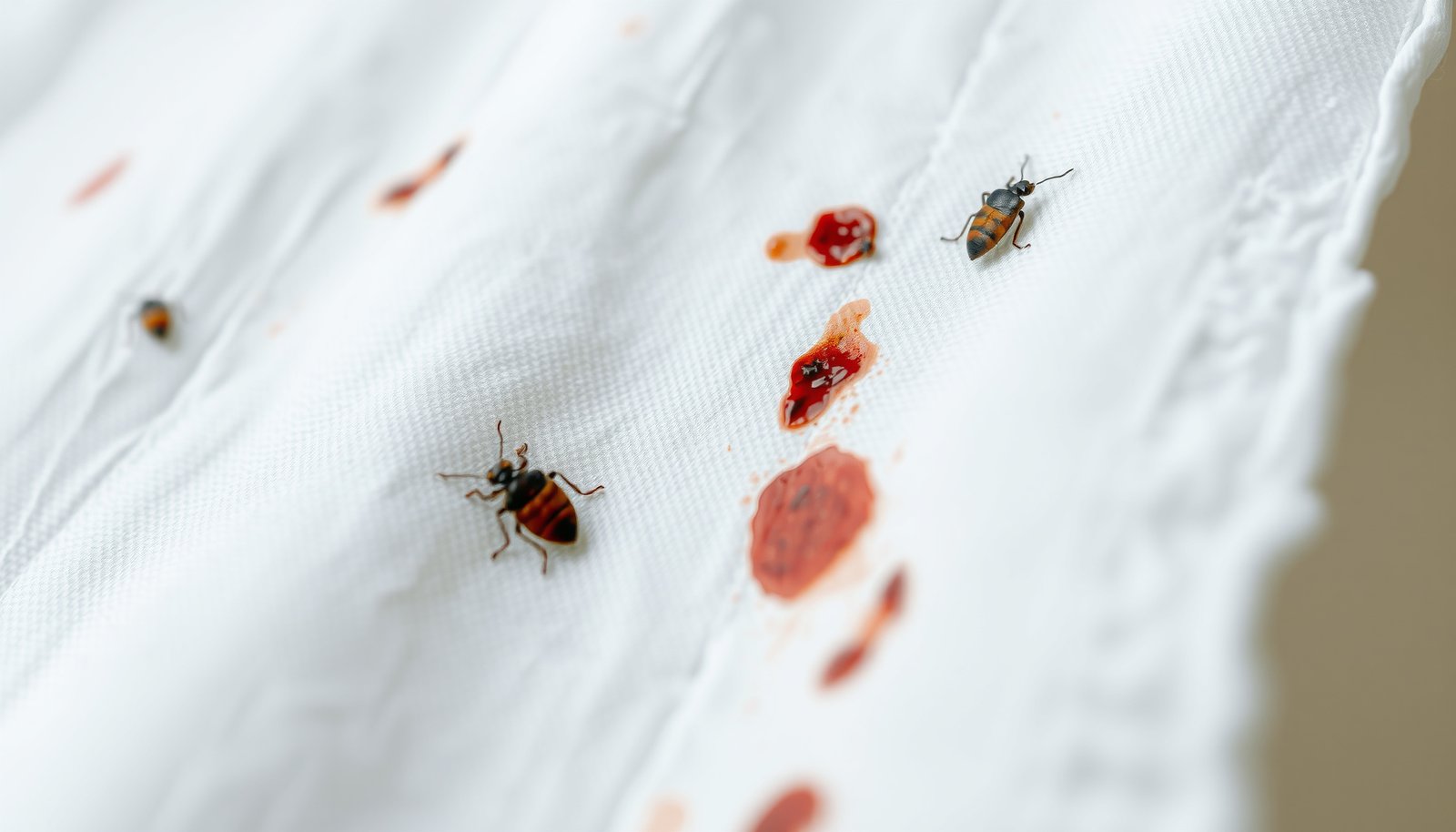
This close-up shows the difference between a fecal smear (dark, feathered edges that bleed into fabric fibers) and a blood spot (reddish-brown, more circular) — being able to tell them apart at a glance is what separates a confident self-inspection from a frustrating one.
What Do Bed Bug Fecal Stains Actually Look Like Up Close?
Bed bug fecal stains look like someone pressed a fine-tipped black marker to your fabric and then let the ink bleed. They’re dark brown to jet black, roughly 1–2mm in diameter per spot, and on sheets or pillowcases they typically feather outward because the digested blood is partially liquid and absorbs into the textile. On a hard surface — like a mattress handle, box spring frame, or headboard slat — they appear as raised, shiny dots that you can sometimes flake off with a fingernail.
The smell is another clue people rarely mention. A heavily stained mattress or box spring has a faint, sweet-musty odor that’s distinct enough once you’ve encountered it — it comes from the bugs’ scent glands, not the fecal matter itself, but the two are almost always found together. On white or light-colored sheets, the staining pattern often shows up as a cluster or irregular trail of dots, not a single isolated mark. If you see something that looks like a tiny splatter of dark ink near the seams or center of your fitted sheet, that’s worth investigating further before you chalk it up to a pen or marker.
Where on the Mattress and Sheets Should You Actually Be Looking?
Bed bugs don’t feed in the open and retreat to the open. They want harborage — tight, dark, undisturbed spaces within roughly 5–8 feet of a sleeping human. That means the fecal evidence concentrates in specific zones, and if you’re doing a visual inspection across the full surface of the mattress top, you’re largely wasting your time.
Here’s where to look, in order of likelihood:
- Mattress seams and piping — Run your finger slowly along every stitched edge. Fecal spotting here is the single most reliable early indicator.
- Box spring interior corners — Flip the box spring and remove the dust cover. The inner wood frame is prime harborage, and staining on the fabric dust cover underneath often goes completely unnoticed.
- Fitted sheet elastic folds — The folded fabric at the corners traps heat and stays undisturbed between washes. Check the inside of every corner fold.
- Headboard attachment points — Anywhere the headboard bolts to the frame or wall has a gap that bed bugs use as a highway. The staining is often on the wall side of the headboard, not the sleeping side.
- Tag labels and handle fabric — The small fabric patches on the side of a mattress are textured and trappy. Staining here is common and easy to miss during a casual inspection.
- Flat sheet center crease — If you fold your flat sheet the same way every time, that crease collects heat. It’s not a harborage spot, but bugs that were disturbed during feeding sometimes leave a trail of fecal dots along it.
How Do You Tell Bed Bug Stains Apart From Other Common Stains?
This is genuinely one of the harder parts of a self-inspection, and it’s where false positives and false negatives both happen regularly. Rust stains from metal coil spring mattresses, hair dye transfer, mildew spots, and even certain medications or supplements (iron supplements in particular) can produce dark brownish-black marks on sheets that look superficially similar to fecal spotting. The difference lies in three things: edge behavior, distribution pattern, and the wet test.
The wet test is something most articles skip entirely: take a damp white paper towel and press it firmly against the stain for 5–10 seconds. Bed bug fecal matter, even when old and dry, will partially rehydrate and leave a reddish-brown smear on the paper towel — because it’s partially digested blood. Rust stains stay orange. Mildew stays dark without transferring a reddish tint. Ink stays black. It’s not a lab-grade test, but it meaningfully narrows the field.
| Stain Type | Color on Sheets | Edge Behavior | Wet Test Result |
|---|---|---|---|
| Bed bug fecal spots | Dark brown to black | Feathered, ink-bleed on fabric | Reddish-brown transfer on towel |
| Blood (human, crushed bug) | Red to rust-brown | Circular, absorbs quickly | Red/brown transfer, no feathering |
| Rust (mattress springs) | Orange-brown | Irregular, often streaky | Orange tint, no reddish transfer |
| Mildew/mold | Gray-black, diffuse | Spreading, fuzzy perimeter | Minimal transfer, no red tint |
Pro-Tip: Use a flashlight held at a low angle — almost parallel to the mattress surface — when doing your inspection. This raking light technique makes fecal deposits on fabric appear as raised or slightly glossy spots that you’d completely miss under overhead lighting. It’s the same technique entomologists use in the field and takes about 30 seconds to set up.
What Does the Staining Pattern Tell You About Infestation Severity?
Not all bed bug staining looks the same, and the pattern gives you surprisingly useful information about how long the infestation has been established and roughly how large the population might be. A few isolated fecal spots along one mattress seam suggests early-stage activity — possibly a single gravid female or a small group that arrived recently. Heavy, overlapping staining that forms dark patches rather than individual dots, combined with staining on the box spring, headboard, and walls simultaneously, suggests a colony that’s been active for weeks or months.
Picture this: you pull the mattress away from the wall for the first time in months and find a dark, almost tar-like staining pattern on the lower seam, shed exoskeletons mixed in, and spots extending up the wall surface behind the headboard. That’s not a new arrival — that’s an infestation that likely started 6–12 weeks prior and has gone through multiple reproductive cycles. A single female bed bug can lay 1–5 eggs per day and up to 500 eggs over her lifetime, which means a small overlooked population can become a significant one faster than most people expect. The staining concentration near harborage points scales roughly with population density, so heavier, denser spotting in multiple zones is always a signal to escalate your response.
“Fecal staining is the forensic record of a bed bug infestation — it doesn’t lie and it doesn’t disappear the way live bugs do. I always tell homeowners to trust the stains over their own ‘I haven’t seen any bugs’ instinct. By the time a colony is producing visible multi-spot staining across multiple surfaces, it’s well beyond a one-bug-crushed-in-my-sleep scenario.”
Dr. Sandra Kowalski, Board-Certified Entomologist and Urban Pest Specialist, University Extension Program
One honest nuance worth acknowledging: staining interpretation can vary significantly based on mattress material, sheet thread count, and even ambient humidity. A memory foam mattress with a tight fabric cover may show very little surface staining even with an active population, because the bugs are harboraged deeper in the seam structure where fecal deposits don’t migrate to the visible surface. High thread-count sheets also absorb fecal spotting differently than standard cotton — the marks look smaller and less dramatic. Don’t assume a visually clean mattress surface means no bugs.
What Should You Do Immediately After Finding Stains?
Finding stains confirms you need to act — it doesn’t tell you the full scope yet. Before you reach for a spray or encasement, do a complete structured inspection of the entire bed zone: mattress, box spring, bed frame (every joint and screw hole), headboard, nightstands, and the wall immediately behind and beside the bed. You’re looking for live bugs, shed casings (translucent empty exoskeletons the size of a sesame seed), and eggs (tiny white ovals about 1mm long, usually in clusters in tight crevices). Document everything with photos before disturbing anything.
Here’s what your immediate response should include:
- Strip all bedding and wash immediately on the hottest water setting your fabric tolerates, then dry on high heat for at least 30 minutes — sustained heat above 118°F kills bed bugs at all life stages
- Bag the stripped bedding before carrying it through the house to prevent spreading bugs or eggs to other rooms
- Install bed bug interceptor traps under all four bed legs — these won’t eliminate the problem but will give you population data and interrupt the feeding cycle
- Photograph all staining with a ruler or coin for scale — this documentation matters both for treatment assessment and, if you’re a renter, for any legal process that follows
- Do not immediately flip or move the mattress to another room — that distributes the population through your home before you’ve assessed what you’re dealing with
- Contact a pest control professional for a formal inspection before purchasing encasements or sprays — treatment strategy changes depending on whether you have a localized or multi-room infestation
If you’re a renter and you’ve found staining in an apartment, the legal picture gets more layered — especially if there’s any question about whether the infestation was present before you moved in. Understanding what rights you have if you bring bed bugs from a previous apartment is worth reading before you have that conversation with your landlord, because the burden of proof works differently than most tenants expect.
One thing that often gets overlooked in the urgency of dealing with bed bugs: other pest activity in the same building can complicate the situation. Rodent activity in walls, for instance, creates structural gaps and harborage that bugs can exploit to move between units. If your building has had any rodent history, it’s worth knowing what a professional rodent exclusion service includes — not because rodents carry bed bugs, but because the same structural vulnerabilities that let one pest spread tend to let others spread too.
Stains are not the infestation — they’re the record of it. The bugs that left those marks are almost certainly still somewhere within a few feet of where you found the evidence. Every day between discovery and treatment is another feeding cycle, another batch of eggs, and a colony that’s measurably harder to eliminate. The stains told you something true. Now’s the time to listen to them.
Frequently Asked Questions
What do bed bug stains look like on sheets?
Bed bug stains on sheets typically appear as small, rust-colored or reddish-brown spots about the size of a pen tip or apple seed. You might also see darker brown or black smear marks, which are bed bug fecal matter. They often cluster near seams, corners, or the center of the mattress where bugs hide and feed.
How do I tell the difference between bed bug stains and regular dirt on my mattress?
Bed bug stains usually bleed into fabric fibers in a distinct halo or ring pattern, similar to a marker bleed, while regular dirt tends to sit on the surface. The color is another clue — bed bug fecal stains are consistently reddish-brown to black, not muddy or gray like general grime. If you dab a wet cloth on the spot and it smears red or rust, that’s a strong sign it’s a blood stain from a bed bug.
Can bed bug stains come out of sheets?
Fresh bed bug stains can often be removed by soaking the sheets in cold water and treating the spot with hydrogen peroxide or an enzyme-based stain remover before washing. Hot water can actually set the stain, so always start cold. Older, dried stains are much harder to fully remove and may leave a faint shadow even after washing.
Where exactly should I look for bed bug stains on my mattress?
Focus on the seams, tufts, and piping around the edges of the mattress first — that’s where bed bugs spend most of their time. Also check the tag area, any folds or creases, and the area directly under where you sleep. If your mattress has a pillow-top, lift it and inspect the underside, since stains and bugs can hide in that gap.
Are bed bug stains on sheets a sign of a bad infestation?
Not necessarily — even a small infestation of just a few bugs can leave visible stains on sheets because bed bugs defecate shortly after feeding. However, widespread staining across multiple areas of your mattress or box spring usually points to a larger, more established infestation. If you’re seeing stains consistently every few days alongside bite marks, it’s worth calling a pest control professional rather than trying to handle it yourself.