
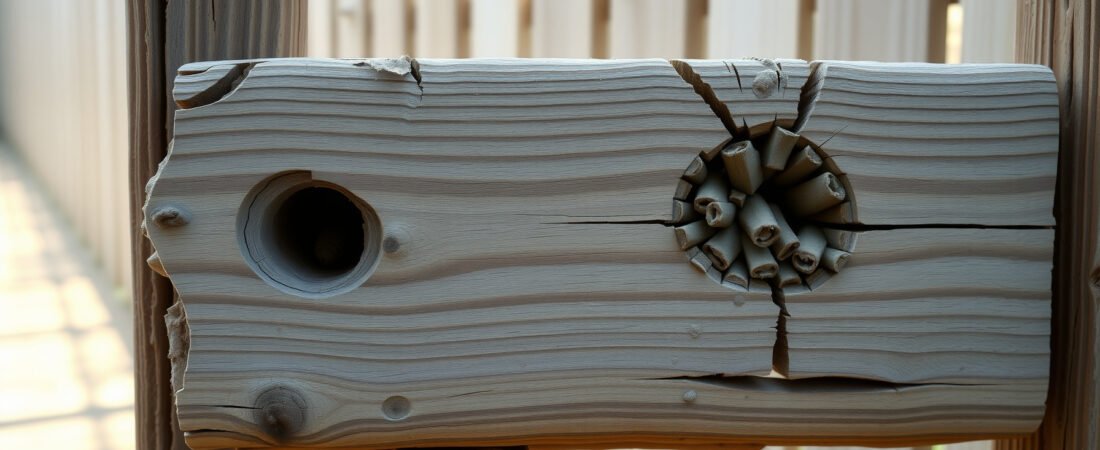
A perfectly round hole in your wood trim isn’t always a sign of termites — and that assumption costs homeowners thousands of dollars in unnecessary treatments every year. The hole you’re staring at is far more likely to be a carpenter bee entrance than termite damage, but here’s the part most pest articles skip over entirely: the real danger isn’t confusing the two in the first place. It’s treating for the wrong pest, patching the wrong holes, and missing the actual structural damage that’s quietly happening somewhere else in the same piece of wood.
What Do Carpenter Bee Holes Actually Look Like?
Carpenter bee entry holes are almost unnervingly precise — nearly perfect circles, roughly 1/2 inch in diameter, drilled straight in or at a very slight downward angle into bare, unpainted, or weathered wood. You’ll almost always find them on the underside of horizontal surfaces: deck railings, porch ceilings, fascia boards, wooden window frames, and exposed roof overhangs. The edges of the hole are clean and smooth, not jagged or splintered, because the bee is boring through end grain or across the grain using powerful mandibles in a remarkably controlled motion.
Just outside the hole, you’ll typically see a yellowish-brown sawdust-like residue called frass mixed with pollen and bee excrement — it often stains the wood below the entry point. The tunnel doesn’t go straight in for long. After about an inch, it typically makes a sharp 90-degree turn and runs parallel to the wood grain, sometimes extending 6 to 10 inches or more. Female carpenter bees use these tunnels for laying eggs, dividing the gallery into chambers with pollen “loaves” as food for the larvae.
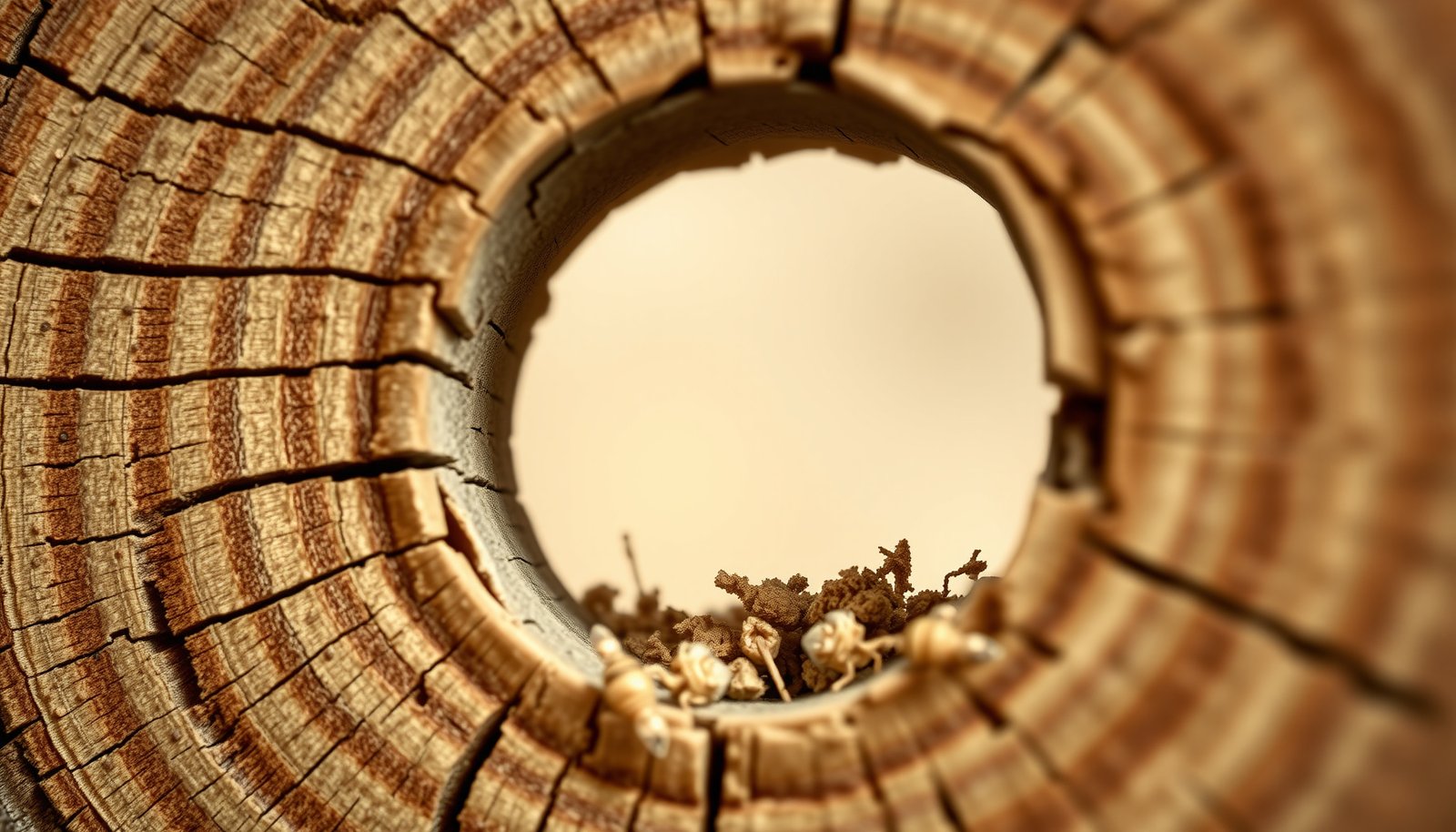
This side-by-side view of a carpenter bee entry hole and termite-damaged wood illustrates exactly why getting the identification right before you reach for any treatment matters — the damage patterns are completely different, and treating one pest’s signature as if it were the other’s is how small problems become expensive ones.
What Does Termite Damage Look Like From the Outside?
This is where the confusion really compounds itself, because termites almost never leave a hole you can see from the outside. Subterranean termites — the species responsible for roughly 80% of termite damage in the U.S. — enter wood at or below the soil line and eat from the inside out, following the soft spring-growth wood grain and leaving the harder outer layers intact. By the time the surface of a board looks disturbed, the interior has often already been hollowed out into a paper-thin shell. Knocking on suspect wood with your knuckle and hearing a dull, hollow thud is one of the earliest surface clues.
Drywood termites are a different situation — they do work above ground, and their damage appears as a network of galleries running with the grain of the wood, sometimes breaking through the surface as irregular, roughened exit holes. These holes are rarely round or clean; they’re more like ragged pits or blistered patches on painted surfaces. The presence of frass (termite droppings) is another giveaway — drywood termite pellets are tiny, six-sided, hard cylinders about 1mm long, distinctly different from the sawdust-like powder that carpenter bees leave behind. If you’re finding piles of what looks like fine sand or coffee grounds near wood, that’s a critical distinction worth getting right.
How to Tell Them Apart: The Key Differences at a Glance
Once you know what you’re looking for, the visual differences between carpenter bee holes and termite damage are actually pretty clear — but there’s a catch. Most homeowners only notice one sign and stop there. The smart approach is to check for at least three indicators before drawing any conclusion, because wood can sometimes show secondary damage from other causes that muddies the picture.
Here’s a structured comparison of the core identification markers:
| Feature | Carpenter Bee Holes | Termite Damage |
|---|---|---|
| Hole shape | Nearly perfect circle, ~1/2 inch diameter, clean edges | Rarely visible holes; if present, irregular and rough-edged |
| Location | Underside of horizontal wood; unpainted/weathered surfaces | At or below soil line (subterranean); anywhere above ground (drywood) |
| Frass/debris | Coarse sawdust mixed with yellow-brown staining below hole | Fine six-sided pellets (drywood) or no visible frass (subterranean) |
| Internal damage pattern | L-shaped tunnel; gallery runs parallel to grain | Galleries follow wood grain; hollow when tapped; mud tubes present (subterranean) |
Pro-Tip: Probe suspect wood with a flathead screwdriver before calling anyone. If the tip sinks in with very little pressure — especially along the grain — you’re looking at termite damage, not carpenter bees. Carpenter bee tunnels are enclosed galleries; the surrounding wood stays structurally firm unless bees have reused the same tunnel for several seasons.
Why Getting the Identification Wrong Is More Costly Than You’d Think
Picture this: a homeowner in the Carolinas spots a round hole in the porch railing and immediately calls for a termite inspection. The inspector finds no termites — because there aren’t any — but recommends a preventive treatment “just to be safe” that runs $800 to $1,200. Meanwhile, the carpenter bees return the following spring, expand the existing gallery, and attract woodpeckers that hammer open the tunnel to reach the larvae, creating far more visible damage than the bees ever would have on their own. The original hole — which could have been addressed with a $12 tube of insecticide dust and a wood plug — is now a 3-inch gouge in the railing.
The reverse mistake is less common but more dangerous. Dismissing what looks like a single small hole as “probably just a bee” when there’s actually drywood termite activity inside the same board means months of unchecked damage before the problem becomes obvious. Drywood termite colonies grow slowly — they can take 3 to 5 years to cause serious structural harm — but a colony of even 2,500 to 3,000 individuals quietly eating through load-bearing members is not a situation you want to let slide. The financial risk of under-reacting to termites vastly outweighs the risk of over-reacting to carpenter bees. If you’re ever genuinely uncertain and the wood is structural, get a professional second opinion before doing anything.
How to Inspect for Carpenter Bees vs Termite Damage Step by Step
A methodical inspection takes less than 20 minutes and will tell you almost everything you need to know. Do it in daylight — carpenter bee activity peaks in mid-morning on warm days, so you may actually see a bee hovering near or entering the hole, which makes identification instant. For suspected termite damage, the best time to inspect is after a warm rain, when subterranean termites are most active near the soil surface and mud tubes are easier to spot.
Work through these steps in order:
- Locate the hole and measure it. A 1/2-inch circular opening in exposed wood on the underside of a horizontal surface is carpenter bee territory almost without exception. Termites don’t create neat entry holes on accessible exterior surfaces — if you see something ragged, pitted, or blistered, that points toward termites or another wood-boring insect entirely.
- Examine the frass. Collect a small amount on your finger. Carpenter bee frass is coarse, fibrous, and slightly gummy from pollen; it smears. Drywood termite frass is dry, gritty, and uniform — those tiny hexagonal pellets roll around like sand. Subterranean termites typically leave no frass at the entry point at all.
- Probe the wood surface. Use a screwdriver or awl and press firmly against the wood face and along the grain near the hole. Solid resistance = carpenter bee (the gallery is internal and the wood around it is intact). Easy penetration or crumbling = potential termite damage.
- Look for mud tubes. Check the foundation, concrete blocks, and any wood-to-soil contact points within a few feet of the suspected area. Pencil-thin tubes of dried mud running up a wall or across a concrete pier are a definitive sign of subterranean termites — carpenter bees leave nothing like this.
- Check for bee activity directly. Wait 5 minutes near the hole. Female carpenter bees will enter and exit repeatedly during nesting season. Males hover aggressively but don’t sting. If you see large, black, fuzzy bees with shiny abdomens near the hole, the case is closed — that’s a carpenter bee nest, not termite damage.
“One of the most consistent mistakes I see in the field is homeowners patching carpenter bee holes with wood filler before treating the gallery. The bees will chew right through soft filler to reuse an existing tunnel, and the larvae inside simply die and attract dermestid beetles that cause their own secondary damage. Treat first, wait a full week, then plug with a hardwood dowel and exterior wood glue — that sequence matters.”
Dr. Marcus Elroy, Board-Certified Entomologist and Wood-Destroying Insect Specialist, University Extension Service
What Should You Actually Do Once You’ve Identified the Source?
Confirmed carpenter bee holes are a DIY-manageable problem in most cases. The most effective treatment is injecting a residual insecticide dust — carbaryl or deltamethrin-based products work well — directly into the gallery opening at dusk when the bees are inside, then leaving the hole open for 24 to 48 hours so returning bees contact the dust before plugging the entry permanently. Timing this to late summer or early fall, after the new generation has emerged but before the following season’s females scout for nesting sites, gives you the best results. Painting or staining the wood is a genuine deterrent — carpenter bees strongly prefer raw, weathered wood and will usually bypass painted surfaces.
Confirmed termite damage is a different calculation entirely, and honesty demands acknowledging that the right answer depends heavily on the situation — the species involved, how far the damage has progressed, whether it’s in structural wood, and your geographic location all affect whether DIY treatment is reasonable or whether you need a licensed pest control professional. For subterranean termites with active mud tubes and structural wood involvement, professional treatment with a liquid termiticide or bait system is almost always the right call. Drywood termite infestations in non-structural trim boards are sometimes manageable with spot treatments; infestations inside load-bearing members typically require fumigation. If you’re weighing DIY options against professional contracts and wondering what kind of coverage you’re actually buying, it’s worth understanding what a pest control bond actually covers and whether you need one before signing anything.
When Both Carpenter Bees and Termites Are Present in the Same Wood
Here’s the counterintuitive part that almost no pest control article mentions: carpenter bee galleries can actually increase the risk of termite infestation in the same piece of wood. Here’s the mechanism. When carpenter bees bore into wood and the gallery is left open or improperly sealed, moisture seeps in. Wet, softened wood is significantly more attractive to subterranean termites and fungal decay than dry, intact wood. So a deck board with three or four active bee galleries that’s been ignored for two or three seasons isn’t just a carpenter bee problem anymore — it’s potentially a compromised, moisture-softened entry point for other wood-destroying organisms.
This is most common in older homes with untreated softwood decking, and it’s one reason why an inspection that starts with “I think these are just bee holes” sometimes ends with a more serious conversation about the overall condition of exterior wood. The two problems aren’t mutually exclusive, and finding one doesn’t rule out the other. Check the full length of any board with bee activity, not just the section around the visible hole — and if you’re renting and discover damage of this scale, understanding your rights matters. Tenants dealing with landlords who delay or ignore structural pest damage have legal protections that most people don’t know about; the same tenant rights framework that covers insect infestations also applies in many states to structural pest damage — similar disclosure obligations exist in other pest contexts too, like the bed bug disclosure laws landlords are required to follow when renting to new tenants.
Common Look-Alikes That Are Neither Carpenter Bees Nor Termites
A handful of other wood-boring insects create damage that gets misidentified as one or the other, and ruling them out quickly saves you from chasing the wrong problem. Old house borers and powderpost beetles both create small holes in wood, but their frass is much finer — almost flour-like — and the holes they leave are smaller (1/16 to 1/8 inch) than a carpenter bee’s clean half-inch circle. Bark beetles create intricate gallery patterns under the bark of dying or stressed trees but rarely move into seasoned structural lumber. Horntail wasps drill holes in freshly milled lumber or recently dead trees and can emerge from walls or flooring years after construction if infested wood was unknowingly used in building — those emergence holes look like they appeared out of nowhere.
The distinguishing characteristics to look for across all wood-boring insects are:
- Hole diameter: Carpenter bee = ~1/2 inch; powderpost beetle = 1/16–1/8 inch; old house borer = 1/4–3/8 inch oval; termite exit holes (drywood) = irregular, rarely a clean circle
- Frass consistency: Coarse/fibrous = carpenter bee; fine powder = powderpost beetle or old house borer; dry hexagonal pellets = drywood termite; none visible = subterranean termite
- Location on structure: Underside of horizontal wood = carpenter bee; soil contact points and foundation = subterranean termite; anywhere in dry seasoned wood = drywood termite or powderpost beetle
- Associated insects: Large fuzzy black bee = carpenter bee; cream-colored soft-bodied workers with no eyes = termite; tiny reddish-brown beetle near wood = powderpost beetle
- Wood condition: Structurally sound with clean internal gallery = carpenter bee; hollow or crumbling when probed = termite or extensive borer damage; surface staining with fine dust = active beetle infestation
Getting to the right pest is the whole game here. A misidentified hole leads to a misapplied treatment, which leads to damage that keeps expanding while you’re busy solving a problem that doesn’t exist. Take the extra 10 minutes to run through the checklist — your wallet will thank you in the spring.
Frequently Asked Questions
What do carpenter bee holes look like vs termite damage?
Carpenter bee holes are nearly perfect circles, about 1/2 inch in diameter, drilled into the surface of bare or weathered wood — you’ll often see a small pile of sawdust and yellow staining below them. Termite damage, on the other hand, doesn’t show clean entry holes from the outside; instead, it appears as hollowed-out wood with a honeycombed interior, mud tubes on surfaces, or blistered paint that looks like water damage.
how do I know if its carpenter bees or termites eating my wood?
The fastest tell is location and what you can see: carpenter bees leave round holes in exposed wood like deck rails, eaves, and fascia boards, while termites typically work from the inside out and stay hidden in structural wood like floor joists and wall studs. Tap the wood with your knuckle — if it sounds hollow in a spot with no visible holes, termites are the more likely culprit.
does carpenter bee damage look like termite mud tubes?
No, carpenter bees don’t produce mud tubes — that’s exclusively a termite behavior, used by subterranean termites to travel between soil and wood without drying out. If you’re seeing pencil-width brown tubes running along your foundation, crawl space walls, or floor joists, that’s a clear sign of subterranean termites, not bees.
can carpenter bee holes cause as much damage as termites?
Carpenter bees are generally less destructive than termites, but they’re not harmless — over several seasons, repeated boring by multiple bees can weaken deck boards, window frames, and wooden siding. Termites, especially subterranean species, can cause tens of thousands of dollars in structural damage by eating load-bearing wood from the inside, which is why termites are considered the more serious long-term threat.
what does carpenter bee sawdust look like compared to termite frass?
Carpenter bee sawdust looks exactly like that — coarse, fresh wood shavings or fine sawdust piled directly below the entry hole. Termite frass (drywood termite droppings) looks more like tiny pellets or grains of sand, often dark brown or black, and it’s pushed out of small kick-out holes rather than falling naturally like sawdust.