
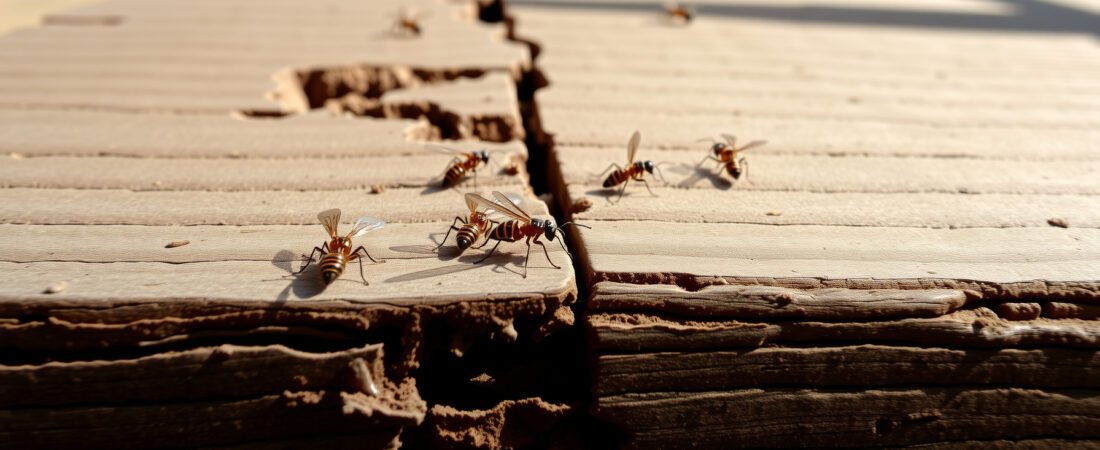
Swarmers aren’t termites — at least, not all of them. That single misidentification sends thousands of homeowners every year straight to the wrong treatment, wasting hundreds of dollars and leaving an active termite colony completely untouched. The real problem isn’t that flying ants and termites look alike — it’s that most identification guides focus on features that are genuinely hard to see in a panicked moment, like wing venation or exact antenna shape. This article skips the biology-textbook approach and focuses on the fast, reliable field checks that actually work when you’ve got a swarm crawling across your windowsill right now.
Why Getting This Wrong Is More Costly Than People Realize
Termite colonies can contain over 1 million individuals, and a single mature subterranean colony can consume roughly a pound of wood every single day. Treating what you think is a flying ant problem — with an over-the-counter ant spray — does absolutely nothing to the termite workers tunneling through your floor joists. You’ve just killed a few dozen swarmers, which are the reproductive members of the colony, not the ones causing structural damage. The colony doesn’t even notice.
Flying ant swarms, on the other hand, don’t destroy wood. Carpenter ants excavate it for nesting, but they don’t eat it, and standard ant treatments address them quickly. The financial gap between these two scenarios is enormous — pest control costs vary dramatically depending on what you’re actually treating, and a termite treatment runs 5 to 10 times more than an ant treatment. That’s why correct identification before you call anyone is worth the 10 minutes it takes.
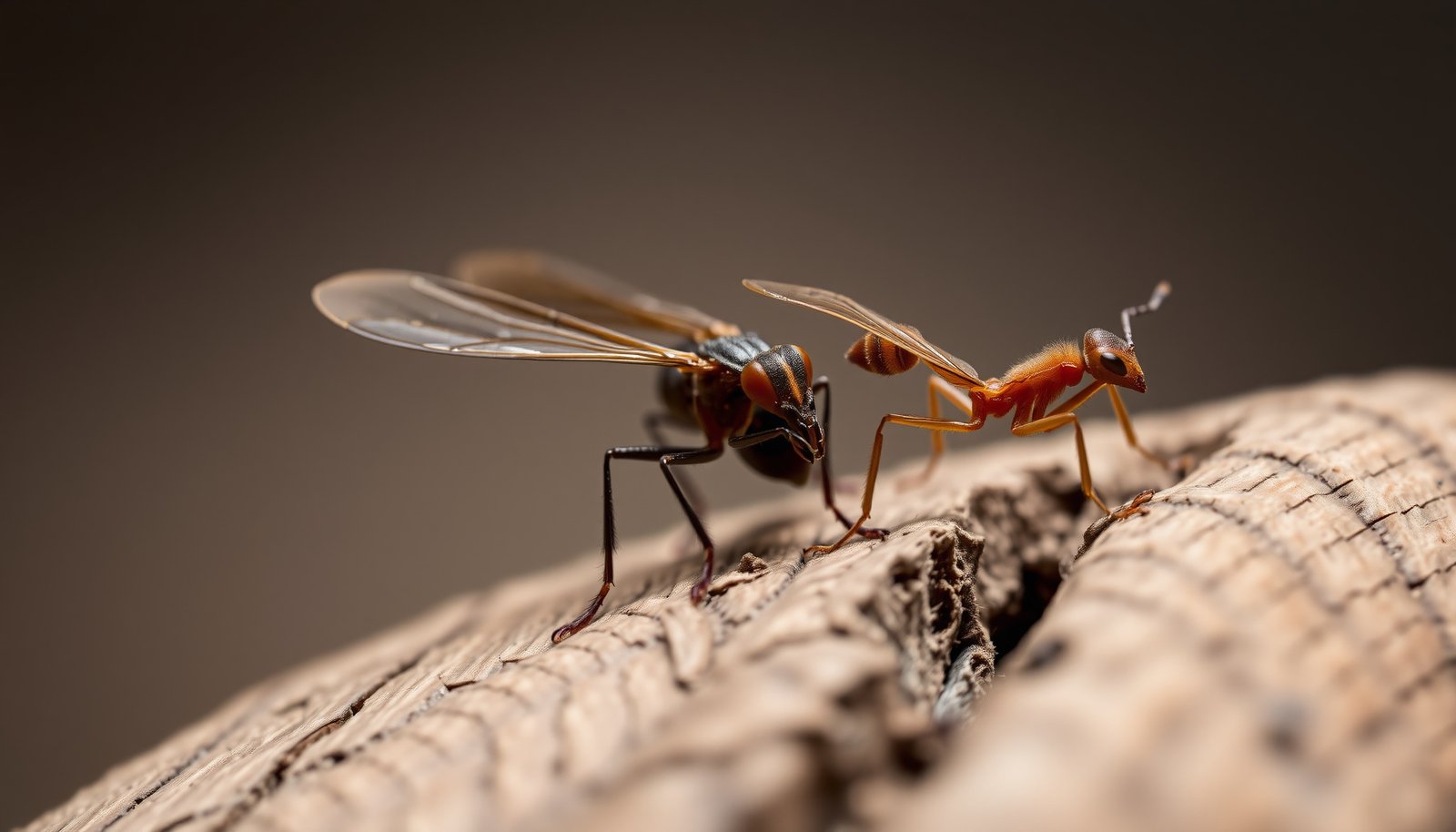
This close-up comparison shows the three body regions of a flying ant versus the two-segment silhouette of a termite swarmer — the single most reliable visual check you can do without a magnifying glass.
What Do Termite Swarmers Actually Look Like Up Close?
Termite swarmers — technically called alates — are roughly 3/8 of an inch long, including wings, and their bodies look almost tubular. The thing that throws people off is color: they’re often dark brown to black, which nobody expects because termite workers are pale and creamy. Swarmers are built for one purpose only, which is leaving the nest, mating, and starting a new colony, so they look nothing like the workers doing the actual damage underground.
The single most useful thing to know about termite swarmers is their wings. They have four wings of equal length, and those wings extend well past the end of the abdomen — sometimes almost doubling the insect’s apparent body length. The wings are translucent and faintly iridescent, almost milky, and they’re fragile enough that swarmers shed them almost immediately after landing. Finding a small pile of discarded wings near a window or door frame, even without seeing a single live insect, is one of the clearest signs of a termite swarm you’ll ever get.
What Do Flying Ants Look Like, and Where Do People Get Confused?
Flying ants are reproductive members of an established ant colony, and they swarm under similar conditions to termites — warm, humid days, often after rain, typically in spring or early summer. They’re usually between 1/4 and 3/4 of an inch depending on species, and their coloring ranges from reddish-brown to black. Here’s the thing most people don’t register in the moment: flying ants have a dramatically pinched waist. That narrow hourglass shape between the thorax and abdomen is visible even without magnification if you get the insect against a light background.
Their wings are where the second big difference lives. Flying ants have two pairs of wings that are unequal in size — the front pair is noticeably larger than the rear pair. The wings are clearer and more rigid-looking than termite wings, and flying ants don’t shed them the way termites do. If you find winged insects and their wings are still attached and look like they’re in good shape, you’re more likely looking at ants. Termite wings are so loosely attached that they fall off with the slightest contact.
Pro-Tip: Sweep up a few of the insects and place them on a white piece of paper. Against that background, you can check body shape in seconds — the ant’s pinched waist is unmistakable, and equal-length wings on a straight-bodied insect confirm termite. Keep a $10 magnifying glass in your utility drawer specifically for moments like this.
The 5-Point Field Check That Works Without a Microscope
Forget memorizing wing venation patterns — that’s entomologist-level detail that doesn’t help you at 7pm when you’re staring at a windowsill covered in insects. These five checks are fast, require no tools, and give you a reliable answer in under two minutes.
- Body shape at the waist: Pinched, narrow hourglass = ant. Straight, uniform tube with no visible waist constriction = termite. This is your single most reliable check.
- Wing length relative to the body: Wings that extend significantly past the abdomen, both pairs looking nearly identical in length = termite swarmer. Front wings clearly larger than rear wings = flying ant.
- Wing condition on the ground: Loose, detached wings scattered near light sources or window frames = termite (they shed immediately after landing). Wings still attached to dead insects = ant.
- Antenna shape: Termite antennae are straight or very slightly curved, like a string of tiny beads. Ant antennae are elbowed — there’s a sharp bend partway along, like a bent arm. You’ll need decent light for this one, but it’s definitive.
- Where you found them: Swarms emerging from soil, a tree stump, or from inside wall voids or baseboards lean toward termites. Swarms emerging from gaps around exterior siding, wood piles, or old deck boards lean toward carpenter ants. Neither is a guarantee, but location narrows it fast.
Picture this: a homeowner in Atlanta finds a swarm inside her sunroom in March, panics, and hits it with ant killer. Two weeks later she notices the window frame is soft when she pushes on it. The swarm was subterranean termites that had been in the wall for at least two years before swarming. The delayed identification added weeks to the damage timeline and thousands to the repair bill. A quick body-shape check would have changed everything.
Side-by-Side: Termite Swarmer vs. Flying Ant at a Glance
The table below covers the four physical features that reliably separate these insects under real-world conditions — not lab conditions. Use it as a quick reference the next time you’re staring at something you’re not sure about.
| Feature | Termite Swarmer | Flying Ant |
|---|---|---|
| Body shape | Straight, tube-like, no visible waist | Distinct pinched waist (3 clear segments) |
| Wings | 4 wings, equal length, extend well past body, shed easily | 4 wings, front pair larger than rear, stay attached |
| Antennae | Straight or gently beaded, no elbow | Elbowed — sharp bend in the middle |
| Color | Dark brown to black (swarmers), creamy white (workers) | Reddish-brown to black depending on species |
One thing that genuinely surprises people: the color difference between termite swarmers and termite workers is so dramatic that most homeowners who’ve seen workers in damaged wood don’t recognize swarmers as the same insect. Swarmers are the public face of the colony — darker, winged, visible. Workers are the ones actually destroying your home, and they almost never see daylight.
Does Finding Swarmers Mean You Have a Full Infestation?
Here’s the honest nuance that most identification guides skip entirely: swarmers don’t automatically mean the colony is inside your home. Subterranean termite swarmers, in particular, can travel up to 300 feet from their originating colony during a swarm event. If you find a dozen swarmers near a window in spring, it’s entirely possible they flew in from a neighbor’s yard or a nearby tree stump and simply ended up inside through an open door or gap. That doesn’t mean you’re in the clear — it means you need to check, not panic.
The real red flag is swarmers emerging from inside — specifically from baseboards, from around a door frame, or from soil in a crawl space. Swarmers that emerge from inside your structure are telling you the parent colony is already established somewhere in or very near the building. That’s categorically different from a few swarmers that wandered in from outside. Climate also plays a role here: in warm, humid climates like the Gulf Coast or Southeast, swarm season can start as early as February and last through summer, which means the window for confusion is longer and the stakes are higher.
“The mistake I see most often isn’t misidentifying the insect — it’s treating the swarmers as the threat. Swarmers are essentially the colony’s announcement that they’ve been established long enough to reproduce. By the time you see them, the workers have typically been feeding for two to four years. The swarm is the symptom, not the problem.”
Dr. Ellen Marsh, Board-Certified Entomologist and University Extension Specialist in Urban Pest Management
What to Do Immediately After You Identify Which One You Have
Flying ant swarm inside the house? Vacuum up as many as you can, then trace back to where they came from. Carpenter ants typically nest in moist or damaged wood — a leaky window frame, a rotting deck ledge, wood in contact with soil. Fix the moisture source and the nest becomes inhospitable. Standard ant baits or perimeter treatments handle the rest, and most homeowners can manage a carpenter ant problem themselves if it’s caught early.
Termite swarmers — especially ones emerging from inside — require a different response entirely. Don’t spray them and assume it’s handled. Collect a few specimens in a zip-lock bag (yes, really — pest control professionals will want to see them), photograph where they emerged from, and call a licensed termite inspector. Many companies do initial inspections at no charge. Whether you’re a homeowner or renter, the treatment responsibility question matters too — understanding who’s responsible for pest treatment costs in your living situation can save you from paying out of pocket for something that legally falls on a landlord.
Here’s what the identification guides rarely tell you: the species of termite matters for treatment selection. Subterranean termites, which live in the soil and travel up through mud tubes, respond to soil treatments and bait systems. Drywood termites, which live entirely within the wood they’re eating, require localized or whole-structure fumigation. Swarmers from a drywood colony are typically larger and often found far from any soil contact — an upstairs room, an attic, furniture. Getting the species right determines whether a $400 bait installation or a $3,000 fumigation is in your future. That’s a call worth making carefully.
The bottom line is that swarmers of any kind are time-sensitive information. They’re telling you something about the state of pest pressure in or around your home right now. A swarm that happens once and isn’t investigated is an opportunity missed — and in the case of termites, every month of delay is structural damage you’re choosing not to stop.
Frequently Asked Questions
How do I tell if I have termites or flying ants in my house?
The easiest way to tell them apart is by looking at their waist and antennae. Termites have a straight, thick waist and straight beaded antennae, while flying ants have a pinched waist and elbowed antennae that bend at roughly a 90-degree angle. Termites also have 4 wings that are all the same length, whereas flying ants have 2 longer front wings and 2 shorter back wings.
do termite swarmers lose their wings
Yes — termite swarmers shed their wings almost immediately after landing, which is one of the biggest giveaways of a termite problem. If you find small piles of discarded wings near windowsills, door frames, or light fixtures, that’s a strong sign termites are present. Flying ants don’t shed their wings this way, so finding detached wings is a pretty reliable indicator you’re dealing with termites rather than ants.
what time of year do termites with wings appear
Termite swarmers most commonly appear in spring, typically between March and June, when temperatures warm up and humidity rises after rain. Subterranean termites — the most common species in the US — tend to swarm during the day, often right after a rainstorm. Flying ants also swarm in warm months, so season alone won’t tell you which one you have — you need to check the physical differences too.
are termite swarmers a sign of infestation
Seeing swarmers inside your home almost always means there’s an established termite colony nearby, typically within 50 to 100 feet. Termites don’t swarm until a colony is at least 3 to 5 years old and has grown large enough to produce reproductives. If you’re finding swarmers indoors rather than just near an outside light, that’s a more urgent sign because it suggests the colony may be inside your structure.
can flying ants damage wood like termites
No — flying ants don’t eat wood the way termites do. Carpenter ants, which are sometimes confused with termite swarmers, do excavate wood to build nests, but they don’t actually consume it as a food source. Termites eat wood from the inside out and can cause serious structural damage over time, so even though both insects can be found in wood, the risk level is very different.