
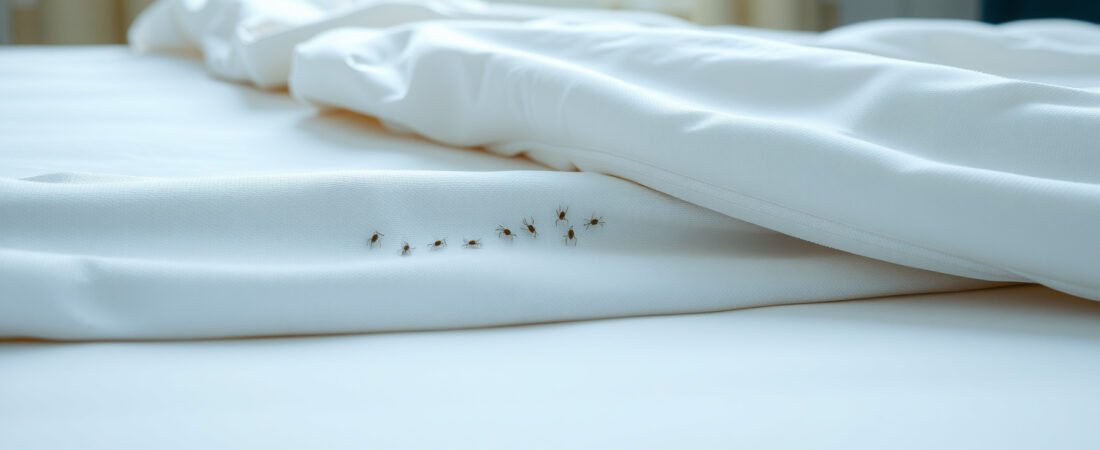
There are at least six different bugs that commonly end up in beds — and only one of them is a bed bug. That distinction matters enormously, because misidentifying what you’re dealing with leads to the wrong treatment, wasted money, and a problem that keeps getting worse. The tiny white or near-white bugs people find on their mattress, sheets, or pillow are almost never bed bugs (which are brown, not white), yet most people’s first instinct is to panic about bed bugs and treat accordingly. That’s the mistake this article is going to help you avoid.
Why Tiny White Bugs in Your Bed Are Almost Never Bed Bugs
Here’s the counterintuitive part: bed bugs are actually one of the easiest bugs to rule out when you’re seeing something white. Adult bed bugs are mahogany-brown, roughly the size and shape of an apple seed, and they don’t turn white at any life stage. Even newly hatched nymphs — which are the palest a bed bug ever gets — are a translucent straw-yellow, not white. If the bug you’re looking at is clearly white, you’re almost certainly dealing with something else entirely.
The reason this mix-up is so common comes down to context, not appearance. People find a small bug in their bed, the brain immediately jumps to “bed bugs,” and they describe the bug as brown even when it isn’t. The anxiety does the misidentifying. Slow down, get a magnifying glass or use your phone camera, and look at the actual color before you do anything else.
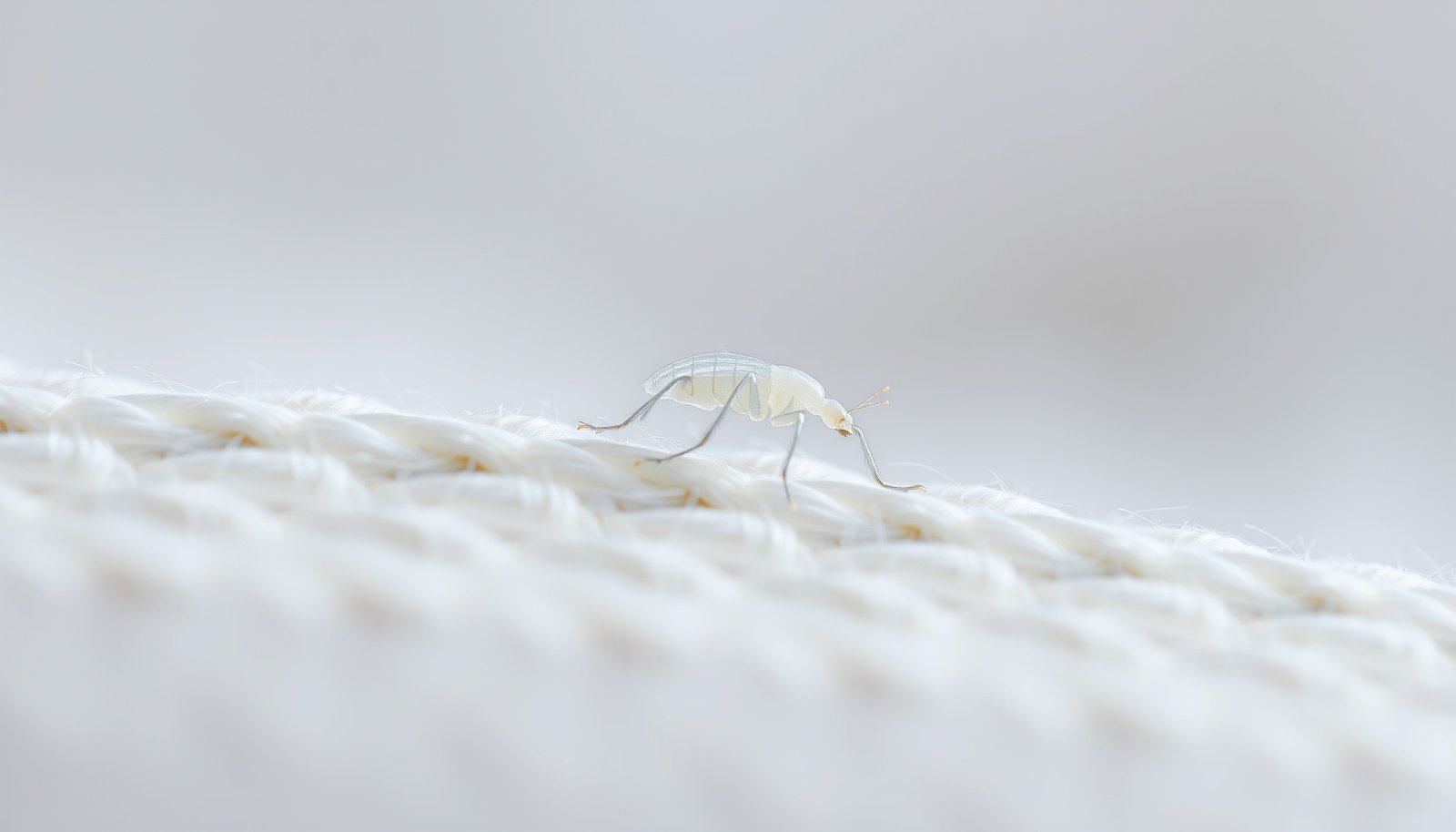
This close-up comparison shows the key visual differences between the most common white bugs found in beds — paying attention to body shape and leg count is what separates a harmless mite from something that needs immediate treatment.
What Are the Most Likely Culprits? A Realistic Breakdown
Once you’ve ruled out bed bugs, you’re probably looking at one of a handful of arthropods that genuinely do show up white or near-white in a bedroom environment. Each one has a different source, a different level of urgency, and a completely different fix. Treating them all the same way is exactly how people end up spraying the wrong product and still waking up with bites.
Here’s a straightforward breakdown of the most common white bugs found in beds, what distinguishes them visually, and what their presence actually signals:
| Bug | Size | Key Visual Trait | What Their Presence Means |
|---|---|---|---|
| Dust Mites | 0.2–0.3 mm (invisible to naked eye) | Eight legs, translucent-white, oval body | Very common; feed on shed skin cells |
| Clover Mites | 0.75 mm | Reddish-brown adults, pale nymphs; very long front legs | Outdoor origin; seasonal invasion through windows |
| Psocids (Book Lice) | 1–2 mm | White to gray, soft-bodied, no wings indoors | Moisture problem nearby; feed on mold |
| Bird/Rodent Mites | 0.5–1 mm | White to gray before feeding, dark red after | Wildlife host nearby — nests in attic or walls |
Can Dust Mites Actually Bite You — or Is Something Else Going On?
This is probably the most important correction to make: dust mites do not bite. They physically cannot. Their mouthparts are designed to break down dead skin cells and organic debris, not to pierce skin. Yet “dust mite bites” is one of the most Googled pest complaints in the country, which means a huge number of people are incorrectly attributing their skin irritation to dust mites and never finding the real cause.
What dust mites do cause is an allergic response — itchy skin, a rash, respiratory symptoms — from their fecal matter and shed exoskeletons becoming airborne. A single gram of mattress dust can contain anywhere from 100 to 500 individual dust mites, and they produce roughly 20 waste particles each per day. So the irritation is real, but it’s immunological, not from biting. If you’re waking up with actual raised bite marks, something other than dust mites is responsible.
Pro-Tip: To get a quick sense of whether you have a dust mite problem (versus actual biting mites), zip your mattress into an allergen-barrier encasement for two weeks. If your symptoms improve but you’re still finding tiny bugs on the surface, those surface bugs are likely a different species entirely — possibly bird or rodent mites coming in from a nearby wildlife nest.
How Do You Tell the Difference Between Mite Species Found in Beds?
The specific type of mite matters a lot, because the treatment and source-elimination strategy are completely different for each one. Dust mites are managed through environmental controls. Bird mites require locating and removing a wildlife nest — often in an attic, soffit, or wall void — and they will keep coming back in large numbers until that host is gone. Rodent mites behave similarly: they abandon their host (a dead or departing mouse or rat) and migrate toward warmth, which is how they end up in your bed.
Picture this: a family in a townhouse notices tiny white specks crawling on their white pillowcases over a three-week period. They treat for bed bugs twice with no result. Eventually an inspector finds a dead mouse inside a wall cavity adjacent to the bedroom — the rodent mites had been migrating through a baseboard gap the entire time. The fix was sealing the entry point and treating the wall void, not the mattress. Without identifying the actual species, they never would have found the source.
Here’s how to tell the key mite types apart without a microscope:
- Dust mites: You won’t actually see them individually — they’re 0.2 to 0.3 mm. If you think you’re seeing individual white specks moving, it’s almost certainly not dust mites.
- Bird/rodent mites: Visible to the naked eye at around 0.5–1 mm; white or gray before they feed, turning dark red after. They move quickly and seem to appear suddenly in large numbers.
- Clover mites: Reddish-brown adults, but pale nymphs are often mistaken for white bugs; they leave a red smear when crushed and are more likely near windows than deep in bedding.
- Psocids (book lice): Slightly larger than mites at 1–2 mm, white to translucent, and they tend to move in groups on surfaces rather than biting. They’re a sign of excess humidity, not a hygiene problem.
- Cheyletiella mites (walking dandruff): Associated with pets — cats, dogs, and rabbits. They appear as moving white flakes on an animal’s fur and can temporarily infest human skin, causing an itchy rash.
“The biggest diagnostic mistake I see is people treating the bed when the actual source is biological — a bird nest, a rodent carcass, or a pet. Mites that originate from a wildlife host will reinfest indefinitely until that host is removed. No amount of mattress treatment will stop that cycle.”
Dr. Renee Calloway, Board-Certified Entomologist and Extension Urban Pest Specialist
How Do You Actually Get Rid of White Bugs in Your Bed — Based on What They Are?
The treatment path depends entirely on which bug you’ve identified, which is why the identification step isn’t optional. Broad-spectrum pesticide sprays on a mattress will not fix a dust mite allergy, will not eliminate the source of bird mites coming through a wall, and may expose you to unnecessary chemical contact in the place you sleep for eight hours a night. Matching the treatment to the actual pest is what gets results.
Here’s a step-by-step approach that works regardless of which white bug you’re dealing with — because the first steps are universal, and the later steps branch based on species:
- Capture a sample. Use tape to lift a few bugs off the surface and press them onto white paper, or drop them into a small zip-lock bag. A phone camera with macro mode can get you a usable photo for identification. Your local cooperative extension office can often identify mites from a photo or sample for free.
- Wash all bedding at 130°F or higher. This temperature kills mites of all species within about 30 minutes of exposure. If your washer doesn’t reach that temperature, a 20-minute dryer cycle on high heat after washing will finish the job.
- Inspect for a biological source. Check the attic, crawlspace, and exterior eaves for bird nests or signs of rodent activity — especially if bugs appeared suddenly in large numbers. A nest removed in the last month is a strong indicator of bird or rodent mites.
- Control humidity for psocids and dust mites. Both species thrive when indoor relative humidity stays above 50%. A dehumidifier keeping the bedroom at 35–45% humidity will significantly reduce populations within a few weeks without any chemical treatment.
- Use a HEPA vacuum on the mattress and box spring weekly. This removes the dead skin cells that dust mites feed on and physically removes mites, eggs, and debris. It’s not glamorous, but it’s one of the most evidence-backed dust mite control methods available.
- Call a professional if biting continues after the source is addressed. Persistent biting mites — particularly bird or rodent mites — sometimes require a licensed pest professional to treat wall voids or attic spaces where migration is originating. If you’re in a rental unit, this repair and treatment is your landlord’s legal responsibility to arrange in most states.
One honest nuance worth mentioning: the right approach also depends on your building type and climate. A ground-floor apartment in a humid Southern climate is a completely different situation than a dry-climate single-family home on a slab — the humidity-driven pests (psocids, dust mites) are far more prevalent in the former, while rodent mite issues are more common where wildlife pressure is higher. What works for one household may be irrelevant for another.
If you’re a renter dealing with a mite infestation tied to a structural issue — a bird nest in the soffit, a rodent problem in the walls — it’s worth knowing your rights before you spend money on treatments that are the landlord’s responsibility to provide. For a deeper look at how tenant protections apply in pest situations, Can a Landlord Evict You for Reporting a Pest Infestation? covers the legal landscape in plain language. And if you’re weighing whether to go with a green pest control provider for mite treatment, Are Eco-Friendly Pest Control Services Worth the Premium Price? gives you a realistic assessment of when those products actually perform.
The one thing that consistently makes this problem worse is treating the symptom instead of the source. Every white bug found in a bed has a reason it’s there — an allergen reservoir, a moisture problem, a wildlife nest, a pet carrier — and eliminating that reason is what ends the infestation. Once you know what you’re actually dealing with, the path forward is usually a lot less complicated than the initial panic suggests.
Frequently Asked Questions
what are tiny white bugs in my bed that are not bed bugs?
The most common culprits are dust mites, mold mites, or book lice. Dust mites are nearly invisible at 0.2–0.3 mm and thrive in mattresses, while mold mites and book lice are slightly larger and show up when there’s excess moisture or mold nearby. None of them bite the way bed bugs do, but they can still cause skin irritation and allergic reactions.
can tiny white bugs in bed make you itch?
Yes, dust mites are the biggest offender — their shed skin and droppings trigger allergic reactions that cause itching, sneezing, and even rashes in sensitive people. Mold mites can also cause skin irritation if you’re exposed to large numbers of them. If you’re waking up with itchy skin but don’t see bite marks or blood spots on your sheets, dust mites are usually the first thing to rule out.
how do I get rid of tiny white bugs in my mattress?
Start by washing all bedding in hot water — at least 130°F — and drying it on high heat for 30 minutes, which kills dust mites and mold mites. Encase your mattress and pillows in allergen-proof covers, and vacuum your mattress weekly using a HEPA-filter vacuum. If mold mites are the problem, you’ll also need to fix the underlying moisture issue or the infestation will keep coming back.
are tiny white bugs in bed harmful to humans?
Most of them aren’t dangerous in the traditional sense — they don’t spread disease and they don’t burrow into your skin. Dust mites are the main health concern because their waste particles are a leading trigger for asthma and allergies, affecting roughly 20 million Americans. Mold mites and book lice are more of a nuisance, but a heavy mold mite infestation can signal a mold problem that does need attention.
how do I tell if white bugs in my bed are dust mites or something else?
Dust mites are so small — under 0.3 mm — that you genuinely can’t see them with the naked eye, so if you can actually spot the bugs, they’re likely mold mites, book lice, or even baby spider mites. Mold mites look like a white or tan powder moving slowly on surfaces, while book lice are slightly elongated and tend to cluster near damp areas. A cheap jeweler’s loupe or a phone macro lens can help you get a closer look to narrow down what you’re dealing with.