

Here’s what almost every bed bug article gets wrong: they describe what a bed bug looks like, but they don’t tell you that the bug you’re most likely to encounter doesn’t look like any of those descriptions. Newly hatched nymphs are translucent and roughly the size of a sesame seed. Fed nymphs turn a murky red-brown. Unfed adults look completely different from fed adults. There isn’t one bed bug “look” — there are at least six distinct appearances depending on age and feeding status, and most people walk right past the ones that don’t match the stock photo in their head.
What Do Bed Bugs Actually Look Like at Each Life Stage?
Bed bugs go through five nymphal stages before reaching adulthood, and their appearance changes dramatically at each one. A first-instar nymph is almost invisible — roughly 1.5mm long, nearly colorless, and practically see-through until it takes its first blood meal. By the time it reaches the fifth instar, it’s around 4.5mm and has developed the flat, oval, reddish-brown silhouette that most people associate with bed bugs. The problem is that most people only know what the adult looks like, so they dismiss every other stage as “not a bed bug.”
Adult bed bugs top out at about 5–7mm — roughly the size and shape of an apple seed, which is actually a useful mental reference. Before feeding, they’re flat enough to slide under a piece of tape. After a blood meal, the abdomen swells and elongates, turning the bug into something that looks almost cylindrical and bright reddish-purple. That fed appearance is genuinely surprising the first time you see it, and it’s the version people most often misidentify as a different insect entirely.
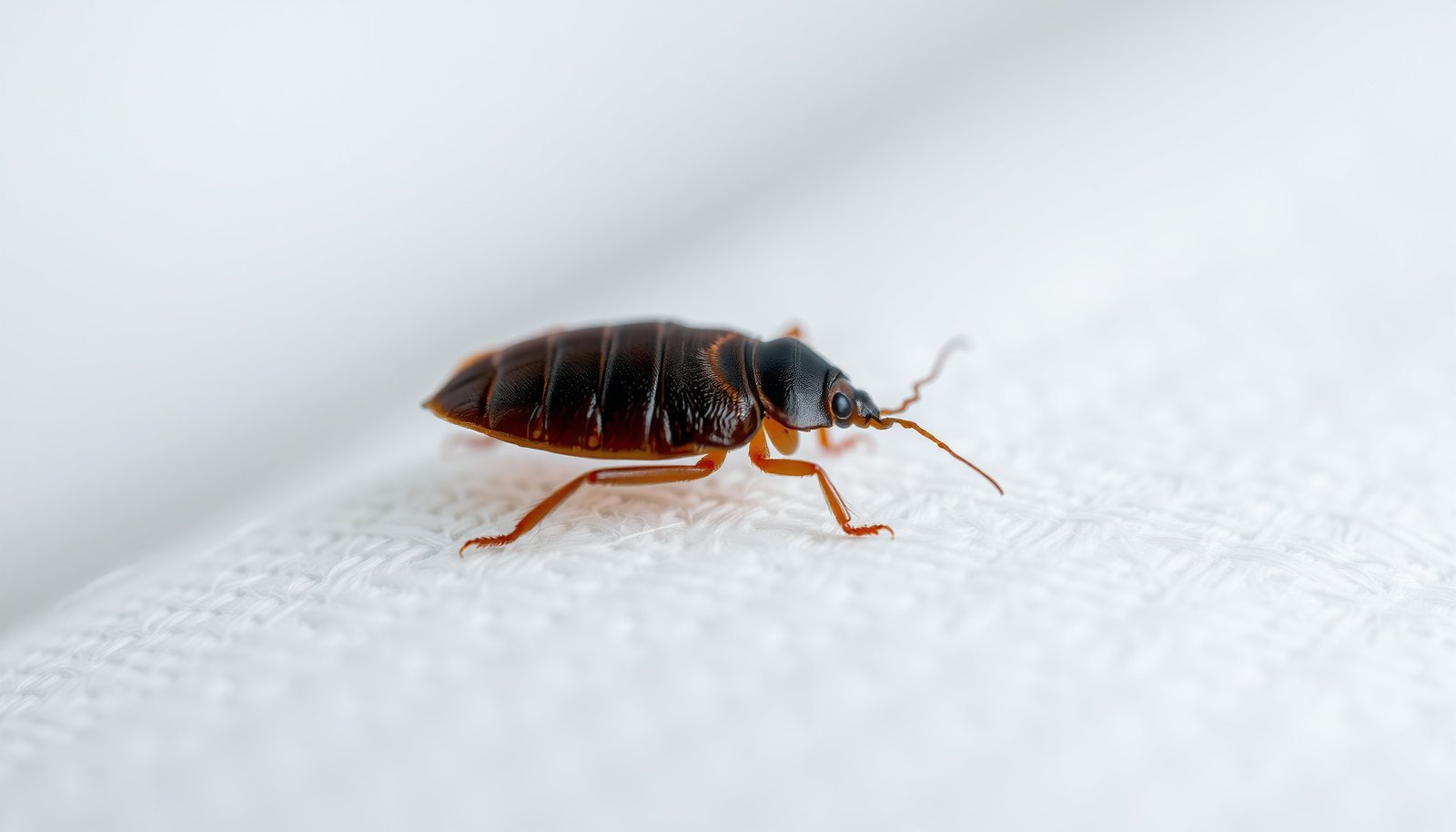
This close-up shows the dramatic difference between an unfed adult bed bug (flat, dark brown, apple-seed shaped) and a recently fed one (swollen, elongated, deep red) — understanding both forms is what separates a correct identification from a missed infestation.
Can You See Bed Bugs With the Naked Eye?
Technically, yes — but “can see” and “will notice” are two very different things. Adult bed bugs are absolutely visible without magnification. The early nymphs, though, exist in a frustrating gray zone: they’re not microscopic, but they’re small enough that most people’s eyes just don’t register them as anything significant, especially against wood grain, mattress seams, or the tiny folds of a box spring. A first-stage nymph on a white sheet might pass for a speck of lint or a grain of sand.
Here’s a counterintuitive truth about bed bugs that most pest control content skips entirely: an unfed adult bed bug can survive over 300 days without a blood meal under cool conditions. That means a bug hiding in a crack in your bed frame could be completely dormant and invisible to a casual inspection for nearly a year. By the time it feeds, molts, and reproduces, you’re dealing with an established infestation that didn’t “start” when you noticed it — it started many months earlier.
“Most people expect to find a bed bug crawling across their mattress. What they actually find — if they find anything — is a shed exoskeleton, a rust-colored smear, or an egg. The live bugs are almost never out in the open. They retreat to harborage sites within minutes of feeding, and those sites can be millimeters-wide cracks nowhere near the bed itself.”
Dr. Michael Sherwood, Board-Certified Entomologist and urban pest specialist, University Extension Program
What Shape, Color and Texture Do Bed Bugs Have?
Shape-wise, an unfed adult is classically oval and extremely flat — almost like someone pressed it under a book. The body has a ridged abdomen with horizontal segments that become more visible as the bug feeds and the abdomen expands. The legs are thin and spindly, six of them, and they’re surprisingly fast for how flat the body is. There’s no visible waist the way you’d see on an ant, and the antennae are short and inconspicuous, which matters when you’re trying to distinguish them from other small insects.
Color is where most identification guides oversimplify. “Reddish-brown” is the go-to descriptor, but that’s only accurate for unfed adults. Here’s a quick breakdown of what you’re actually looking at depending on age and feeding status:
| Stage / Condition | Color | Size |
|---|---|---|
| First-instar nymph (unfed) | Translucent / pale yellow | ~1.5mm |
| Late-instar nymph (unfed) | Yellow-brown to tan | 3–4.5mm |
| Adult (unfed) | Reddish-brown to mahogany | 5–7mm |
| Adult (recently fed) | Deep red to reddish-purple | Up to 9mm (swollen) |
Pro-Tip: If you find a small, pale insect in your bed and think “that’s too light to be a bed bug,” don’t dismiss it. Hold it against a white surface in bright light and look for the segmented abdomen and six legs. Young nymphs are the most common stage found in early infestations precisely because adults are better at hiding.
How Do You Tell Bed Bugs Apart From Other Bugs That Look Similar?
Misidentification is the single most expensive mistake you can make with a potential bed bug problem. Treating for the wrong pest wastes time, wastes money, and lets a real infestation grow. Picture this: a renter spots a small, flat brown bug near their headboard, decides it’s a carpet beetle, buys a carpet beetle spray, and sprays the room twice over two weeks. Six weeks later, they’re waking up with bites in rows of three and calling a pest control company — who finds a well-established bed bug population that’s had six weeks of uninterrupted reproduction.
The bugs most commonly confused with bed bugs, and how to tell them apart:
- Carpet beetle larvae: Covered in bristly hairs, elongated and carrot-shaped — nothing like the smooth, flat oval of a bed bug. They also don’t bite.
- Bat bugs: Nearly identical to bed bugs under a microscope, but the fringe hairs on their thorax are longer. If you find them without bats in the attic or walls, it’s unusual — call a pro to be sure.
- Booklice: Much smaller (under 1mm), pale gray-white, and have a distinctively large head compared to body size. They’re attracted to mold and humidity, not blood.
- Swallow bugs: Close relatives of bed bugs, slightly hairier, and associated with cliff swallow nests. They can migrate into homes when birds leave in fall.
- Spider beetles: More rounded and humped, with long legs that give them a spider-like appearance — easy to separate from the flat profile of a bed bug once you know what to look for.
The one physical feature that almost definitively identifies a bed bug — at any age — is the pronotum shape: the plate just behind the head has distinctively scalloped, concave edges that curve inward like a crescent on each side. You might need a magnifying glass to see it clearly, but it’s consistent across all life stages and it’s not shared by the common look-alikes.
What Other Signs Confirm a Bed Bug Infestation Beyond the Bug Itself?
Realistically, you’re more likely to identify a bed bug infestation by its evidence than by spotting an actual bug. The bugs feed at night, typically in the 1–3 AM window when humans are in their deepest sleep, and they retreat to harborage sites within minutes. A thorough visual inspection matters, but knowing what to look for beyond a live insect is what separates a confirmed identification from a long guessing game.
These are the physical signs to look for methodically, in order of how commonly they appear in early versus established infestations:
- Fecal spots: Small dark brown or black dots, roughly the size of a marker tip, found on mattress seams, box spring fabric, or behind headboards. They don’t wipe off cleanly — they smear or absorb into fabric like an ink dot.
- Shed exoskeletons (cast skins): Bed bugs molt five times before adulthood, leaving behind translucent, empty husks that hold the exact shape of the bug. Finding these is one of the clearest confirmations of an active infestation.
- Blood stains on bedding: Small rust-colored smears, usually from a bug being crushed during sleep after feeding. These appear on sheets, pillowcases, or mattress covers.
- Egg clusters: Bed bug eggs are about 1mm long, pearl-white, and slightly shiny. A female lays 1–5 eggs per day and up to 500 over her lifetime. They’re typically glued to surfaces in harborage areas, making them sticky and resistant to brushing off.
- Musty odor: Heavy infestations sometimes produce a distinctive sweet, musty smell — often compared to coriander or almonds — from the bugs’ scent glands. You won’t smell this in early infestations, but it’s a notable sign in severe cases.
One honest nuance worth acknowledging: the severity of signs varies enormously depending on how long the infestation has been active, the size of your living space, and even the time of year. In a cooler apartment with an older infestation where the bugs have spread to multiple rooms, you might find almost no fecal spotting on the mattress because the population has dispersed to baseboards, outlet covers, and furniture joints across the whole unit. Don’t rule out bed bugs just because the mattress looks clean.
Knowing exactly what a bed bug looks like — in every stage, fed and unfed — changes how you inspect and what you find. Most people who “checked for bed bugs” and found nothing were actually looking for the wrong thing: a fully grown, reddish-brown adult in plain sight. The real infestation was in the cast skins behind the outlet cover, the pale nymphs tucked into the mattress zipper, and the fecal dots along the seam of the box spring. Arm yourself with a flashlight, a credit card for probing seams, and a clear picture of all six life-stage appearances before you declare any space clear.
Frequently Asked Questions
What do bed bugs look like to the human eye?
Adult bed bugs are visible without a magnifying glass — they’re about the size of an apple seed, roughly 5–7mm long. They’re flat, oval-shaped, and reddish-brown. You’re most likely to spot them hiding in mattress seams, box spring corners, or along baseboards near the bed.
How do I know if it’s a bed bug or something else?
The easiest way to tell is by shape and color. Bed bugs are flat and oval before feeding, but they swell up and turn a deeper red after a blood meal. Fleas are thinner and jump, carpet beetles have a rounder shape with a mottled pattern, and spider beetles have longer legs — none of those match a bed bug’s distinct flat, seed-like profile.
What do baby bed bugs look like?
Baby bed bugs, called nymphs, are tiny — as small as 1.5mm — and almost translucent or pale white when they haven’t fed. After feeding, they turn bright red because their bodies are so small you can see the blood inside. They go through 5 molting stages before reaching full adult size, and they shed their skins along the way, so finding tiny pale shells is also a warning sign.
What color are bed bugs?
It depends on whether they’ve eaten recently. Unfed bed bugs are mahogany or reddish-brown. Right after feeding, they darken to a deeper rust-red and their bodies become more elongated and balloon-like. Nymphs start out nearly colorless and gradually get darker as they mature through each molt.
What do bed bug eggs look like?
Bed bug eggs are tiny white or off-white ovals, about 1mm long — roughly the size of a pinhead. They’re sticky when first laid, so they tend to cluster together in cracks, seams, and hidden corners. If you see a small white dot that doesn’t wipe away easily, that’s worth a closer look with a flashlight.