

Fleas are smaller than you think — and that’s exactly why most people misidentify them for weeks. At 1–3 millimeters long, a flea is roughly the size of a sesame seed, dark reddish-brown, and moves so fast it seems to vanish the moment you spot it. The problem isn’t that fleas are invisible. It’s that people spend days staring at the wrong thing — looking for a crawling bug when what they’re actually finding is flea dirt, flea eggs, or dried flea feces on their pet’s coat, and dismissing it as regular debris.
What Does a Flea Actually Look Like Up Close?
A flea’s body is laterally compressed — meaning it’s incredibly flat from side to side, like someone pinched it. This isn’t a coincidence. That shape lets fleas move through pet fur and carpet fibers with almost no resistance, which is a big part of why they’re so hard to catch or crush between your fingers. Under magnification, you’ll see a shiny, hard exoskeleton in dark reddish-brown or mahogany tones, six long legs (with the hind pair dramatically longer than the others), and a rounded abdomen that swells visibly after a blood meal.
Fleas don’t have wings — none, at any life stage. If you’re seeing a tiny jumping bug with wings, you’re looking at something else. What fleas do have is an extraordinary ability to jump: up to 7 inches vertically and 13 inches horizontally, which translates to roughly 150 times their own body length. Their eyes are small and simple, their antennae are short and recessed into grooves on the head, and their mouthparts are designed to pierce skin and draw blood — though you won’t see those details without a magnifying glass.
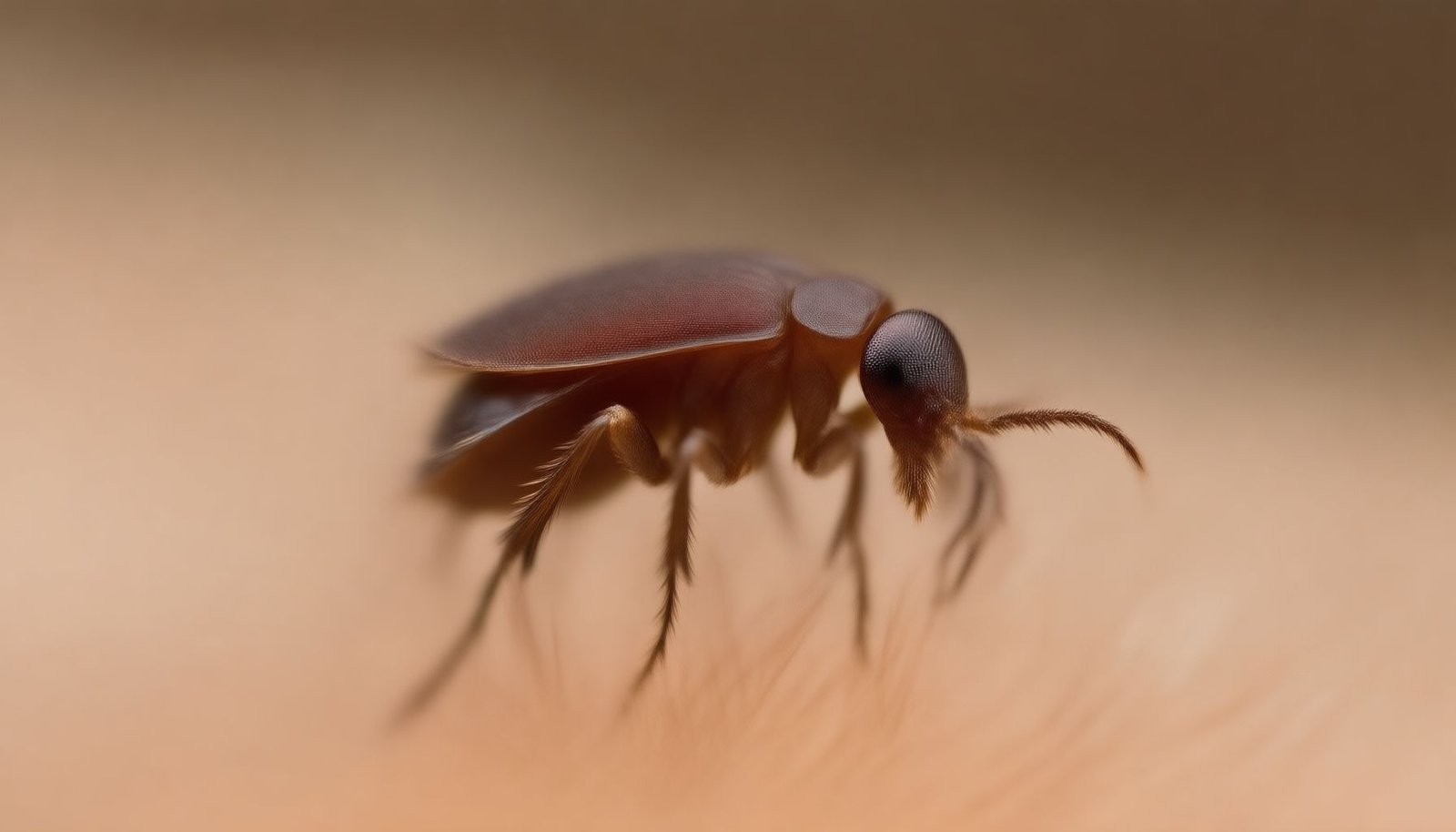
This close-up view shows the flea’s distinctive laterally flattened body and enlarged hind legs — details that separate it from nearly every other tiny bug you might find on your pet or furniture.
What Are the Signs of Fleas on a Pet’s Coat (That Aren’t the Flea Itself)?
Here’s the part that most flea identification guides skip entirely: by the time you actually see an adult flea on your pet, there are already hundreds of eggs and larvae in your home. Adult fleas make up only about 5% of a total flea population at any given time — the other 95% is eggs, larvae, and pupae living in carpet, furniture, and bedding. So spotting a flea on your dog’s coat is a late-stage clue, not an early warning sign. The earlier, more reliable signals are the ones most people mistake for dirt or dandruff.
Flea dirt is the most telling indicator. It looks like coarse black pepper scattered across your pet’s skin, especially concentrated around the base of the tail, the belly, and behind the ears. To confirm it’s flea feces and not regular dirt, do the wet paper towel test: scoop a few specks onto a damp white paper towel and press gently. If they turn reddish-brown or rusty red within 30 seconds, that’s digested blood — which means fleas. Regular dirt stays dark or brown. A pet scratching obsessively at their neck and tail base, losing patches of hair, or developing small red scabs along the spine are all signs worth investigating with a fine-tooth flea comb.
Pro-Tip: Run a flea comb slowly through your pet’s fur over a white paper towel or white pillowcase. Even if you don’t catch a live flea, any flea dirt that falls will show up clearly against the white background — and the wet test will confirm it within seconds.
How Do You Spot Fleas on Furniture and Carpet Without a Pet?
Picture this: you move into a rental where the previous tenants had a cat. The carpets look clean, and the apartment was professionally cleaned — but within a week, you’re getting bitten around your ankles every time you walk through the living room. This is one of the most common flea scenarios people encounter without owning pets, and it happens because flea pupae can remain dormant in carpet fibers for up to 5 months, waiting for vibration, warmth, and carbon dioxide — the signals that a host has arrived. Your footsteps and body heat are all it takes to trigger a mass emergence.
To spot fleas on carpet or furniture without a pet, the white sock test is your best tool. Put on a pair of tall white socks and walk slowly across the carpeted area, shuffling your feet slightly to disturb the fibers. Stand still for 30 seconds in a few different spots. Fleas are attracted to warmth and will jump toward your legs — and against white socks, even a 1mm reddish-brown flea is easy to spot. Check the lower seams and crevices of upholstered furniture, too, especially in gaps where cushions meet the frame. Fleas rarely congregate on hard floors, so if you’re getting bitten, focus your inspection on soft surfaces first.
“Most people focus entirely on finding the adult flea, but adult fleas are transient — they’re on the host to feed and reproduce, then drop off. The infestation is really in the environment: the carpet, the baseboards, the furniture upholstery. If you don’t find evidence there, you haven’t found the infestation.”
Dr. Patricia Vance, Board-Certified Entomologist and Urban Pest Management Specialist
What Does Each Flea Life Stage Look Like — And Why Does It Matter?
This is where flea identification gets genuinely counterintuitive. Most of the flea population in your home is in a life stage you probably wouldn’t recognize as a flea at all. A flea egg is white, oval, and about 0.5mm long — smaller than a grain of salt. Larvae are pale, worm-like, and about 1–5mm long with no legs and a slightly translucent body. The pupal stage is wrapped in a sticky silk cocoon that collects debris from the surrounding environment, making it nearly invisible against carpet or soil. Understanding what each stage looks like tells you exactly where to treat — because eggs and larvae respond to different products than adults do.
A single female flea can lay 40–50 eggs per day and up to 2,000 eggs over her lifetime. Those eggs aren’t sticky — they fall off your pet as it moves around the house, distributing throughout every room your pet frequents. This is why you find fleas in rooms where your pet barely goes. The larvae that hatch from those eggs avoid light instinctively, burrowing deep into carpet fibers and under furniture edges, which is also why surface treatments often fail to reach them. Knowing the visual differences between life stages isn’t just academic — it directly affects whether the treatment you choose will actually work.
| Life Stage | Size | Appearance | Where Found |
|---|---|---|---|
| Egg | ~0.5mm | White, oval, smooth | Pet bedding, carpet, furniture |
| Larva | 1–5mm | Pale, worm-like, no legs | Deep in carpet fibers, baseboards |
| Pupa | ~4mm (in cocoon) | Sticky cocoon coated in debris | Carpet, soil, under furniture |
| Adult | 1–3mm | Dark reddish-brown, flat, jumping | On host, furniture seams, bedding |
What Bug Are You Actually Looking At? Fleas vs. Common Lookalikes
The maddening thing about flea identification is that several other common household bugs get misidentified as fleas constantly — and treating for the wrong pest wastes both time and money. The key distinctions come down to three things: shape, movement, and where you’re finding them. Just as early cockroach infestation signs are often mistaken for something more benign, early flea activity gets written off as carpet lint or pet debris until the biting starts. Getting the ID right on day one changes everything about how you respond.
Here’s how to separate fleas from the bugs most commonly confused with them:
- Springtails: Similar size but rounder body, found near moisture sources like drains or houseplant soil — they jump but don’t bite and are gray or white rather than reddish-brown.
- Bed bugs: Flat and oval like a flea, but they don’t jump at all, they’re much wider relative to their length, and bites appear on exposed skin during sleep rather than ankles and lower legs during the day.
- Carpet beetles (larvae): Slow-moving, hairy or banded in appearance, and they don’t bite — they cause damage to fabric rather than skin irritation.
- Chiggers: Microscopic and red, found exclusively outdoors in tall grass — if you’re finding tiny red dots indoors, it’s almost certainly something else.
- Lice: Much slower than fleas, found only on the host (never in carpet or furniture), and species-specific — your pet’s lice won’t transfer to you, and vice versa.
One honest caveat worth mentioning: if you’re in a humid Southern state and your dog spends time outdoors, you’re almost certainly dealing with the cat flea (Ctenocephalides felis) — the species responsible for roughly 90% of all flea infestations in US homes, regardless of whether you have a cat. But in dryer climates with limited wildlife pressure, bites around the ankles might actually be from a completely different arthropod. Identifying the exact pest correctly before treating is always worth the extra step, because throwing flea products at a springtail problem or a mite issue won’t solve anything. The white sock test and the flea dirt wet test together will get you to a confident answer in under five minutes.
How to Do a Systematic Flea Inspection of Your Home in 20 Minutes
A thorough flea inspection doesn’t require professional equipment — just a flashlight, white socks, a fine-tooth comb, and a damp paper towel. The mistake most people make is inspecting randomly, poking around wherever feels obvious. A systematic approach covers the spaces where fleas actually concentrate, which are not always the spaces that seem most logical. Fleas cluster where pets rest and sleep, not necessarily where they eat or play — so your dog’s food bowl area is much less relevant than the corner of the couch where he naps every afternoon.
Work through this sequence in order:
- Pet bedding first. Remove the cover and inspect the seams and corners with a flashlight. Look for white eggs (use magnification if needed), flea dirt, and any live movement. This is almost always the highest-concentration zone.
- Your pet’s body. Use a fine-tooth flea comb on a white surface, focusing on the base of the tail, belly, groin, and behind the ears. Perform the wet paper towel test on any dark specks you collect.
- Upholstered furniture. Check along seam lines, under cushions, and in the gap between the cushion base and the frame back. Press a white towel into the seams and examine what comes out.
- Carpet in pet traffic zones. Perform the white sock walk in the areas your pet frequents most. Move slowly and check your socks every 30–60 seconds. Use a flashlight at carpet level to spot movement or flea dirt in the pile.
- Baseboards and room edges. Flea larvae migrate away from light and toward the edges of rooms. Run a strip of white tape along a baseboard, press it flat, and examine it under a light for tiny pale larvae or eggs.
- Your own bed. If you’ve been getting bitten at night, check mattress seams and the area of flooring directly beneath your bed — larvae concentrate in undisturbed low-light zones, and your bed frame’s shadow is ideal habitat.
One thing that genuinely surprises people: the severity of what you find during inspection doesn’t always match how bad the biting feels. A light infestation in a house with multiple pets can produce intense biting because the fleas are concentrated on the hosts. A heavier environmental infestation in a pet-free home might produce fewer bites but much more flea activity in the carpet — because there’s no preferred host, so fleas jump at anything warm, including you. The inspection results tell you where to treat, not necessarily how bad the problem is overall.
Once you’ve confirmed fleas and mapped out where they’re concentrated, you’re in a much better position to decide on treatment — whether that’s a targeted carpet spray, an IGR (insect growth regulator) that prevents eggs and larvae from maturing into adults, or professional intervention for a heavy infestation. The identification step isn’t just about naming the pest. It’s about understanding exactly what part of the flea lifecycle you’re dealing with and where it’s entrenched, so whatever you do next actually has a chance of working.
Frequently Asked Questions
what do fleas look like to the human eye?
Fleas are tiny, dark reddish-brown insects about 1/16 to 1/8 inch long — roughly the size of a sesame seed. They’re flat from side to side, which helps them move through pet fur, and they don’t have wings. Without magnification, they look like moving dark specks that disappear fast when disturbed.
how can you tell if your pet has fleas?
The most reliable sign is watching your pet scratch, bite, or lick certain spots — especially the base of the tail, belly, and neck. Part your pet’s fur and look for fast-moving dark specks or tiny white oval eggs near the skin. You can also comb your pet over a white paper towel and look for flea dirt, which are small reddish-black specks that turn red when wet.
what does flea dirt look like on furniture?
Flea dirt looks like ground black pepper scattered on fabric, cushions, or pet bedding. It’s actually flea feces made up of digested blood, so if you put a few specks on a damp white paper towel and they turn reddish-brown, that confirms it’s flea dirt and not regular debris. You’ll most often find it where your pet sleeps or rests the most.
can fleas live in carpet without pets?
Yes, fleas can survive in carpet for several months without a host — flea pupae are especially hardy and can lay dormant until they sense heat and vibration from a passing animal or person. If you’ve moved into a home where the previous occupants had pets, you can still get a flea infestation. Vacuuming daily and treating carpet with an insect growth regulator are the most effective ways to break their life cycle.
what’s the difference between fleas and bed bugs?
Fleas are long and narrow, jump extremely well, and tend to bite around ankles and lower legs. Bed bugs are rounder and flatter, can’t jump at all, and typically bite in clusters or lines on exposed skin while you sleep. If you’re finding bites but can’t spot insects, check your mattress seams for bed bugs and your pet’s fur for fleas — the location of the bites is usually the quickest way to tell them apart.