
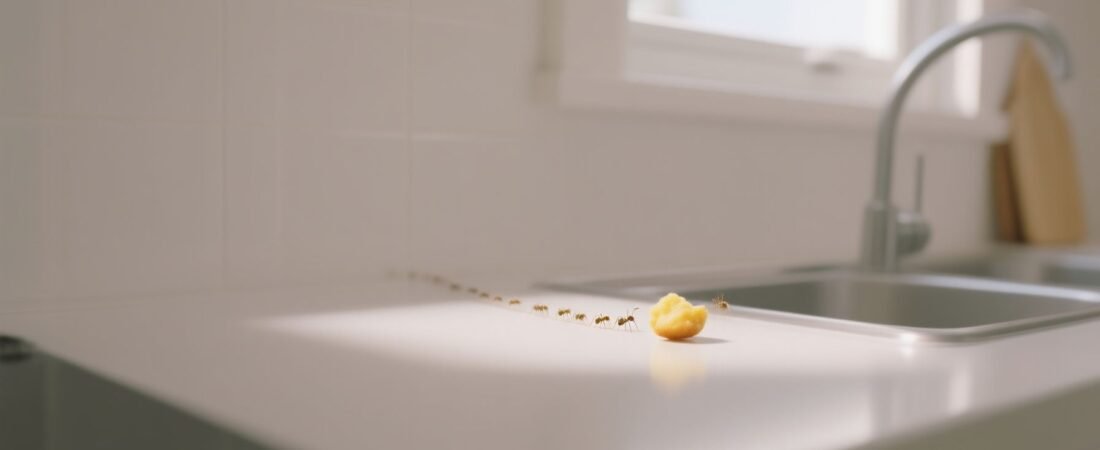
Pharaoh ants are not sugar ants, grease ants, or ghost ants — and that misidentification is exactly why so many homeowners spend months losing the battle against them. These are roughly 1/16-inch-long, pale yellow-to-amber insects with a slightly darker abdomen, and they are one of the most difficult ant species to eliminate in North America. Get the ID wrong and you’ll reach for the wrong treatment, which — with pharaoh ants specifically — can make the infestation dramatically worse.
What Do Pharaoh Ants Actually Look Like Up Close?
Pharaoh ants are tiny — adults max out at about 1/16 of an inch (roughly 2mm), which makes them among the smallest household ant species you’ll encounter in the US. Their bodies are a translucent pale yellow to light orange-brown, almost like they’ve been lightly toasted, and their abdomen often has a faint darker banding that gives them a two-toned look under magnification. Workers are all one size (monomorphic), which distinguishes them from carpenter ants that come in multiple worker sizes.
The antennae have 12 segments and end in a distinctive 3-segmented club — you won’t see that detail without a magnifying glass, but pest control professionals use it as a definitive identifier. Queens are slightly larger at around 3-4mm and are darker reddish-brown, almost mahogany, while winged reproductive males are even darker, nearly black. If you’re seeing a mix of very pale yellow ants and a few darker reddish ones in the same trail, you’re almost certainly looking at a pharaoh ant colony.
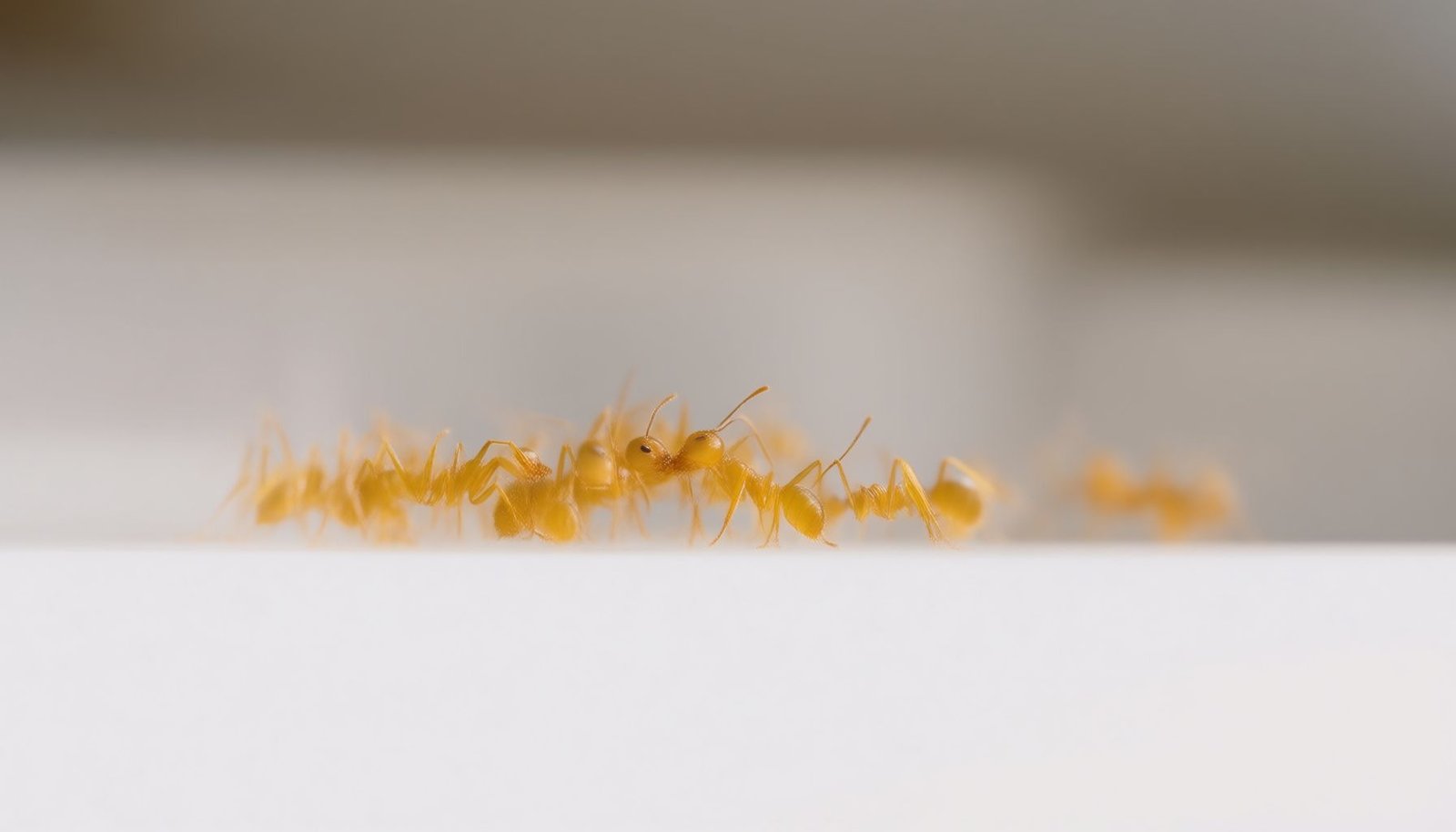
This close-up shows the pale yellow coloring and darker abdominal banding that separate pharaoh ants from the many other small ant species commonly misidentified in kitchens — getting this detail right is what determines whether your treatment plan will actually work.
How Is a Pharaoh Ant Different From Other Tiny Yellow Ants in Your Kitchen?
This is the question that most identification guides gloss over, and it’s the one that actually matters. At least three other ant species get regularly confused with pharaoh ants: ghost ants, thief ants, and odorous house ants (when they’re younger and lighter in color). Ghost ants share the pale coloring but have a distinctly dark head and thorax with a whitish, almost transparent abdomen — pharaoh ants do not have that stark two-part contrast. Thief ants are similarly tiny but are uniformly yellowish and lack the darker abdominal banding; they also typically form much narrower, harder-to-see trails.
The easiest field test most people skip: crush one ant gently and smell it. Odorous house ants release a rotten-coconut smell when crushed. Pharaoh ants produce no notable odor. That single 10-second test can save you from buying the completely wrong bait product. Ghost ants, common in Florida and Gulf Coast states, also have no smell when crushed, so if you’re in a humid southern state and can’t tell the two apart visually, the coloring of the head is your best distinguishing feature — dark head means ghost ant, yellow-amber head means pharaoh ant.
| Ant Species | Body Color | Size | Distinct Feature |
|---|---|---|---|
| Pharaoh Ant | Pale yellow to amber, darker abdomen | ~2mm | No odor when crushed; 3-segment antennal club |
| Ghost Ant | Dark head/thorax, pale whitish abdomen | ~1.5mm | Translucent abdomen; common in humid southern states |
| Thief Ant | Uniform pale yellow | ~1.5mm | Extremely narrow trails; no abdominal banding |
| Odorous House Ant | Brown to dark brown | ~2.5-3mm | Rotten coconut smell when crushed |
Why Do Pharaoh Ants Show Up in Clean Kitchens — and Spread to Rooms With No Food?
Here’s the part that genuinely surprises people: pharaoh ants don’t need your kitchen crumbs to thrive. They’re one of the few ant species that actively seeks out moisture and protein as much as sugar, which means they’ll forage through plumbing chases, wall voids, and HVAC conduits to reach water sources, grease residue on stove knobs, and even non-food items like toothpaste or soap scum in bathrooms. A colony doesn’t have to be anywhere near your pantry to send scouts into it. This behavior — combined with their ability to nest inside walls, inside electrical outlets, and underneath flooring — is why homeowners find trails in places that make no logical sense.
Pharaoh ants are also exceptional travelers through multi-unit buildings. A single colony can maintain satellite nests connected by hidden trails running through shared walls, and workers can travel 100-150 feet from the main nest to forage. That means your neighbor’s infestation can become your kitchen problem without any ant ever coming through your front door. If you’ve also noticed ants appearing in a bedroom far from the kitchen, it’s worth reading about Why Do I Have Ants in My Bedroom With No Food? — the same wall-void travel behavior explains both situations.
Pro-Tip: Never spray pharaoh ants with a repellent pesticide — this is not just unhelpful, it’s actively counterproductive. Pharaoh ant colonies “bud” under stress, meaning the queen (or multiple queens) will split the colony and relocate to new nesting sites when threatened by a chemical barrier. One colony of 10,000 to 300,000 workers can fracture into dozens of satellite colonies almost overnight, spreading the infestation through walls faster than it would have spread naturally.
What Does a Pharaoh Ant Infestation Look Like in a Home?
Picture this: you’re heating up leftovers at midnight and notice a thin, steady line of near-invisible pale specks moving along the edge of your backsplash grout, disappearing into a small gap around a pipe. You almost mistake them for debris. That’s a pharaoh ant trail — and by the time it’s visible at that scale, the colony behind it has likely been established in your walls for weeks or months. A mature pharaoh ant colony can contain anywhere from 10,000 to over 300,000 workers, spread across multiple nesting sites simultaneously.
Signs of a pharaoh ant infestation look different depending on where you find them. Here’s what to look for in each part of the home:
- Kitchen and bathrooms: Thin, steady trails of pale yellow ants along grout lines, caulk gaps, under the lip of the sink, or around the base of appliances — especially near water sources like the dishwasher drain area or under the refrigerator drip pan
- Walls and outlets: Ants appearing out of electrical outlet plates, light switch covers, or small cracks in drywall — this indicates active nesting inside the wall void
- Hospital-like areas: Pharaoh ants are notoriously found in medical facilities because they’re attracted to IV fluids, wounds, and sterile packaging — if you have a home with medical equipment or regular wound care, they will find it
- Under flooring: Small piles of frass (debris) or dead workers appearing between floor tiles or under loose laminate, particularly near plumbing runs
- Non-food rooms: Scouts in bedrooms, hallways, and even closets — not foraging but scouting new nesting territory during colony budding
“Pharaoh ants are unique among common household ants in that they’re polygyne — meaning each colony can have hundreds of reproducing queens. This is what makes budding so explosive. You don’t need a fertilized queen to start a new satellite nest; you just need a few queens and some workers to peel off. Standard repellent sprays essentially do the colony’s splitting work for it, which is why baiting is the only reliable method for this species.”
Dr. Michael Raupp, Extension Entomologist, University of Maryland Department of Entomology
How Do You Confirm an Identification Before Treating?
Correct identification before you do anything is not a formality — with pharaoh ants, treating the wrong way is worse than waiting a few extra days to confirm. Here’s a step-by-step approach that actually works for homeowners without a microscope:
- Collect a sample. Place a small piece of tape sticky-side-down over an active trail to capture 5-10 live or dead workers. A clear piece of scotch tape works fine. Don’t crush them yet.
- Check the size. Place the tape next to a ruler. Pharaoh ant workers are right around 2mm — roughly the thickness of a dime on its edge. If the ants are 3mm or larger, you’re probably not dealing with pharaoh ants.
- Check the color. In natural light or under a flashlight, workers should appear pale yellow to amber. Dark brown or black workers eliminate pharaoh ants from consideration immediately.
- Crush one and smell it. No odor confirms you’re not dealing with odorous house ants. This eliminates one of the most common misidentifications in one second.
- Look for the trail behavior. Pharaoh ant trails are remarkably consistent and linear — they follow the same path repeatedly, often along edges, grout, or caulk. Random or erratic ant movement suggests a different species scouting, not an established pharaoh ant trail.
- Contact your local cooperative extension office. Most university extension programs will identify an ant sample from a photo or mailed specimen for free — this is underused and genuinely valuable when you’re not sure.
One honest nuance worth flagging: identification difficulty does vary by region and building type. In apartment buildings and older multi-unit housing, pharaoh ants are far more common than in standalone single-family homes with intact wall vapor barriers. In newer construction with tightly sealed walls, you’re more likely dealing with odorous house ants or thief ants even if the size and color seem similar at a glance. Climate matters too — pharaoh ants can’t survive cold outdoor winters, so in northern states, any infestation is entirely indoor-nesting, while in southern states they sometimes maintain outdoor colonies as well. This affects where you’d need to focus baiting.
It’s also worth noting that some structural sounds you’re attributing to other causes could indicate more than one pest issue running simultaneously. Pharaoh ants nesting in wall voids often share that space with other insects. If you’re ever unsure whether the sounds inside your walls are ant activity or something else entirely, What Does Termite Damage Sound Like Inside Walls? can help you rule out or confirm whether a more destructive pest is also present.
The counterintuitive truth about pharaoh ants is that their size is their best camouflage — not against predators, but against homeowners who assume any visible pest problem must be obvious. These ants do most of their traveling inside walls, inside appliances, and through utility conduits you’ll never see. By the time you spot a trail, you’re usually looking at a mature colony that’s been established for 60-90 days. The good news is that slow-acting protein and sugar-based gel baits, placed along active trails without any repellent sprays in the area, can reach every queen in a network of satellite nests through worker trophallaxis — the ants literally share the bait back through the colony. That’s the biology working in your favor, once you’ve made the correct identification to begin with.
Frequently Asked Questions
What do pharaoh ants look like?
Pharaoh ants are tiny, measuring about 1/16 of an inch long, with pale yellow to light orange bodies and darker, almost black abdomens. They have 12-segmented antennae with a 3-segmented club at the tip. If you’re spotting small yellowish ants near your kitchen sink or countertops, there’s a good chance you’re dealing with pharaoh ants.
How do I tell pharaoh ants apart from other small yellow ants?
The easiest way to tell pharaoh ants apart is by their two-node waist — there are two distinct bumps between the thorax and abdomen — and their pale, almost translucent coloring. Ghost ants look similar but have white legs and a darker head, while odorous house ants are darker brown and smell like blue cheese when crushed. Pharaoh ants also don’t swarm outdoors like many other species do.
Why do I have pharaoh ants in my kitchen?
Pharaoh ants are drawn to kitchens because they need moisture, warmth, and easy access to proteins and sweets. They’ll nest inside walls, behind baseboards, and under appliances — anywhere close to a food source. Even a small grease splatter or crumbs near your stove can be enough to attract and keep a colony going indoors.
Are pharaoh ants dangerous or do they bite?
Pharaoh ants can bite, but their bites are so small they’re rarely painful or noticeable to most people. The bigger concern is that they’re known to carry and spread bacteria like Salmonella and Streptococcus, especially in environments like hospitals and apartment buildings. They’ve also been documented getting into wounds and IV bags in medical settings, which makes them more of a health risk than most household ants.
What is the best way to get rid of pharaoh ants in my house?
Slow-acting sweet bait stations, like those containing borax or hydramethylnon, are the most effective method because worker ants carry the poison back to the colony and queen. Don’t use repellent sprays — they cause pharaoh ant colonies to split and spread, which makes the infestation much worse. If the colony is well-established, it can take 4 to 8 weeks of consistent baiting to fully eliminate it.