
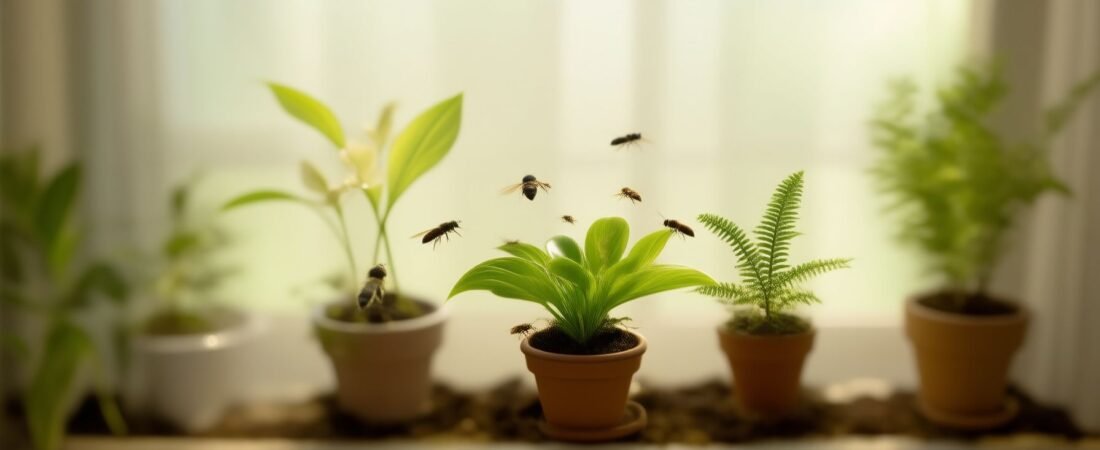
Those tiny flies hovering around your potted plants are almost certainly fungus gnats — but solving the problem has nothing to do with the flies themselves. That’s the part most people get completely wrong. Killing the adults you see buzzing around does almost nothing, because the real infestation is happening underground, in your soil, where larvae are actively feeding on roots and organic matter. Spray the air all you want; the next generation is already hatching beneath the surface.
Are These Fungus Gnats, Fruit Flies, or Something Else Entirely?
The honest answer is that most people can’t tell these apart without slowing down and actually looking. Fungus gnats are small — about 1/16 to 1/8 inch long — with long legs, dark bodies, and a distinctive Y-shaped wing vein you can see under a magnifying glass. They move sluggishly and tend to stay close to the soil, often crawling along the surface rather than flying in erratic loops. Fruit flies, by contrast, are rounder, hover mid-air near fruit or beverages, and have those characteristic red eyes.
Getting the ID right actually matters for treatment, because the two pests breed in completely different locations. Fruit flies breed in overripe produce, drains, and fermenting liquids — not soil. If the tiny flies are swarming your plant but you also have a banana on the counter going soft, there’s a real chance you’re dealing with two separate problems at once. Ruling out other suspects — like tiny black insects that look like thrips, which are plant feeders that can also appear near leaves — will save you a lot of wasted effort.
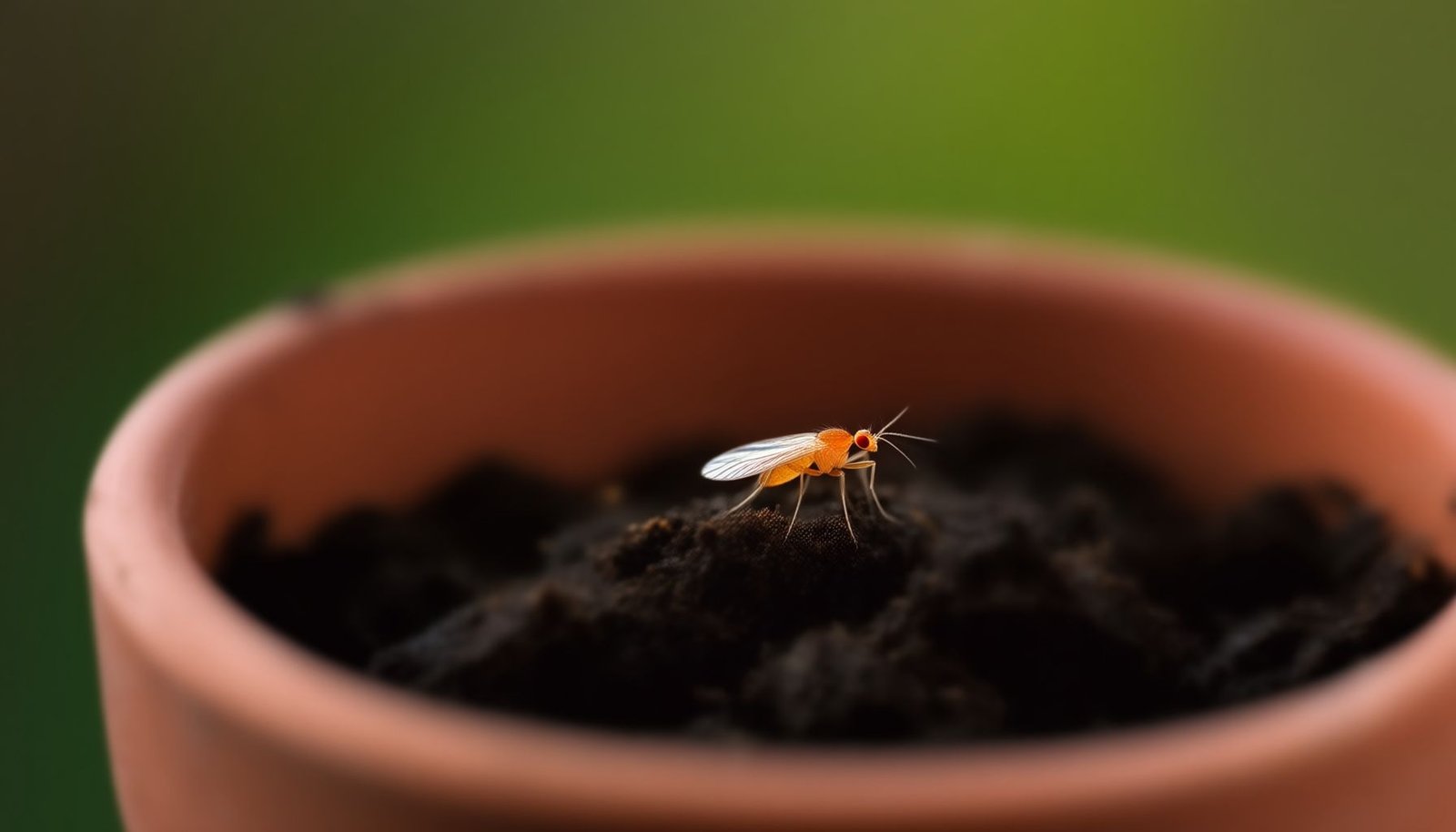
This close-up shows the key distinguishing features of a fungus gnat near plant soil — note the slender dark body and long trailing legs, which set it apart from the rounder, hovering fruit fly most people assume they’re seeing.
Why Are They on Your Plants in the First Place?
The single biggest driver of fungus gnat infestations is overwatering — and not in a vague, general sense. Soggy soil creates the precise conditions that fungus gnat larvae need to survive: a moist, oxygen-poor environment rich in decomposing organic matter and fungal growth. A female gnat can lay up to 300 eggs in her short 7-to-10-day adult lifespan, depositing them in batches of 20–30 just below the soil surface. If your pot is staying wet for more than 3–4 days after watering, you’re essentially running a gnat nursery.
The type of potting mix also plays a bigger role than most people realize. Peat-heavy mixes and mixes with a lot of compost or bark retain moisture and break down organically — both of which feed gnat larvae. Plants sitting in decorative pot covers without drainage holes are especially vulnerable, because standing water at the bottom stays hidden. Picture this: you bring home a gorgeous monstera from the garden center in a plastic nursery pot, nestle it inside a ceramic pot cover for looks, and water it on your usual schedule. Within two weeks, you’ve got clouds of gnats every time you walk past — because excess water has nowhere to go and the bottom inch of soil never dries.
What’s Actually Happening in the Soil — and Why It Matters
Here’s the counterintuitive part that most pest control write-ups skip: the larvae aren’t just a nuisance — they’re actively damaging your plant. Fungus gnat larvae feed primarily on fungal growth and decomposing organic matter, but when populations get high, they also chew on fine root hairs and even the base of stems. Seedlings and young plants can be killed outright. Established plants may show sudden wilting, yellowing, or failure to thrive that gets misdiagnosed as a watering problem — which leads the owner to water more, which makes the infestation worse.
A single lifecycle from egg to adult takes roughly 3–4 weeks at typical indoor temperatures around 70–75°F. That means if you notice adults in week one and do nothing, you’ll have a full second generation of adults emerging in week four — and each of those females will start the whole cycle again. The population doesn’t stay flat; it compounds. This is why a “just a few gnats” situation can spiral into a genuine infestation within a single month if the soil conditions that attracted them aren’t corrected.
“Most homeowners focus entirely on the adult gnats — which are annoying but essentially harmless — while the larvae quietly damage root systems below the soil surface. Effective control has to target the larval stage, not just what you can see flying around. Letting the top two inches of soil dry out completely between waterings is the single most effective thing you can do, because it breaks the lifecycle at the most vulnerable point.”
Dr. Patricia Wynn, Urban Entomologist and Extension Specialist, Cooperative Extension Service
How to Confirm You Have Fungus Gnats Before You Treat Anything
Don’t guess — confirm. The fastest way to verify larvae are present is the potato slice test: cut a raw potato into 1-inch chunks and press them cut-side-down into your soil. Leave them for 48 hours, then lift them up and check the underside with a magnifying glass or your phone camera. If you have larvae in the soil, they’ll be drawn to the potato starch and you’ll see small, clear-to-white worm-like creatures about 1/4 inch long with a distinctive black head capsule. Finding even a few confirms an active infestation.
Yellow sticky traps work well for catching and counting adults, but think of them as monitoring tools, not solutions. Place one trap per pot at soil level — gnats walk along the surface more than they fly high — and check it after 48 hours. More than 5–6 adults per trap in two days suggests a population large enough to warrant active treatment of the soil itself. The trap count also helps you track whether your treatment is working over subsequent weeks.
Pro-Tip: Press a wooden chopstick or your finger 2 inches into the soil before every watering. If it comes out with moist soil clinging to it, hold off watering for another day or two. This one habit alone will prevent the majority of fungus gnat infestations from ever getting started, because it keeps the soil surface and upper layer dry enough that females won’t lay eggs there.
How to Actually Eliminate Tiny Flying Bugs Around Indoor Plants
Effective treatment has to work on two levels at once: stopping new eggs from hatching in the soil, and preventing adults from reproducing while you do it. Neither one alone is enough. Adults live 7–10 days, so if you treat the soil but ignore the adults, existing females will keep laying eggs throughout that window. If you only catch adults on sticky traps without fixing the soil, the next batch of eggs is already in the ground.
Here’s a step-by-step treatment sequence that actually breaks the full lifecycle — not just the visible part of it:
- Stop overwatering immediately. Let the top 2 inches of soil dry out completely before watering again. This isn’t just advice — it’s the single most effective action you can take, because larvae can’t survive in dry conditions and females won’t lay eggs in dry soil.
- Apply a Bacillus thuringiensis israelensis (Bti) soil drench. Bti is a naturally occurring soil bacterium sold under brand names like Gnatrol or in granular mosquito dunk form. When larvae ingest it, it produces proteins that are toxic to them specifically — it doesn’t harm plants, beneficial insects, pets, or people. Mix per label directions and water it into the soil so it reaches the full root zone. Reapply every 5–7 days for 3–4 weeks to cover multiple generations.
- Place yellow sticky traps at soil level. One per pot, changed weekly. This reduces the adult population and helps you track when populations are declining.
- Top-dress soil with a 1/2-inch layer of coarse sand or perlite. This creates a dry, inhospitable surface layer that discourages egg-laying without affecting your plant’s water intake deeper in the pot.
- Check drainage and remove standing water. Empty decorative pot covers after every watering. If a pot has no drainage hole, it needs to either be repotted into a container with drainage or watered with extreme caution using a measured amount.
- Isolate new plants for 2 weeks before adding them to your collection. Fungus gnats commonly hitchhike into homes in potting soil purchased from garden centers. Quarantining new arrivals — and doing a Bti drench on fresh-purchased soil as a preventive measure — stops the infestation before it spreads to other pots.
It’s worth being honest about one thing: how quickly this works depends on the size of your collection, your home’s humidity, and how long the infestation has been going. A single potted succulent in a dry climate might clear up in two weeks. A collection of 30 tropical plants in a humid apartment could take 6–8 weeks of consistent treatment to fully resolve. That’s not a failure — it’s just the reality of a multi-generational pest working through its lifecycle.
One thing that rarely comes up in gnat articles: some people dealing with plant pests start wondering whether other insects in the home might also be causing health issues. If you’re seeing multiple types of insects and have pets, it’s worth knowing that separate infestations can interact in unexpected ways — for example, a flea infestation can pose real health risks beyond itching, especially in homes with small animals, and shouldn’t be dismissed as a minor nuisance while you’re focused on plant pests.
Could These Flying Bugs Be Something Other Than Fungus Gnats?
It’s a reasonable question, and the answer is yes — though fungus gnats account for the vast majority of “tiny flying bugs around houseplants” calls. Here’s a quick comparison of the other insects that show up near indoor plants, so you can rule them out:
| Pest | What They Look Like | Where You’ll See Them | Key Difference from Fungus Gnats |
|---|---|---|---|
| Fungus Gnats | Tiny, dark, long-legged; 1/16–1/8 inch | Near soil, crawling on surface | Sluggish flight; larvae in soil |
| Whiteflies | White, moth-like; 1/16 inch; waxy wings | Under leaves, fly up when plant is disturbed | Cloud of white insects when leaves are touched |
| Shore Flies | Dark, stocky, red eyes; similar size to gnats | Near standing water or algae in soil | Rounder body; faster, more direct flight |
| Springtails | Tiny, white/gray; jump rather than fly | Soil surface, drainage trays | Jump when disturbed; don’t actually fly |
Whiteflies are the one pest here that gets misidentified as gnats most often, and the distinction matters because whiteflies feed on the plant itself — specifically on leaf sap — and require an entirely different treatment approach involving insecticidal soaps or neem oil applied to the leaves. Shore flies look almost identical to fungus gnats but tend to breed in algae-covered soil or hydroponic setups rather than typical potting mix. And springtails, while alarming when they suddenly jump, are actually harmless decomposers — they don’t damage plants or bite people, and they respond to the same fix as gnats: dry out the soil.
The bugs that never get mentioned in this context, but occasionally do show up near indoor plants: thrips and aphids can both produce what looks like debris or movement near foliage, and while neither flies in the erratic gnat-like way, their tiny winged adults can be mistaken for gnats at first glance, especially in poor lighting. Getting close with a phone camera usually settles the question immediately.
Once you’ve confirmed what you’re actually dealing with and started treatment, the temptation is to declare victory as soon as you stop seeing adults buzzing around. Resist that. Keep using Bti drenches and sticky trap monitoring for a full four-week cycle after the last adult sighting — because larvae already in the soil will keep pupating and emerging for weeks after conditions improve. The plants that relapse are almost always the ones where treatment was stopped too soon.
Frequently Asked Questions
What are the tiny flying bugs around my indoor plants?
They’re almost always fungus gnats or fruit flies — fungus gnats are the most common culprit and look like tiny dark mosquitoes hovering near the soil. Fungus gnats breed in moist potting mix, while fruit flies are more attracted to decaying organic matter like overripe fruit nearby. If the bugs are yellowish and flying up from the leaves when you touch the plant, those could be whiteflies instead.
How do I know if I have fungus gnats or fruit flies on my plants?
Watch where they hang out — fungus gnats stay close to the soil and fly up when you water or disturb the pot, while fruit flies tend to swarm around your kitchen and are rounder and lighter in color. You can also press a piece of yellow sticky trap near the soil for 24 hours; if you catch mostly small, dark, long-legged flies, it’s fungus gnats. Fruit flies are typically bigger at about 1/8 inch, while fungus gnats are closer to 1/16 inch.
how do I get rid of tiny flying bugs in houseplant soil?
Let the top 2 inches of soil dry out completely between waterings, since fungus gnat larvae can’t survive without moisture. You can also drench the soil with a Bacillus thuringiensis israelensis (Bti) solution, which kills the larvae without harming your plant. Yellow sticky traps placed at soil level will catch the adults and help you monitor how bad the infestation actually is.
are tiny flies around houseplants harmful to the plant?
Adult fungus gnats are mostly just annoying and don’t directly damage plants, but their larvae are a different story. The larvae feed on roots and organic matter in the soil, and a heavy infestation can stunt growth, cause wilting, or even kill seedlings and young plants. If your plant looks like it’s struggling despite proper care, check the roots — you might see tiny white worm-like larvae in the top few inches of soil.
why do I suddenly have flying bugs around my plants after repotting?
Fresh potting mix is often the culprit — many commercial potting soils contain fungus gnat eggs or larvae already in the bag when you buy it. The act of repotting also disturbs the soil and brings larvae closer to the surface, making the adults more visible. To reduce the risk, you can microwave small batches of potting mix for about 90 seconds to sterilize it before use, or choose a perlite-heavy mix that dries out faster.