

Fleas don’t need a cat or dog to move into your home — they need a warm host, and you qualify. That’s the part most pest control articles gloss over, and it’s exactly why pet-free households get blindsided. You’re scanning your house for the usual suspects: no fur, no pet beds, no visible animals. So you dismiss the bites on your ankles, the faint jumping specks near the baseboard, the weird black grit on your hardwood. By the time you connect the dots, a flea population that started with one hitchhiking female has already laid hundreds of eggs deep in your carpet fibers.
Here’s the counterintuitive reality: a pet-free home can actually make a flea infestation harder to detect, not easier. Pets scratch, owners notice. Without that signal, the infestation grows undisturbed for weeks. This article is about what to look for when the usual warning signs aren’t there.
How Do Fleas Even Get Into a House With No Pets?
The most common entry point is wildlife — and it’s one that most homeowners never consider. Squirrels in the attic, raccoons under the deck, opossums in the crawl space, even a single mouse moving through a wall void can seed your home with fleas. A single rodent host can carry up to 100 fleas at a time, and those fleas drop eggs continuously as the animal moves around your structure. You never see the animal, you never see the fleas arrive, but suddenly you have both.
The second major route is human transport. Used furniture — sofas, mattresses, rugs picked up curbside or from a thrift store — is one of the most underappreciated flea delivery systems in the country. Flea pupae (the cocoon stage) can survive dormant inside upholstery for up to 5 months without a host, then hatch within seconds of detecting carbon dioxide and vibration from a nearby body. You drag in a “free couch,” set it down, and two weeks later you’re getting bitten every time you sit on it.
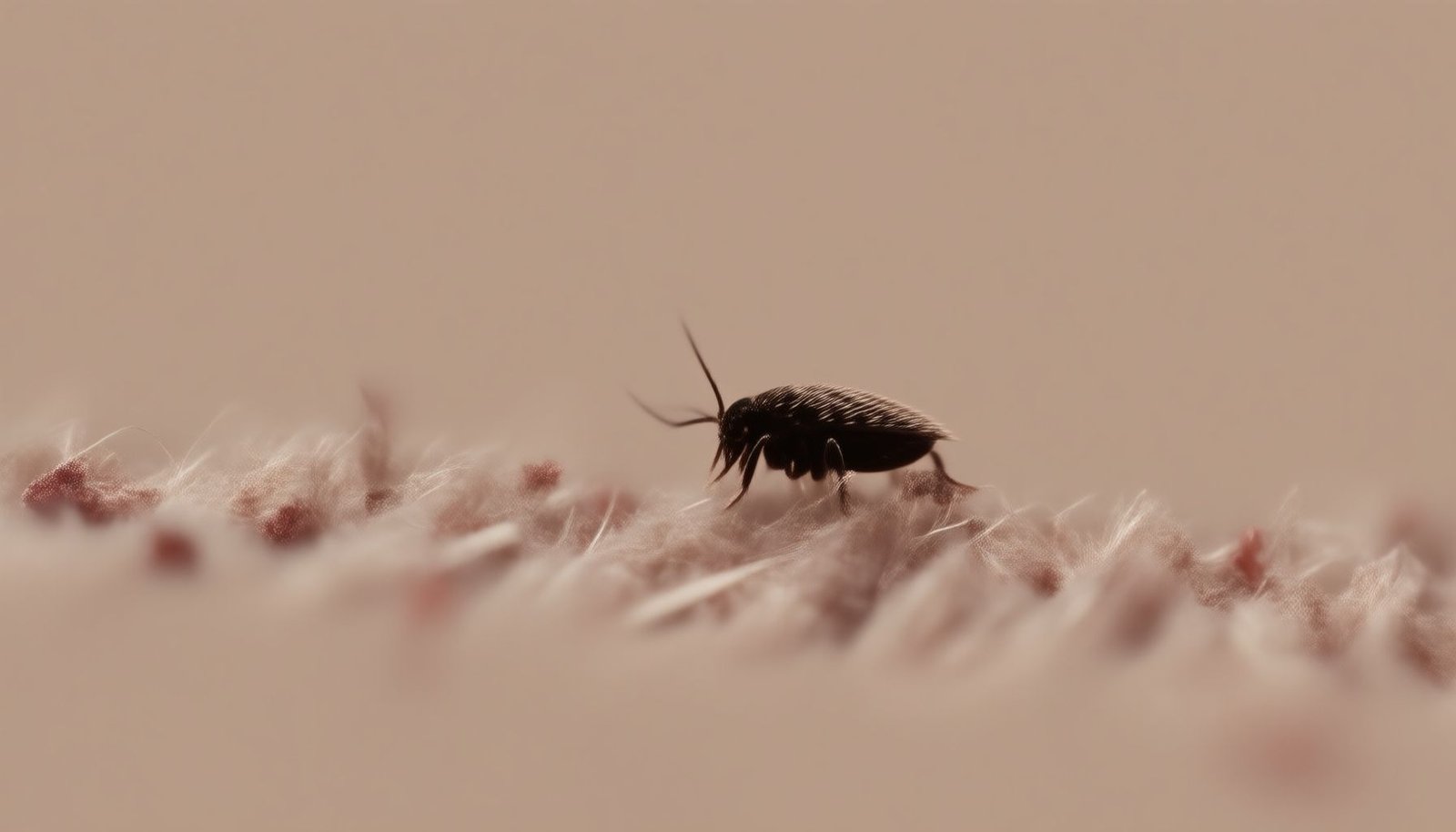
This close-up shows the telltale signs of flea activity in a pet-free home — flea dirt (dark specks), shed casings, and eggs visible against a light-colored floor surface — details that are easy to miss without knowing what you’re looking for.
What Does a Flea Infestation Actually Look Like When There’s No Animal to Check?
Without a dog or cat as your “indicator,” you have to read the environment differently. The most reliable physical sign is flea dirt — tiny black or reddish-brown specks that look like ground pepper scattered near baseboards, in carpet, on upholstered furniture seams, or along the edges of area rugs. Here’s the confirmation trick: wet a white paper towel and press it onto the specks. Flea dirt is digested blood, so it will smear red or rust-colored when damp. Regular dirt doesn’t do that.
The other thing to watch for is movement. Fleas are visible to the naked eye — adults are about 1/16 to 1/8 inch long, laterally flattened, and dark brownish-red. They don’t fly, but they jump up to 13 inches vertically, which is why you’ll often notice a tiny speck launching off your sock or leaping near the floor rather than walking. Picture this: you come home after a vacation, walk through your front door, and within 60 seconds you see a half-dozen tiny things jumping at your ankles. That’s a classic dormant-flea-population hatch — the vibration and CO₂ from your footsteps triggered cocoons that had been waiting for weeks with no host available.
Pro-Tip: Put on a pair of white knee-high socks and slowly walk through each room of your home, pausing to stand still for 30 seconds in areas with carpet or upholstered furniture. Fleas are attracted to body heat and will jump toward you. The white fabric makes them easy to spot. Do this in natural daylight or near a bright lamp for best visibility.
Where Do Fleas Hide in a Home Without Pet Bedding or Fur?
Fleas don’t cluster around a pet bed if there is no pet bed. Instead, they concentrate wherever their host — you — spends the most time. That means your couch cushions, your bed (especially the mattress edge and box spring), upholstered chairs, and any floor space where you walk regularly. In carpet, they tend to stay within the bottom third of the pile, close to the backing, where it’s protected and humid. Short-pile carpet actually harbors fewer fleas than thick shag precisely because there’s less structural depth for eggs and larvae to hide in.
Flea larvae actively avoid light and move away from it, which is why they concentrate under furniture, along wall-floor junctions, and in any gap where your flooring meets a baseboard. This behavior — called negative phototaxis — is why you can have a substantial larval population in a room that looks spotless in normal lighting. The larvae are feeding on “flea dirt” (adult flea excrement) that falls from the adult flea on the host, so wherever you sit or sleep longest is where the flea dirt falls, which is where larvae congregate. It’s a self-reinforcing cycle that builds in the exact places you’d least think to check.
The most flea-dense zones in a pet-free infested home, ranked by frequency of detection:
- Primary seating areas — sofa cushions, recliner crevices, and the floor space directly in front of where you sit most often
- Bedroom floor perimeter — the 12-18 inches of carpet or flooring bordering your bed, where larvae accumulate from flea dirt falling off you while you sleep
- Entry points from outside — mudrooms, doorway rugs, and the interior side of exterior doors where wildlife-sourced fleas first enter
- Crawl spaces and attic access areas — particularly if rodents or wildlife are or were present, since adult fleas will descend from those areas through gaps into living space
- Area rug edges — the underside and perimeter of area rugs, especially those laid over hardwood or tile, collect both flea dirt and larvae in the gap between rug and floor
How Do You Know Fleas Are Biting You and Not Something Else?
Flea bites have a distinctive pattern that separates them from bed bugs, mosquitoes, or mites. They almost always cluster in groups of 2-3 bites, and they concentrate on the lower legs and ankles — the body parts closest to the floor where adult fleas are jumping. This is the single biggest diagnostic clue in a pet-free home: if the bites are exclusively on your upper body, arms, or torso, fleas are much less likely to be the culprit. Flea bites are small red spots with a central puncture point, surrounded by a slightly raised, itchy halo, and they typically appear within an hour of being bitten rather than hours later like some reactions.
A useful comparison worth knowing — just like identifying fruit flies vs fungus gnats vs drain flies requires looking at behavioral patterns rather than just appearance, distinguishing flea bites from other insect bites relies on pattern and location, not just what the individual bite looks like. Multiple bites in a straight line usually point to bed bugs. Random single bites across the body suggest mosquitoes. Clustered bites in groups of 2-3 on the lower legs, often appearing after you sit on carpet or upholstered furniture, are the classic flea signature.
| Bite Characteristic | Fleas | Bed Bugs | Mosquitoes |
|---|---|---|---|
| Location on body | Lower legs, ankles | Arms, torso, neck | Any exposed skin |
| Pattern | Clusters of 2-3 | Lines or clusters | Scattered, single |
| Timing of reaction | Within 1 hour | Hours to days | Minutes to 1 hour |
| Associated location | After sitting on floor/couch | After sleeping in bed | Outdoors or near windows |
“In pet-free homes, we see flea infestations persist for months because residents keep attributing the bites to something else — mosquitoes, dry skin, allergies. Without a scratching pet to prompt investigation, the population can reach several thousand adults before anyone calls us. The flea life cycle is extraordinarily efficient: a single female lays 20-50 eggs per day, and under warm indoor conditions, you can go from a dozen hitchhiking adults to a full household infestation in under six weeks.”
Dr. Karen Vail, Extension Entomologist, University of Tennessee Institute of Agriculture
What Are the Hidden Signs of Fleas Most People Miss Entirely?
Beyond flea dirt and actual sightings, there are secondary signs that most pest control guides skip because they assume you have a pet to observe. The biggest overlooked indicator is flea eggs — white, oval specks about 0.5mm long that are so small they’re essentially invisible unless you’re on your hands and knees with a flashlight, looking at carpet fibers or cracks in hardwood floors near the wall. They look like fine white salt or dandruff scattered across the floor. Unlike flea dirt, they don’t turn red when wet, but a magnifying glass will reveal their smooth, rounded oval shape compared to the irregular shape of actual debris.
The signs worth auditing systematically in a pet-free home include:
- Flea dirt on light-colored surfaces — run your fingers along baseboards, mattress seams, and sofa cushion gaps; tiny dark specks that smear rust-red when wet confirm flea activity
- Pale, translucent larvae — roughly 1/4 inch long, worm-like, with visible dark gut contents; they move slowly and will curl when disturbed, typically found in carpet backing or under furniture
- Empty pupal casings — tan, papery, slightly sticky cocoon casings stuck to carpet fibers; these confirm a full hatch has already occurred
- Unexplained scratching or skin irritation in humans, particularly around socks and waistbands, that worsens after sitting on upholstered surfaces or carpet
- Evidence of wildlife intrusion — droppings, gnaw marks, or disturbed insulation — which frequently co-occurs with flea introduction even if the animal itself is no longer present
- Recent used furniture acquisition — any secondhand soft goods brought in within the past 3-5 months should be treated as a potential flea source regardless of visible evidence
One honest nuance worth acknowledging: how severe these signs appear depends heavily on the building type, climate, and how long the infestation has been running. A ground-floor apartment in a warm, humid Southern city will show signs faster and more intensely than a third-floor unit in a dry climate, because flea eggs need relative humidity above 50% to hatch reliably and larvae need it above 70% to survive. A home that runs air conditioning aggressively may suppress flea development even with active adults present — which can make an infestation appear to “come and go” seasonally when it’s actually a steady low-level population responding to indoor humidity cycles.
It’s also worth noting that flea problems in pet-free homes are rarely isolated to just fleas. The same rodent that delivered the fleas may also be creating other contamination risks in your kitchen and food storage areas — similar to how mice and rats can spread Salmonella in the kitchen without leaving obvious signs until you know what to look for. Treating the flea problem without addressing the wildlife or rodent source is one of the most common reasons pet-free flea infestations come back after treatment.
The unique insight most guides miss entirely: flea pupae are chemically resistant. Adult fleas, eggs, and larvae all respond to insecticides and IGRs (insect growth regulators) — but the pupal cocoon actively repels chemical penetration, which is why a single fogger treatment almost never ends a flea infestation. The pupae survive, hatch 7-14 days later, and homeowners think the treatment failed or the fleas “came back.” They didn’t come back. They never left. Any effective treatment plan for a pet-free home needs to account for a second round of action two weeks after the first, specifically timed to catch the newly hatched adults before they can lay more eggs.
If you’ve confirmed flea activity — flea dirt that smears red, visible jumping adults, or the distinctive bite pattern on your ankles — don’t wait to see how bad it gets. A single mated female flea produces 20-50 eggs per day and can live up to 100 days indoors without treatment. That math compounds fast. Start with the source: identify and eliminate the wildlife or entry point that introduced the fleas, then treat the environment systematically from the inside out. Your home doesn’t need a pet to have a flea problem — it just needs you.
Frequently Asked Questions
can you have a flea infestation without pets?
Yes, you absolutely can. Fleas can enter your home through rodents like mice or rats living in walls or attics, on secondhand furniture, or even on your clothing after walking through infested grass. A flea infestation without pets is actually common in homes that recently housed animals or that have a wildlife problem.
what do fleas look like in a house without pets?
You’ll typically spot tiny dark brown insects about 1/16 to 1/8 inch long jumping on light-colored floors, rugs, or bedding. Without a host animal to stay on, fleas scatter across the floor more than they would in a home with pets, making them easier to notice near baseboards and carpet edges. You might also see small white oval eggs or black pepper-like flea dirt clustered in corners or on upholstered furniture.
how do I know if I have fleas in my house or just regular bites?
Flea bites are small, red, and intensely itchy, and they almost always appear in clusters of 3 or more around the ankles, lower legs, or waist. Unlike mosquito bites, flea bites don’t swell much but they tend to have a tiny red dot at the center. A quick confirmation test is to wear white socks and walk slowly across your carpet — if fleas are present, you’ll often see them jump onto the fabric within a few minutes.
where do fleas hide in a house with no pets?
Without pets to stay on, fleas concentrate in carpets, area rugs, upholstered furniture, and along baseboards where they can wait for a passing host. They’re also commonly found in crawl spaces, attics, or inside wall voids if rodents are present in the home. Pay close attention to any rooms that are rarely disturbed, since fleas can survive in low-traffic areas for weeks without feeding.
how long can a flea infestation last in a house without pets?
Fleas can survive surprisingly long without a host — adult fleas can live up to 2 weeks without feeding, while flea pupae in their cocoons can remain dormant for up to 5 months waiting for a host to appear. This is why homes can still have active infestations months after a pet or previous tenant has left. Without treatment, a flea infestation without pets won’t just disappear on its own, especially if eggs and larvae are already embedded in carpeting.