

A clean kitchen doesn’t mean a mouse-free kitchen — and that’s exactly where most people go wrong. Mice aren’t searching for a dirty home; they’re searching for three things: warmth, water, and something to gnaw on. Your spotless countertops won’t stop them. But knowing exactly what to look for tonight — before you have a full-blown infestation — absolutely will.
The real problem isn’t missing the obvious signs. It’s that most homeowners look for the wrong things first. They wait to see a mouse. By the time you see one, a female has likely already produced her first litter — mice can breed within 6 weeks of birth, and a single pair can generate up to 60 offspring in a year under the right conditions. The signs that matter show up long before the mouse does.
Here are the 7 specific things to check in your kitchen tonight — and what each one is actually telling you.
Are Those Droppings or Just Dirt? How to Tell the Difference Fast
Mouse droppings are the single most reliable early indicator, but they get misidentified more than you’d think. Fresh droppings are dark brown to black, shiny, and soft — roughly the size and shape of a grain of rice, about 3–6mm long. Older droppings dry out, turn gray or chalky, and crumble when you touch them. That age difference matters because it tells you whether you have an active problem or an old one.
Check the inside corners of cabinet bases, the shelf directly under your kitchen sink, behind the refrigerator, and along any wall where the baseboard meets the floor. Mice hug walls when they travel — it’s a hardwired survival behavior — so droppings cluster along those paths, not randomly in the open. Finding even 5 to 10 droppings in one spot is enough to treat as confirmed activity.
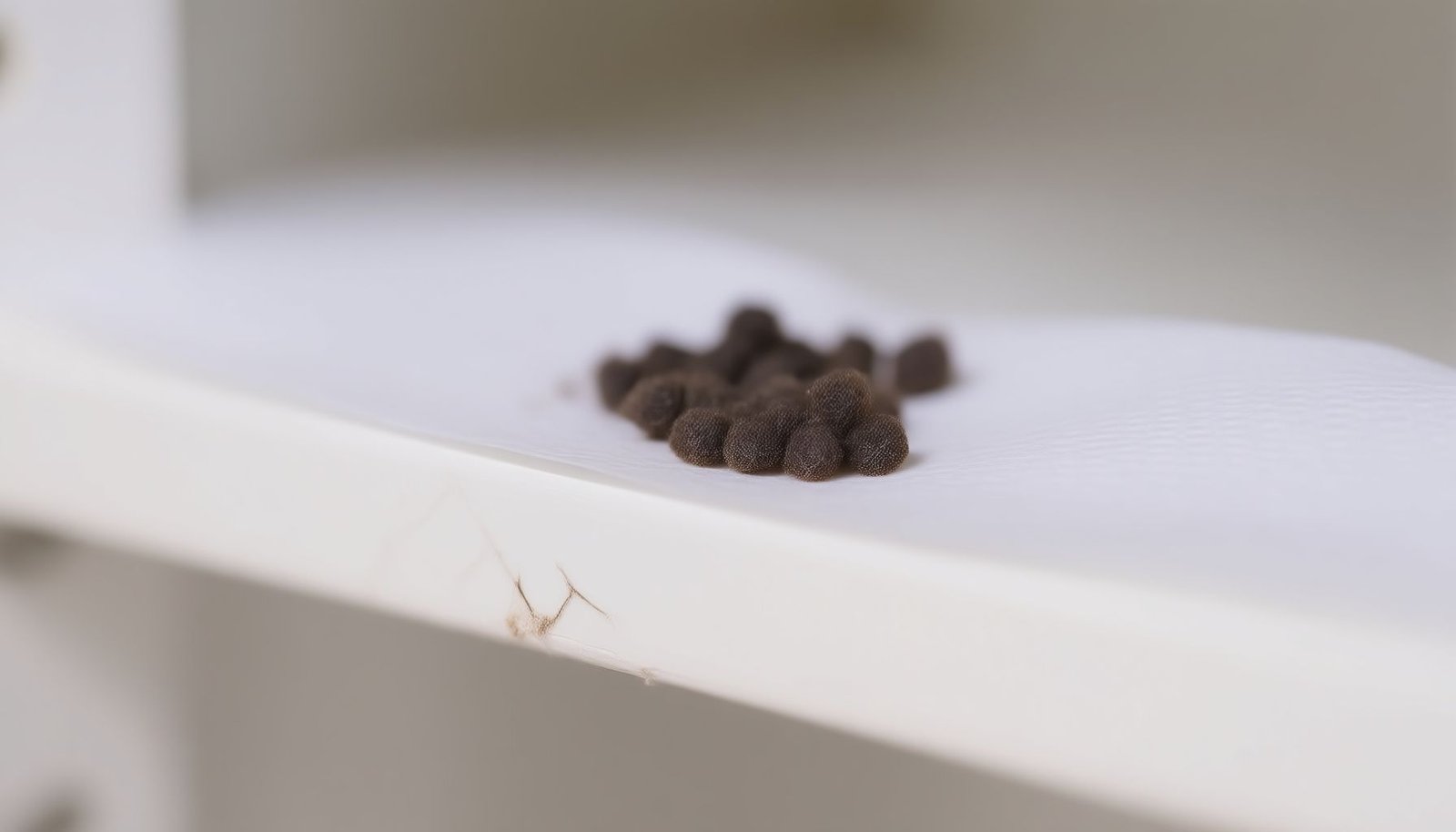
This close-up shows the typical size, color, and clustering pattern of mouse droppings near a cabinet base — the kind of detail that’s easy to overlook in dim light but confirms active mouse presence when you know what you’re looking at.
What Does a Mouse Entry Point Actually Look Like in a Kitchen?
This is the check most people skip entirely, and it’s the most important one for stopping an infestation at the source. A mouse can squeeze through a gap as small as 1/4 inch — about the diameter of a standard pencil. That means the spaces around your water supply lines under the sink, the gap where the stove’s gas line enters the wall, and the unfinished edges of cabinet kick plates are all potential highways into your kitchen.
Grab a flashlight and get low. Look specifically at the back wall inside every base cabinet — you’re checking where utility lines (water, gas, electrical conduit) pass through the drywall or subfloor. Builders almost never seal these gaps tightly. You’re looking for rough, unfinished holes, gaps along the bottom edge of the wall where it meets the floor, or any point where you can see daylight or feel a draft. If a gap exists, a mouse has already found it — or will.
Pro-Tip: Stuff steel wool into any gap you find tonight as a temporary block — mice can’t chew through it. Follow up within a few days with expanding foam or hardware cloth for a permanent seal. Don’t use regular foam alone; mice chew through it without much effort.
What Does Mouse Activity Smell Like — and Why Does It Matter?
There’s a specific smell that comes with a mouse presence, and once you know it, you won’t mistake it for anything else. It’s a sharp, musky, ammonia-heavy odor — not exactly like cat urine, but in that neighborhood. The smell comes from urine that mice constantly deposit as they travel, which also serves as a trail marker for other mice. A faint odor suggests one or two animals. A strong, persistent smell, especially when you open a cabinet door, points to heavy activity or a nesting site nearby.
The smell check matters for a reason most articles don’t mention: mice urinate on food packaging. They don’t just chew into your cereal box — they mark it. That contamination is invisible to the eye but very real as a health hazard. Mice are known carriers of pathogens that can survive on surfaces for days, which is part of why certain pest infestations in the home can trigger allergic and respiratory reactions in sensitive individuals, particularly in kitchens where contamination mixes with food prep areas.
7 Specific Spots to Check in Your Kitchen Tonight
Rather than doing a vague general sweep, work through this list systematically. Each location has a specific reason it’s worth checking — and knowing why helps you understand what you’re actually looking for.
- Inside every base cabinet — back corners and floor edges. This is where droppings and gnaw marks concentrate first. Pull everything out, not just a quick glance.
- The space between your refrigerator and the wall or cabinet beside it. Warm, dark, rarely disturbed — a perfect transit zone. Use a flashlight and check for droppings, nesting material, or gnaw marks on any electrical wiring visible at the back.
- Under and behind the stove. Pull it out from the wall if you can. The area directly behind and beneath a stove is one of the top three nesting spots in any kitchen. Food debris accumulates there, and the heat from the appliance keeps it warm year-round.
- The cabinet under the kitchen sink. Utility line penetrations, frequent moisture, and usually low foot traffic make this the single most common entry and nesting point in a kitchen.
- Your pantry or food storage area — specifically the floor corners and bottom shelves. Look for gnawed corners on cardboard boxes, torn plastic bags, and scattered food particles that weren’t there before.
- Along the baseboard where it meets the floor, the full length of the kitchen. Mice run along this line consistently. A smear of grayish grease or repeated droppings in a line here is a confirmed mouse runway.
- Inside any drawer at floor level, especially in an island or base unit. Mice climb into lower drawers to nest. Check for shredded paper, insulation bits, or fur-like nesting material — even if you’ve never seen signs elsewhere.
Picture this: you open the drawer under your kitchen island to grab a dish towel and find a golf-ball-sized nest of shredded paper and dried grass tucked into the back corner. That’s not uncommon. Mice will nest inside a drawer that’s opened daily if the drawer is deep enough and the back corner stays undisturbed. It happens in kitchens that are cleaned weekly.
Fresh vs. Old Signs: How Do You Know If Mice Are Still Active?
This is the question that determines your next move, and most guides don’t address it directly. Finding droppings doesn’t tell you enough on its own — you need to know if the activity is current. The difference between a mouse that passed through weeks ago and one that’s actively living in your kitchen right now changes everything about how urgently you need to respond.
Use this table to read the evidence in front of you:
| Sign | Fresh / Active | Old / Inactive |
|---|---|---|
| Droppings | Dark, shiny, soft — smear when pressed | Gray, chalky, crumble to dust |
| Gnaw marks | Light-colored wood, rough edges, fresh debris below | Darkened edges, smooth from age, no debris |
| Nesting material | Loose, fluffy, may feel slightly warm | Compressed, dusty, possibly with old droppings mixed in |
| Tracks in dust | Sharp, clear footprint impressions | Blurred, faint, partially filled with more dust |
One reliable field test: sprinkle a thin layer of flour or baby powder along the baseboard in the most suspicious area before you go to bed. Check it first thing in the morning. Fresh tracks in the powder confirm active movement within the past 8 hours — no guesswork required. It works better than any electronic detector and costs almost nothing.
“The mistake I see constantly is homeowners treating evidence of mice the same regardless of age. Fresh droppings and gnaw marks mean you have days, not weeks, to act before a population establishes. A mouse pair can produce their first litter in as little as 19 days after mating — and they’ll breed again within 24 hours of giving birth. The timeline is not forgiving.”
Dr. Raymond Hess, Board-Certified Entomologist and Urban Pest Management Specialist
What Does Mouse Damage Actually Look Like on Food Packaging and Surfaces?
Gnaw damage in the kitchen falls into two categories: structural and food-related. Structural gnawing happens on wood cabinet interiors, door frames, and — importantly — electrical wiring. If you find wiring at the back of a base cabinet with the outer insulation stripped or chewed away, that’s a fire risk that needs an electrician, not just a mousetrap. Mice gnaw constantly because their incisors never stop growing, and they’ll work through almost any material except steel.
Food-related gnaw damage is easier to spot but easy to rationalize away as a torn package from normal handling. Look specifically for:
- Ragged, irregular holes in cardboard boxes — not clean tears — typically in the lower corner where the box sits on the shelf
- Chew marks on plastic containers or bags, particularly around the seal area or any existing weak point
- Scattered crumbs, seeds, or grain outside of any container that was previously intact
- Small, scattered pieces of packaging material — bits of cardboard, foil, or plastic film — found away from the original package, which suggests the mouse carried material elsewhere to nest
- Grease smears along the lower edges of walls or cabinet interiors — this is oil from mouse fur depositing over repeated passes, and it’s one of the most overlooked signs in kitchens
It’s worth knowing that the mere presence of mouse activity near food — even without visible gnawing — is enough to warrant discarding any dry goods stored in soft or cardboard packaging. Contaminated food doesn’t always look contaminated, and that’s not a risk worth taking. Just as some homeowners are surprised to learn that tiny insects like thrips can cause extensive plant damage before they’re noticed, mice leave behind far more contamination than the visible gnaw marks suggest.
Does One Mouse Mean You Have an Infestation — or Just a Single Intruder?
Honestly, this one depends — on the season, the structure of your home, and what the signs are telling you. A single mouse that wandered in through a briefly open door in early fall is a different situation from one that found a gap in your wall and has been living behind the stove for three weeks. The signs themselves tell you which scenario you’re dealing with. Isolated droppings in one spot, no smell, no gnaw marks, and no nesting material points to a transient. Multiple sign types across multiple locations means you’ve got a resident.
Here’s the counterintuitive part that most pest control content skips over: mice are not naturally solitary animals in a home environment. House mice live in social groups structured around a dominant male and several females. Where you have one female nesting, you typically have others nearby. Finding a single nest doesn’t mean one mouse — it means you’ve found one nest. The others may be in the wall void, under the dishwasher, or behind insulation in an adjacent cabinet. One confirmed sign in a kitchen is a reason to check the whole room, not just the one spot.
If your checks tonight turn up multiple sign types — droppings in more than one location, a smell, and any gnaw damage — treat it as an active infestation and start sealing entry points and placing snap traps within 24 to 48 hours. The window for catching a problem before it multiplies is short, and acting on incomplete information still beats waiting for certainty while the population grows.
Frequently Asked Questions
what are the first signs of mice in the kitchen?
The earliest signs are usually droppings and gnaw marks — mice leave behind 50 to 75 droppings per day, so you’ll often spot them along baseboards, inside cabinets, or near the stove. You might also notice a faint musky odor before you ever see a mouse or find any damage.
how do I know if I have mice or rats in my kitchen?
Mouse droppings are small — about the size of a grain of rice — with pointed ends, while rat droppings are larger, roughly the size of a raisin, with blunt ends. Gnaw marks also differ: mice leave smaller, cleaner chew marks on food packaging, while rats tend to cause more visible structural damage to cabinets and walls.
can mice get into sealed food containers in the kitchen?
Mice can chew through cardboard, thin plastic bags, and foil packaging with no problem, so those aren’t safe. Your best bet is storing pantry staples in hard-sided containers made of glass or thick plastic — mice can’t gnaw through those.
where do mice hide in a kitchen?
Mice stick close to walls and love tight, dark spaces, so check behind the refrigerator, inside the back corners of lower cabinets, under the stove, and around any pipes coming through walls. They can squeeze through a gap as small as a dime, so even tiny openings near plumbing are common entry points.
is one mouse in the kitchen a big deal or do I have an infestation?
One mouse is rarely alone — a single female can produce 5 to 10 litters per year, with 5 to 6 pups each, so a small problem can grow fast. If you’re seeing fresh droppings in multiple spots or hearing scratching at night, it’s worth acting immediately rather than waiting to see if it’s just one.