

Throwing out the infested flour and wiping down the shelves doesn’t fix a larder beetle problem — it just delays it. That’s the mistake most people make, and it’s why the beetles keep coming back month after month. The real issue isn’t what’s sitting on your shelves right now. It’s the hidden protein source you haven’t found yet, and the fact that larder beetle larvae can survive inside sealed containers, inside wall voids, and even inside a dead mouse tucked behind your refrigerator. You can clean your kitchen to a shine and still have a full-blown infestation six weeks later if you don’t address the actual food source driving it.
Why Larder Beetles Keep Coming Back Even After You Clean
Larder beetles — Dermestes lardarius — earned their name from the old-fashioned larder, the cool room where cured meats, dried fish, and animal fats were stored. They’re not after your cereal or your pasta. They’re after high-protein animal products: dried pet food, forgotten beef jerky, a dead rodent in the wall cavity, a bird carcass in the attic above the kitchen, or improperly stored dog treats. This is where almost every online guide gets it wrong — people assume larder beetles behave like pantry moths or grain weevils and treat their spice jars accordingly. But these beetles don’t care about your cumin.
A female larder beetle lays between 100 and 800 eggs in her lifetime, placing them directly onto or near a protein food source. The larvae are the destructive stage — they feed aggressively for 5 to 6 weeks before burrowing into a nearby surface (wood, cork, foam insulation, even soft plaster) to pupate. That burrowing behavior is why you’ll sometimes find small, oval-shaped holes in wooden cabinets or pantry shelving near an infestation with no obvious cause. The larvae literally chew their way into the structure. By the time you see adult beetles crawling across the counter, the larvae have probably already been feeding for weeks out of sight.
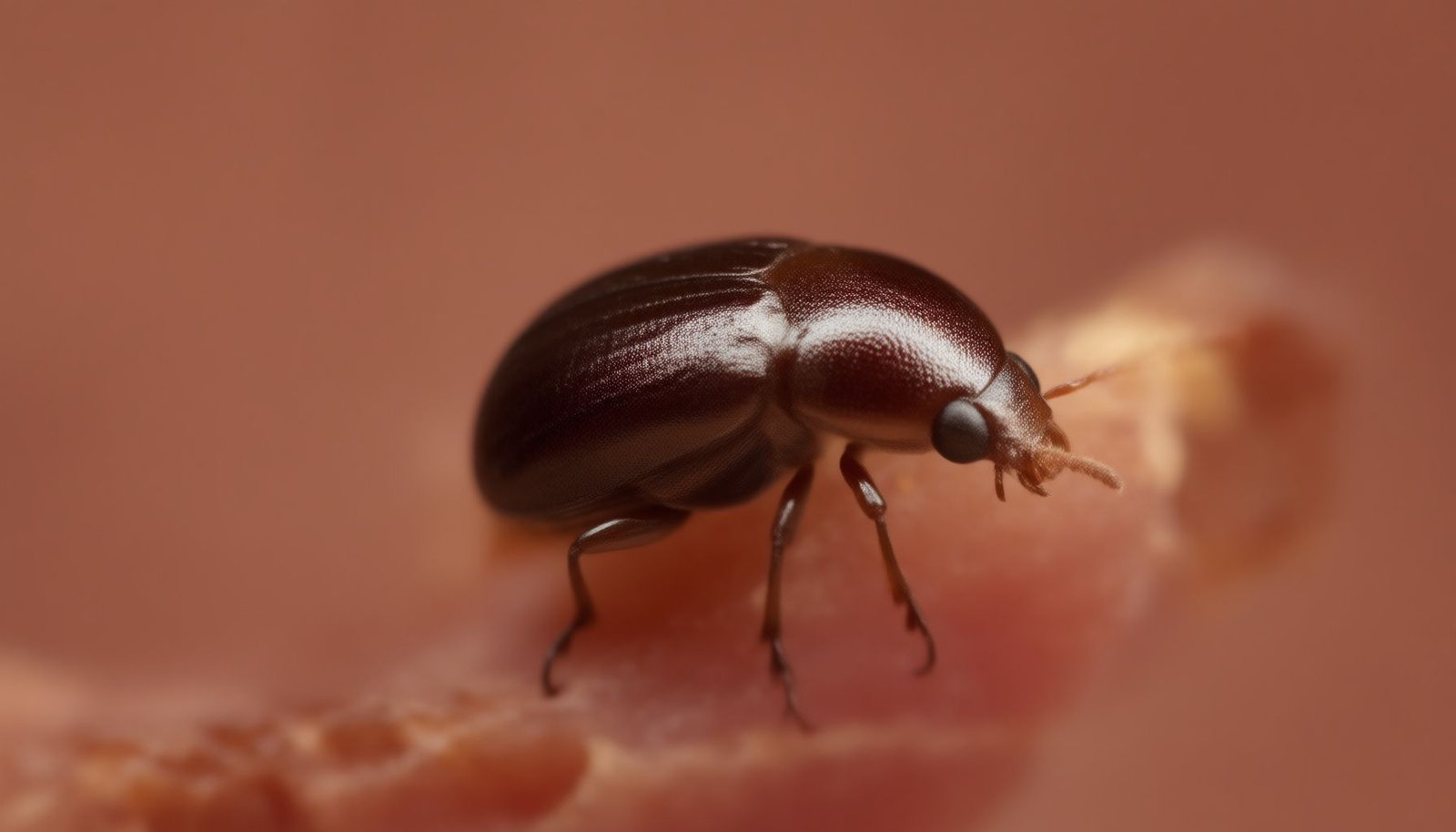
This close-up shows the distinctive pale band across the larder beetle’s dark back — the same band that helps distinguish it from other small dark beetles, and the reason a positive ID matters before you commit to any treatment strategy.
How to Find the Actual Source Feeding Larder Beetles in Your Kitchen
Here’s a counterintuitive truth most people don’t consider: the kitchen may not even be where your larder beetle problem started. These beetles are strong fliers and will travel from a different room — or from outside — if a food source is present. Picture this: a homeowner in a split-level house spends three weekends dismantling their kitchen pantry trying to find the source, only for an exterminator to locate a dead squirrel in the crawlspace directly below the kitchen floor. The beetles were entering through a gap around a pipe chase. No amount of pantry cleaning was ever going to solve it.
Finding the source requires a systematic search that goes beyond the obvious. Work through these locations in order, because skipping steps is what leads to repeat infestations:
- Pet food storage areas — including the space beneath and behind the container, where spilled kibble accumulates. Dry dog and cat food is one of the top attractants for larder beetles in residential kitchens.
- Beneath and behind large appliances — refrigerators, stoves, and dishwashers create warm, dark voids where protein debris (grease, meat drippings, rodent remains) collects undisturbed for years.
- Wall voids and pipe chases — a dead mouse or rat inside a wall is one of the most common hidden sources. Larder beetles are actually used by taxidermists and natural history museums to clean animal skulls, which tells you exactly how efficiently they process carcasses.
- Attic or crawlspace above or below the kitchen — dead birds, rodents, or old wasp nests (which contain insect protein) can sustain a larder beetle colony that sends adults down into the living space through gaps and light fixtures.
- Stored dried goods with animal content — beef bouillon cubes, powdered bone broth, fish-based supplements, gelatin packets, and even some vitamin capsules with animal-derived gelatin coatings are all viable food sources.
- Taxidermy mounts, wool rugs, or decorative feathers — if your kitchen opens into a dining or living area with these items, don’t rule them out as a food source for larder beetle larvae.
What Actually Kills Larder Beetles vs. What Just Moves Them Around
Vacuuming up visible adults feels productive, but it addresses maybe 5% of the population. The larvae and pupae are where the numbers are, and they’re hidden inside food sources, inside pupal chambers bored into soft wood, and sometimes inside wall voids you can’t reach without taking apart a cabinet. Effective treatment targets the larvae specifically, because adults don’t cause the structural damage and don’t reproduce in the open — they need a concentrated protein source to lay eggs on.
The treatment approach that actually works depends heavily on where the source is located. For exposed infestations — contaminated pet food bags, dried meat products, or similar — remove and double-bag the material, then treat the surrounding area. For hidden infestations in wall voids or beneath appliances, insecticide dust applied into voids (boric acid or diatomaceous earth for a low-toxicity option, or a pyrethroid dust like deltamethrin for faster knockdown) tends to outperform sprays because dust stays active for weeks and reaches areas where larvae are pupating. Sticky traps placed at floor level near likely entry points help you monitor adult activity and confirm when the infestation is declining — but traps alone won’t eliminate a breeding population.
Pro-Tip: Apply a thin line of food-grade diatomaceous earth along the base of cabinet kickboards and around pipe penetrations in the kitchen floor. Larder beetle larvae that pupate near these areas must crawl across it to reach adulthood, and DE damages their exoskeleton without leaving chemical residue in a food prep area. Reapply after any mopping or cleaning.
How Long Does a Larder Beetle Infestation Take to Clear Up?
Timeline matters because people give up too early and assume treatment failed. Larder beetle development from egg to adult takes roughly 40 to 50 days at typical indoor temperatures (between 65°F and 80°F), though warmer kitchens can accelerate this to under 30 days. That means even after you’ve eliminated every food source and treated the area, you may still see new adults emerging from pre-existing pupal chambers for up to 6 weeks. Seeing a beetle after treatment doesn’t automatically mean the treatment failed — it may mean a pupa that was already in the wall has just matured.
Use this general timeline to set realistic expectations and decide when to escalate to a professional:
| Timeline After Treatment | What to Expect |
|---|---|
| Days 1–14 | Adult beetles still visible; may increase briefly as disturbed larvae mature and emerge |
| Days 14–30 | Adult sightings should decline significantly if the food source has been removed |
| Days 30–50 | Occasional stragglers possible from late-stage pupae; sticky trap counts should be near zero |
| Day 50+ | Continued sightings strongly suggest an unidentified food source still present — reassess |
One honest nuance here: if your kitchen is in an older home with gaps between structural elements, or if you’ve had a rodent problem in the past (even a resolved one), clearing a larder beetle infestation can take considerably longer than 50 days. Decomposing rodent material inside wall voids can sustain larder beetles for months after the rodent itself has been removed — the dried remains still contain enough protein to support larvae indefinitely. In those cases, professional void treatment or even targeted wall access may be the only reliable fix.
“Larder beetles are one of the few kitchen insects where sanitation alone almost never solves the problem. In my experience, about 60% of persistent infestations trace back to a hidden protein source outside the kitchen itself — a dead rodent in a wall, a bird carcass in the attic, even old wasp nests with insect matter inside. Until that source is identified and removed, any treatment is temporary at best.”
Dr. Marcus Holt, Board-Certified Entomologist and Urban Pest Management Specialist, formerly with the University of Florida IFAS Extension
How to Keep Larder Beetles Out of the Kitchen for Good
Prevention for larder beetles looks different from prevention for most other kitchen pests, and that distinction is worth getting right. You’re not primarily managing food packaging or moisture — you’re managing protein sources and entry points. The two most effective long-term changes most kitchens never make are: switching pet food to airtight hard-sided containers with a rubber gasket seal (not just a clip lid), and sealing the gap around pipe penetrations in the cabinet below the sink and near the stove. Those two gaps are the most common larder beetle entry routes from wall voids and crawlspaces into the kitchen proper.
Beyond those two fixes, the prevention measures that actually hold up over time are:
- Inspect incoming protein-rich products — dried fish, jerky, bone broth products, and pet treats brought from bulk stores or international grocery stores carry a higher contamination risk than standard packaged goods. Check packaging for small holes or larvae before storing.
- Don’t store dried animal protein products longer than 3 months — the longer high-protein food sits, especially in warm pantry conditions, the greater the risk of undetected early-stage infestation going unnoticed until it’s large.
- Address any rodent activity immediately — even a single dead mouse inside a wall void can initiate a larder beetle infestation within days. If you’ve recently used rodent bait stations and a rodent has died inside the wall, expect larder beetles to follow within 1 to 2 weeks as the carcass becomes accessible. This connection — between rodent control and subsequent beetle activity — is something many homeowners never get told. (For a parallel example of how resolving one pest problem can trigger a secondary one, the same dynamic sometimes plays out when dealing with firebrats near a fireplace or furnace — disrupting one part of the environment shifts where other insects shelter.)
- Seal attic and crawlspace access points — if wildlife has accessed the space above or below your kitchen, a larder beetle colony feeding on a carcass up there can send beetles down through light fixtures, recessed lighting, or gaps around exhaust fans. Addressing the wildlife entry point is part of the beetle solution.
- Use sticky monitoring traps year-round in the kitchen — not as a primary control method, but as an early warning system. A single adult beetle caught in late spring or early fall tells you there’s something to investigate before it becomes a full infestation.
It’s also worth knowing that larder beetles are more active from late spring through early fall, when warm temperatures accelerate their development cycle. Winter doesn’t eliminate them — it slows larval development — so an infestation that seems to quiet down in December may resume full force by March if the food source is still present. Outdoor populations overwinter under bark, in bird nests, or near animal burrows, and they re-enter homes through the same gaps every season. Sealing those entry points is the only thing that breaks the annual cycle. Just as some pest problems require thinking about the outside environment as much as the inside — the way opossums under a deck or crawl space can introduce secondary pest pressure into a home — larder beetles often have an outdoor component that gets overlooked entirely.
Getting rid of larder beetles in the kitchen isn’t really about the kitchen — it’s about tracking down a hidden protein source that could be anywhere from the pantry shelf to the wall cavity to the attic above your head. Fix the source, seal the entry points, and monitor with traps. Do those three things in order and you’re done. Skip any one of them and you’ll be back here in six weeks wondering why the beetles returned.
Frequently Asked Questions
What causes larder beetles in the kitchen?
Larder beetles are drawn into kitchens by protein-rich foods like cured meats, dry pet food, cheese, and animal-based pantry items. They can also enter through gaps around windows, doors, or vents — especially if there’s a dead rodent or insect buildup nearby that they’re feeding on first. Once they find a food source, they reproduce quickly, so even a small forgotten bag of dog treats can kick off an infestation.
How do I know if I have larder beetles and not another pantry bug?
Larder beetles are about 1/3 inch long, dark brown to black, with a distinctive pale yellow band covered in black spots across the middle of their back — that band is the easiest way to tell them apart from other pantry beetles. You might also spot their larvae, which are brown, hairy, and about 1/2 inch long with two curved spines at the tail end. If you’re seeing that combination of adults and larvae near meat, pet food, or stored animal products, it’s almost certainly larder beetles.
Are larder beetles in the kitchen dangerous?
Larder beetles aren’t dangerous to humans in the sense that they don’t bite or transmit disease, but they do contaminate food and can cause real damage. Their larvae bore into hard materials — including wood, cork, and even soft metals — to pupate, which means a heavy infestation can physically damage cabinets or walls over time. You shouldn’t eat food they’ve infested since it’s contaminated with shed skins, frass, and bacteria.
What kills larder beetles fast?
Throwing out all infested food is your first step — no pesticide works if the food source stays. After that, a vacuum gets rid of adults, larvae, and shed skins immediately, and wiping down shelves with a solution of dish soap and water removes eggs. For stubborn infestations, an insecticide spray labeled for pantry beetles — containing pyrethrin or deltamethrin — applied along cabinet cracks and baseboards can knock down remaining beetles within a few days.
How do I keep larder beetles from coming back?
Store all dry goods, pet food, and animal-based pantry items in airtight containers — glass or heavy-duty plastic with sealed lids works best. Inspect new groceries before putting them away, especially packaged meats, dried fish, and dog or cat food, since larder beetles can already be inside store-bought packaging. Sealing cracks around baseboards and checking that window screens don’t have gaps also cuts off their entry points significantly.
Disclaimer: This article is for informational purposes only and isn’t a substitute for professional pest control advice. Always read and follow the product label instructions exactly — label directions are legally binding and vary by brand and active ingredient. Keep all pesticides, baits and traps away from children and pets, ventilate treated areas as directed, and consider calling a licensed pest control professional if an infestation is large, recurring, or involves a structural pest like termites or carpenter ants.