
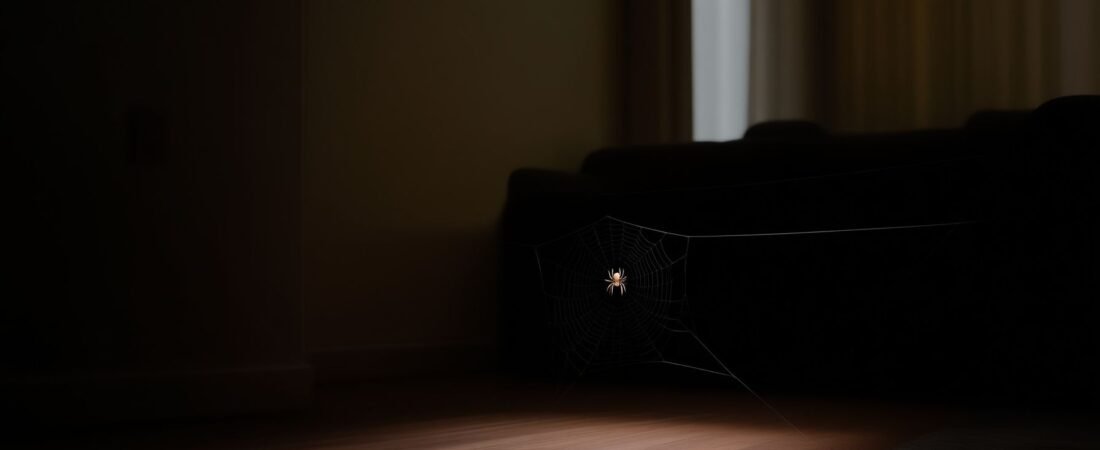
Spraying baseboards won’t fix a spider problem that’s living three inches behind your couch. That’s the piece most advice skips entirely — spiders behind furniture and in corners aren’t passing through, they’re set up camp, and surface sprays almost never reach them. The real fix isn’t more spray; it’s understanding why those specific spots are so attractive in the first place, then eliminating what makes them worth staying in.
Why Furniture Gaps and Corners Are Prime Spider Territory (And Your Treatments Aren’t Reaching Them)
Spiders aren’t randomly wandering your living room. They’re microhabitat specialists — they look for low light, low air movement, and a reliable food supply. The gap between the back of your sofa and the wall checks every one of those boxes. Temperatures back there stay a few degrees warmer in winter and cooler in summer than the open room, and that stability is exactly what spiders — and the insects they eat — prefer.
Here’s what most treatment guides completely ignore: spiders don’t ingest poisons the way cockroaches do. They have to physically walk through a residual pesticide long enough and at a high enough concentration to absorb a lethal dose through their leg joints. The underside of a baseboard gets a light mist; the back wall behind your bookshelf gets nothing. You’re spraying the perimeter of the room they’re not standing in.
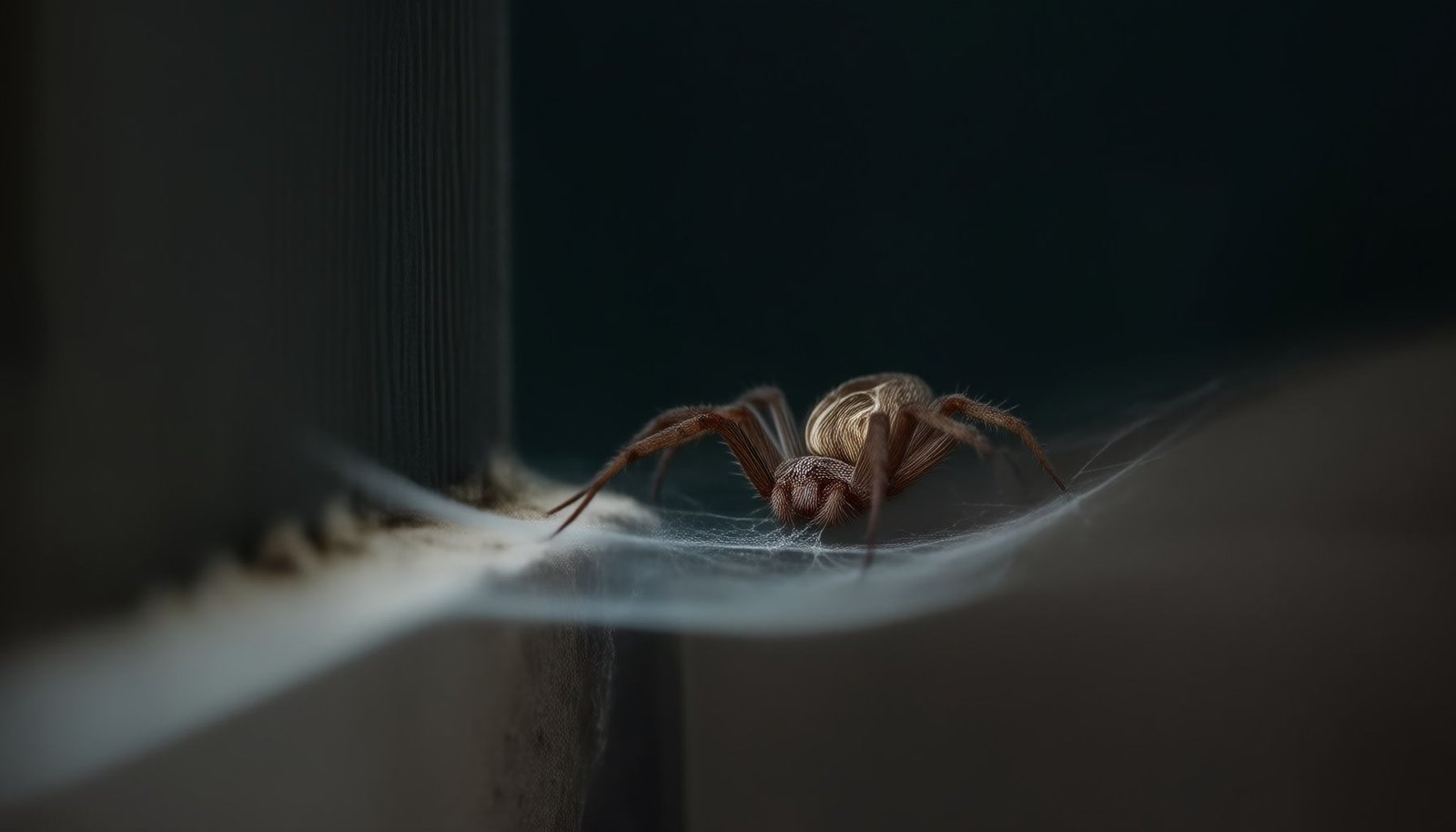
This close-up shows the kind of web structure spiders build in recessed, undisturbed gaps — the layered, dusty anchor points reveal a spider that’s been resident for weeks, not days, and that level of establishment is exactly why a single spray pass on the wall nearby accomplishes almost nothing.
What’s Actually Attracting Spiders to Those Specific Spots in Your Home?
Picture this: you pull your entertainment center six inches from the wall to run a new cable, and behind it you find three separate webs, shed exoskeletons, and a half-dozen dead gnats. That’s not a coincidence — that corner behind electronics is almost always warmer than the rest of the wall because of radiated heat, and heat draws the small insects spiders feed on. The spider didn’t pick your living room at random; it followed the food chain to its most concentrated point.
The counterintuitive fact most pest control articles skip: a high spider count in your home almost always means you have a thriving population of smaller insects first. Spiders are the secondary infestation. If you’ve got a lot of them behind furniture, you’ve almost certainly also got an underlying population of fungus gnats, small flies, or carpet beetles living in the same undisturbed zones. Treating only the spiders is like pulling weeds without addressing the soil — they’ll be back within a few weeks because the buffet is still open.
How to Actually Reach Spiders Living Behind Furniture and in Deep Corners
Getting product where spiders actually live requires a different delivery method than perimeter spraying. The goal is to create a treated zone inside the gap, not on the exposed wall next to it. Here’s the sequence that actually works, in the order you should do it:
- Move the furniture completely away from the wall — not just tilted or scooted. You need full access to the back wall panel, the floor strip, and the underside of the furniture itself. A 12-inch gap isn’t enough if you’re trying to treat a 24-inch-deep sofa cavity.
- Vacuum before any product goes down — use a crevice attachment to remove existing webs, egg sacs, shed skins, and dead prey insects. Leaving organic debris behind dramatically reduces how long any residual product stays effective, because the spider can simply avoid treated surfaces by walking over debris.
- Apply a dust insecticide (delta dust or CimeXa) into the floor-wall junction — dusts stay effective for up to 8 months in undisturbed voids and don’t break down the way liquid sprays do in low-light areas. Use a hand bellows duster to puff a thin layer, not a heavy coat. A heavy coat repels spiders rather than attracting foot contact.
- Place glue board traps flat on the floor directly behind the furniture — not on the baseboard, but in the recessed floor zone where spiders actually walk. These intercept any spider moving between the wall and the furniture and tell you within a week whether activity is dropping.
- Treat the underside rails and recessed base of the furniture itself — spiders often anchor webs to the furniture frame, not the wall. A residual spray applied to the wooden underframe of a couch or bookshelf bottom rail is often more effective than the wall behind it.
- Return the furniture but leave a 2–3 inch gap from the wall — this sounds minor, but a small maintained gap lets you monitor glue boards without moving everything again, and allows treated dust to stay undisturbed longer.
Repeat the glue board check at 7 and 14 days. If you’re still catching spiders at week two, the food source (smaller insects) hasn’t been addressed yet — that’s your next step, not more spider spray.
Which Spider Species Are Most Likely Behind Your Furniture — and Does It Change What You Do?
Honestly, it changes your urgency level more than your treatment approach. The vast majority of spiders found behind furniture in US homes are one of three groups: common house spiders (Parasteatoda tepidariorum), cellar spiders, or wolf spiders. None of these are medically significant in a typical encounter. Brown recluses are the exception — they’re flat-bodied, prefer undisturbed tight voids, and are genuinely dangerous — but they’re geographically concentrated in the Midwest and South, not nationwide.
The treatment method is largely the same regardless of species, but if you’re finding brown-colored spiders with a dark fiddle-shaped mark on the cephalothorax, skip the DIY dust phase and check whether you have a larger colony established. A single brown recluse sighting doesn’t mean an infestation — but if you’re catching more than 3–4 per week on glue boards, that warrants a professional inspection. For how to get rid of ants trailing along baseboards overnight, the logic is similar — small numbers are manageable DIY; consistent high counts signal a structural problem worth professional eyes.
“Most homeowners apply pesticide to the visible surfaces and call it done, but spiders in furniture gaps are living in a microenvironment the spray never touches. Dust formulations in the actual void, combined with systematic prey reduction, are the two steps that consistently produce results — the spray on the wall is largely theater.”
Dr. Renata Colón, Board-Certified Entomologist and Urban Pest Management Specialist, Extension Services Advisory Board
How to Stop Spiders From Coming Back Behind Furniture Long-Term
Elimination is step one. Prevention is the part most guides drop the moment you’ve killed the spiders you can see. The single most effective long-term deterrent isn’t a spray or a repellent — it’s reducing clutter directly behind and under furniture to the point where spiders can’t anchor webs without them being disturbed regularly. Spiders pick spots they won’t be bothered in. If you vacuum behind furniture every 4–6 weeks, they’ll keep relocating rather than establishing.
Beyond regular disruption, there are a few physical changes worth making:
- Seal wall penetrations behind furniture — pipe entry points, cable pass-throughs, and electrical outlets on exterior walls behind furniture are common spider entry points. A small bead of paintable caulk eliminates dozens of potential entry routes that you’ll never think about again.
- Switch to yellow-spectrum bulbs near entry points — standard white LED bulbs attract the flying insects spiders feed on; warm yellow or sodium-vapor spectrum lights draw significantly fewer prey insects to the area.
- Eliminate cardboard boxes stored near or under furniture — cardboard holds moisture and provides layered hiding spots that are essentially spider condominiums. Plastic bins with lids are a genuine upgrade here, not just an organizational preference.
- Address any moisture issues along the floor-wall junction — cellar spiders and certain house spiders are drawn to humidity. If your interior walls sweat in summer or you have a leaking baseboard heating pipe, that moisture is a spider magnet entirely independent of any food source.
- Re-apply dust to the floor-wall junction every 6–8 months — even delta dust loses effectiveness as it absorbs moisture and gets disturbed by foot traffic over time. A semi-annual touch-up in the specific zones behind heavy furniture keeps the treatment active without retreating the whole room.
Pro-Tip: Before sliding heavy furniture back into place after treatment, press a strip of door sweep foam or a thin bead of rope caulk along the bottom rear rail of bookshelves and entertainment units. This prevents spiders from crawling up through the gap between the furniture base and the floor — a route that bypasses your floor-level dust treatment entirely.
| Treatment Method | Where It Works | Where It Fails | Effective Duration |
|---|---|---|---|
| Liquid residual spray (perimeter) | Exposed baseboards, open wall surfaces | Behind furniture, inside voids, recessed corners | 30–90 days on exposed surfaces |
| Insecticide dust (delta dust, CimeXa) | Floor-wall junctions, furniture undersides, wall voids | High-traffic areas where dust is disturbed | 6–8 months in undisturbed voids |
| Glue board traps | Behind furniture, along floor runs spiders travel | Not a kill method — monitoring and capture only | Until full (replace every 4–8 weeks) |
| Web removal + vacuuming | Everywhere — essential prep step before any product | Not a standalone fix; removes existing activity only | Immediate disruption only |
One thing worth being honest about: the timeline varies significantly based on your home’s construction and regional climate. Older homes with more wall gaps and penetrations tend to re-establish spider populations faster than newer tight-construction builds, regardless of how thoroughly you treat. In the South and Pacific Northwest — regions with longer insect seasons — you may need to vacuum and re-treat behind furniture every three months rather than twice a year. The process works, but the maintenance frequency isn’t one-size-fits-all.
It’s also worth remembering that the same logic applies to any pest living in the undisturbed zones of your home. How to get rid of bed bugs without throwing away your mattress follows a parallel principle — it’s the harborage zone treatment, not surface-only product, that actually clears the infestation. Spiders are no different in that regard.
Once you’ve cleared the spiders behind your furniture and kept them out for a full season, you’ll notice something useful: the absence of webs there becomes a reliable early-warning system. If webs start appearing again in a spot you’ve been maintaining, that’s your cue that something changed — a new moisture source, a new insect population, or a seal that failed. At that point you’re not starting over; you’re troubleshooting one small variable. That’s a much easier problem to solve than the whole-room spider mystery you started with.
Frequently Asked Questions
How do I get rid of spiders behind furniture without moving everything?
Use a long-nozzle vacuum attachment to reach into gaps behind sofas, dressers, and beds without pulling them out. Follow up by spraying a residual insecticide like peppermint oil spray or a pyrethrin-based product along the baseboard directly behind the furniture. Doing this every 2 to 3 weeks breaks the cycle before new spiders can set up webs.
What home remedy kills spiders in corners?
A spray made with 10 to 15 drops of peppermint essential oil mixed into 16 oz of water works well in corners and is safe around kids and pets once it dries. White vinegar mixed 1:1 with water is another option that kills spiders on contact, though it won’t keep new ones away for long. For corners with heavy webbing, knock the webs down first with a broom so the spray actually reaches the surface.
Why do I keep getting spiders in the same corners of my house?
Spiders return to the same spots because those corners have the right conditions — low foot traffic, poor air circulation, and usually a nearby food source like flies or gnats. If you’re seeing spiders repeatedly in one area, there’s likely a bug problem drawing them there that you haven’t addressed yet. Seal gaps around windows and doors near those corners and use a dehumidifier if the space feels damp, since moisture attracts the insects spiders feed on.
What smell do spiders hate the most?
Spiders strongly avoid peppermint, eucalyptus, and citrus scents — peppermint oil is the most well-documented and easiest to use at home. Tea tree oil and lavender also work as deterrents, though they tend to be less potent than peppermint. Reapply any scent-based repellent every 5 to 7 days since the smell fades and loses effectiveness quickly.
Should I be worried about spiders behind my bed?
Most spiders found behind beds in the US — like cellar spiders and common house spiders — are harmless and actually eat other pests. The ones worth worrying about are brown recluses and black widows, which prefer undisturbed, dark spots and can hide behind furniture for months. If you spot a spider with a violin-shaped marking on its back or a shiny black body with a red hourglass shape, don’t handle it — call a pest control professional.
Disclaimer: This article is for informational purposes only and isn’t a substitute for professional pest control advice. Always read and follow the product label instructions exactly — label directions are legally binding and vary by brand and active ingredient. Keep all pesticides, baits and traps away from children and pets, ventilate treated areas as directed, and consider calling a licensed pest control professional if an infestation is large, recurring, or involves a structural pest like termites or carpenter ants.