
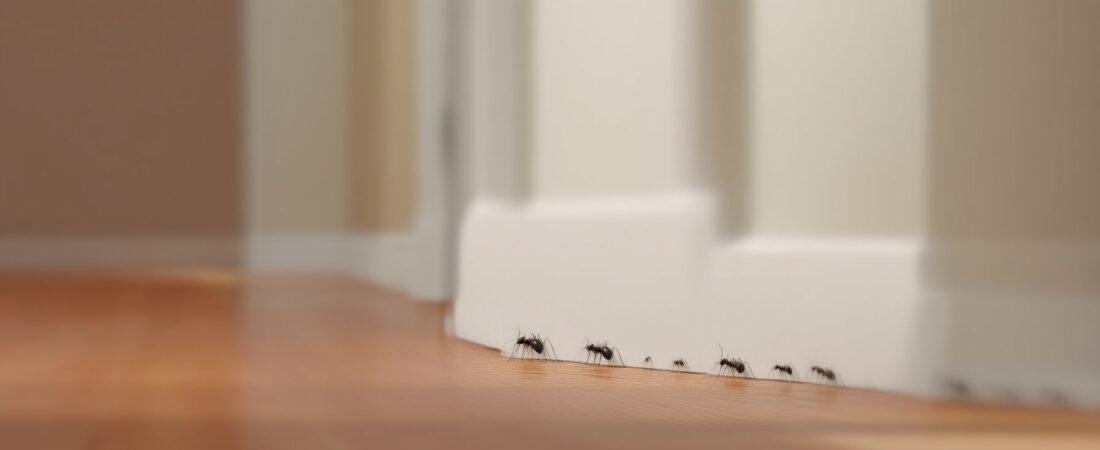
A single ant trailing along your baseboard isn’t a random wanderer — it’s a scout actively broadcasting a chemical highway back to a colony that could number anywhere from 10,000 to 500,000 individuals. Here’s what most baseboard ant guides get wrong: they tell you to spray the trail. Spraying kills the visible ants but leaves the pheromone trail intact, and the next wave follows the same invisible road within hours. The fix isn’t faster killing — it’s trail disruption combined with bait that travels back to the source.
Why Are Ants Following the Exact Same Line Along Your Baseboard?
That perfectly straight procession along your baseboard isn’t coincidence — it’s chemistry. Forager ants deposit pheromones from glands near their stingers as they walk, creating a scent trail that recruits additional workers from the colony. The baseboard is almost always the preferred route because it provides a physical edge to follow, keeps ants hidden from predators, and typically runs close to wall voids where colonies nest or travel. Within 20 to 30 minutes of a single successful scout returning with food evidence, you can go from 3 visible ants to 60.
The pheromone signal also intensifies with traffic — the more ants that travel a route, the stronger the chemical marker becomes, which is exactly why a trail you wiped down yesterday can reappear just as strong by morning. Different species use different pheromone chemistry, which affects how long trails persist. Odorous house ant trails can stay active for several hours after the ants are gone. Pavement ant trails can last even longer, especially along warm baseboards near heating ducts or plumbing.
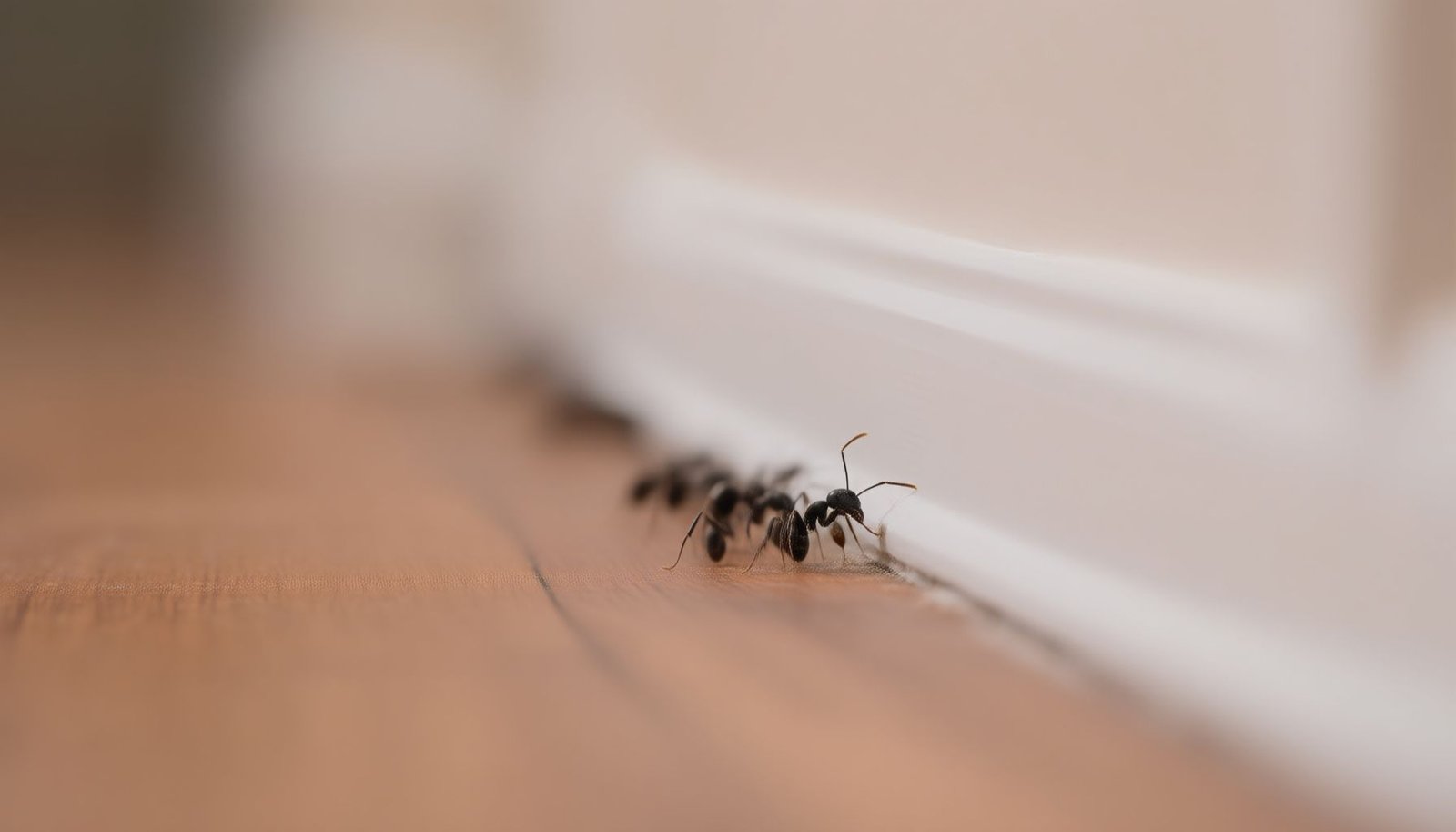
This close-up shows a typical ant pheromone trail hugging a baseboard edge — notice how every ant stays on the exact same narrow path, which is a direct result of the chemical signal, not random movement.
What Kind of Ant Is Trailing Along Your Baseboard (And Why It Changes Your Approach)
Picture this: two neighbors in the same apartment building both have ant trails along their baseboards and both buy the same spray. One solves the problem in a week. The other watches the same trail reappear every three days for two months. The difference almost always comes down to species. Odorous house ants, pavement ants, Argentine ants, and pharaoh ants all trail along baseboards — but they respond very differently to treatments. Pharaoh ants, for example, will “bud” when stressed by sprays, splitting into multiple new colonies and making the problem dramatically worse.
Here’s a quick identification reference so you’re treating the right ant before you buy anything:
| Ant Species | Size & Color | Key Identifier | Bait Response |
|---|---|---|---|
| Odorous House Ant | 1/16–1/8 in, dark brown/black | Smells like rotten coconut when crushed | Excellent — sweet gel baits |
| Pavement Ant | 1/16–1/8 in, dark brown | Parallel grooves on head and thorax | Good — protein + sweet baits |
| Argentine Ant | 1/16 in, light to dark brown | Single node, musty odor when crushed | Good — sweet liquid baits |
| Pharaoh Ant | 1/16 in, pale yellow | Two nodes, very pale color, tiny | Protein-based bait only — never spray |
If you’re not sure which species you’re dealing with, collect a few in a small sealed bag and compare against the table above before purchasing any product. Getting this wrong doesn’t just waste money — with pharaoh ants, it actively multiplies your infestation.
Why Spraying the Trail Directly Makes the Problem Worse Overnight
This is the part that feels counterintuitive but is backed by straightforward myrmecology: killing the visible trail ants doesn’t reach the queen or the brood, and the colony simply dispatches more foragers — sometimes within the hour. Repellent sprays like most pyrethroid-based products create a chemical barrier that surviving ants detect and route around. You’ll see the trail disappear from one stretch of baseboard and reappear three feet away, sometimes emerging from a different gap in the floor trim. The colony hasn’t been affected at all — you’ve only rerouted the highway.
“Homeowners consistently underestimate how compartmentalized ant colonies are. Killing foragers along a baseboard trail is like cutting off the tip of a plant — the root system is completely untouched. The only way to collapse a colony is to introduce a slow-acting toxicant that workers carry back and share through trophallaxis with the brood and reproductives. That process takes 24 to 72 hours to show real results, and most people give up and spray before it has a chance to work.”
Dr. Ellen Marsh, Board-Certified Entomologist and Urban Pest Management Specialist, University Extension Advisory Program
Trophallaxis — the mouth-to-mouth food sharing that happens inside ant colonies — is actually your greatest tool here. A bait that’s slow enough to allow a worker to return to the nest and feed the queen is far more effective than any contact kill product. The sweet spot for bait toxicity is a delayed kill window of 24 to 48 hours: fast enough to affect the colony, slow enough that it gets shared widely before the carrier dies.
The Overnight Protocol That Actually Disrupts a Baseboard Trail
Getting meaningful results overnight requires hitting two problems simultaneously — disrupting the existing trail signal and introducing bait that the colony will adopt. Done in the right order, you can see 60–80% reduction in visible trail activity within 8 to 12 hours. Here’s the sequence that works:
- Erase the pheromone trail first. Wipe the entire baseboard trail line with a solution of white vinegar and water (equal parts). Vinegar disrupts the chemical signal without leaving a residue that repels ants from bait you’re about to place. Don’t use commercial cleaners — most leave a film that deters ant contact.
- Identify the entry points, not just the trail. Follow the trail to both ends. One end should lead to a food source or moisture area; the other should lead to a crack, gap behind the baseboard, or under a door threshold. Mark these with tape so you don’t lose them.
- Place gel bait directly on the trail path — not near it. Ants follow the trail line, so bait placed an inch away often gets ignored entirely. A pea-sized drop of slow-acting bait gel (borax or indoxacarb-based) placed every 12 to 18 inches along the trail route gives foragers maximum opportunity to find it.
- Do not spray anything near the bait for at least 72 hours. Any repellent product — including common kitchen sprays — within 12 inches of bait will cause ants to abandon the bait station entirely.
- Apply a non-repellent residual at the entry point only. Products containing fipronil or imidacloprid are non-repellent, meaning ants walk through them without detecting them and carry the active ingredient back to the colony. Apply only at the identified entry crack or gap, not along the trail itself.
- Seal the entry point — but only after 72 hours. Sealing immediately traps foragers and forces the colony to find or create new entry points, potentially in a worse location. Let the bait and non-repellent do their work first, then caulk the gap on day four.
One honest caveat here: if you’re in a multi-unit building and the ant trail originates from a neighboring unit’s wall void or a shared utility chase, this protocol will reduce the visible trail significantly but won’t eliminate the colony. The same dynamic applies to pest activity coming from neighboring units — just as getting rid of roaches coming from a neighbor’s unit requires a combined building-level approach, shared-wall ant trails often need property management involvement to fully resolve.
Pro-Tip: If the ant trail appears consistently near a bathroom or kitchen baseboard, check for a slow leak or condensation under the wall — ants often trail along baseboards not because of food but because they’re tracking moisture. Fixing the water source eliminates the attraction entirely, no chemicals required.
What to Do When the Trail Keeps Coming Back After Treatment
A trail that reappears within 48 hours of correct bait placement usually means one of three things: the colony is too large for the bait volume you placed, there are multiple entry points you haven’t found, or there’s a persistent moisture or food source that continues to draw new scouts. Argentine ant supercolonies can span multiple city blocks and contain millions of workers across interconnected nests — no single bait placement on one baseboard will collapse that kind of network. You’ll need to think in terms of consistent bait management rather than a one-time treatment.
Recurring trails along a specific baseboard wall that shares a plumbing stack also deserve a closer look at what’s happening inside that wall. Moisture from a slow pipe drip or failing grout in the bathroom on the other side can sustain a satellite nest indefinitely. Interestingly, the same wall-void moisture dynamics that attract ants are often behind drain-adjacent insect problems — if you’ve also noticed gnats or small flies near that part of the kitchen, it may be worth reading about getting rid of fruit flies from a drain permanently, since the underlying moisture issue can drive multiple pest problems at once.
Here’s what to audit when a baseboard ant trail keeps returning despite treatment:
- Baseboard gaps behind furniture — ants often enter through sections of baseboard that are hidden and never found during the initial inspection
- Expansion gaps at flooring transitions — the gap where hardwood or tile meets carpet is a common undetected entry highway
- Condensation lines from AC units or refrigerators — even a slow drip inside a wall creates enough humidity to attract moisture-seeking species year-round
- Pet food and water bowls near baseboard walls — the water bowl especially — even a small splash that dries by morning is enough to mark a foraging zone
- Electrical conduit penetrations behind outlet covers — ants that trail through outlets (a separate but related issue) often enter from baseboard-level wall penetrations and can be missed entirely
The reality is that persistent baseboard trails in older homes — especially those with wood subfloors, aging caulk, or settled baseboards that have pulled slightly away from the wall — are structurally harder to resolve than new construction. In those cases, a quarterly non-repellent perimeter application combined with rotating bait formulas (ants can develop bait aversion over time) is often the most realistic long-term management strategy rather than a permanent elimination.
Ant colonies are biological systems that adapt. The ones trailing your baseboard tonight have survived by being flexible — and your treatment approach needs to match that. Get the bait in place, leave it alone long enough to work, and fix the structural gap that gave them access. That sequence, done patiently, is what actually ends a baseboard trail problem rather than just relocating it.
Frequently Asked Questions
why are ants trailing along baseboards in my house?
Ants follow invisible pheromone trails left by scout ants that found a food or water source near your baseboards. The trail usually leads back to a nest either inside your walls or outside near your foundation. Baseboards are a common highway because they offer a protected edge to travel along without being exposed in open space.
what kills ants trailing along baseboards overnight?
Slow-acting gel bait like Terro or a similar borax-based product works best overnight because worker ants carry the bait back to the colony and kill the queen within 24 to 72 hours. Place small pea-sized drops of bait directly on the trail and don’t disturb it — let the ants feed. Spraying them with a contact killer will just scatter the trail and won’t touch the nest.
how do I find where ants are coming into my house along the baseboards?
Follow the ant trail in both directions — one end leads to food, the other leads to the entry point. Common entry spots along baseboards include small cracks where the baseboard meets the floor, gaps around pipe penetrations, and wall voids near exterior walls. A flashlight and a thin piece of paper can help you feel for drafts coming through tiny cracks you might otherwise miss.
is it normal to suddenly have ants running along baseboards with no food nearby?
Yes, and it usually means the ants aren’t after food — they’re either nesting inside your walls or looking for moisture. Carpenter ants and odorous house ants especially tend to trail along baseboards even when there’s no crumb in sight. Check for any moisture damage, leaky pipes, or condensation near that wall, since wet wood is a major attractant.
what can I put along baseboards to stop ants from coming back?
After the bait has cleared the active trail, apply a residual insecticide spray like a permethrin or bifenthrin product along the baseboard line and let it dry completely. Diatomaceous earth pressed into cracks and crevices is a non-toxic option that damages the ants’ exoskeletons over time. Seal any visible gaps with caulk to remove the entry point entirely, since no product works as well as cutting off access.
Disclaimer: This article is for informational purposes only and isn’t a substitute for professional pest control advice. Always read and follow the product label instructions exactly — label directions are legally binding and vary by brand and active ingredient. Keep all pesticides, baits and traps away from children and pets, ventilate treated areas as directed, and consider calling a licensed pest control professional if an infestation is large, recurring, or involves a structural pest like termites or carpenter ants.