

Your unit can be spotless — scrubbed counters, sealed food, no standing water — and you’ll still wake up to roaches in your kitchen if the apartment next door is infested. That’s the part most pest control advice skips entirely: your hygiene is irrelevant when the source of the infestation isn’t in your unit. The roaches aren’t coming because you did something wrong. They’re coming because your building’s shared infrastructure — pipes, wall cavities, electrical conduit, drop ceilings — is essentially a roach highway with no toll booths. Treating your own unit without understanding how they’re traveling and why they keep returning is the reason most people fail over and over again.
Why Roaches Keep Coming Back Even After You Treat Your Own Unit
Here’s the mechanism that most articles gloss over: cockroaches — especially German cockroaches, the dominant apartment species — don’t need much of a reason to move. They follow moisture gradients, temperature shifts, and pheromone trails left by other roaches. If your neighbor’s unit gets treated by an exterminator, the roach population doesn’t die off cleanly. It scatters. Suddenly you’ve got dozens of displaced roaches pushing through shared wall voids and plumbing chases into the path of least resistance — which is often your unit.
This “scatter effect” after a neighboring treatment is one of the most underreported causes of roach reinfestations in multi-unit housing. A female German cockroach carries an egg capsule containing 30–40 eggs, and she detaches it just before hatching — meaning even a single pregnant roach that migrates into your space can start a new colony within weeks. You treated, you cleaned, you caulked — and then your neighbor’s exterminator showed up next door and sent a wave of roaches straight at you.
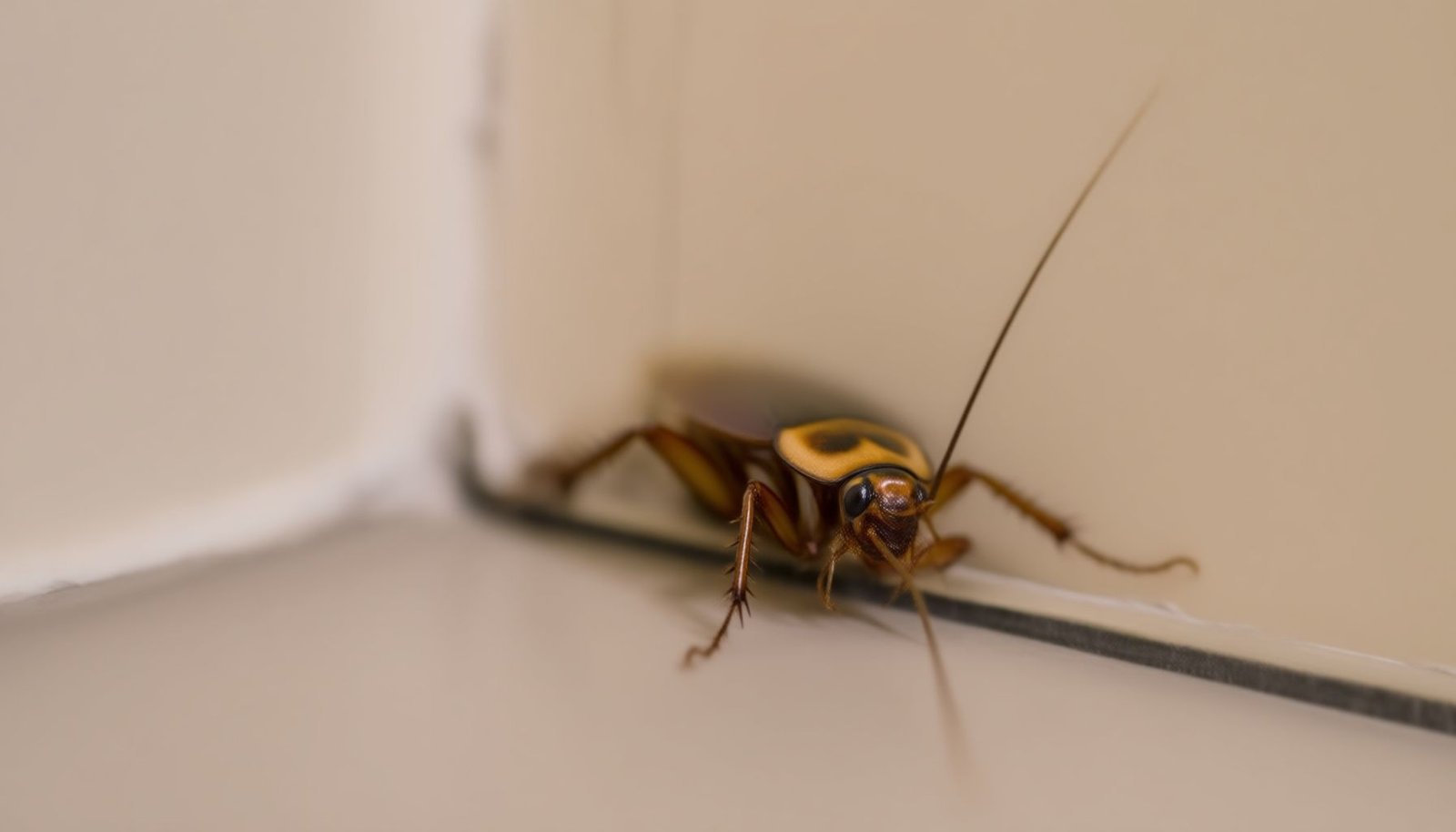
This close-up shows how German cockroaches flatten their bodies to pass through gaps as thin as 1/16 of an inch — the kind of gap found around nearly every pipe penetration in a typical apartment wall.
How Are Roaches Actually Getting Into Your Unit From Next Door?
Before you can stop them, you need to know exactly which routes they’re using — and it’s almost never the dramatic “they walked under my front door” scenario people imagine. Picture this: a plumber ran a pipe through your shared wall years ago and the gap around that pipe was never properly sealed. It’s a half-inch opening hidden behind your bathroom vanity. You’d never notice it. A cockroach absolutely does. These sub-surface entry points are how roaches move between units without ever being seen in transit.
The most common migration routes in multi-unit buildings include shared plumbing walls (especially between kitchens and bathrooms on the same stack), electrical conduit runs that connect multiple units, gaps behind outlet boxes and switch plates, unsealed spaces where baseboards meet the floor, and hollow interior door frames. In older construction — pre-1980 buildings especially — these gaps can be extensive. You might caulk every visible crack in your kitchen and still have a roach superhighway running through the wall behind your refrigerator.
What You Can Actually Control: Sealing, Baiting, and Intercepting Before They Settle In
The honest answer is that you can’t control what happens in your neighbor’s unit. What you can control is making your unit as inhospitable and physically inaccessible as possible — and doing it in a way that kills any roach that does make it through before it can reproduce. That’s a two-layer strategy: physical exclusion first, then chemical interception.
On the exclusion side, the goal is collapsing the gap size below what even a juvenile roach can navigate. On the chemical interception side, gel bait is your best tool — not sprays, not foggers. Sprays repel roaches and push them deeper into walls or into adjacent units. Gel bait, placed in small dots along the routes roaches travel, draws them out and kills them via a slow-acting toxicant that they carry back to harboring sites. It works with their behavior instead of against it.
Pro-Tip: Apply gel bait in pea-sized dots — not smears — every 6 to 12 inches along the inside edges of cabinet kick plates, behind the stove, under the sink near the pipe penetrations, and along the back of the refrigerator. Replace it every 3 months or sooner if it dries out. Dried bait is ignored bait.
Here’s the step-by-step approach to sealing your unit against roach migration:
- Inspect all pipe penetrations under sinks and behind toilets. Use a flashlight and look for any gap where a pipe passes through drywall or tile. Gaps larger than 1/16 inch need to be filled. Use fire-rated acoustic sealant or copper mesh stuffed in first for large gaps, then sealed over with caulk.
- Pull out your stove and refrigerator and check the wall behind them. This is one of the most commonly missed entry zones in apartments. There’s often an unsealed knockout in the drywall behind major appliances where electrical and gas lines pass through.
- Seal the gap between your baseboard and the floor, particularly along shared walls. In apartments, shared walls are the primary migration corridor. A bead of paintable latex caulk along the base of the shared wall costs about $4 and takes 20 minutes.
- Check every electrical outlet and switch plate on shared walls. Remove the cover plate — you’ll often find an open chase behind it that runs directly into the wall void. Foam backer rod stuffed behind the box and a foam outlet gasket on the plate face will close most of this off.
- Inspect your bathroom where it shares a wall or plumbing stack with a neighbor. The area around the toilet floor flange and the gap behind the tub surround where it meets the wall are frequent entry points that never get sealed during original construction.
- Look up, not just down. In units with drop ceilings or in buildings where ceiling tiles are shared across units, roaches can travel laterally through the ceiling plenum. Check where any light fixture, exhaust fan, or sprinkler head passes through your ceiling on a shared wall side.
What Products Actually Work When the Source Is Next Door (and What Wastes Your Money)
The product category that fails worst in this specific scenario is the fogger — also called a “roach bomb.” Foggers release a cloud of insecticide that can’t penetrate wall voids, can’t reach behind appliances, and does nothing to address roaches that are actively migrating through your walls from another unit. Worse, the repellent effect of fogger chemicals causes roaches to retreat deeper into structure and push into adjacent spaces — including yours. It’s one of those situations where the “fix” actively makes things worse.
What actually works in a shared-building situation is a combination of gel bait (indoxacarb- or fipronil-based products like Advion or Alpine work well), boric acid dust applied in wall voids and behind outlet plates, and insect growth regulators (IGRs) like hydroprene or pyriproxyfen. IGRs don’t kill adult roaches — they prevent juveniles from reaching reproductive maturity, which breaks the breeding cycle. This matters especially when you’re dealing with a continuous source from a neighboring unit, because new roaches will keep arriving and you need to stop them from establishing before you can fully stop the flow.
| Product Type | Works Against Migrating Roaches? | Notes |
|---|---|---|
| Gel Bait (Advion, Alpine) | Yes — highly effective | Place near entry points; replace every 60–90 days |
| Boric Acid Dust | Yes — long residual in voids | Apply lightly in wall voids, not open surfaces |
| IGR (hydroprene/pyriproxyfen) | Yes — breaks reproduction cycle | Use alongside bait, not as sole treatment |
| Fogger / Bug Bomb | No — repels and scatters roaches | Avoid entirely in multi-unit situations |
“In multi-family housing, treating a single unit in isolation is almost always inadequate. German cockroaches in particular are highly mobile between units through utility chases and plumbing voids, and a treatment that displaces rather than eliminates a population often makes adjacent units worse. Gel bait combined with physical exclusion is the only approach that addresses both the harboring population and the migration pathway simultaneously.”
Dr. Patricia Kells, Board-Certified Entomologist and Urban Pest Management Specialist, Purdue University Extension
How to Get Your Landlord or Building Management to Actually Act
Here’s where renters in multi-unit buildings have more leverage than they often realize — and where most pest advice completely drops the ball by treating this as purely a DIY problem. In most US states, landlords are legally required to maintain habitable conditions, and an active cockroach infestation qualifies as a habitability violation under implied warranty of habitability law. The key is documentation. Every time you see a roach, write it down: date, time, location in the unit, and any photo evidence you can get. Then put your complaint in writing — not a text, not a verbal conversation, a written notice delivered by email or certified mail.
The building-wide angle is the critical piece. If you can establish — and this is often provable through building inspection records or by talking to other tenants — that the infestation is originating in another unit, the landlord’s responsibility shifts from reactive to proactive. They can’t just treat your unit and call it done. They’re required to address the source. Some tenants find success requesting that management coordinate simultaneous treatment across multiple units, which is how professional pest control companies recommend handling building-wide roach problems anyway. A staggered treatment schedule — treating one unit this week and the next unit next month — is how roach populations survive building-wide remediation efforts.
The exclusion tactics you take on yourself are worth doing regardless of what your landlord does. Just as you’d want to get rid of bed bugs without throwing away your mattress by addressing the actual infestation rather than reacting emotionally, the same principle applies here — don’t throw money at surface-level solutions when the structural pathways haven’t been closed.
Some specific things to include in a written complaint to your landlord:
- The date you first observed roaches and a log of every subsequent sighting
- Photographs with timestamps showing roach activity, egg cases, or fecal spotting
- Any statements from neighboring tenants about their own infestation (even informal ones)
- A specific request for building-wide inspection and coordinated treatment — not just your unit
- A reasonable response deadline (typically 14–30 days is considered reasonable depending on your state)
- Reference to your state’s implied warranty of habitability statute if you know it (most state landlord-tenant guides list these)
One thing worth knowing: roaches aren’t the only pest that spreads between units through shared building infrastructure. If you’ve been dealing with silverfish in your bookshelves and closets, the same pipe penetrations and wall voids that roaches use are likely how silverfish are getting in from adjacent units or from a damp basement below — which means the exclusion work you do to stop one pest often pays dividends against several others at once.
One honest nuance worth acknowledging: how much DIY exclusion and baiting can realistically accomplish depends heavily on your building’s age and construction. A newer building with tight drywall and properly sleeved utility penetrations is a very different challenge than a 1960s building where the plumbing stack is essentially an open column running from basement to roof through every unit on that side of the building. In older buildings, even perfect sealing of visible gaps may not be enough if structural chases run open through the building core — and that’s genuinely a situation where pushing hard for professional building-wide treatment is the more realistic path forward.
Keep your bait fresh, keep your pressure on management, and don’t let a neighbor’s infestation become a permanent fixture in your unit. Roaches are persistent — but so is documentation, and so is a properly placed dot of gel bait right in front of the gap they’re walking through.
Frequently Asked Questions
how do roaches get from a neighbor’s apartment into mine?
Roaches travel through shared walls, plumbing pipes, electrical conduits, and gaps around outlets or baseboards. They can squeeze through cracks as thin as 1/16 of an inch, so even a well-kept unit isn’t safe if a neighboring one is heavily infested. Common entry points include the space under doors, around water pipes under sinks, and through shared ventilation systems.
can I make my landlord deal with roaches coming from a neighbor’s unit?
Yes — in most U.S. states, landlords are legally required to maintain a pest-free property under the implied warranty of habitability. Document the infestation with photos, notify your landlord in writing, and keep copies of everything. If they don’t respond within a reasonable timeframe (typically 14–30 days depending on your state), you may have grounds to withhold rent, break your lease, or file a complaint with your local housing authority.
what can I put in gaps and cracks to stop roaches from coming through walls?
Silicone-based caulk is your best option — it’s flexible, durable, and roaches can’t chew through it the way they can foam sealants. Focus on sealing gaps around baseboards, pipe penetrations under sinks, and around electrical outlets on shared walls. Steel wool stuffed into larger gaps before caulking adds an extra layer of protection for areas where pipes enter the wall.
do roach baits work if the infestation is coming from a neighbor?
Gel baits like those containing hydramethylnon or indoxacarb are highly effective because roaches carry the poison back to the nest, which can kill roaches at the source — even in a neighboring unit. Place bait stations near entry points like under sinks, behind appliances, and along baseboards. Results typically show within 1–2 weeks, but you’ll need to reapply every 1–3 months if the neighbor’s infestation is ongoing.
should I talk to my neighbor about their roach problem?
It’s worth trying if you have a decent relationship with them, since coordinated treatment is far more effective than treating just your unit. Keep the conversation matter-of-fact — mention you’ve seen roaches and that the building might have a shared problem. If they’re uncooperative or the situation is a hoarding or severe sanitation issue, go directly to your landlord or property management so they can require a building-wide inspection.
Disclaimer: This article is for informational purposes only and isn’t a substitute for professional pest control advice. Always read and follow the product label instructions exactly — label directions are legally binding and vary by brand and active ingredient. Keep all pesticides, baits and traps away from children and pets, ventilate treated areas as directed, and consider calling a licensed pest control professional if an infestation is large, recurring, or involves a structural pest like termites or carpenter ants.