

Cedar blocks and lavender sachets won’t solve a silverfish problem in your bookshelves or closets — and that misplaced confidence is exactly why so many infestations drag on for months. The real issue isn’t that homeowners ignore silverfish; it’s that they treat the symptoms (the bugs they can see) while leaving the actual cause completely untouched. Moisture, darkness, and a buffet of cellulose-rich materials are what’s keeping silverfish alive in your home, and no amount of repellent will override those three things if you haven’t addressed them first.
Why Are Silverfish Living in Your Bookshelves and Closets Specifically?
Silverfish aren’t wandering into your bookshelves by accident. They’re there because those spaces offer everything they need in one spot: starchy paper, fabric, darkness, and — critically — stable humidity. A closed bookshelf or packed closet maintains a microclimate that’s noticeably more humid than the rest of the room, especially along exterior walls or in older homes without proper vapor barriers. Silverfish thrive at relative humidity levels between 75% and 95%, and they can locate these humid pockets with remarkable precision.
Here’s the part most pest guides skip: silverfish aren’t eating your books or clothes out of desperation. They’re eating polysaccharides — specifically the starch in book bindings, sizing agents in paper, and the cellulose in cotton and linen fabric. A female silverfish can lay up to 20 eggs per day and live for 3 to 6 years, which means a small, undetected population in a bookshelf can quietly become a serious infestation before you ever find a single damaged spine. You’re not dealing with a nuisance pest that wandered in; you’re dealing with a highly adapted organism that has found your home genuinely hospitable.
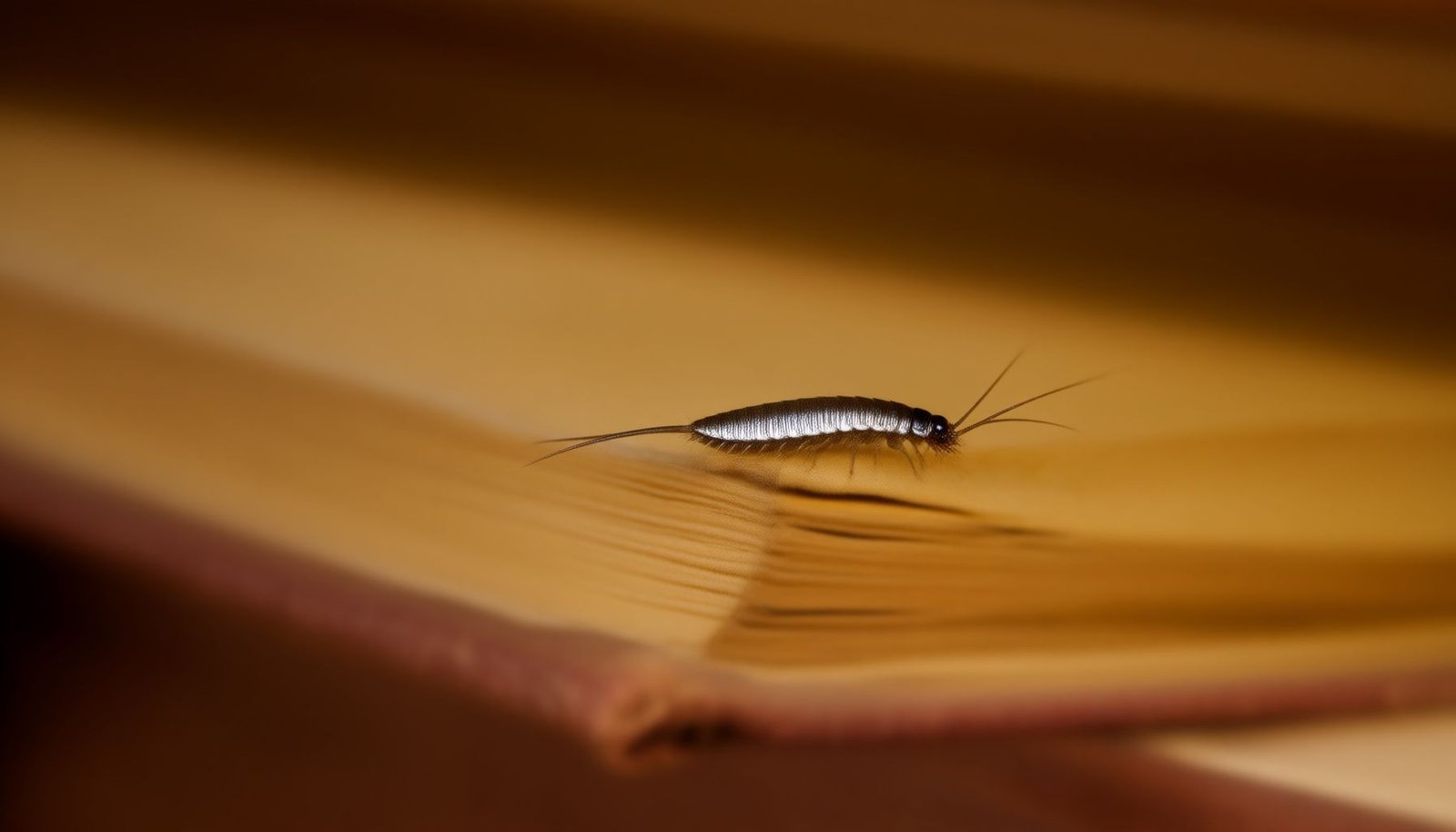
This close-up shows the telltale silvery scales and three-pronged tail of a silverfish resting on a book spine — the kind of detail that helps you confirm you’re dealing with silverfish rather than firebrats or psocids, which require different treatment approaches.
What’s the Actual Source — and Why Treating the Closet Alone Won’t Work?
Picture this: you spray the inside of your closet, toss in a couple of cedar blocks, and feel good about it for a week. Then you notice more silverfish. That’s because the closet isn’t the origin point — it’s the dining room. Silverfish almost always nest in a different location from where you find them feeding. Common harborage sites include wall voids, subflooring, attic insulation, and the spaces behind baseboards, particularly near bathrooms or laundry rooms where moisture is highest. They travel 30 to 50 feet from their harborage to feed, which means the silverfish you see in your bookshelf at midnight came from somewhere else entirely.
This travel behavior is also why silverfish problems in bookshelves and closets often intensify after plumbing work, heavy rains, or any event that changes the moisture dynamics inside your walls. Just like mice that establish runs behind a refrigerator or stove based on warmth and food proximity, silverfish establish consistent routes between harborage and feeding areas. Disrupt the harborage, and you disrupt the feeding activity in your closets and bookshelves. Treat only the feeding area, and you’re fighting the same battle indefinitely.
How Do You Eliminate the Moisture That’s Actually Sustaining Them?
Killing silverfish you can see is the easy part. Stopping them from coming back requires dropping the relative humidity in the affected areas below 50% — the threshold below which silverfish struggle to reproduce and eventually abandon a space. That means dehumidification isn’t optional; it’s the foundation of any effective treatment. A portable dehumidifier running in the room with your bookshelves, set to maintain 45-50% RH, will do more long-term work than any pesticide applied to the shelf surface.
For closets specifically, the problem is often poor air circulation combined with exterior wall contact. Closets built against exterior walls are significantly colder than the rest of the room in winter, which causes moisture to condense on that surface — a phenomenon called thermal bridging. Leaving a small gap between stored items and exterior walls, adding a low-wattage closet dehumidifier rod, or even just leaving the closet door cracked open periodically can meaningfully reduce the humidity silverfish are counting on. These aren’t glamorous fixes, but they’re the ones that actually hold.
Pro-Tip: Before you buy any silverfish treatment product, spend $12 on a digital hygrometer and place it inside the affected bookshelf or closet for 24 hours. If the reading is above 60% relative humidity, moisture control is your first job — not pesticide application. Products applied to a humid environment will degrade faster and deliver a fraction of the intended residual effectiveness.
What Products Actually Kill Silverfish in Enclosed Spaces Like Shelves and Closets?
Not all pesticide formulations are appropriate for a bookshelf or closet, and using the wrong one can damage paper, fabric, or leather and create a bigger headache than the silverfish themselves. The most effective and shelf-safe options work through desiccation or ingestion — not residual contact sprays, which can stain and aren’t labeled for use near books or clothing in most cases. Here’s a prioritized treatment sequence that works for enclosed storage areas specifically:
- Diatomaceous earth (food-grade): Apply a thin, barely visible layer along the back edges and corners of bookshelves, behind drawers, and along closet baseboards. DE damages the waxy cuticle of silverfish, causing fatal dehydration within 24-72 hours of contact. Use a duster applicator — visible clumps are less effective than an even, fine coat.
- Boric acid powder: Applied similarly to DE but works through ingestion when silverfish groom their legs. It’s particularly effective in wall voids and beneath flooring — the harborage zones, not just the feeding areas. Keep away from book pages and fabric directly.
- Silverfish gel bait: Products containing pyrethrin or deltamethrin in a gel bait matrix can be placed in the back corners of shelves and behind baseboard gaps. Silverfish are attracted to the carbohydrate matrix and carry it back toward the harborage, which treats the source rather than just the feeding zone.
- Pheromone sticky traps: Place these inside bookshelves and on the closet floor near walls. They won’t eliminate an infestation on their own, but they’re indispensable for monitoring — they tell you whether treatment is working and where activity is concentrated. Check every 5-7 days.
- Residual perimeter spray (pyrethroid-based): Applied along the exterior of the closet baseboard and around the room perimeter — not inside the closet or on shelves directly. This intercepts silverfish traveling from harborage to feeding areas. Reapply every 4-6 weeks or after any wet mopping of floors.
One counterintuitive thing worth knowing: silverfish are neophobic, meaning they’re cautious about new objects in familiar spaces. Fresh traps or newly applied bait can take 5-10 days to start showing significant catch numbers because silverfish will avoid unfamiliar items initially. Don’t pull traps after 48 hours and conclude they’re not working — give the program at least 2-3 weeks before evaluating results.
“The biggest mistake I see homeowners make with silverfish is focusing entirely on the insects they can find and ignoring moisture management entirely. Silverfish are extraordinarily resilient — a single female can produce over 100 offspring in her lifetime — but they’re also highly dependent on specific humidity conditions. Bring the relative humidity below 50% consistently, and you’ve made the environment biologically hostile to them regardless of what else you apply.”
Dr. Marcus Tilley, Board-Certified Entomologist and Urban Pest Management Specialist, University Extension Program
How Do You Protect Your Books, Clothes, and Belongings While Treating for Silverfish?
Treatment and protection have to happen simultaneously — waiting until the infestation is resolved to protect your belongings means accepting ongoing damage in the meantime. For books, the most effective protective measure isn’t cedar or mothballs; it’s reducing starch availability. Silverfish are particularly attracted to older books because the sizing agents used in vintage paper manufacturing contained significantly more starch than modern equivalents. Wrapping genuinely valuable or irreplaceable books in acid-free archival sleeves isn’t just preservation practice — it also physically blocks silverfish access to the binding glue and paper edge they’re targeting.
For closets, the material composition of what’s stored matters more than most people realize. Natural fibers — cotton, linen, silk, wool — are all on the silverfish menu because they contain cellulose or protein compounds silverfish can digest. Synthetic fabrics like polyester are essentially worthless to them nutritionally. That doesn’t mean you need to overhaul your wardrobe, but seasonal items made from natural fibers that you’re not wearing regularly should be stored in sealed plastic bins or vacuum storage bags rather than left hanging open on a closet rod where silverfish can access them nightly.
| Item Type | Silverfish Risk Level | Best Protection Method |
|---|---|---|
| Old hardcover books (pre-1980) | Very High | Archival sleeves + DE on shelf edges |
| Cotton/linen clothing | High | Sealed plastic storage bins |
| Wool or silk garments | High | Vacuum storage bags with cedar insert |
| Synthetic fabrics (polyester, nylon) | Very Low | Standard hanging — minimal intervention needed |
One more thing that almost never makes it into silverfish guides: the glue used in wallpaper is a prime silverfish food source, and if your closet or the room adjacent to your bookshelves has wallpaper — especially older paste-hung wallpaper — you may have a feeding site hiding in plain sight. Silverfish will feed behind wallpaper in the dark for years without leaving obvious surface evidence. If you’re seeing consistent silverfish activity in a room with old wallpaper and can’t identify another obvious food source, the wall itself may be the issue.
Managing a pest that operates on such a different schedule than you do requires some patience with the process. Severity matters a lot here — a light infestation in a single bookshelf in a dry climate is genuinely manageable with the steps above in 4-6 weeks. A longstanding infestation spread across multiple rooms in an older home with chronic moisture issues may take 3-4 months of consistent treatment before populations meaningfully decline, and in some cases — particularly in homes where silverfish have established harborage in wall voids across multiple floors — professional treatment targeting those void spaces with residual dust may be the only realistic path to full resolution. Some situations are just beyond what a surface-level DIY approach can reach, and recognizing that threshold early saves a lot of frustration.
The same principle applies to other pests that hide in structural spaces — whether it’s wasps nesting under roof shingles or silverfish in wall voids, the visible pest is almost never the whole story. What matters is identifying where they’re living, not just where they’re showing up.
Here’s what to look for that tells you the treatment is working — a checklist for ongoing monitoring:
- Sticky trap catch numbers declining week over week (a good sign even if you’re still catching some)
- No new damage appearing on books or fabrics that were previously unaffected
- Hygrometer readings consistently below 55% RH in the treated spaces
- Silverfish sightings shifting from nighttime in feeding areas to daytime in open spaces (indicates they’re being displaced from harborage — a sign treatment is reaching them)
- No fresh silverfish frass (tiny black pepper-like pellets) or cast scales appearing on shelf surfaces
Once you’ve got the population under control, the real win is making your home structurally less attractive to them long-term — sealing gaps around baseboards and pipe penetrations with silicone caulk, maintaining consistent dehumidification in problem areas, and storing high-risk items in sealed containers rather than open shelving. Silverfish that can’t find the conditions they need don’t stay. The goal isn’t just eliminating the population you have now; it’s making your home a place the next generation of silverfish doesn’t want to colonize either.
Frequently Asked Questions
what kills silverfish in bookshelves and closets fast?
Diatomaceous earth works fast and is one of the most effective options — sprinkle a thin layer along shelf edges, baseboards, and closet corners. You can also use cedar blocks or sachets, which repel silverfish naturally, though they won’t kill an active infestation on their own. For heavier infestations, boric acid powder applied in cracks and along wall seams is a stronger chemical-free option.
why do I keep finding silverfish in my closet?
Silverfish are drawn to dark, humid spaces where they can feed on starchy materials like paper, cardboard, and natural fabrics — closets check all those boxes. If your closet humidity is above 75%, that’s basically an open invitation. Poor ventilation, stored cardboard boxes, and clothing made from cotton or linen give them both shelter and a food source.
can silverfish damage books and clothing?
Yes, silverfish will eat the glue in book bindings, paper pages, and natural fabrics like cotton, linen, and silk. You’ll notice irregular holes, yellowish staining, or a scraped surface on paper — those are telltale signs of silverfish feeding damage. A single silverfish won’t destroy a book overnight, but a population left unchecked for weeks or months can cause serious damage to stored items.
how do I get rid of silverfish without chemicals?
Reducing humidity is the single most important step — use a dehumidifier to keep indoor humidity below 50%, which makes the environment hostile to silverfish. Cedar blocks, lavender sachets, and whole cloves placed in closets and on shelves act as natural deterrents. Sealing books and clothing in airtight plastic bins removes their food source and hiding spots without any chemical treatment.
how do I know if I have a silverfish infestation in my bookshelf?
Look for small, pepper-like black droppings on shelves, yellowish scales or molted skins, and irregular scraping marks or holes on book covers and paper edges. Silverfish are nocturnal, so seeing one during the day often means the population is large enough that they’re getting crowded out. Check the back corners of shelves and inside rarely opened books, since those are the spots they tend to hide.
Disclaimer: This article is for informational purposes only and isn’t a substitute for professional pest control advice. Always read and follow the product label instructions exactly — label directions are legally binding and vary by brand and active ingredient. Keep all pesticides, baits and traps away from children and pets, ventilate treated areas as directed, and consider calling a licensed pest control professional if an infestation is large, recurring, or involves a structural pest like termites or carpenter ants.