
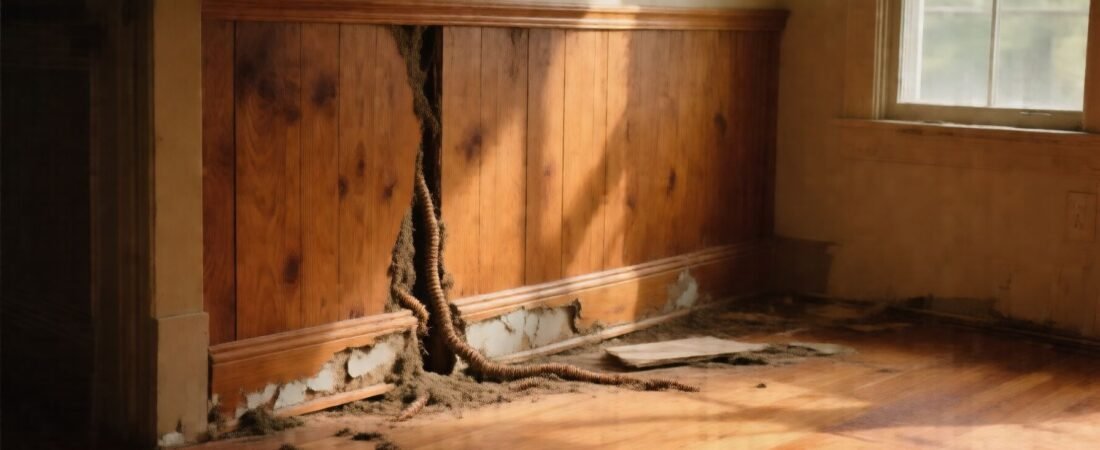
Termites destroy wood from the inside out — which means by the time you see obvious damage, they’ve already been eating for months, sometimes years. That’s the uncomfortable truth most people discover too late. The signs of termites in wood aren’t dramatic at first. They’re quiet, easy to dismiss, and almost always hiding in plain sight as something more boring: a squeaky floorboard, a door that sticks, a tiny pile of what looks like sawdust near a baseboard.
Here’s what most guides get wrong: they tell you to look for termites. You should actually be looking for what termites leave behind, because the insects themselves are almost never visible. A single subterranean termite colony can contain over 1 million individual workers feeding 24 hours a day, and you may never see one termite — just the slow, structural wreckage they leave in walls, floors, and furniture. This article focuses on reading those clues correctly, including the ones that get misidentified constantly.
Why Termite Damage in Wood Looks Like Something Else First
The single most common reason homeowners miss a termite infestation early is that the initial signs mimic normal house wear. A floor that feels slightly soft underfoot gets blamed on age. Paint that bubbles near a baseboard gets blamed on humidity. A door that starts dragging in summer gets blamed on seasonal wood expansion. All of those things can have perfectly innocent explanations — and all of them can also mean termites have been working inside your walls for the past 18 months.
Subterranean termites feed along the wood grain, hollowing out the soft interior while leaving a paper-thin outer shell intact. That shell is what fools people. You tap a floor joist or a section of baseboard, and instead of a solid thud, you get a hollow, papery knock — but the surface looks completely fine. Drywood termites behave differently, consuming wood across the grain and creating smooth, chambered galleries. Both species are experts at staying hidden, but each leaves a different fingerprint if you know what to feel and listen for, not just look for.
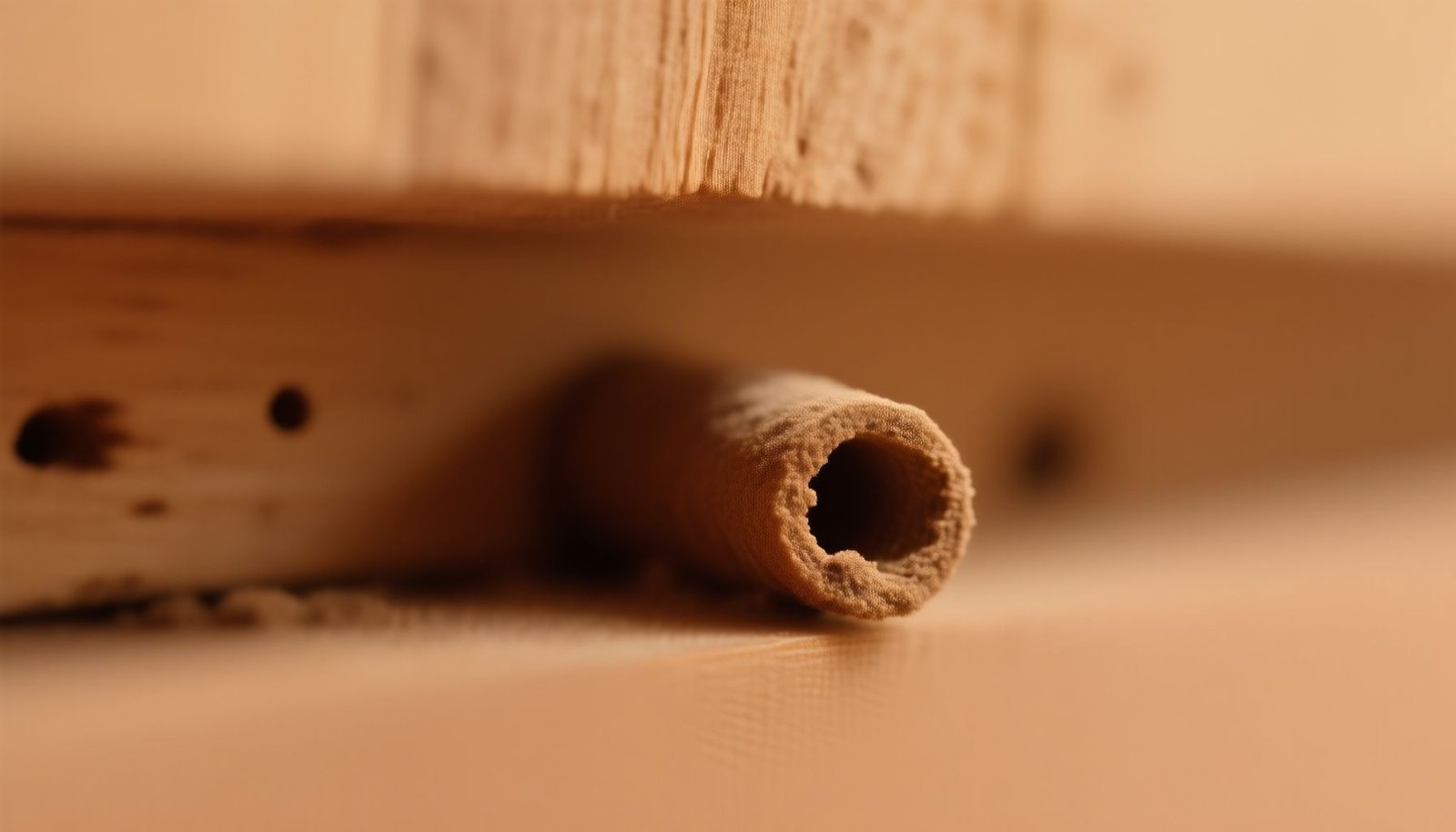
This close-up shows the characteristic hollowed galleries termites leave inside wood — note how the outer surface appears nearly intact, which is exactly why so many infestations go unnoticed until the damage is already severe.
What Do Termite Signs in Wood Floors Actually Look Like?
Wood floors are one of the first places a subterranean termite infestation becomes detectable — not visually, but physically. You’ll notice the floor gives slightly where it shouldn’t, almost like pressing on cardboard. Some homeowners describe a faint crunching sensation when walking across certain spots. That’s not the floorboard settling. That’s the sound of galleries that were once solid wood collapsing incrementally under your weight.
Drywood termites in flooring leave a different calling card: small, hexagonal fecal pellets — called frass — that look eerily like coarse sand or coffee grounds, often found in tiny piles near cracks in the floor or at the base of walls. Picture this: a homeowner notices what looks like a small drift of sawdust near a closet door frame every morning, sweeps it up, and finds a fresh pile again by the next day. That cycle — frass reappearing within 24 to 48 hours — is almost always drywood termite activity. The pellets are pushed out of kick-out holes as the colony clears debris from their galleries.
Pro-Tip: Press a screwdriver or your thumb firmly into a suspicious area of wood flooring near walls or under rugs. Healthy wood resists cleanly. Termite-damaged wood will dimple, crack, or feel spongy under moderate pressure — even if the surface finish looks completely normal.
How to Spot Termite Activity Inside Walls Before You See Damage
Walls are where termite infestations do their most serious structural work, and they’re also the hardest place to catch them early. One underexplored sign is what pest professionals call “mud mapping” — faint, irregular lines or blistering on painted drywall surfaces that trace the mud tubes termites build just beneath the paint or behind the wallboard. These look almost identical to water staining or old paint failure, which is exactly why they get ignored for so long.
The other wall sign that doesn’t get nearly enough attention is sound. Soldier termites bang their heads against tunnel walls to signal danger — a behavior that creates a faint, dry clicking or rustling sound inside affected wall voids. It’s subtle enough that most people never notice it, but if you press your ear to a wall in a quiet room and hear a faint crackling that doesn’t correlate with pipes or HVAC, that’s worth investigating. Knock along the baseboard in a grid pattern — a shift from a solid sound to a flat, hollow one pinpoints where the damage begins.
“The biggest mistake I see is homeowners waiting for visual confirmation of termites before acting. By the time you can see the damage clearly with the naked eye, a subterranean colony has typically been established for two to four years. The early signs — frass accumulation, subtle floor deflection, mud tube fragments — are always there if you know the sequence to look for them.”
Dr. Marcus Hale, Board-Certified Entomologist and Structural Pest Management Specialist
Signs of Termites in Furniture: What’s Different and What to Check
Furniture termite damage gets misread more often than almost any other infestation sign, largely because people assume termites only attack structural wood. Drywood termites absolutely infest furniture — antique pieces, solid wood cabinets, bed frames, and wooden shelving are all fair targets. The colony doesn’t need soil contact, which is what makes drywood species so different from their subterranean relatives and why the usual “check your foundation” advice doesn’t fully apply here.
On furniture, look specifically for these signs — and understand what each one tells you:
- Frass piles beneath furniture legs or joints — small, gritty pellets ranging from tan to dark brown depending on the wood species being consumed; reappear quickly after cleaning
- Tiny, pinhole-sized exit holes — perfectly round, 1–2mm in diameter, often found along furniture joints or on the underside of pieces; these are kick-out holes where frass is expelled
- Surface blistering or rippling on painted or varnished wood — galleries just beneath the surface cause the finish to separate; looks like moisture damage but is dry to the touch
- Hollow sound when tapping — solid wood furniture has a dense, resonant knock; termite-hollowed wood sounds flat and papery even where the exterior looks intact
- Shed wings near or beneath furniture — swarmers (reproductive termites) lose their wings immediately after landing; finding 6–12 small, equal-length wings near furniture legs or windowsills indicates a nearby or emerging colony
One counterintuitive fact worth knowing: a piece of furniture can harbor a self-contained drywood termite colony for years without any visible surface damage, because the colony deliberately preserves the structural shell of the wood as it expands inward. The piece looks fine, feels solid from the outside, and then one day a leg snaps under normal use. That’s not bad luck — that’s the end stage of an infestation that was already well-established when the furniture entered your home, possibly carried in from a secondhand shop or storage unit.
Termite Signs vs. Other Wood-Damaging Insects: How to Tell Them Apart
Not every sign of wood damage means termites, and misidentifying the culprit leads to wasted money on the wrong treatment. Carpenter ants, powderpost beetles, and carpenter bees all damage wood, but each leaves a distinctly different fingerprint. Getting this right matters — a lot — because the treatment approach for each pest is completely different. Just as you’d need to properly distinguish between species before treating (the same way you’d need to correctly identify carpenter ants vs. regular ants before choosing a control method), wood damage requires the same careful reading before you act.
Use this comparison to narrow down what you’re actually dealing with:
| Sign | Termites | Carpenter Ants | Powderpost Beetles |
|---|---|---|---|
| Frass appearance | Hard, hexagonal pellets (drywood) or none visible (subterranean) | Coarse, fibrous shavings mixed with insect debris and dead ants | Very fine, flour-like powder, almost talcum consistency |
| Exit holes | Small, round kick-out holes 1–2mm | Larger, irregular openings with rough edges | Tiny round holes 1–2mm, very clean edges |
| Wood galleries | Smooth-walled, follow grain (subterranean) or cross-grain chambers (drywood) | Smooth, excavated galleries — no frass inside, ants keep galleries clean | Packed with fine powder; winding, random tunnels |
| Mud tubes present? | Yes, subterranean only — pencil-width tubes along foundation, walls | Never | Never |
The mud tube is the single most definitive sign of subterranean termites specifically — no other common household wood pest builds them. These pencil-width tunnels, made from soil, wood particles, and termite saliva, are constructed to maintain humidity as the colony travels between the soil and its food source. Finding one running up a concrete foundation wall or across a floor joist in a crawl space is about as close to a confirmed diagnosis as you can get without professional inspection. Break a section open — if you see live, pale, soft-bodied workers inside, you have an active infestation. If the tube is dry and empty, the colony may have moved, but that doesn’t mean they’re gone.
How to Do a Systematic Termite Check on Your Own Home
A proper self-inspection won’t replace a professional assessment — some termite damage genuinely requires borescopes, moisture meters, and trained eyes to catch — but a systematic walkthrough can catch active signs that save you months of undetected damage. The honest nuance here: how thoroughly you need to inspect depends on your region (termite pressure is dramatically higher in the southeastern US and coastal California than in the northern plains), your home’s construction type, and whether you have a basement, crawl space, or slab foundation. Slab homes can still get subterranean termites through expansion joints and utility penetrations.
Work through this sequence in order, because each step builds on what you find in the previous one:
- Start at the exterior foundation. Walk the full perimeter and look for mud tubes — even narrow, half-formed ones — running from soil level up the foundation wall. Check where the wood framing meets the concrete sill plate, a common entry point.
- Inspect the crawl space or basement thoroughly. Bring a flashlight and a screwdriver. Probe every accessible floor joist, support beam, and wooden post. Wood that a screwdriver tip punctures with almost no resistance has been compromised.
- Check interior walls at the baseboard level. Move furniture, roll back rugs, and look closely along the bottom of all exterior-facing walls. Tap every 6 inches and listen for the shift from solid to hollow.
- Inspect all wooden door and window frames. Pay particular attention to frames on the ground floor and any frames near bathrooms or exterior moisture sources — termites follow moisture gradients into structures.
- Check solid wood furniture and built-ins. Look at the underside of pieces, along joints, and anywhere frass could accumulate unseen. Place a white sheet of paper under suspect furniture overnight and check for new pellet deposits by morning.
- Look in the attic if you have one. Drywood termites swarm upward and frequently infest roof framing, rafters, and attic flooring — areas that rarely get inspected until the damage is already significant.
One thing that doesn’t come up often enough in DIY inspection guides: timing matters. Subterranean termite swarming typically occurs in late winter through spring, often triggered by warm temperatures and rain. Finding shed wings — small, equal-length, milky-white wings about 1/4 to 3/8 inch long — clustered near windowsills, doors, or light fixtures in this period is a strong indicator that a mature colony is nearby, either inside the structure or immediately adjacent to it. Swarmers themselves are weak fliers and don’t survive long indoors, so the wings are the evidence, not the insects. It’s a similar situation to how identifying the evidence rather than the pest directly is often the more reliable approach — the same logic applies when ruling out whether something unrelated, like a centipede bite versus a different skin reaction, requires immediate attention versus a more measured response.
If your inspection turns up any of the signs above — frass reappearing after cleanup, hollow-sounding structural wood, mud tubes anywhere in the structure, or shed swarmers — the next step isn’t a DIY treatment. It’s an independent professional inspection, ideally from a company that doesn’t profit from your decision to treat. What you do in the next few weeks won’t make or break the structure — termites work slowly — but what you do in the next few months absolutely will. Getting an accurate read on the species, the colony size, and the extent of the damage is what separates a targeted, cost-effective treatment from an expensive guess.
Frequently Asked Questions
What are the first signs of termites in wood floors?
The earliest signs are hollow-sounding boards when you tap them, small pinholes in the wood surface, and fine powdery dust called frass near the edges of planks. You might also notice your floors starting to buckle or sag in spots — that’s a sign termites have been eating through the subfloor underneath for a while.
How do I know if my walls have termites?
Tap along your drywall or wood paneling — a hollow or papery sound can mean termites have eaten through the wood framing inside. You might also spot mud tubes running up the base of your walls, which subterranean termites build to travel between the soil and their food source. Tiny piles of frass near baseboards or outlet covers are another red flag.
What does termite damage look like in furniture?
Termite-damaged furniture often looks fine on the outside but feels unusually light or sounds hollow when you knock on it. Look for small exit holes about 1mm wide on the surface, and check underneath or in joints for frass — a gritty powder that looks like fine sawdust or coffee grounds. Drywood termites are the most common culprit in furniture since they don’t need soil contact to survive.
Can you see termites in wood with the naked eye?
Yes, you can — worker termites are pale white or cream-colored and about 1/8 inch long, so they’re visible if you expose an active gallery or crack open damaged wood. That said, termites avoid light and stay hidden inside wood most of the time, which is why people usually spot the damage or frass before they ever see an actual termite.
How do I tell the difference between termite damage and wood rot?
Termite damage typically shows a honeycomb pattern inside the wood with mud or frass packed into the galleries, while wood rot usually causes the wood to crumble, discolor, and feel soft or spongy to the touch. If you poke the wood with a screwdriver and it collapses easily but looks dry on the surface, termites are more likely the cause. Wood rot almost always has visible moisture staining or fungal discoloration that termite damage doesn’t.