
Size alone will not save you from misidentifying these two insects — and that mistake costs homeowners thousands of dollars in structural repairs every year. The real problem isn’t that carpenter ants and regular ants look alike. It’s that most people check the wrong features first, convince themselves it’s just a “harmless” pavement ant, and wait six months before realizing the framing inside their wall is being systematically hollowed out. This article skips the stuff everyone gets right and focuses on the part almost everyone gets wrong: the subtle, reliable clues that separate a nuisance ant from one that is actively destroying your home.
Why Size Is a Misleading First Clue (And What to Check Instead)
“It looked big, so I assumed carpenter ant” is the sentence pest professionals hear constantly — and it leads people astray more often than not. Carpenter ants do run large, typically between 3/8 and 1/2 inch for workers, with queens reaching 3/4 inch. But here’s what throws people off: a mature carpenter ant colony produces workers in a wide range of sizes within the same nest, so a small carpenter ant worker can easily be the same length as a large pavement ant or odorous house ant.
The feature that actually doesn’t lie is the waist. Carpenter ants have a single, distinctly rounded node (petiole) connecting the thorax to the abdomen, and their thorax profile is evenly arched — perfectly smooth when viewed from the side, almost like a gentle dome. Common nuisance ants like the pavement ant have a two-segmented waist and a thorax that shows an uneven, bumpy silhouette. You’ll need decent lighting and ideally a phone camera zoomed in, but this one check is more reliable than eyeballing length alone.
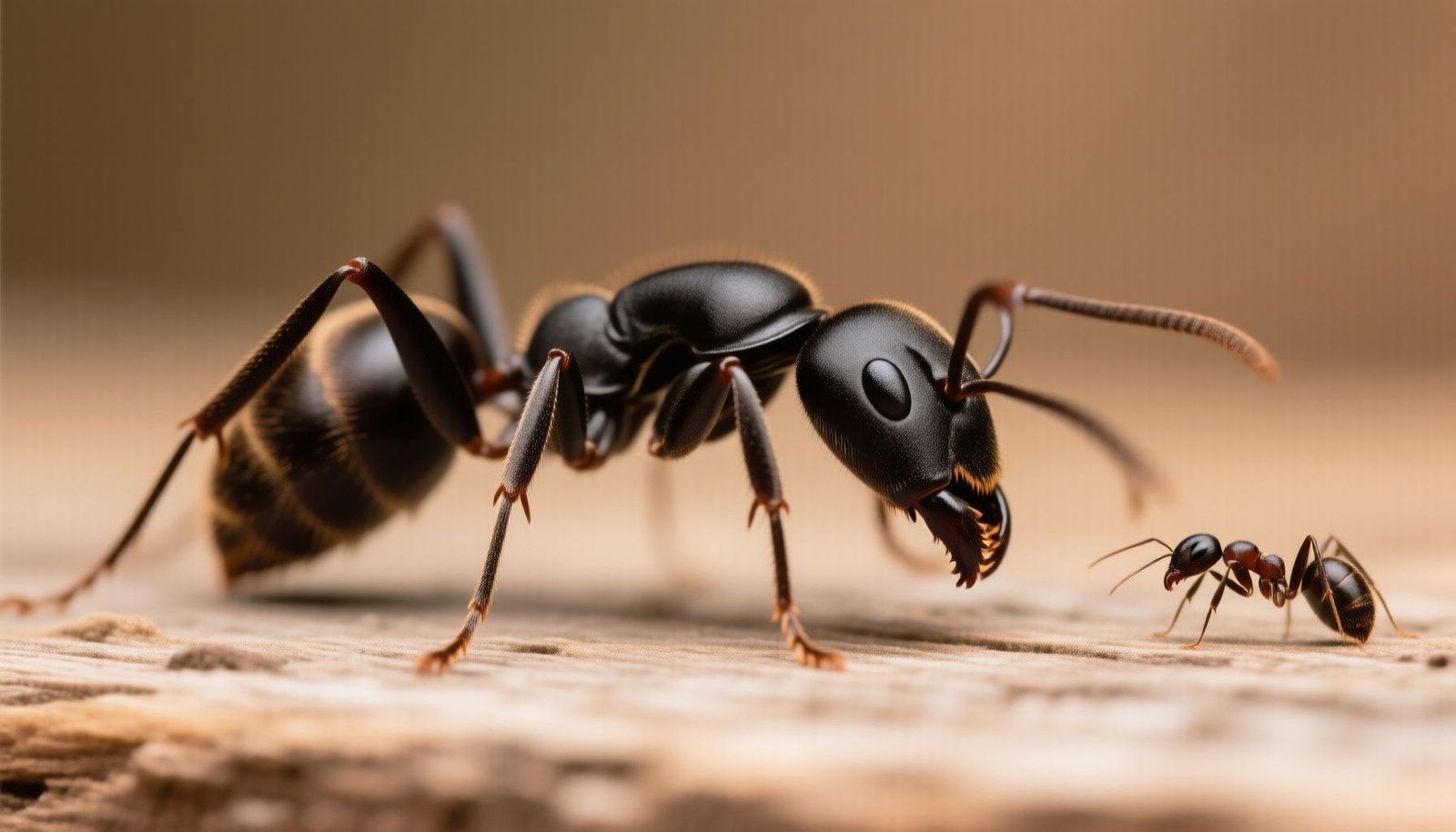
This close-up comparison shows exactly how different the waist nodes and thorax profiles look between species — details that are invisible at a glance but become obvious once you know where to look.
What Do Carpenter Ants Actually Look Like Up Close?
Carpenter ants in the US are almost always Camponotus pennsylvanicus (the black carpenter ant) or a closely related Camponotus species. Workers are typically solid black, though some western species show reddish-brown coloring on the thorax, which sometimes causes people to confuse them with fire ants — a very different problem. The antennae are elbowed (bent at an angle), which they share with other ants, but the overall build of a carpenter ant is noticeably more robust and elongated than your typical kitchen ant.
One overlooked identification clue is the fringe of golden hairs around the abdomen, visible on black carpenter ants in good light. It doesn’t look like fur — more like a faint halo. That characteristic, combined with the smooth arched thorax and single waist node, gives you three confirming data points without needing a magnifying loupe. If winged ants are part of what you’re seeing, check whether the front wings are noticeably longer than the rear wings — that’s a carpenter ant (and termite) trait that common nuisance ants don’t share as distinctly.
How to Tell Common House Ants Apart From Carpenter Ants at a Glance
The ants most commonly confused with carpenter ants inside US homes fall into a short list. Knowing which species you’re actually dealing with changes whether you need to worry about structural damage or just about protecting your pantry.
| Ant Species | Size (worker) | Waist Nodes | Structural Risk? |
|---|---|---|---|
| Carpenter Ant (Camponotus spp.) | 3/8–1/2 inch | One (petiole only) | Yes — excavates wood |
| Pavement Ant (Tetramorium caespitum) | 1/8 inch | Two (petiole + postpetiole) | No |
| Odorous House Ant (Tapinoma sessile) | 1/16–1/8 inch | One (hidden under abdomen) | No |
| Black Garden Ant (Lasius niger) | 1/8–3/16 inch | One | No |
The odorous house ant is the one that trips people up the most because it also has a single node, similar to a carpenter ant. The giveaway is the smell — crush one and it releases a distinctly rotten coconut or blue-cheese odor. Carpenter ants don’t produce that scent. Odorous house ants are also dramatically smaller and move in tight, frantic trails rather than the slower, more deliberate march you’ll see from carpenter ants.
Where Each Ant Shows Up Inside Your Home (And Why Location Matters)
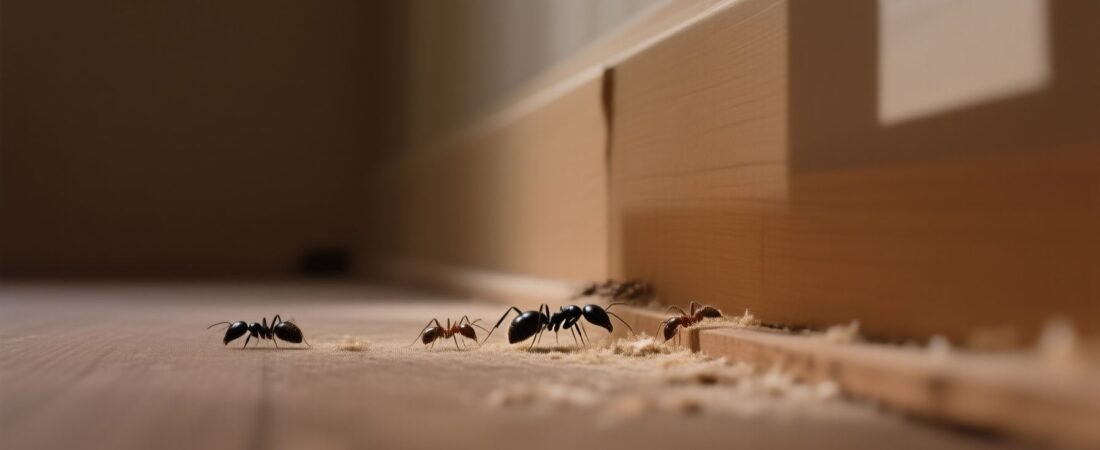
Picture this: you’re replacing a bathroom vanity and find a cluster of large black ants inside the wall cavity, along with a pile of coarse sawdust-like material that looks almost like pencil shavings. That frass — a mixture of wood shavings, insulation bits, and ant debris — is one of the clearest signs a carpenter ant colony has set up a satellite nest inside your structure. Common nuisance ants don’t produce that kind of debris because they’re not chewing through wood.
Location within the home also tells a story. Carpenter ants prefer moist or previously water-damaged wood — they’re not eating the wood for nutrition, they’re excavating it for nesting galleries. You’ll find them near leaking pipes, around window frames with failed caulk, in attic spaces near roof leaks, and in basement sill plates that have absorbed ground moisture. Regular ants, by contrast, tend to forage anywhere food is present: kitchen counters, pantry shelves, bathroom sinks (for water). If you’re seeing large black ants near a slow drip under the kitchen sink and you’ve ignored it for a season, that’s a situation worth taking seriously. For more on what behavioral and structural evidence to watch for before you even spot the ants themselves, the article on Signs of Carpenter Ants in Walls: What to Listen and Look For covers the acoustic and visual clues in detail.
Does Finding One Carpenter Ant Mean You Have an Infestation?
Not automatically — but it warrants more than a shrug. A single carpenter ant spotted on a kitchen counter in spring or early summer is often a forager from an outdoor colony in a tree stump or old fence post, scouting for food. That’s manageable. The threshold that should make you take action is finding 6 or more carpenter ants indoors over the course of a few days, especially if they’re showing up at night (carpenter ants are most active between sunset and 10pm), or if you’re finding them consistently near the same wall, window, or ceiling area.
Here’s the counterintuitive part that most pest articles gloss over: a well-established carpenter ant colony inside your walls may have been there for 3 to 6 years before you see the first indoor worker ant. Colonies grow slowly — a founding queen starts with just a handful of eggs, and it takes 3 to 6 years to reach the 2,000 to 3,000 workers that produce the satellite nests and the foragers that finally end up in your kitchen. By the time you’re regularly seeing carpenter ants indoors, the colony is already mature. That’s the part worth sitting with.
“Most homeowners assume they caught a carpenter ant problem early because they’ve only seen a few ants. In reality, they’re almost always seeing the tail end of a slow build that started years earlier. The indoor foragers are a sign of colony maturity, not the beginning of an infestation.”
Dr. Michael Bentley, Entomologist and Director of Training, National Pest Management Association (NPMA)
A Step-by-Step Method for Identifying the Ant in Your Home Right Now
You don’t need a microscope or a professional to make a confident ID call. Work through these steps in order — each one either confirms or rules out carpenter ants before you move to the next.
- Measure or estimate the body length. Anything under 1/4 inch is almost certainly not a carpenter ant worker. If the ant is 3/8 inch or larger, keep going.
- Check the thorax profile from the side. Use your phone camera or a magnifying glass. A carpenter ant’s thorax is smoothly arched with no dips or bumps. An uneven profile points toward pavement ants or fire ants.
- Count the waist nodes. One rounded node = possibly carpenter ant. Two nodes = not a carpenter ant.
- Crush one and smell it. A rotten coconut smell rules out carpenter ant and points to odorous house ant. No notable smell is consistent with carpenter ants.
- Look for frass near where you found them. Carpenter ant frass looks like coarse pencil shavings mixed with insulation fibers or dead ant parts. It’s often found in small piles below wall voids, window frames, or ceiling gaps.
- Note the time of day. Carpenter ants are strongly nocturnal. Seeing them in late evening or after dark is a stronger signal than daytime sightings, which are more typical of common foraging ants.
One honest caveat here: this method works well for the most common US species, but geographic location matters. In the Pacific Northwest and parts of the Southeast, you may encounter Camponotus species with reddish or bi-colored bodies that don’t fit the “solid black” expectation. If you’re in Florida dealing with Florida carpenter ants (Camponotus floridanus), they’ll have a reddish thorax and black abdomen — a combination that throws off a lot of people doing their first identification.
Pro-Tip: Tap on wood surfaces near where you’ve seen carpenter ants — baseboards, door frames, window sills. If the wood sounds hollow where it should be solid, or if you hear a faint rustling or crinkling sound (ants moving inside the gallery), that’s a stronger indicator of an active nest than any visual ID alone. Healthy, structurally sound wood has a consistent solid thud; wood being actively worked by carpenter ants often sounds dull or papery.
What Else You Might Be Confusing for Ants (Including Flying Ones)
Winged carpenter ants are the source of some of the most expensive misidentifications homeowners make — and not just because people confuse them with termites (though that happens constantly). The more underappreciated mistake is assuming that any winged ant found indoors in winter must have blown in or wandered from outside. Winged reproductive ants found indoors between November and March almost always signal a mature colony already living inside the structure. Swarmers need warmth to emerge, and in winter, the only warmth available is inside your heated home.
It’s worth knowing that other insects showing up unexpectedly indoors during cold months sometimes get misidentified as small ants due to size and dark coloring. If you’re seeing tiny dark insects in late fall or winter that don’t quite match any ant description, it’s worth checking whether seasonal entry by other overwintering pests could be a factor — the same way some flies and beetles seek shelter indoors as temperatures drop, as explained in the piece on Why Are There Flies in My House in Winter?. Context clues like timing, location, and behavior help narrow down what you’re actually dealing with.
Here’s a quick breakdown of the physical differences between winged carpenter ants and the insects most often confused with them:
- Winged carpenter ants vs. termite swarmers: Carpenter ants have a pinched waist, bent (elbowed) antennae, and unequal wing lengths (front wings longer). Termite swarmers have a thick waist, straight bead-like antennae, and four wings of equal length.
- Winged carpenter ants vs. flying odorous house ants: Much smaller body on the odorous house ant — under 1/8 inch even with wings. Carpenter ant reproductives are often 3/4 inch or more with wings extended.
- Winged carpenter ants vs. winged pavement ants: Pavement ants have two waist nodes (visible even on reproductives) and parallel grooves on the head and thorax visible under magnification.
- Indoor winter appearance: Any winged ant found indoors between December and February almost certainly came from inside the wall, not outside — the outdoor colony would be dormant in cold weather.
Getting the identification right before you act matters more than acting fast. Using the wrong bait formulation on carpenter ants — for example, a sugar-based bait designed for odorous house ants — won’t attract carpenter ants at all, since they’re primarily protein feeders in spring and switch to carbohydrate sources in late summer. Misidentify the ant, use the wrong bait, see no results, and repeat the cycle for another season while the colony keeps expanding.
Once you’ve made a confident ID, you’re in a much better position to respond appropriately — whether that’s sealing an exterior entry point and eliminating a moisture source, targeting a satellite nest inside the wall, or calling in a professional for a colony you can’t locate. The identification step isn’t a formality. It’s the thing that determines whether everything you do next actually works.
Frequently Asked Questions
How do I tell if I have carpenter ants or regular ants in my house?
The easiest way is to look at size — carpenter ants are noticeably larger, usually 1/2 to 5/8 of an inch long, while common house ants like pavement ants or odorous house ants are typically 1/16 to 1/8 of an inch. Carpenter ants also have a rounded, evenly arched back and a single node between their thorax and abdomen. If you’re seeing large black or reddish-black ants near wood, windowsills, or door frames, that’s a strong sign you’re dealing with carpenter ants.
Do carpenter ants actually eat wood like termites?
No — carpenter ants don’t eat wood, they excavate it to build their nests. Unlike termites, they push the wood out as a sawdust-like material called frass, which often looks like pencil shavings mixed with dead insect parts. If you spot this debris near baseboards, door frames, or wood beams, that’s a red flag that carpenter ants are tunneling through the structure of your home.
What time of year do carpenter ants come inside?
Carpenter ants are most active from spring through early fall, and you’ll often spot them indoors in late winter or early spring when an existing indoor colony becomes active again after winter. Seeing large ants inside your home during cold months — especially winged ones — is a serious sign that a colony is already established inside your walls. Regular ants tend to show up later in spring, usually following food trails from outside.
Are carpenter ants dangerous to my home’s structure?
Yes, but it depends on how long the infestation has been going on. A mature carpenter ant colony can take 3 to 6 years to grow large enough to cause significant structural damage, but by that point they may have hollowed out load-bearing wood like joists, beams, or wall studs. They’re not as fast as termites, but an untreated infestation absolutely causes real damage that can be expensive to repair.
What attracts carpenter ants to a house versus regular ants?
Regular ants are usually after food — crumbs, spills, or anything sugary or greasy in your kitchen. Carpenter ants are primarily attracted to moisture-damaged or rotting wood, so you’ll find them in areas with water leaks, poor drainage, or high humidity like crawl spaces, bathrooms, or around window frames. Fixing moisture problems is one of the most effective ways to make your home less appealing to carpenter ants specifically.