
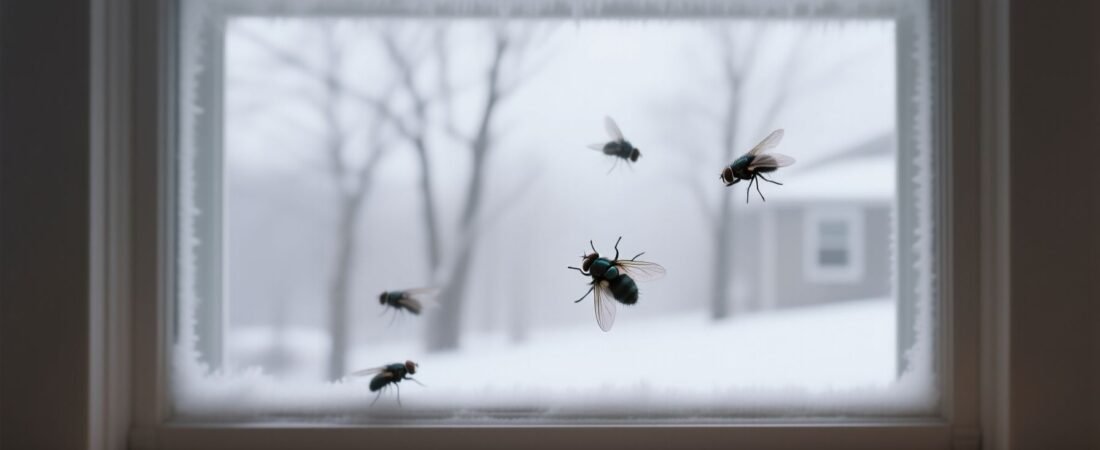
Dead of winter, windows sealed shut, heat running — and there’s a fly buzzing against your window. That single fly feels like a fluke. Then you see another one a few days later. Then three more the following week. Here’s the thing most people get wrong about winter flies: they assume they’ve got a breeding problem. They tear apart the kitchen looking for rotting fruit, dump every trash can, and scrub the drains. But indoor flies in winter almost never come from an active breeding source inside your home. They’re already in your house — they’ve been there since fall — and they’re waking up because you’re keeping the place warm.
Why Are Flies Still Alive Inside My House in Winter?
The short answer is overwintering. Several fly species — cluster flies being the most common culprit — enter homes in late summer or early fall looking for a warm place to spend the winter. They squeeze through gaps in window frames, siding, soffits, and roof vents, and they tuck themselves into wall voids, attic spaces, and insulated cavities. Once settled, they enter a sluggish, dormant-like state. They’re not dead. They’re just waiting.
The problem is your thermostat. On a warm sunny afternoon in January, the south-facing wall of your house absorbs enough solar heat to trick the flies inside that wall cavity into thinking spring has arrived. They start moving toward light — which means toward your windows, your ceiling, your living spaces. A cluster fly infestation can involve anywhere from dozens to several hundred flies packed into a single wall void, so even a small “waking fraction” can feel like a full-blown invasion.
What Kind of Flies Show Up Indoors in Winter?
Not all winter flies are the same species, and getting the identification right matters because each type points to a different entry point and a different fix. Cluster flies (Pollenia rudis) are the most frequent winter invader — they’re slightly larger and slower than house flies, have a dark gray checkered abdomen, and tend to pile up in clusters (hence the name) near warm sunny windows. They breed in earthworm-rich soil outdoors in warmer months and have zero interest in your food or garbage.
Face flies (Musca autumnalis) are another common one, almost identical in appearance to house flies but slightly more robust — they primarily overwinter in rural or semi-rural homes near livestock. Blow flies and bottle flies can also appear in winter, but when they show up, it usually signals something different and more serious: a dead animal somewhere inside the structure. A mouse or squirrel that died in your wall cavity can sustain a blow fly population even in cold weather if it’s near a heat source, producing flies that emerge into your living space over a period of 1-3 weeks post-death.
| Fly Type | Appearance | What It Usually Means |
|---|---|---|
| Cluster Fly | Dark gray, gold hairs on thorax, sluggish movement | Overwintering in wall voids or attic |
| Face Fly | Very similar to house fly, slightly larger | Overwintering — common in rural homes |
| Blow Fly / Bottle Fly | Metallic blue, green, or bronze sheen | Dead animal inside the structure |
| House Fly | Gray with 4 dark stripes, active and erratic | Active indoor breeding source — check drains, trash, hidden organic material |
How Did Flies Get Inside a Sealed House?
This is the part that genuinely surprises people. Your house feels sealed tight in winter, but cluster flies entered months ago — typically between late August and October — before you even thought to close things up for the season. They’re remarkably good at finding tiny gaps. A cluster fly can squeeze through an opening as small as 1/16 of an inch, which is barely the thickness of a credit card. Common entry points include loose-fitting window screens left in place into fall, gaps around utility penetrations in exterior walls, deteriorated caulk around window and door frames, open or unscreened roof vents, and soffits where the fascia board has pulled slightly away from the roofline.
Picture this: you replace your windows in late spring, everything looks tight and new. But the contractor leaves a small gap where the new frame meets the old exterior trim — maybe 3mm wide, running 8 inches along the top. By September, cluster flies have found it. By the time the first hard frost hits, 200 flies are sleeping inside your wall cavity and you have no idea. You won’t know until January, when a warm afternoon wakes 30 of them up and they start bumbling across your ceiling.
Pro-Tip: If you’re seeing winter flies consistently on the same side of the house year after year — almost always the south or west-facing walls — that’s a reliable indicator that the overwintering colony is concentrated in the wall cavity on that side. Focus your exclusion work there first. Solar exposure is what warms that side faster, triggering emergence.
How Do You Know If It’s Overwintering or an Active Infestation?
This distinction is the one that saves you the most time and frustration. An overwintering situation has a recognizable pattern: flies appear in small numbers, they’re slow and disoriented, they congregate near windows and upper walls rather than food areas, and the problem peaks on sunny winter days and then seems to calm down for stretches. You might see 5 flies one afternoon, nothing for a week, then 8 more during the next warm spell. The numbers don’t steadily escalate. That’s the dormancy cycle playing out.
An active indoor breeding infestation looks different. The numbers climb steadily. You find flies near food, garbage, drains, or any area with moisture and organic decay. You might find maggots — which are the larval stage — or notice a smell. House flies complete their full life cycle in as little as 7-10 days at room temperature, so an unchecked indoor breeding situation doubles down fast. If you’re seeing more flies every single day with no plateau, stop looking at your windows and start looking at your drains, your trash cans, any area under appliances where organic material might accumulate.
“Most homeowners who call us about winter flies have already spent a week cleaning things that have nothing to do with the problem. Cluster flies don’t care about your fruit bowl. They care about getting back outside in spring. The real issue is always structural — gaps in the building envelope that let them in during fall. Once you understand that, the fix becomes a lot simpler and a lot less panicked.”
Dr. Marcus Bellfield, Board-Certified Entomologist and Urban Pest Management Specialist
What Can You Actually Do About Winter Flies Right Now?
Your options split into two categories: dealing with the flies that are already inside, and preventing next year’s population from getting in at all. Both matter, but they require completely different actions. For the flies already in your home, the most effective immediate approach is a combination of a fly-specific aerosol insecticide applied into wall voids through electrical outlets or light fixtures (with the power off), plus a light trap or sticky trap near windows to catch the ones that are already mobile. Trying to swat your way out of a cluster fly overwintering situation is a losing game — you can kill 30 and 200 more are still asleep in the wall.
For next season’s prevention, timing is everything. The exclusion work needs to happen before Labor Day — September at the latest in most of the northern US. By October, the flies have already started looking for entry points. Here’s a practical action plan organized by timing:
- Inspect and seal in late summer (August–September): Walk the exterior of your home and caulk any gap wider than 1/16 inch around window frames, door frames, utility penetrations, and where siding meets the foundation. Use a silicone-based exterior caulk that stays flexible through freeze-thaw cycles.
- Address roof and attic vents: Make sure all soffit vents, gable vents, and roof vents have intact fine-mesh screens. Cluster flies routinely use these as highway entrances to attic overwintering sites.
- Apply a residual insecticide to exterior surfaces in early fall: A pyrethroid-based product (like lambda-cyhalothrin or bifenthrin) applied to the south and west-facing exterior walls in late August to early September creates a chemical barrier flies contact when they land and probe for entry points. This is the single most effective preventive step.
- Install a UV light trap indoors for the current winter: These won’t eliminate the overwintering colony but they’ll catch emerging flies before they become a nuisance. Place it near the window where you see the most activity, not in the center of the room.
- If you suspect a dead animal, act within 72 hours: Metallic-colored blow flies emerging in winter almost always mean a carcass somewhere in the structure. The longer you wait, the deeper the maggot development and the longer the emergence continues. A pest professional or wildlife removal specialist can often locate the carcass using a moisture meter or thermal camera.
One honest nuance here: the severity of your winter fly problem varies considerably depending on where you live and what surrounds your property. Homes on the edge of agricultural land or near pastures deal with far heavier cluster fly and face fly pressure than urban properties surrounded by pavement and buildings. If you’re in that rural or semi-rural situation, DIY exclusion may reduce but not eliminate the problem, and a professional perimeter treatment applied by a licensed pest control company in late August tends to produce substantially better results than anything you can do with store-bought products alone.
It’s also worth knowing that some other winter visitors get misidentified as flies. If you’re finding slow-moving, many-legged creatures crawling across your ceiling or basement walls rather than buzzing against windows, you might be dealing with something else entirely — understanding what centipedes vs millipedes look like and their key differences can help you sort out what you’re actually seeing before you treat for the wrong pest.
Are Winter Flies Actually Harmful, or Just Annoying?
Cluster flies are genuinely harmless from a health standpoint. They don’t bite, they don’t breed on food, and they don’t transmit disease. Their one unpleasant quality — besides the sheer number of them — is the faintly sweet, musty odor they release when disturbed or crushed, which comes from an aggregation pheromone they use to attract more flies to the same overwintering site. That pheromone lingers in wall voids for years, which is why homes that have had cluster fly problems tend to have them again the following fall in the same location.
The real risk, and it’s indirect, is that a large overwintering cluster fly population in your walls or attic can attract other predators. Certain spider species actively hunt for overwintering flies in attic spaces. And while most spiders are harmless, the presence of a reliable food source in your attic can support larger, more persistent spider populations. If you’ve ever noticed what seemed like an unusually high number of spiders in your upper floor or attic and couldn’t figure out why, a fly overwintering colony is sometimes the explanation nobody mentioned. For context on when spiders’ biting relatives might actually pose a concern, the same logic applies — knowing when a bite actually warrants medical attention is useful any time you’re dealing with unexpected pest activity indoors.
Here are the practical health and safety considerations to keep in mind with winter flies:
- Cluster flies and face flies: No direct health risk to humans or pets — nuisance only
- Blow flies and bottle flies: Indicate a decomposing animal source; the carcass itself can create air quality issues and attract other pests
- House flies breeding indoors: Can mechanically transfer bacteria from breeding material to food surfaces — this is the scenario worth taking seriously
- Aggregation pheromone in walls: Can stain interior wall surfaces over time and will attract new flies to the same site each fall indefinitely if not addressed
- Insecticide use in wall voids: Follow label directions carefully — treating a wall void with too much product can cause dead flies to accumulate and secondary pest issues (dermestid beetles feeding on fly carcasses, for instance) to develop
One counterintuitive fact that almost never makes it into pest control articles: crushing or swatting cluster flies indoors actually makes your future problem worse. When you crush them, they release that aggregation pheromone, which can intensify the chemical signal in your wall void and draw even more flies to the same site next fall. A vacuum with a bag — seal and dispose of it immediately — is a genuinely better removal method than a fly swatter in a cluster fly situation.
If you’re dealing with winter flies right now, the single most useful shift in thinking is this: stop treating it as a sanitation problem and start treating it as a building envelope problem. Cleaning won’t fix overwintering cluster flies. Sealing the structure will. Get through this winter with light traps and a vacuum, then make exclusion work your priority before the first frost next fall — that’s the action that actually ends the cycle.
Frequently Asked Questions
why are there flies in my house in winter?
Flies don’t disappear in winter — they find warm places to ride out the cold, and your home is a perfect target. Cluster flies, house flies, and blow flies are the most common culprits, and they typically sneak in through gaps around windows, doors, and utility lines in the fall before temperatures drop below 50°F. Once inside your walls or attic, they stay dormant until a warm spell wakes them up and they start buzzing around your living space.
what kind of flies are in my house in winter?
The three flies you’re most likely dealing with are cluster flies, blow flies, and house flies. Cluster flies are sluggish and tend to appear in large groups near windows and sunny walls — they’re bigger than house flies and have a golden fuzz on their thorax. Blow flies are metallic green or blue and often signal a dead rodent or bird somewhere in your walls or attic, since they need decaying organic matter to breed.
how do I get rid of flies in my house in winter?
Start by vacuuming up any flies you can see, then seal entry points like window frames, door sweeps, and utility penetrations with caulk or weatherstripping. For large cluster fly infestations inside walls or attics, a pyrethrin-based aerosol or insecticide dust applied in late summer or early fall works best as a preventive treatment. If flies keep coming back despite sealing gaps, call a pest control professional — they can treat wall voids and attic spaces where flies are overwintering in large numbers.
are winter flies in my house dangerous?
Cluster flies aren’t a direct health threat — they don’t bite, breed indoors, or contaminate food the way house flies do. However, house flies and blow flies can spread bacteria like Salmonella and E. coli if they’re landing on food prep surfaces, so you’ll want to deal with them quickly. Blow flies in winter are a bigger red flag because their presence usually means there’s a dead animal decaying somewhere nearby, which can create odor and secondary pest problems.
where are winter flies coming from in my house?
In most cases, flies that appear in winter are coming from inside your walls, attic, or crawl space — not from outdoors. They entered your home in the fall through tiny gaps and have been overwintering in clusters, and warm indoor air or a sunny wall surface triggers them to become active again. Check around south- and west-facing walls, attic vents, and roof soffits, since those are the warmest spots flies tend to gather in large numbers before winter sets in.