

Adult clothes moths almost never eat your wool sweater. That’s the part nobody tells you — and it’s exactly why most homeowners waste weeks hunting for the wrong pest. The moth you spotted fluttering near your closet is essentially a distraction. It’s the larvae doing every bit of the destruction, and they look nothing like what you’d expect.
Getting clothes moths identification right means shifting your focus away from the adult insect entirely and learning to read a different kind of evidence. By the time you see a grown moth in the room, there’s a good chance the larvae have already been feeding for weeks — possibly months — hidden deep inside folded fabric, beneath furniture cushions, or in that box of cashmere you haven’t opened since last winter.
What Do Adult Clothes Moths Actually Look Like?
Adult clothes moths are small — roughly 1/4 to 3/8 of an inch long — and a pale, golden-buff color that most people describe as “tan” or “straw yellow.” They don’t have the dramatic wing patterns of pantry moths or the size of common house moths. Two species are responsible for the overwhelming majority of household fabric damage in the US: the webbing clothes moth (Tineola bisselliella) and the casemaking clothes moth (Tinea pellionella). Both are small and unremarkable-looking, which is part of why they go unnoticed for so long.
One reliable visual detail: webbing clothes moths have a tuft of reddish-gold hairs on top of their head, like a tiny mohawk. Casemaking clothes moths have small dark spots on their wings — subtle, but visible if you get close enough. Both species actively avoid light, which is the opposite of most moths you’ve encountered outside. If a moth is dive-bombing your porch light, it isn’t a clothes moth. Clothes moths flee from bright light, which is exactly why you find them lurking in dark closets, under furniture, and inside storage bins.
This close-up comparison shows both the webbing clothes moth and the casemaking clothes moth side by side — pay attention to the head coloring and wing spot differences, because confusing these two species can send your control strategy in the wrong direction.
What Do Clothes Moth Larvae Look Like Up Close?
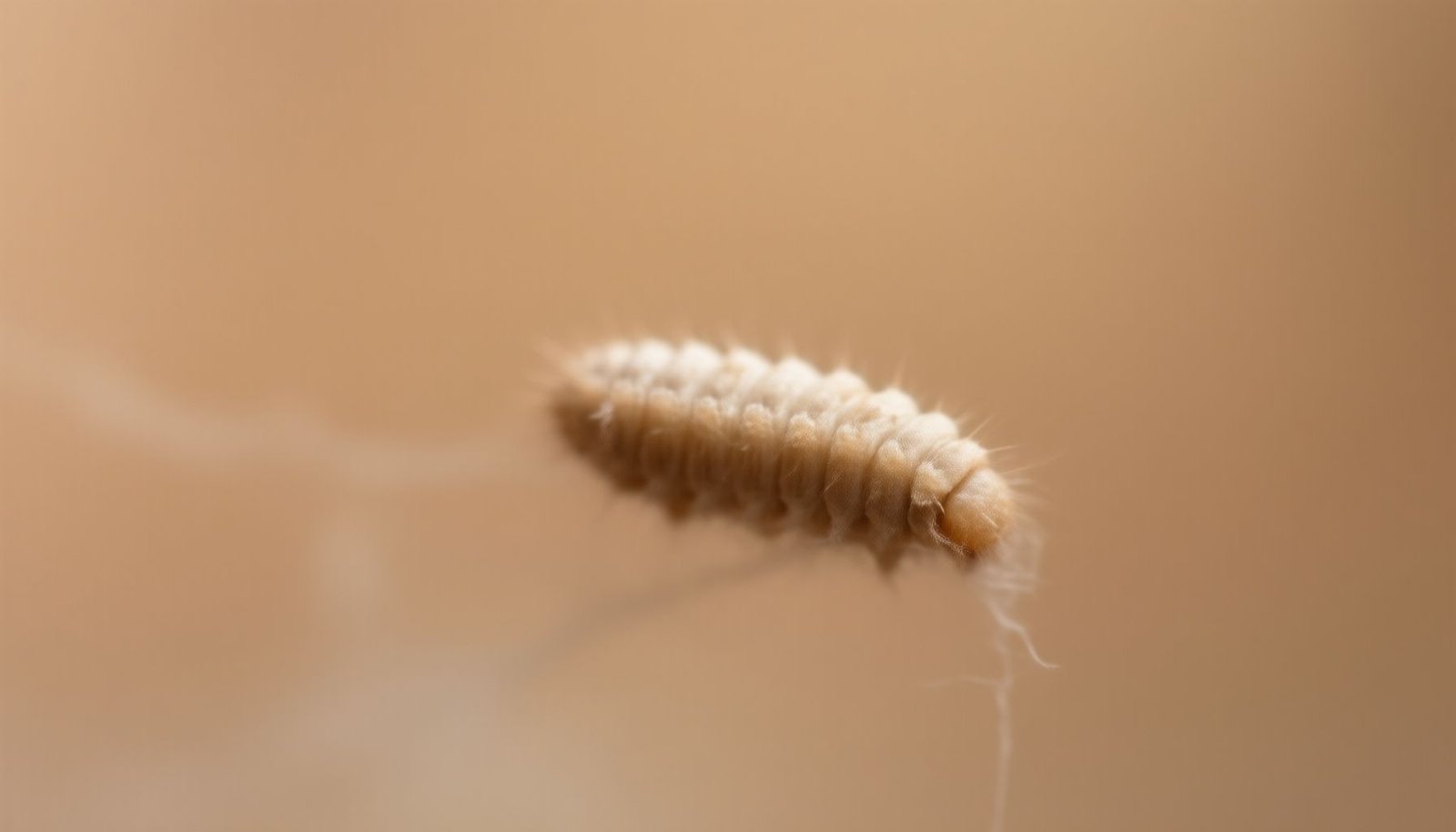
Clothes moth larvae are creamy-white caterpillars with a brown or amber-colored head capsule. They’re tiny — newly hatched larvae are barely 1 millimeter long, and even fully grown ones rarely exceed 1/2 inch. They don’t wander openly. Larvae of the webbing clothes moth spin silken tubes or mats and feed while staying inside or directly beneath that webbing, which is why spotting them requires actually disturbing the fabric and looking underneath.
Casemaking moth larvae are arguably easier to identify because they carry a small, portable silken case around with them — think of it as a tiny sleeping bag made of fiber and their own excrement. The case is usually the same color as the fabric they’ve been eating, so on a beige garment it looks beige, and on dark wool it looks dark. That color-matching detail trips people up constantly; they assume the case is just a bit of fluff rather than evidence of an active infestation. A female clothes moth can lay between 40 and 50 eggs over a 2–3 week period, and those eggs hatch in as little as 4 days in warm conditions — which means a population can build silently before you’ve noticed a single damaged thread.
“Most people bring infested items into their home without knowing it — a thrift store coat, a vintage rug, a gift of inherited wool blankets. By the time fabric damage appears, the infestation is usually at least one or two generations deep. Learning to identify the larval stage and its physical traces is genuinely the most practical skill a homeowner can develop here, because adults are largely irrelevant to the damage equation.”
Dr. Patricia Kelso, Board-Certified Entomologist and University Extension Specialist in Urban Pest Management
How Do You Tell Clothes Moth Damage Apart From Other Fabric Damage?
This is where clothes moths identification gets genuinely difficult, and most guides gloss right over it. Clothes moth damage looks almost identical to carpet beetle damage at first glance — both create irregular holes or thinning patches in natural-fiber textiles. The key difference is in the physical evidence left behind. Clothes moth larvae leave silken webbing (sometimes matted flat against the fabric surface) and tiny sand-grain-sized fecal pellets that match the color of the fiber they’ve been eating. Carpet beetle larvae leave cast skins — brittle, hollow brown shells — but no webbing at all.
The location of damage is another reliable tell. Clothes moth larvae avoid light so intensely that they almost always feed in concealed areas: the underside of a rug, inside a folded sweater, the hidden areas of an upholstered chair near the floor. If you’re seeing damage on the top surface of a displayed rug or on easily visible areas of a garment, carpet beetles become more likely. That said, in a heavy infestation, clothes moth larvae will eventually feed in more exposed areas — so this isn’t a hard rule, just a strong starting point.
Pro-Tip: Run your hand firmly across the surface of suspected fabric and then flip it over. If you find flat, silken tracks or tiny tubes of webbing fused to the fibers — not just surface fuzz — you’re almost certainly looking at webbing clothes moth larvae, not carpet beetles or general wear.
| Damage Feature | Clothes Moth Larvae | Carpet Beetle Larvae |
|---|---|---|
| Silken webbing on fabric | Yes — flat mats or tubes | No |
| Cast skins left behind | Rarely visible | Yes — brittle brown husks |
| Fecal pellets | Yes — tiny, fiber-colored | Minimal |
| Preferred feeding location | Hidden, dark areas of fabric | More exposed surfaces tolerated |
Which Fabrics and Materials Are Clothes Moths Actually After?
Here’s the counterintuitive part that most articles skip: clothes moths aren’t after the fabric itself. They’re after keratin — the protein found in animal-derived fibers. Wool, cashmere, angora, mohair, silk, leather, and fur are all high-value targets. A 100% cotton t-shirt could sit in the same closet for years without a single bite taken out of it. This is why a “moth problem” in someone’s wardrobe almost always concentrates in the most expensive pieces they own — the natural-fiber items — while cheaper synthetics go untouched.
There’s one important exception worth knowing: blended fabrics. A sweater that’s 80% merino wool and 20% nylon will still be attacked because the keratin content is high enough to be useful to the larvae. And clothes moths will occasionally feed on cotton or synthetic fabrics if those items are soiled with food, body oils, or sweat — the stain itself provides enough protein to make it worthwhile. Picture this: a gym bag left in a dark closet corner, stuffed with a polyester sports jersey that hasn’t been washed — that jersey is now potentially at risk, even though the material itself isn’t a natural fiber. It’s a scenario most people never consider.
Where in Your Home Should You Be Inspecting for Clothes Moths?
Clothes moths are remarkably predictable in where they establish. They’re not roamers — a single female will often lay all her eggs in one spot if conditions are right. That means infestations tend to stay concentrated in one area for a surprisingly long time before spreading, which is actually useful information if you catch it early. The list below covers the high-probability locations to inspect, in rough order of likelihood.
- Dark closet corners and folded storage: Any wool or cashmere item that hasn’t been moved in 3+ months is a primary target. Unfold and inspect each piece individually — larvae hide in the folds.
- Underneath area rugs and carpet edges: The underside of wool rugs is a classic infestation site. Pull back a corner and look for silken webbing, fecal debris, or thinning fibers.
- Upholstered furniture near floor level: The bottom fabric layer of sofas and chairs, especially if made with wool or down filling, is frequently damaged before the visible surfaces show any sign.
- Storage boxes and vacuum-sealed bags: Counterintuitively, vacuum-sealed storage isn’t always a barrier — if an infested item was sealed inside, the larvae simply develop in the low-oxygen environment and can survive.
- Piano felts and taxidermy: Both contain keratin-rich animal material and are common, often-overlooked infestation sources. If you have either in the home, they deserve a close inspection.
- Items stored in garages or attics: Seasonal clothing stored in those spaces is particularly vulnerable because low foot traffic means infestations go undetected longer. If you’re also dealing with other fabric-damaging insects in those spaces, it’s worth reading about bugs in your garage and how to identify what you’re dealing with before assuming it’s definitely a moth problem.
One thing that genuinely affects how widespread an infestation becomes is humidity. Clothes moth larvae thrive in relative humidity above 70% and temperatures between 65°F and 80°F. In drier climates or well-ventilated homes, development slows considerably — larvae can take up to 30 months to reach adulthood in cool, dry conditions, versus as little as 2 months in warm, humid environments. This means a home in coastal Florida faces a materially different risk profile than the same home in Arizona, and it’s worth factoring local climate into how aggressively you respond.
What Signs Confirm You Have Clothes Moths and Not Something Else?
The confirmation checklist matters because misidentification here leads to wasted effort. Silverfish, for instance, also damage natural-fiber textiles and paper, but leave a completely different physical signature — irregular surface grazing and yellow staining rather than through-holes, with no webbing involved. If you haven’t already ruled out silverfish as a contributor, it’s worth understanding how to tell if your house has a silverfish problem, because both pests can be active in the same dark, undisturbed spaces at the same time.
A confirmed clothes moth infestation shows a specific cluster of signs together — rarely just one in isolation. Here’s what to look for as a package:
- Small, pale gold moths moving slowly along walls or baseboards (not flying toward light)
- Silken webbing or flat tubes fused to the surface or underside of wool or silk fabrics
- Creamy-white larvae with brown heads found inside webbing or inside a portable silken case
- Tiny fecal pellets the same color as the fabric being consumed
- Irregular holes or thinning patches in natural-fiber textiles — often in folded or hidden areas first
- Empty egg casings (very small, white, oval) on or near damaged items
Finding two or more of these signs together — especially larvae with webbing and fabric damage in a concealed location — is about as close to a definitive identification as you’ll get without a lab. The more signs present simultaneously, the longer the infestation has likely been active, and the more systematically you’ll need to inspect the entire home rather than just the one spot where you found the evidence.
Getting the identification right before you treat is non-negotiable. Cedar blocks and lavender sachets — the standard DIY advice — do essentially nothing against an active larval infestation. They may have some weak repellent effect on egg-laying adults, but they won’t kill larvae that are already feeding. Knowing exactly what you’re dealing with, confirmed by physical evidence rather than a single adult moth sighting, is the difference between taking real action and rearranging your closet while the larvae keep feeding underneath your cashmere.
Frequently Asked Questions
What do clothes moths look like?
Clothes moths are small, buff or golden-tan colored moths about 1/2 inch long with narrow wings fringed with tiny hairs. Unlike pantry moths, they avoid light and you’ll rarely see them flying around — they prefer dark, undisturbed spots like the back of closets or under furniture. If you’re seeing moths fluttering toward lamps, it’s probably a different species.
How do I know if I have clothes moth larvae or just normal wear on my clothes?
Clothes moth larvae damage shows up as irregular holes, usually on natural fibers like wool, cashmere, silk, or fur — they won’t touch synthetic fabrics. You might also spot silky tubes or patches of webbing woven into the fabric, which is a dead giveaway. Normal wear tends to thin fabric evenly, while moth damage looks patchy and concentrated in one area.
What do clothes moth eggs look like?
Clothes moth eggs are tiny — about 0.5mm long — white or cream colored, and oval shaped. A female can lay anywhere from 40 to 50 eggs over her 2-3 week lifespan, tucking them into fabric fibers where they’re nearly impossible to spot with the naked eye. If you’re trying to identify an infestation early, look for the larvae or webbing rather than the eggs themselves.
Where do clothes moths hide in your house?
Clothes moths gravitate toward dark, undisturbed areas — think stored woolens in the back of closets, under upholstered furniture, inside cardboard boxes, or in wool rugs that rarely get moved. They’re especially drawn to items that have sweat, food stains, or body oils on them, since that extra protein helps the larvae develop. Seasonal storage bins are one of the most common places people discover an infestation.
Are clothes moths the same as pantry moths?
No, they’re completely different insects. Clothes moths belong to the Tineidae family and feed on keratin found in animal-based fibers, while pantry moths (like the Indian meal moth) infest dry foods like grains, nuts, and cereals. The easiest way to tell them apart is behavior — clothes moths flee from light, while pantry moths are attracted to it and you’ll often see them near kitchen lights at night.