
Your neighbor brought bed bugs home from a hotel, and now they’re in your apartment too. So who’s on the hook? Here’s the answer most people don’t want to hear: it’s almost never as simple as “the landlord pays” or “the tenant who brought them in pays.” The real problem is that how the infestation spread — not just where it started — determines legal and financial responsibility, and that distinction gets ignored in nearly every conversation about this topic.
Why Spread Pattern Matters More Than Origin Point
Most renters focus on figuring out who introduced the bed bugs — the person who traveled, the tenant with secondhand furniture, the one who “lives dirty.” But that framing almost never holds up legally or practically, because bed bugs can travel through wall voids, electrical conduit runs, plumbing chases, and shared HVAC systems. A single female bed bug that crosses from Unit 4B to Unit 4A can lay between 1 and 5 eggs per day, meaning a full-scale infestation can establish itself within 30 to 45 days — long before anyone in Unit 4A even notices a bite.
The spread pattern is the part that actually defines responsibility. If bed bugs moved between units because of gaps in shared walls that the landlord failed to seal, that’s a maintenance failure — not a tenant failure. If a tenant knowingly concealed an infestation and it spread to three neighboring units, that changes the calculus entirely. The origin story matters less than you’d think; the building’s condition and the landlord’s response time matter a whole lot more.
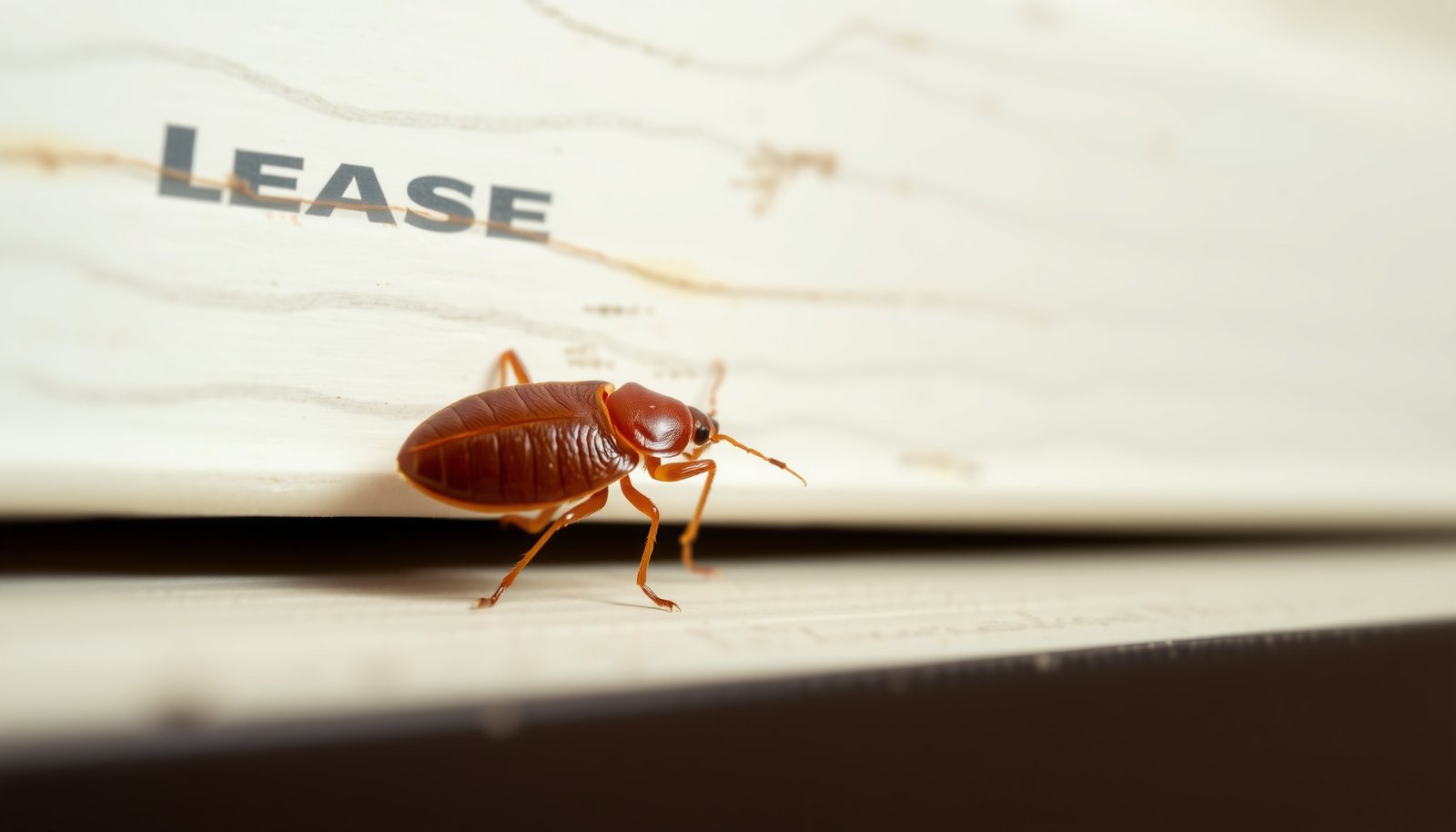
This close-up shows how bed bugs cluster near wall seams and baseboards — exactly the hidden pathways they use to migrate between adjacent units without anyone seeing them move.
How Bed Bugs Actually Move Through a Building
Picture this: a building inspector doing a routine check finds bed bug activity in five separate units — none of which share a wall directly with each other. This happens more often than anyone admits, and it usually means the bugs traveled through the building’s infrastructure rather than through doors or hallways. Bed bugs are remarkably flat (a fully grown adult is roughly the thickness of a credit card) and can squeeze through gaps as narrow as the edge of a piece of cardboard. Wall outlets, pipe penetrations, and gaps around conduit are not just possible pathways — they’re common ones.
Here’s the counterintuitive part: bed bugs don’t actually prefer to travel. They’re not aggressive wanderers like cockroaches. They move when their food source disappears — meaning when a tenant travels, leaves for a week, or sleeps in a different room — the bugs follow carbon dioxide and body heat toward new hosts. A bed bug can survive over 400 days without a blood meal under cooler conditions, so they’re not desperate. They’ll wait, then migrate when it’s worth it. That patience is what makes multi-unit spread so hard to catch early.
What the Law Actually Says About Landlord Responsibility
Landlord-tenant law on bed bugs varies significantly by state, but the underlying principle is consistent: landlords are generally required to provide and maintain a habitable dwelling. Bed bug infestations — especially ones that spread across units — typically trigger that habitability standard. Over 20 U.S. states have laws that explicitly address bed bugs in rental properties, and most of them place the initial treatment burden on the landlord, not the tenant, unless the tenant demonstrably caused or concealed the infestation.
The legal timeline is where tenants consistently lose leverage. If you notify your landlord in writing and they fail to respond within a reasonable window (typically 7 to 14 days depending on state law), you may gain rights to withhold rent, arrange treatment yourself and deduct from rent, or break the lease without penalty. But if you wait, treat it yourself without notifying the landlord, or tell your neighbors before telling management, you may inadvertently complicate your own legal standing. Document everything, and do it the day you find the first bug.
“The most common mistake I see tenants make is treating the infestation themselves first and notifying the landlord second. Once you’ve done that, you’ve muddied the record of when the problem started and how bad it was. Landlords use that ambiguity against you. Your first move should always be written notification — email, not a text — before you throw out a single piece of furniture or buy a single spray.”
Dr. Patricia Wren, Board-Certified Entomologist and Rental Housing Consultant, University Extension Pest Management Program
When a Neighbor Is Clearly the Source — Does That Change Anything?
Legally speaking, even if you can prove your neighbor introduced the bed bugs — say, management confirmed the infestation originated in Unit 3C and spread to yours — that rarely shifts financial responsibility from the landlord to your neighbor. In most states, your legal relationship is with your landlord, not with the other tenants. Your neighbor isn’t your landlord’s agent, and unless they acted with gross negligence (like ignoring repeated notices and refusing treatment while knowingly spreading infestation), you can’t typically sue them in small claims court and win on that basis alone.
That said, the “source tenant” situation does affect how treatment gets coordinated. Most pest management professionals won’t guarantee results in your unit if the adjacent unit isn’t being treated simultaneously. Some landlords try to bill the source tenant for the full treatment across all affected units — that’s legally murky and often doesn’t hold up, but it happens. What’s clearer is that a landlord who treats only your unit and ignores the reported source unit is likely failing their duty of care, and that failure creates additional liability for them if the infestation returns.
Pro-Tip: Ask your landlord in writing whether adjacent units are also being inspected and treated. If they say yes, ask for confirmation of that from the pest control company. Bed bug treatment that covers only your unit in a multi-unit building has roughly a 60-70% chance of requiring retreatment within 90 days — because the source population is untouched.
What Tenants Should Actually Do When Bed Bugs Spread Into Their Unit
The steps below are ordered deliberately — the sequence matters as much as the actions themselves, especially if you end up in a dispute with your landlord or a future legal proceeding.
- Document before you touch anything. Take photos and video of any bugs, casings, staining, or bite patterns. Capture the date with a timestamp. This is your baseline evidence and it’s irreplaceable once you start treating or cleaning.
- Send written notification to your landlord immediately. Email is better than text because it creates a timestamp and a paper trail. State the date you found the bugs, describe the extent of what you saw, and request a written response with a timeline for inspection and treatment.
- Request that adjacent units be inspected. You can do this in the same notification email. If your landlord refuses or ignores this request, that refusal is itself significant documentation.
- Do not discard furniture without landlord approval. Throwing out a mattress before an inspection is complete can destroy evidence and may actually trigger bed bug spread through the hallway or dumpster area, affecting other tenants.
- Contact your local housing authority if the landlord is unresponsive. Most cities and counties have a housing code enforcement office that can compel landlords to act. A formal complaint also creates an official record that strengthens any future legal claim.
- Know your state-specific rights before taking any unilateral action. Rent withholding and “repair and deduct” remedies are not available in every state, and using them incorrectly can expose you to eviction proceedings. Check your state’s tenant rights handbook before acting.
The honest nuance here is that this process plays out very differently depending on whether you’re in a large professionally managed building, a small landlord situation with a single owner, or a rent-controlled unit in a city with strong tenant protections. A tenant in San Francisco has meaningfully different leverage than a tenant in a state with minimal bed bug statutes. The steps above apply everywhere, but the outcomes vary.
How to Reduce Spread to Your Unit While the Landlord Responds
There’s a window between when you report the infestation and when treatment actually happens — sometimes a few days, sometimes a few weeks. During that window, you can take defensive measures that won’t undermine your legal standing and will genuinely slow the spread. These aren’t cures. They’re containment tactics, and the distinction matters.
Here’s what actually makes a measurable difference in that interim period:
- Seal electrical outlets on shared walls with outlet covers or foam gaskets — this blocks one of the most common bed bug travel corridors between units.
- Use mattress and box spring encasements rated specifically for bed bugs (look for “bite-proof” seams). These don’t kill bugs already present, but they eliminate the most common harborage site and make visual inspection dramatically easier.
- Run clothing and bedding through a dryer at high heat for 30 minutes — not a wash cycle, a dry cycle. Temperatures above 120°F kill bed bugs at all life stages within minutes, and most home dryers reach that threshold.
- Reduce clutter near beds and shared walls to eliminate harborage zones and make any follow-up inspection faster and more accurate.
- Do not use bug bombs or foggers. They don’t penetrate the cracks where bed bugs live, and the repellent effect can scatter bugs deeper into walls — including into neighboring units — making the infestation harder to treat and potentially expanding your liability.
Understanding the actual cost breakdown between heat treatment and chemical treatment is worth doing before your landlord schedules anything — because not all treatment methods are equally effective in multi-unit buildings, and heat treatment, while more expensive, tends to produce better outcomes in apartment settings where chemical resistance is a growing issue.
What Building-Wide Treatment Actually Involves
One thing that surprises tenants going through this process is how different building-wide bed bug treatment is from a single-unit treatment. It’s not just “more of the same.” Treating multiple connected units requires coordinated scheduling, simultaneous access, and often a different chemical or heat protocol than what works for a single apartment. If a pest control company treats units on alternating days — Monday in 4A, Wednesday in 4B — they’re essentially chasing bugs around the building, not eliminating them.
Here’s a practical comparison of how different treatment approaches play out in a multi-unit building context:
| Treatment Type | Best For Multi-Unit? | Key Limitation |
|---|---|---|
| Heat treatment (whole-unit) | Yes — high efficacy | Requires tenant to vacate; expensive at scale |
| Chemical spray (residual) | Moderate — works if all units treated simultaneously | Growing chemical resistance in urban populations; requires multiple visits |
| Canine inspection + targeted treatment | Yes — good for identifying scope | Detection only; must be paired with a treatment protocol |
| DIY foggers/bombs | No — contraindicated in apartments | Scatters bugs without killing them; increases spread risk |
It’s also worth knowing that some pest control companies will only treat the units a landlord pays for — they won’t proactively flag adjacent units even if they suspect infestation there. That’s not negligence on their part; it’s just the scope of the contract. As a tenant, you can ask the technician directly during the visit whether they observed signs of activity in other areas. Most will tell you honestly, even if their report only covers what they were hired to assess.
One thing that rarely gets mentioned in bed bug articles: the same diligence you’d apply to a bed bug problem applies to other parasitic infestations too. If your building has had any history of flea problems from previous tenants with pets, some of the same containment logic applies — and understanding which flea treatments actually work for home infestations can help you protect your space during any interim period between reporting and treatment.
Can You Sue Your Landlord — and What Would It Actually Take?
Small claims court is a realistic option for tenants whose landlords fail to address a spreading bed bug infestation — but only if the paperwork is solid. Courts want to see: when you notified the landlord, what their response was (or wasn’t), what the infestation cost you in treatment, lost property, or alternative housing, and whether you took reasonable steps to cooperate with treatment. A tenant who documented everything and followed the proper notification process has a genuinely strong case. One who threw out a $1,200 mattress without notice and started self-treating has a much harder time.
The realistic ceiling on small claims damages varies by state — most are in the $5,000 to $10,000 range — and you’d typically be pursuing reimbursement for extermination costs, damaged property, and potentially temporary housing if the infestation made your unit uninhabitable. Punitive damages are rarely available in small claims. But the threat of a credible small claims filing is often enough to motivate a landlord to act, especially if they manage multiple units and a judgment would affect their rental history. Sometimes the goal isn’t to win in court — it’s to make inaction more expensive than action.
Bed bugs spreading between apartments is genuinely one of the messier pest situations a renter can face — not because the bugs are impossible to eliminate, but because responsibility is shared across people who often don’t trust each other and are communicating through a property manager who has their own interests. The tenants who come out of it best aren’t necessarily the ones in the most legally favorable states. They’re the ones who documented early, communicated in writing, didn’t act unilaterally, and pushed consistently for building-wide treatment rather than accepting a band-aid fix in just their unit. That combination — documentation, persistence, and scope — is what actually resolves this.
Frequently Asked Questions
who is responsible for bed bugs spreading between apartments landlord or tenant?
In most states, landlords are responsible for treating bed bugs when an infestation spreads between units, since it’s considered a building-wide habitability issue. However, if a tenant introduced the infestation — like after bringing in used furniture — they can be held liable for treatment costs. Check your lease and your state’s landlord-tenant laws, because responsibility rules vary significantly by state.
can bed bugs travel through walls from one apartment to another?
Yes, bed bugs can absolutely travel through walls by moving through electrical outlets, plumbing gaps, and cracks in drywall. They’re flat enough to squeeze through openings as thin as a credit card, so shared walls between units are a common pathway. If your neighbor has an active infestation, you can see bugs in your apartment within days, especially if you share a wall or floor.
do I have to tell my landlord if I have bed bugs in my apartment?
In most states, you’re legally required to report a bed bug infestation to your landlord in writing as soon as you notice it. Failing to report it promptly can actually shift liability onto you if the infestation spreads to neighboring units. Keep a copy of any written notice you send, and document the date you reported it.
can my landlord make me pay for bed bug treatment if they spread from another unit?
Generally, no — if bed bugs spread to your unit from another apartment, the landlord is responsible for covering the treatment costs. You shouldn’t be billed for an infestation you didn’t cause, and attempting to charge you in that situation may violate your state’s implied warranty of habitability. If your landlord is pushing back, contact your local housing authority or a tenant rights organization.
how fast can bed bugs spread from one apartment to another?
Bed bugs can spread to an adjacent unit within a few weeks if an infestation goes untreated, and a single pregnant female can produce up to 500 eggs in her lifetime. High-density buildings with shared walls, floors, and ceilings are especially vulnerable to rapid spread. The faster the original infestation is treated, the lower the risk of it jumping to neighboring units.
Disclaimer: This article is for general informational purposes only and does not constitute legal advice. Landlord-tenant laws and pest-related disclosure or habitability requirements vary significantly by state and even by city, and they change over time. Before withholding rent, breaking a lease, or taking other legal action over a pest infestation, consult a licensed attorney or your local tenant rights organization familiar with the laws in your area.