
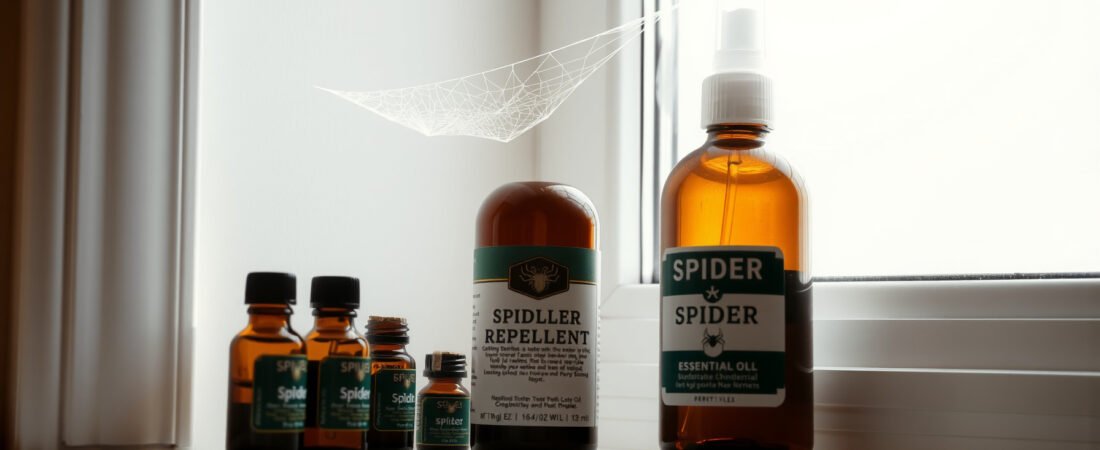
Peppermint oil does repel spiders — just not in the way most people think, and definitely not for as long as the label implies. The real problem with spider repellents isn’t choosing the wrong product. It’s applying the right one in the wrong places, at the wrong frequency, while ignoring the entry points that keep spiders cycling back inside. That’s the gap most guides skip entirely, and it’s why people reapply essential oils every week and still find wolf spiders in their hallway.
The short answer: for indoor use, a combination of residual contact spray along baseboards and targeted essential oil application at entry points outperforms either approach used alone. But the products you pick matter a lot less than understanding why spiders enter in the first place — and timing your repellent application around that behavior.
Why Most Spider Repellents Stop Working After 3–5 Days Indoors
Here’s the part that almost no product listing mentions: spiders don’t absorb chemicals the same way most insects do. They have long legs that keep their bodies elevated off treated surfaces, which means contact repellents that work well on ants crawling across a treated baseboard are dramatically less effective on a spider moving through the same space. A spider can walk right through a treated zone and pick up only a fraction of the chemical dose that a crawling insect would.
Essential oils lose potency indoors even faster — typically within 3 to 5 days at room temperature, and faster near heat sources or in dry climates. Spiders detect chemical irritants through sensory organs on their legs and pedipalps, and once the volatile compounds in peppermint, eucalyptus, or tea tree oil have off-gassed, the deterrent effect is essentially gone. The bottle doesn’t tell you this, but your wall corners will.

This close-up shows the typical application zones where spider repellents are most effective — baseboards, window frames, and wall-floor junctions — which are exactly where spiders travel rather than where homeowners usually spray.
Which Indoor Spider Sprays Actually Hold Up Longer Than a Week?
Residual pyrethroid sprays — products containing active ingredients like bifenthrin, cypermethrin, or lambda-cyhalothrin — are the workhorses of indoor spider control when used correctly. Applied to baseboards, door frames, and the perimeter of rooms, a good bifenthrin-based spray like Bifen IT or Ortho Home Defense Max can maintain effectiveness for 30 to 90 days on non-porous surfaces. That’s a meaningful difference compared to anything essential oil-based.
The catch is surface type. On porous surfaces like unfinished wood, painted drywall, or carpet edges, residual sprays degrade significantly faster — sometimes within a week. Smooth surfaces like tile, vinyl baseboards, and painted trim hold the residual much longer. If your home has a lot of textured walls or natural wood trim, plan to reapply every 3 to 4 weeks instead of every 3 months.
Pro-Tip: Before applying any residual spray, wipe down baseboards and window sills with a dry cloth. Dust, pet hair, and debris act as a physical barrier that insulates spiders from chemical contact — a dirty surface cuts your residual’s effective life nearly in half.
Do Essential Oils Actually Repel Spiders — or Is That Mostly Marketing?
Essential oils do have real repellent properties against spiders — this isn’t just folk wisdom. A study from Sichuan University found that peppermint oil and chestnuts both demonstrated measurable aversion responses in spiders when tested in controlled environments. The active compound in peppermint, menthol, is genuinely irritating to a spider’s chemoreceptors. So yes, there’s something real here. The problem is translating lab findings into a living room.
Picture this: you spray diluted peppermint oil around your bathroom window every Sunday, and for the first couple of days it seems to work. By Wednesday the scent is faint, and by the weekend you’ve got a new cellar spider in the upper corner. That’s not a product failure — that’s just how volatile compounds behave in a ventilated indoor environment. Essential oils are best used as a complement to residual sprays, not a replacement, and they’re most effective as a deterrent at specific entry points rather than broadcast around a whole room.
“Essential oils have genuine aversion properties for spiders, but homeowners overestimate their persistence. The volatile compounds dissipate quickly, especially in climate-controlled homes with air circulation. Where I see them work best is as a targeted deterrent at known entry points — window gaps, door sweeps, pipe penetrations — applied every three to four days. Think of them as a speed bump, not a wall.”
Dr. Mara Hensley, Board-Certified Entomologist and Urban Pest Management Specialist, Cooperative Extension Program
The essential oils with the strongest documented repellent effect on common household spiders include peppermint, tea tree, lavender, eucalyptus, and citrus (d-limonene). Of these, peppermint and eucalyptus have the most consistent supporting research. Cedarwood oil is frequently mentioned online but has weaker evidence for spiders specifically — it’s better documented against certain insects than arachnids.
How to Apply Spider Repellents Indoors So They Actually Work
Application method matters more than product choice for most homeowners. Spiders aren’t randomly distributed throughout a home — they follow edges, corners, and transition zones between wall and floor. They travel along the same paths repeatedly, which is actually useful information when you’re deciding where to apply repellent. Spraying the middle of a wall does almost nothing. Treating the junction where the wall meets the floor does a lot.
Use this sequence for indoor spider repellent application:
- Identify active spider zones first. Check corners at ceiling height, the backs of closets, under bathroom sinks, and along baseboards in rarely disturbed rooms. Active webs or egg sacs tell you where to focus.
- Remove existing webs before treating. Webs contain pheromone markers that attract other spiders. Vacuuming them up eliminates a signal that actively draws more spiders in — don’t just knock them down.
- Apply residual spray along baseboards and door frames in a 4-inch band. Keep the spray low and consistent rather than saturating the surface. You want a treated path, not a puddle.
- Apply essential oil solution at entry points only. A mix of 15–20 drops of peppermint oil per 8 oz of water in a spray bottle works well for window sills, door frames, and any visible cracks or gaps. This is where the volatility is an asset — the strong initial scent deters spiders trying to enter.
- Reapply essential oils every 3–4 days. Set a reminder. Consistency here is the whole game — one missed week and the deterrent effect resets to zero.
- Treat wall voids and pipe gaps with a residual spray or silicone caulk. Spiders entering from outside don’t come through your front door — they come through utility penetrations, gaps behind cabinets, and baseboards near exterior walls. Addressing these entry points physically is more effective than any repellent alone.
One thing that surprises a lot of people: spiders entering from outdoors in fall aren’t looking for warmth the way rodents are. They’re following prey — primarily small flying insects that are themselves moving indoors as temperatures drop. If you’re dealing with a fall spider surge, controlling your indoor insect population (moths, fungus gnats, fruit flies) removes the food source that’s pulling spiders in. The same logic applies to how to get rid of stink bugs in your house in fall and winter — the entry point problem is essentially the same, and sealing gaps pays dividends for multiple pest types at once.
Spider Repellent Products Compared: What to Use, Where, and How Long It Lasts
Not every product type makes sense for every situation. A renter in an apartment building with shared walls has different constraints than a homeowner treating a basement with gaps in the foundation. Here’s how the main categories of indoor spider repellents compare on the factors that actually matter:
| Product Type | Active Ingredient | Indoor Residual Duration | Best Use Case |
|---|---|---|---|
| Residual pyrethroid spray (e.g., Ortho Home Defense, Bifen IT) | Bifenthrin or cypermethrin | 30–90 days on smooth surfaces | Baseboards, perimeter treatment, closets |
| Essential oil spray (DIY or commercial) | Peppermint, eucalyptus, tea tree | 3–5 days | Entry points, window sills, targeted deterrence |
| Glue trap boards | None (mechanical) | Until full or dusty (typically 30–60 days) | Monitoring, high-traffic paths, under furniture |
| Spider repellent granules (cedar or pyrethrin-based) | Cedar oil or pyrethrins | 7–14 days indoors | Closet floors, attic access points, garage entries |
Glue traps deserve more credit than they get in spider control conversations. They don’t repel — but they do two things repellents can’t: they physically remove spiders from the population and they tell you exactly where spiders are traveling. Place them along baseboards at room corners and check them after 48 hours. If you’re catching multiple spiders in one specific location, that’s a trail marker pointing to a nearby entry point that needs sealing. Speaking of entry points — if you’re finding spiders concentrated near walls in one area of your home, it’s worth checking the same spots you’d check for rodents, since small gaps attract multiple pest types; a guide on how to identify rodent entry points and what mice holes look like walks through exactly how to find and evaluate those gaps.
One honest nuance worth stating clearly: if you live in a high-humidity region like the Southeast or the Pacific Northwest, spider pressure is fundamentally different than in an arid climate. Humidity supports larger prey insect populations year-round, which means spider populations are continuously reinforced from outside. In those climates, essential oil deterrents alone are genuinely insufficient — you’ll need consistent residual spray application and aggressive entry point sealing just to stay even. In a dry climate, essential oils are much more likely to be adequate if you’re dealing with occasional wanderers rather than an established population.
Here are the specific product features worth checking before you buy any indoor spider repellent:
- Listed for spiders specifically — not just “insects.” Some pyrethroids are less effective on arachnids at standard dilution rates, so check the label’s pest list.
- Indoor-rated formulation — outdoor concentrates can have higher solvent loads that are inappropriate for enclosed spaces without ventilation.
- Non-staining formula — particularly important for carpet edges and finished wood trim.
- Child and pet re-entry time — most residual sprays are safe once fully dry (typically 30–45 minutes), but verify the specific product’s label, not just the category.
- Scent load — essential oil-based commercial sprays vary enormously in concentration. Products with a very faint scent out of the bottle typically have insufficient active ingredient to maintain even short-term deterrence.
The counterintuitive thing about spider control that almost never gets said plainly: spiders are actually beneficial in most homes. A single adult female house spider can catch and consume 2,000 or more insects per year. The goal for most homeowners shouldn’t be eliminating spiders — it’s keeping them out of living spaces while letting them do their work in garages, basements, and exterior areas where the coexistence is easier to tolerate. Repellents, used strategically, let you draw that line without nuking the population entirely.
Start with the entry points, add a consistent residual spray to your perimeter, and use essential oils as a targeted first line of defense at gaps and windows. Do all three together and you’ll see results that using any one of them alone simply won’t deliver. And if spider activity picks back up after a few weeks despite consistent treatment, that’s almost always a sign of an unaddressed entry point — not a product failure.
Frequently Asked Questions
What is the best spider repellent for indoor use?
Peppermint oil spray is one of the most effective natural spider repellents for indoor use — spiders hate the strong scent and will avoid treated areas. For faster results, chemical sprays containing cypermethrin or deltamethrin work well along baseboards, corners, and entry points. If you’ve got a serious infestation, a residual indoor spray that stays active for up to 12 weeks is your best bet.
How often should you spray spider repellent inside your house?
Most chemical spider sprays need to be reapplied every 4 to 12 weeks depending on the product, while DIY essential oil sprays lose their potency much faster and should be refreshed every 5 to 7 days. High-traffic areas or spots near doors and windows may need more frequent treatment. Always check the product label for specific reapplication intervals.
Is peppermint oil actually effective at repelling spiders?
Yes, peppermint oil does repel spiders — the strong menthol scent overwhelms their sensory receptors and discourages them from crossing treated areas. You’ll want to mix about 15 to 20 drops of pure peppermint essential oil with water in a spray bottle for a workable concentration. It’s not as long-lasting as chemical options, but it’s a safe choice if you’ve got kids or pets in the home.
Are spider repellent sprays safe to use around pets and kids?
It depends on the active ingredient — pyrethrin-based sprays are relatively low-toxicity once dry, but you should keep kids and pets out of the treated room for at least 30 minutes after spraying. Essential oil sprays are generally safer, though tea tree and eucalyptus oils can be toxic to cats even in small amounts. Always read the label and ventilate the room well after any indoor application.
What smells do spiders hate the most?
Spiders are strongly repelled by peppermint, eucalyptus, tea tree, lavender, and citrus scents. Peppermint and eucalyptus tend to get the best results because their compounds are particularly harsh on a spider’s chemoreceptors. You can use these as essential oils, scented sprays, or even place dried lavender sachets in closets and corners where spiders like to hide.