
A single tick treatment for an average suburban yard runs $150 to $500 — but that number alone tells you almost nothing useful. The real problem isn’t finding a price. It’s that most homeowners hire a pro, see the bill, and still end up with ticks three weeks later because they misunderstood what they actually paid for. Professional tick yard treatment cost is one of those topics where the pricing is simple, but the reasoning behind it is the part that saves you money.
Here’s the angle most tick treatment articles skip entirely: the cost of a single treatment is almost never the right comparison point. Ticks don’t work like wasps or mice — you can’t eliminate them in one visit and be done. A female tick can lay up to 3,000 eggs in a single batch, and larvae that haven’t yet found a host can survive in leaf litter for months without feeding. Understanding that biology is what turns a $250 check into a smart investment instead of a frustrating waste.
What Does a Single Professional Tick Yard Treatment Actually Cost?
For a standard quarter-acre suburban lot, a single professional tick yard treatment typically costs between $150 and $350. Larger properties — anything over half an acre — can push that number to $400 to $650 or more, especially if the yard includes wooded edges, dense shrubs, or heavy leaf accumulation. Some companies charge a flat rate per treatment; others price by square footage, usually in the range of $0.10 to $0.35 per square foot of treated area.
What’s included in that price matters as much as the number itself. Most professional treatments involve a liquid pyrethroid application — permethrin-based products are the industry standard — sprayed along the perimeter, into ornamental beds, and through any transitional zones where ticks concentrate. Some companies add a granular treatment to high-risk areas as a slow-release supplement. Labor, materials, and a basic inspection are usually bundled into that base rate, but always confirm what you’re getting before you sign anything.

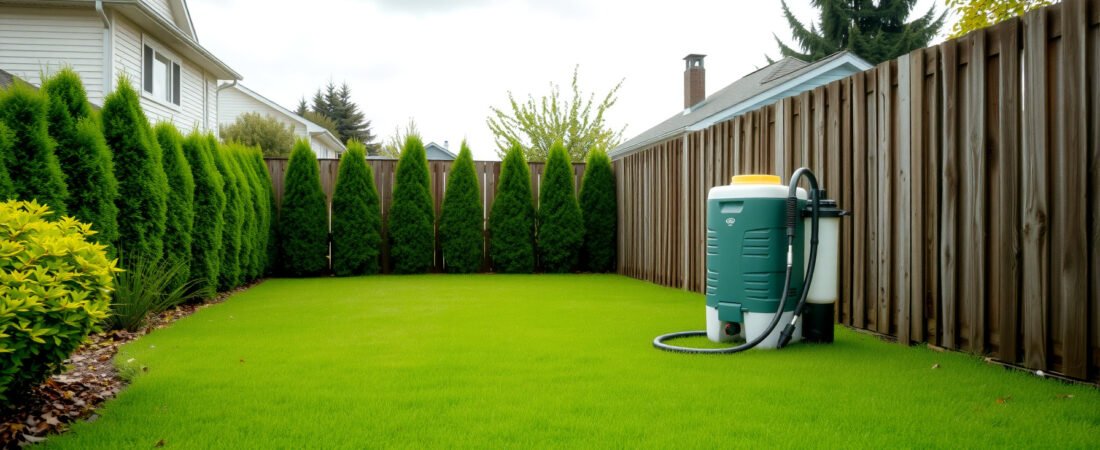
This image shows a technician applying a perimeter treatment along a lawn edge and mulch bed — exactly where ticks stage before moving onto hosts, which is why treatment precision in these transition zones matters far more than saturating the open lawn.
Why One Treatment Is Almost Never Enough (The Part Companies Don’t Lead With)
This is the part of professional tick yard treatment cost that doesn’t show up in most price breakdowns: the biology of a tick infestation almost guarantees that a single application won’t hold. Tick populations move through three active life stages — larvae, nymphs, and adults — and these stages don’t all peak at the same time. Nymphs are most active in late spring and early summer, adults in fall. A treatment timed for one peak can leave the other stage largely untouched.
Picture this: a homeowner pays $275 for a May treatment, feels confident for six weeks, then starts finding ticks on the dog again by August. That’s not the chemical failing — that’s a new cohort of the same population cycling through. Most NPMA-certified professionals recommend a minimum of three seasonal treatments per year to maintain meaningful suppression: one in early spring, one in late spring or early summer, and one in early fall. That puts the realistic annual cost for a quarter-acre lot at $450 to $900 before any service contracts or discounts.
“The biggest mistake homeowners make is judging tick control by whether they see ticks the week after treatment. Tick suppression is measured over a full season, not a single visit. One application can knock down 80 to 90 percent of the active population, but if larvae are still hatching in the soil and your neighbor’s deer corridor runs through your back fence line, you will need follow-up treatments to hold that reduction.”
Dr. Marcus Ellery, Board-Certified Entomologist and Urban Pest Management Consultant, University Extension Partner
What Drives the Price Up (or Down) for Your Specific Yard?
Yard size is the most obvious cost driver, but it’s not the only one — and for heavily wooded or irregularly shaped properties, it’s not even the most important one. Tick pressure in your yard is directly tied to wildlife activity, particularly deer and rodent traffic. White-footed mice, which serve as the primary reservoir host for Lyme disease-carrying bacteria, can infest a yard perimeter without any visible signs. A yard with dense ornamental beds, leaf litter, and a nearby wood line will require more product, more time, and sometimes more visits than a clean open lawn of the same square footage.
Regional pricing also shifts the numbers considerably. Companies in the Northeast and upper Midwest — where black-legged tick pressure is highest — tend to charge more because demand is higher and treatment frequency is clinically recommended rather than optional. In parts of the South, lone star ticks and American dog ticks dominate, and treatment protocols are sometimes less intensive. Here’s a breakdown of the key variables that will move your quote up or down:
| Cost Factor | Effect on Price |
|---|---|
| Lot size under ¼ acre | $150–$250 per treatment |
| Lot size ¼ to ½ acre | $250–$400 per treatment |
| Lot size over ½ acre or wooded edge | $400–$650+ per treatment |
| Seasonal program (3 treatments) | $450–$900 bundled, often discounted 10–20% |
Seasonal Treatment Programs vs. One-Time Service: Which Is Worth the Money?
Most professional pest control companies offer a seasonal tick program — typically three to four scheduled treatments from spring through fall — at a bundled price that runs 10 to 20 percent below what you’d pay for the same visits booked individually. For a lot with genuine tick pressure, this is almost always the better financial decision, and not just because of the discount. Scheduled programs lock in priority service dates, which matters because timing is everything with tick control. A treatment that misses the nymph peak by three weeks delivers a fraction of the value of one applied correctly.
One-time treatments make more sense in specific situations: you’re hosting an outdoor event and want to reduce exposure for that window, you’ve just moved into a property and want a baseline reduction before assessing ongoing need, or you live in a low-pressure region where tick activity is genuinely seasonal and mild. The honest nuance here is that “worth it” depends heavily on your property’s specific risk profile — a shaded half-acre in Connecticut with active deer traffic is a completely different calculation than a sunny quarter-acre lot in a suburban Arizona neighborhood. Don’t let a company sell you a full program if your actual tick exposure doesn’t justify it.
Pro-Tip: Before you book a tick treatment, walk your yard’s perimeter and note any transition zones where mowed lawn meets leaf litter, mulch, or natural ground cover. These are called “ecotones,” and they’re where 80 to 90 percent of host-seeking ticks actually stage. Showing a technician these zones before they begin means the product goes exactly where it needs to, not just evenly across the whole lawn.
What Questions to Ask Before Hiring a Tick Treatment Company
Not all professional tick treatments are created equal, and the price difference between a thorough service and a rushed one isn’t always visible on the invoice. Some companies apply a blanket pyrethroid spray in under 20 minutes and consider the job done. Others spend time treating microhabitats — under deck boards, along stone walls, around brush piles, and through dense ornamental plantings — where ticks actually concentrate between hosts. The time a technician spends on your property is a reasonable proxy for the quality of coverage.
Just as you’d compare active ingredients before buying a product — the same way you’d research options like Ortho vs Raid vs Terro for ant control — you should know exactly what chemical is being applied, at what concentration, and what the re-entry interval is for your household, especially if you have kids or pets. Here are the questions that separate a professional service from a glorified spray-and-go:
- What active ingredient will you use, and what is the application rate? Permethrin is standard and effective; bifenthrin is common in granular formulations. Vague answers here are a red flag.
- How long should people and pets stay off the treated area? Most products require 30 to 60 minutes of dry time; some recommend up to 24 hours for full efficacy. Know the actual number before booking.
- Do you treat microhabitats separately, or just the open lawn? Tick populations don’t live in the open grass — they’re in the edge zones. If the answer is “we do a full yard spray,” ask them to define that specifically.
- Is this treatment effective against all three life stages? Most pyrethroid applications kill larvae and nymphs on contact but have limited effect on eggs. A good technician will explain this without prompting.
- What’s included if I see ticks within 2 to 3 weeks of treatment? Some companies offer a free re-treatment window; others don’t. Get this in writing before the technician starts.
When DIY Tick Control Makes Sense — and When It Doesn’t
Yard-applied permethrin concentrate is available to homeowners, and it’s the same active ingredient professionals use. A 32-ounce concentrate runs $25 to $50 and can treat a quarter-acre yard multiple times over. On paper, that sounds like an easy win over a $275 professional visit. The real variable is application quality. Professional-grade equipment — backpack misters, high-pressure wands, and boom sprayers — delivers more consistent droplet size and penetration into dense vegetation than a typical hose-end sprayer. That difference in coverage translates directly to how long the treatment holds and how far into thick ground cover the product actually reaches.
DIY makes the most sense for homeowners with relatively open yards, low-to-moderate tick pressure, and the willingness to apply multiple times per season on the right schedule. It’s also a reasonable supplemental strategy between professional visits — some pest control professionals actually encourage clients to do a mid-season DIY application of perimeter granules while waiting for their next scheduled service. Where DIY consistently underperforms is in heavily wooded properties or situations with active wildlife corridors, where tick reinfestation pressure is constant and coverage gaps cost you more than the money you saved. For context: other hard-to-treat exterior pests like boxelder bugs follow a similar pattern — DIY can manage light pressure but doesn’t replace thorough perimeter treatment when populations are high.
Here’s what an honest DIY vs. professional comparison looks like for tick yard treatment:
- Open suburban yard, low deer pressure: DIY permethrin concentrate applied 3x per season is likely sufficient and costs $75–$150 annually in materials.
- Wooded edge, active deer or rodent activity: Professional treatment is worth the premium — coverage depth and product concentration matter more than they do in open settings.
- History of tick-borne illness in household: The risk calculus changes entirely. Professional treatment with a verified re-treatment guarantee is a reasonable health investment, not just a comfort purchase.
- Properties over half an acre: DIY application becomes labor-intensive and inconsistent at scale. Professional equipment earns its cost on larger lots.
- First-time treatment on a neglected property: Start with a professional knockdown treatment to establish a baseline, then maintain with DIY if budget is a concern.
There’s one counterintuitive fact worth knowing here: studies have shown that treated yards in neighborhoods with untreated adjacent properties can see tick counts rebound to near pre-treatment levels within 4 to 6 weeks during peak season, entirely due to reinfestation from neighboring wildlife movement. This isn’t a failure of the product or the applicator — it’s ecology. No single yard treatment, professional or DIY, operates in isolation. If your immediate neighbors also have heavy tick pressure, your results will always be partially limited by that shared environment, and that’s worth factoring into how much you’re willing to spend per visit versus how often you’re willing to treat.
The smartest approach for most homeowners is a hybrid one: book a professional for the two highest-risk treatment windows — early spring and early fall — and supplement with a DIY perimeter application in midsummer. That typically runs $350 to $600 annually for a quarter-acre lot, lands you in the sweet spot between coverage and cost, and keeps the biology of the problem — not just the price — at the center of your decision.
Frequently Asked Questions
How much does professional tick yard treatment cost?
Most homeowners pay between $150 and $500 per treatment, depending on yard size and the company you hire. A standard quarter-acre lot typically runs $150 to $300, while larger properties over half an acre can push costs to $400 or more. Getting quotes from 2 to 3 local pest control companies is the best way to nail down a fair price for your area.
Is it cheaper to do tick yard treatment yourself or hire a professional?
DIY tick sprays and concentrates usually cost $20 to $80 per application, which is significantly less than hiring a pro. That said, professional-grade products and equipment tend to penetrate dense vegetation and leaf litter more effectively, which is where ticks actually hide. If you’ve got a heavy infestation or wooded property, the extra cost for a pro is usually worth it.
How many tick treatments does my yard need per year?
Most pest control companies recommend 3 to 6 treatments per year, timed from late spring through early fall when ticks are most active. Some programs run monthly from May through September, while others target peak activity windows in spring and late summer. The number of visits directly affects your total annual cost, which can range from $400 to $1,200 or more for a full season program.
What factors affect the cost of tick yard treatment?
Yard size is the biggest driver — companies often charge per square foot or per fraction of an acre. Other factors include how wooded or overgrown your property is, the treatment method used (spray vs. granules vs. tick tubes), and whether you’re buying a one-time service or a seasonal contract. Properties with heavy brush, tall grass, or deer activity typically cost more to treat because they require more product and labor.
Do pest control companies offer tick treatment contracts or bundles?
Yes, most companies offer seasonal packages or annual contracts that bundle multiple tick treatments at a discounted rate compared to one-off visits. A typical seasonal contract covering 4 to 6 treatments might cost $350 to $900, saving you $50 to $150 versus booking each visit separately. Some companies also bundle tick control with mosquito treatments, which can be a good deal if you’re dealing with both problems.
Disclaimer: This article is for informational purposes only. Pest control costs, timelines, and outcomes vary widely depending on the pest, the severity of the infestation, your location, and the company you hire. Always get multiple quotes and ask for a written inspection report before agreeing to a treatment plan.