
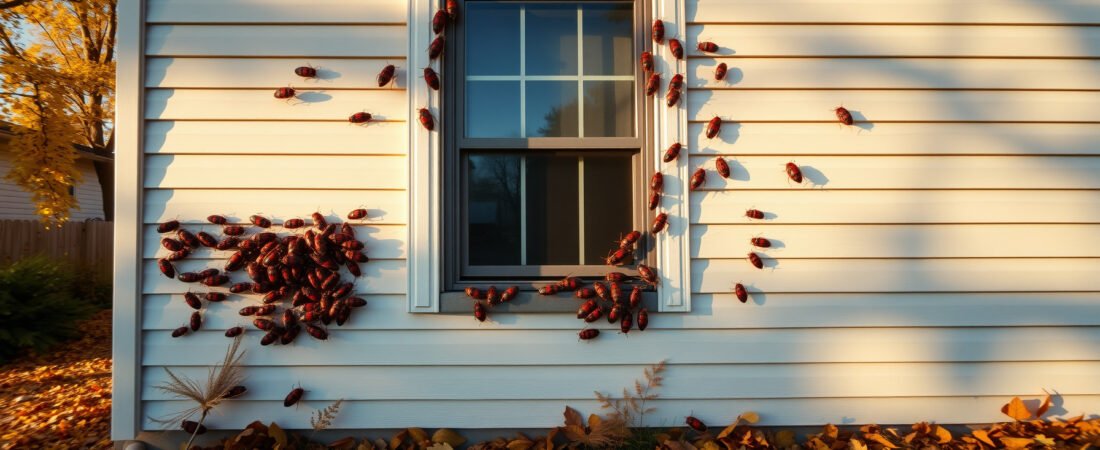
Killing boxelder bugs after they’re already inside your walls is almost always a losing battle — and that’s the piece of advice you won’t find on most pest control sites. The real window to stop an infestation is the 3–4 weeks before outdoor temperatures drop below 50°F, when these insects are still aggregating on the sunny sides of your home’s exterior. Miss that window and you’re not dealing with a bug problem anymore — you’re dealing with a hibernation problem, which is a completely different fight.
Why Boxelder Bugs Are Harder to Eliminate Than You Think
Here’s what trips people up: boxelder bugs don’t infest your home the way cockroaches or ants do. They’re not there for your food, your moisture, or your garbage. They’re using your house as a thermal shelter — specifically the air gaps, wall voids, and attic spaces that hold heat long after outdoor temps have plunged. A single sunny exterior wall can attract hundreds of them within 48 hours of the first cold snap, and by the time you’re noticing them inside, many are already tucked 6–18 inches deep into wall cavities where sprays can’t reach them.
The real frustration is that the bugs you see on your windowsills in late fall are just the unlucky stragglers that wandered the wrong direction — toward the living space instead of deeper into the wall. Squashing them does nothing to reduce the population in your walls. You’re essentially playing whack-a-mole with the 5% of bugs that got lost.
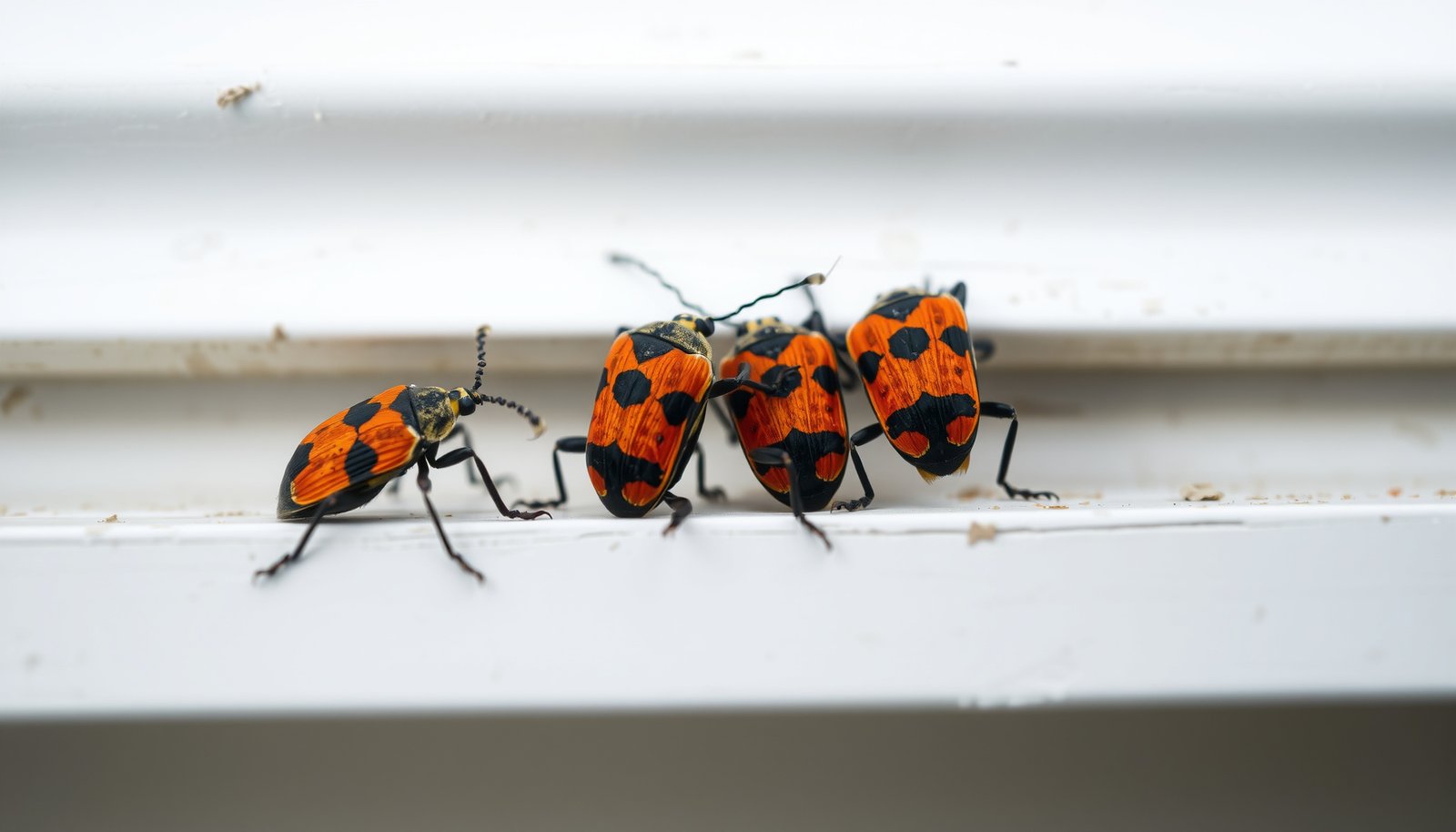
This close-up shows the distinctive red-and-black markings on an adult boxelder bug — knowing exactly what you’re looking at matters because several other fall-invading insects get misidentified and treated with the wrong methods.
What Draws Boxelder Bugs to Your Home in the First Place?
Boxelder bugs — Boisea trivittata — spend spring and summer feeding almost exclusively on the seed pods of female boxelder trees (Acer negundo), though they’ll also work on silver maple and ash when boxelder seeds aren’t available. By late August, populations that built up all summer start looking for overwintering sites. They’re drawn to south- and west-facing surfaces because those walls absorb the most solar radiation — essentially, your beige vinyl siding is acting like a giant heat lamp to a bug that desperately needs warmth.
Picture this: a two-story colonial with a large female boxelder tree in the backyard, maybe 40 feet from the house. By mid-September, that tree can be hosting 10,000–20,000 bugs in a good seed year. When the bugs start dispersing toward heat sources, your home’s south wall is the most attractive object within a quarter mile. The presence of that one tree isn’t just “increasing your risk” — it’s essentially guaranteeing an annual invasion until you address it directly.
“Most homeowners focus on the bugs they’re finding in October, but the population management that actually works happens in August and September — before aggregation begins. By the time you’re vacuuming them off your curtains, the treatment window has already closed for that season.”
Dr. Marcus Hale, Urban Entomologist and University Extension Specialist, Department of Entomology
How to Treat Boxelder Bugs Before They Get Inside Your Walls
The most effective approach is a perimeter spray applied to your home’s exterior — specifically the south- and west-facing walls, window frames, door frames, soffits, and foundation — while bugs are still aggregating outside. Pyrethroid-based insecticides (bifenthrin, cyfluthrin, or deltamethrin) are the standard of care here because they leave a residual film that kills bugs as they crawl across treated surfaces for 4–8 weeks after application. Timing matters more than product choice: apply when daytime temps are still above 55°F so the spray dries and bonds to the surface properly.
One counterintuitive truth about boxelder bugs: soapy water actually kills them on contact faster than most store-bought sprays. A solution of 1–2 tablespoons of dish soap per quart of water disrupts the waxy coating on their exoskeleton and causes rapid dehydration. It has no residual effect whatsoever, but if you’ve got a live cluster of several hundred bugs on a sunny afternoon in September, a pump sprayer with soapy water can eliminate them immediately without any chemical concerns around children or pets.
Pro-Tip: Spray exterior surfaces in the early afternoon on a sunny day — boxelder bugs are most active and clustered when surface temps are at their peak, giving you the most efficient coverage per sprayer tank. Spraying at dawn or dusk when they’ve dispersed wastes product and effort.
Here’s a step-by-step treatment sequence that covers both the immediate kill and residual protection:
- Knock down active clusters first — Use dish soap solution or a direct-contact pyrethrin spray on any visible aggregations on siding, trees, or foundation walls. This reduces the live population before sealing.
- Apply residual perimeter spray — Treat the full exterior with a bifenthrin or deltamethrin concentrate mixed per label, covering 3 feet up the foundation wall and 3 feet outward along the ground. Focus extra product around utility entry points, weep holes, and window trim.
- Seal all exterior gaps wider than 1/16 inch — Boxelder bugs can squeeze through gaps you’d barely notice. Use silicone caulk around window and door frames, replace damaged weatherstripping, and install door sweeps on any exterior door with visible light underneath.
- Stuff weep holes with copper mesh — Weep holes in brick veneer are a highway for overwintering insects. Copper mesh (not steel wool, which rusts) allows moisture drainage while blocking insects without requiring permanent sealing.
- Address the boxelder tree directly — If you have a female boxelder on or near your property, a soil-applied systemic insecticide (imidacloprid) applied around the root zone in late summer can reduce seed production and make the tree less attractive as a feeding site over time.
- Repeat the perimeter spray after 4 weeks — One application often isn’t enough if aggregation is heavy or if your neighbor has a large boxelder tree nearby. A second application before the first hard freeze covers the secondary wave of insects.
What Actually Works Inside the House (And What Doesn’t)
Once boxelder bugs have made it into your wall voids, the options narrow significantly. Residual sprays applied inside wall voids through drilled holes are technically possible but rarely worth it — you’re treating a population that will largely stay put until spring, and the product rarely distributes evenly through irregular cavities. The honest reality is that wall void treatments for boxelder bugs are mostly cosmetic: they make homeowners feel like something is being done without dramatically changing the outcome.
What does work indoors is a vacuum — specifically, vacuuming any bugs that emerge into living spaces and immediately disposing of the bag or canister contents outside. Don’t crush them: boxelder bugs release a pungent defensive odor when crushed, and the red pigment in their bodies can stain light-colored fabrics and paint. A shop vac with a few inches of soapy water in the canister kills them instantly on contact, which eliminates both the smell problem and the need to handle the bag carefully.
| Treatment Method | Best Used | Effectiveness |
|---|---|---|
| Pyrethroid perimeter spray (exterior) | Before first cold snap (Sept–Oct) | High — kills on contact, 4–8 week residual |
| Dish soap contact spray | Anytime bugs are actively clustering outside | High contact kill, zero residual |
| Vacuuming interior bugs | Once bugs are already inside | Moderate — removes individuals, doesn’t reduce wall population |
| Indoor residual sprays or foggers | Not recommended for wall void populations | Low — poor penetration, minimal impact |
One scenario that changes the calculus considerably: if you’re in a multi-unit building and your unit is sharing walls with a common space or another apartment that isn’t being treated, your individual efforts are going to be only partially effective. Bugs overwintering in shared wall cavities will continue to emerge in your unit regardless of what you do on your side. This is a landlord responsibility issue in most jurisdictions — if you’re a renter dealing with a building-wide boxelder problem that your landlord isn’t addressing, it may be worth understanding how to report a landlord for pest neglect to your local housing authority, because this isn’t a problem an individual tenant can solve alone.
Which Boxelder Bug “Fixes” You Can Skip Entirely
There’s a lot of advice floating around about boxelder bugs that sounds reasonable but doesn’t hold up. Diatomaceous earth is one of the most commonly recommended indoor options — and while it does work on soft-bodied insects over prolonged contact, boxelder bugs have a relatively tough cuticle and don’t pick up DE efficiently as they walk through it. You’d need constant, heavy reapplication in every crack and crevice for marginal results. It’s not zero, but it’s not worth your time as a primary strategy.
Some pest-specific behaviors worth knowing about when comparing invaders: boxelder bugs are often confused with other fall-invading species. If the insects you’re seeing don’t have the distinctive red-and-black oval markings — specifically, the three red stripes on the thorax and red wing venation — you might be dealing with a different species entirely. Smoky brown cockroaches, for instance, also enter structures in fall seeking warmth, but the treatment approach is completely different. If you’re not certain what you’re looking at, learning to identify smokybrown vs American cockroach outside can help rule out a cockroach problem that would need a separate strategy.
Here are the commonly recommended approaches that aren’t worth your money or effort for boxelder bugs specifically:
- Bug bombs / foggers — Total release foggers fill the room with insecticide but don’t penetrate wall voids where overwintering bugs are hiding. The bugs that emerge afterward are often the ones displaced by the fumes, not killed.
- Essential oil sprays (peppermint, tea tree, eucalyptus) — These have anecdotal repellent effects but no scientific backing for boxelder bugs specifically, and no residual efficacy whatsoever.
- Cedar repellent blocks or sprays — Effective for some fabric pests like carpet beetles; zero mechanism of action against overwintering insects in wall cavities.
- Sticky traps placed indoors — These are passive monitoring tools, not control tools. You’ll catch the bugs that were already in your living space; you won’t reduce the wall population at all.
- Removing the boxelder tree mid-season — Cutting down the tree during summer doesn’t eliminate the current year’s population, which has already been feeding and breeding for months. Removal is only a long-term solution, effective the following season at the earliest.
One honest nuance here: how aggressive your treatment needs to be depends heavily on your local boxelder tree density. A homeowner in Minnesota or Wisconsin — where boxelder is an extremely common volunteer tree in urban greenbelts and drainage areas — is fighting a fundamentally different scale of problem than someone in the mid-Atlantic who has one boxelder tree in their yard. The same perimeter spray that fully resolves the problem for one homeowner might only reduce it by 60% for another, simply because the pressure from neighboring properties is relentless.
The most durable solution for high-pressure situations is combining exterior chemical control with aggressive exclusion work — not choosing one or the other. Exclusion alone fails when bugs number in the thousands and can find any gap you missed. Sprays alone fail when new bugs are constantly arriving from nearby trees. But both together, applied before the aggregation season peaks, can cut indoor intrusions by 90% or more even in heavy-pressure environments.
Boxelder bugs are an annual problem in most regions where boxelder trees grow, which means you’re not solving this once — you’re building a seasonal habit. Set a calendar reminder for late August each year: inspect the south and west walls, check your weatherstripping, and have your pyrethroid concentrate on hand before the first cool nights arrive. The homeowners who stop fighting this pest are the ones who started treating it like a predictable annual event instead of a surprise every October.
Frequently Asked Questions
what kills boxelder bugs instantly?
A direct spray of soapy water kills boxelder bugs on contact — mix about 1 tablespoon of dish soap per quart of water and spray it directly on the bugs. You can also use insecticide sprays containing pyrethrin or deltamethrin for faster results on larger groups.
why do I have so many boxelder bugs in my house?
Boxelder bugs move indoors in fall when temperatures drop below 50°F, looking for a warm place to overwinter. If you have boxelder, maple, or ash trees on or near your property, you’re especially likely to see large numbers — those trees are their primary food source and breeding ground.
how do I keep boxelder bugs from coming inside?
Seal every gap you can find around windows, doors, utility pipes, and foundation cracks before fall hits — boxelder bugs can squeeze through surprisingly small openings. Installing door sweeps and replacing torn window screens also cuts down on how many actually make it inside.
are boxelder bugs harmful to humans or pets?
Boxelder bugs aren’t dangerous — they don’t bite hard enough to break skin, they don’t sting, and they’re not known to transmit diseases. They’re mostly a nuisance pest, though they can leave behind reddish fecal stains on curtains, walls, and upholstery if they’re crushed or left unchecked indoors.
should I spray outside my house for boxelder bugs?
Yes, applying a residual insecticide around your home’s exterior in early fall is one of the most effective ways to stop boxelder bugs before they get inside. Focus on the south- and west-facing walls, foundation perimeter, and around window and door frames, since those are the spots they tend to gather on sunny fall days.
Disclaimer: This article is for informational purposes only and isn’t a substitute for professional pest control advice. Always read and follow the product label instructions exactly — label directions are legally binding and vary by brand and active ingredient. Keep all pesticides, baits and traps away from children and pets, ventilate treated areas as directed, and consider calling a licensed pest control professional if an infestation is large, recurring, or involves a structural pest like termites or carpenter ants.