
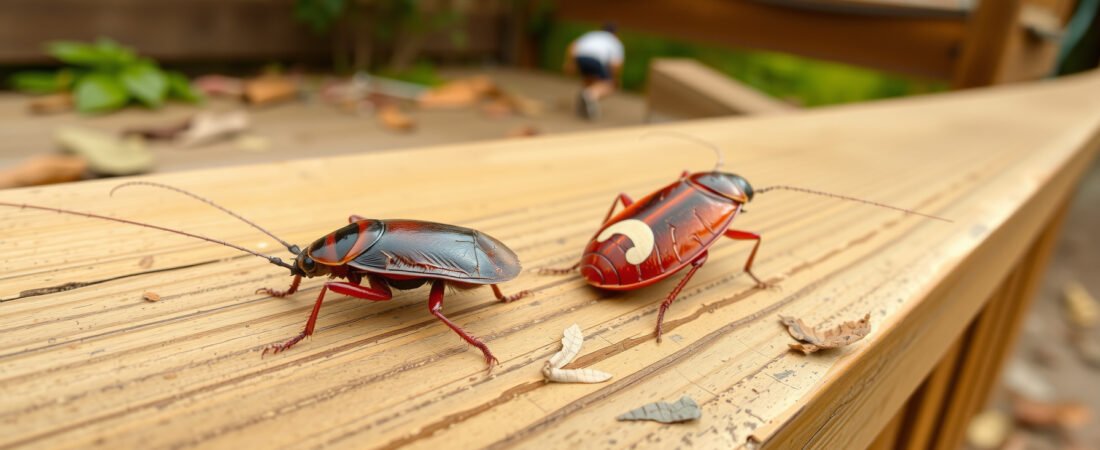
Both cockroaches look big, brown, and fast — and outdoors, most people just call them “the big ones” and move on. That’s the mistake. Smokybrown and American cockroaches share the same habitat, the same size range, and enough visual overlap that homeowners routinely treat for the wrong species, set traps in the wrong locations, and wonder why the problem keeps coming back. Getting the ID right outside isn’t just a matter of curiosity — it tells you exactly where to focus your control efforts and why the roaches keep appearing at your door in the first place.
Why Most People Misidentify These Two Species in the First Place
Here’s the part most pest guides skip entirely: the confusion between smokybrown and American cockroaches isn’t just about color or size — it’s about where you’re standing when you see them. At a glance, both are large, reddish-brown insects that scatter when disturbed, and both are found around mulch, wood piles, and foundation walls. The average person watching one bolt under a shrub isn’t thinking about pronotal markings. They’re thinking about how to make it stop happening.
The real gap in most identification guides is that they assume you’re holding the roach still under good lighting. Outdoors, you almost never are. So learning to distinguish these two species requires leaning on behavioral cues and habitat patterns just as much as physical features — sometimes more. Once you understand what each species is actually doing outside your house and why, the ID becomes much easier even from a distance.
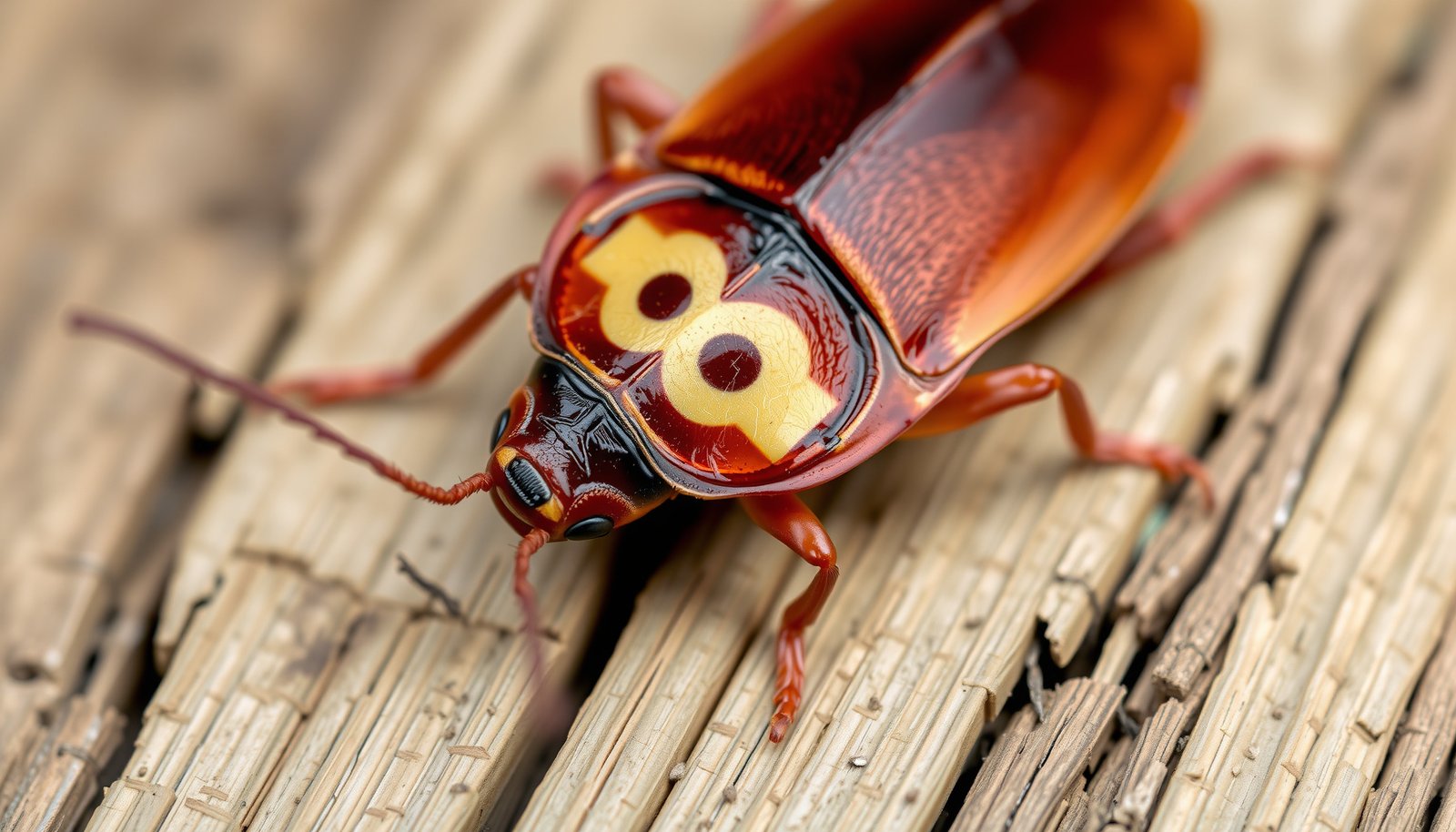
This close-up shows the key visual differences between a smokybrown cockroach (left, uniform dark mahogany) and an American cockroach (right, with its distinctive pale yellow figure-8 marking on the pronotum) — details that are easy to miss when one is sprinting across your patio at night.
What Do Smokybrown and American Cockroaches Actually Look Like Up Close?
Adult American cockroaches run 1.5 to 2 inches long — sometimes longer — and have a very recognizable pale yellow figure-8 or keyhole-shaped marking on the pronotum (the shield-like plate just behind the head). Their body color is a warm reddish-brown, slightly lighter toward the edges. Both sexes have fully developed wings and can fly short distances, though they rarely do except in hot weather when temperatures exceed around 85°F.
Smokybrown cockroaches are typically 1.25 to 1.5 inches long — slightly smaller on average — and their most definitive feature is the uniform, deep mahogany-to-black coloration with no pale markings anywhere on the pronotum. That’s the single fastest visual check: if you see any pale yellowish marking behind the head, you’re looking at an American cockroach. No markings at all? Likely smokybrown. Both have long, thread-like antennae that can actually exceed their body length, which makes them look enormous when they’re moving.
| Feature | American Cockroach | Smokybrown Cockroach |
|---|---|---|
| Adult length | 1.5–2+ inches | 1.25–1.5 inches |
| Pronotum marking | Pale yellow figure-8 pattern | None — uniformly dark |
| Body color | Reddish-brown | Deep mahogany to near-black |
| Wing development | Full wings, occasional flier | Full wings, more frequent flier |
Where You Find Them Outside Tells You More Than the Bug Itself
Picture this: you’re walking your dog at dusk and notice a large roach disappear into a crack at the base of your porch. Is it a smokybrown or an American? The answer depends heavily on where exactly you live and what’s around that porch. American cockroaches are moisture-seekers first and foremost. Outdoors, they concentrate near sewer manholes, floor drains, basement window wells, leaking hose bibs, and anywhere organic debris gets damp and stays damp. They’re often the ones emerging from storm drains after heavy rain.
Smokybrown cockroaches, by contrast, are far more tied to plant material and canopy environments. They thrive in mulched flower beds, leaf litter, tree holes, dense shrubbery, and the spaces between stacked firewood. They lose moisture through their cuticle faster than American cockroaches do — which is why they’re so drawn to humid, sheltered plant environments rather than pipe corridors or drains. If your roach problem seems to concentrate around the landscaping and tree line rather than near water sources, that’s a strong behavioral indicator you’re dealing with smokybrown cockroaches.
Pro-Tip: Check your outdoor lighting. Smokybrown cockroaches are significantly more attracted to light than American cockroaches, which means the big roaches clustering around your porch light or flying toward floodlights on warm nights are almost certainly smokybrown. Switching to yellow-spectrum or LED “bug lights” around entry points can meaningfully reduce how many ever reach your door — no chemical required.
Which States and Regions Does Each Species Actually Dominate?
Geography matters more than most identification articles admit. American cockroaches are genuinely nationwide — you’ll find them in every US state, though they peak in warm, humid climates like Florida, Texas, Louisiana, and the Gulf Coast generally. They’ve also established themselves firmly in older urban infrastructure across northern cities like Chicago and New York, living in steam tunnels, basements, and sewers year-round. Their tolerance for cooler temperatures (they can survive down to about 59°F, though they become sluggish) gives them broader reach than smokybrown cockroaches.
Smokybrown cockroaches are far more regionally concentrated. Their core range runs across the Southeastern US — especially Florida, Georgia, Alabama, Mississippi, Louisiana, and coastal Texas — and they follow the humid subtropical climate band closely. They don’t survive freezing winters without shelter, which is why their outdoor populations drop off sharply north of the Mason-Dixon line. If you’re in Ohio or Minnesota and you’re finding large roaches outdoors, American cockroach is the much more probable answer. If you’re in Houston or Tampa, both species are entirely plausible, and you’ll need to use those visual and behavioral cues together.
“One of the most common misidentifications I see is homeowners in the Southeast treating aggressively for American cockroaches when what they actually have is a smokybrown population living in the tree canopy and mulch beds around the house. The harborage points are completely different, so the treatments end up in the wrong places. A correct species ID outside can cut your control time in half.”
Dr. Michael Carver, Board-Certified Entomologist and Urban Pest Management Specialist, University of Florida Extension
How to Use This ID to Actually Fix the Problem Outside
Knowing which species you have changes where you apply control — and that’s the whole point of getting the ID right. Treating for smokybrown cockroaches means focusing on the perimeter landscape: reducing leaf litter within 12 inches of the foundation, pulling mulch back from the house, sealing tree holes with foam or hardware cloth, and treating mulched beds with a granular insecticide bait like those containing indoxacarb. Smokybrown cockroaches feed on decaying plant material and are very responsive to outdoor bait stations placed near their actual harborage zones.
For American cockroaches, the control strategy shifts toward moisture management and entry point sealing. Here’s the numbered breakdown of an outdoor-focused control sequence for American cockroaches specifically:
- Inspect and seal pipe penetrations — Check where utility lines, pipes, and conduits enter the foundation wall. American cockroaches can squeeze through gaps as small as 1/4 inch, so even small voids around pipes are valid entry points.
- Eliminate standing moisture sources — Fix dripping outdoor faucets, extend downspouts at least 6 feet from the foundation, and make sure window wells drain properly. American cockroaches are moisture-dependent and will congregate wherever humidity is high.
- Apply a residual perimeter insecticide — A bifenthrin or deltamethrin spray along the foundation, up about 3 feet and out about 3 feet, creates a contact barrier. Reapply every 60–90 days or after heavy rain.
- Place bait near drain covers and utility boxes — American cockroaches forage from sewer systems and sub-slab voids. Gel bait or granular bait near outdoor drains and utility access panels targets them where they actually travel.
- Check for harborage under debris — Compost bins, stacked lumber, cardboard, and old landscaping timbers all attract American cockroaches. Elevate or remove them to eliminate outdoor resting spots within 10–15 feet of the home.
One honest nuance worth acknowledging: if you’re in a humid Southern state like Florida or coastal Texas, you may well have both species active simultaneously — especially in yards with both mulched landscaping and older plumbing infrastructure. In that case, a dual approach that addresses both plant harborage and moisture entry points makes sense, and inspecting at night with a flashlight will help you observe which areas see the heaviest activity from each type. Outdoor pest pressure also varies significantly with season — smokybrown cockroaches peak in late summer and early fall as they seek humidity and light, while American cockroach intrusions spike after heavy rains flush them from underground harborage.
For renters dealing with this in a multi-unit property, the equation gets complicated — especially if the roach pressure is coming from a shared outdoor area the tenant doesn’t control. If you’re in that situation and your landlord isn’t acting on an outdoor cockroach population that’s entering the unit, it’s worth knowing your options: How to Report a Landlord for Pest Neglect to Your Local Housing Authority walks through exactly what documentation and process is involved. And if you’re tempted to go fully DIY on the outdoor treatment yourself, the principles that apply to DIY pest control outdoors — risk assessment, product selection, when to call a pro — are covered well in our piece on Is DIY Scorpion Control Safe or Should You Call a Pro?, which outlines the same decision framework that applies to any outdoor perimeter pest.
Here’s a quick behavioral reference to use when you spot one outside and need a fast answer before it disappears:
- Flying toward your porch light? Almost certainly smokybrown — they’re far more phototactic than American cockroaches.
- Emerging from a drain or sewer cover? Strong indicator of American cockroach — they’re the dominant species in underground utility systems.
- Found in a tree hollow or inside a rolled-up garden hose? Smokybrown — they use tight, elevated, dry-ish plant cavities as daytime harborage.
- Spotted near a leaking outdoor faucet or wet mulch against the foundation? Either species is possible, but the moisture draw points more toward American cockroach.
- Uniform dark body with no pale markings visible? Smokybrown — the absence of any yellow on the pronotum is the fastest visual confirmation you’ll get at distance.
The counterintuitive thing about outdoor cockroach control that most guides don’t say plainly enough: the roaches you see outside are rarely the ones that will cause you the most problems indoors. The ones to worry about are the ones you don’t see — the population living 20 feet from your foundation in landscape debris, gradually working their way closer as conditions change. Getting the species right outside gives you a map of where that population actually lives, and that’s where the real control work happens.
Frequently Asked Questions
smokybrown vs American cockroach outside how do you tell them apart?
The easiest way to tell them apart is by color and size. Smokybrown cockroaches are a solid, dark mahogany-brown with no color variation, while American cockroaches are reddish-brown with a distinctive yellowish figure-8 pattern behind their head. Americans are also slightly larger, typically reaching 1.5 to 2 inches, while smokybrownss usually top out around 1.25 to 1.5 inches.
where do smokybrown cockroaches live outside compared to American cockroaches?
Smokybrown cockroaches prefer high-moisture areas like tree holes, wood piles, mulch beds, and gutters — they dry out fast and need constant humidity to survive. American cockroaches are more flexible and are commonly found in sewer drains, dumpsters, and under concrete slabs. If you’re finding roaches in your gutters or up in trees at night, smokybrownss are the more likely culprit.
do smokybrown cockroaches fly more than American cockroaches outside?
Yes, smokybrownss are much more active fliers than Americans, especially on warm, humid nights. They’re strongly attracted to outdoor lights and will fly toward porch lights, which is a reliable behavioral clue when you’re trying to ID them at night. American cockroaches can fly but rarely do — if a roach is actively flying around your yard, it’s more likely a smokybrown.
what US states have smokybrown cockroaches outside vs American cockroaches?
Smokybrown cockroaches are most common in the southeastern US, especially Texas, Louisiana, Florida, Georgia, and the Gulf Coast states where humidity stays high. American cockroaches have a much wider range and are found across most of the continental US, including northern states. If you’re in the Southeast and finding roaches in your yard, there’s a real chance you’ve got both species living outside at the same time.
how do I know if cockroaches outside will come inside my house?
Both species can and do enter homes, but they’re drawn indoors for different reasons. Smokybrown cockroaches come in when outdoor humidity drops or they’re attracted to interior lights, while American cockroaches typically enter through drains, sewer connections, or gaps at ground level when conditions outside get too dry or hot. Sealing gaps larger than 1/4 inch around doors, pipes, and utility lines cuts off the most common entry points for both species.