
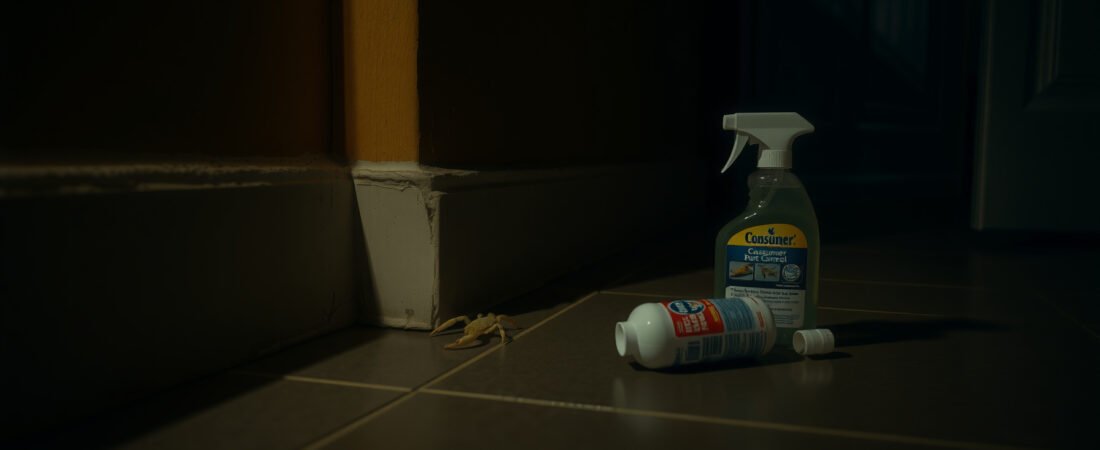
DIY scorpion control works — until it doesn’t, and the reason most people fail has nothing to do with which spray they bought. The real problem is that homeowners treat scorpions like they treat ants: spray what you see and call it done. Scorpions aren’t responding to your spray the same way a cockroach does, and understanding that one difference is what separates a scorpion-free home from one where people are still getting stung six months later.
Here’s the bottom line: DIY scorpion control is genuinely safe and effective for most low-to-moderate infestations in the right conditions — but “safe” depends heavily on which species you’re dealing with, how your home is built, and whether you’re willing to address the prey insects driving scorpions indoors in the first place. Skip that last part and no amount of spraying, sealing, or trapping will give you lasting results.
Why Spraying Scorpions Directly Is Usually a Waste of Time
Scorpions have a waxy, thick exoskeleton that makes them dramatically more resistant to residual insecticide sprays than most pests. A product that kills a cockroach on contact within minutes can take hours to affect a scorpion — and if the scorpion isn’t walking directly through a wet application, it may absorb little to nothing. This is why people spray the same corners for months and still find live scorpions every morning.
The mechanism matters here. Pyrethroid-based sprays (the active ingredient in most consumer scorpion products) work by disrupting the nervous system on contact and through cuticular absorption. Scorpions absorb these chemicals much more slowly than soft-bodied insects, which means timing and application surface matter far more than concentration. Spraying a scorpion directly is satisfying but strategically almost pointless — the residual barrier along baseboards, entry points, and harborage zones is where the chemistry actually works.
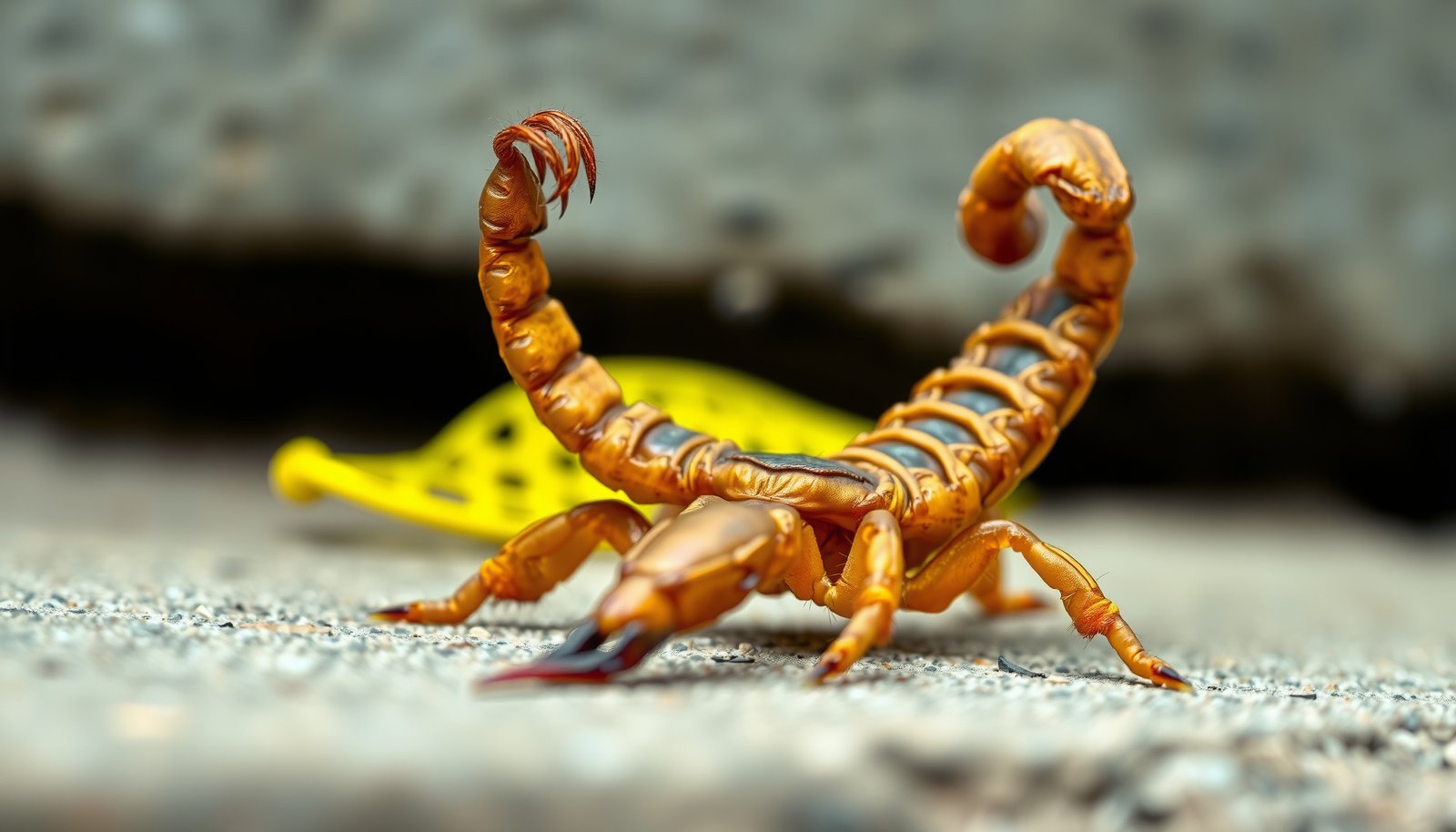
This close-up shows the thick, segmented exoskeleton of a common bark scorpion — the same physical armor that makes direct spray contact far less lethal than most homeowners expect, and why residual barrier treatment beats spot-spraying every time.
Which Scorpion Species Are You Actually Dealing With?
There are roughly 90 scorpion species in the United States, but only one — the Arizona bark scorpion (Centruroides sculpturatus) — poses a genuine medical threat to healthy adults. Its venom can cause severe neurological symptoms, and in young children, elderly individuals, or immunocompromised people, a sting can be life-threatening without prompt treatment. Every other US species will cause pain, localized swelling, and misery, but they’re not in the same danger category.
Identification changes your decision-making entirely. If you’re in Arizona, New Mexico, or parts of Texas and California where bark scorpions are common, the risk calculus for DIY shifts. A striped tail scorpion or a giant hairy scorpion found in a Phoenix garage is a different situation than a bark scorpion found inside a child’s bedroom closet. Know what you have before you decide how aggressively to respond — and if you can’t confidently identify the species, that alone is a reasonable argument for a professional assessment.
What DIY Scorpion Control Actually Requires (Most Guides Leave This Out)
Here’s what most DIY scorpion articles skip: scorpions follow their food. If crickets, roaches, silverfish, and other soft-bodied insects are entering your home freely, scorpions will follow them in. You can seal cracks, spray barriers, and set glue traps — but if the prey population inside your walls stays high, you’ll keep attracting new scorpions. Effective DIY control is a two-part job: scorpion-specific treatment and general insect reduction simultaneously.
The same logic applies to outdoor harborage. Scorpions rest under rocks, wood piles, mulch, bark, and debris within 10–15 feet of your foundation. Treating indoors while leaving an undisturbed scorpion habitat right outside the back door is the single most common reason DIY efforts stall. A complete DIY approach has to include yard modification, not just indoor spraying. This is also why pest problems that seem unrelated are often connected — How to Get Rid of Centipedes in House: Causes and Fixes covers the same food-chain dynamic: kill the prey, and the predator pests lose their reason to be there.
A realistic DIY scorpion control plan looks like this:
- Identify the species — use a UV/blacklight flashlight at night (scorpions fluoresce bright green) to locate and identify what you’re dealing with before buying any products.
- Eliminate harborage zones within 15 feet of the foundation — move woodpiles away from the house, rake out deep mulch, clear debris, and relocate stacked materials like bricks or pavers.
- Seal entry points — scorpions can squeeze through gaps as small as 1/16 inch, so door sweeps, weatherstripping, pipe penetrations, and weep holes in brick all need attention.
- Apply a residual pyrethroid barrier — products containing bifenthrin or cypermethrin applied along the foundation perimeter, around windows, and inside along baseboards create the actual kill zone. Reapply every 30–60 days.
- Place sticky glue traps — set these in corners, under appliances, and along interior walls to monitor activity levels and catch stragglers moving through treated areas.
- Reduce prey insects independently — address any existing cricket, cockroach, or silverfish population with targeted bait or traps, since removing the food source is the only long-term suppression strategy that actually holds.
Pro-Tip: Do your scorpion inspections at night with a UV blacklight — scorpions fluoresce bright blue-green under ultraviolet light and are nearly impossible to spot during the day. A $15 UV flashlight will show you exactly where they’re active, which tells you precisely where to apply your residual treatment and set traps. Skipping this step is why most DIY scorpion programs treat the wrong areas entirely.
When Is DIY Scorpion Control Actually Risky?
The safety question has two sides: safety for your household from scorpion stings, and safety from the products you’re applying. Both matter. On the sting side, DIY becomes genuinely high-risk when you’re in bark scorpion territory and have young children, pets, or household members with compromised immune systems. A single bark scorpion sting sends roughly 15,000 people to US emergency rooms annually — and most of those stings happen inside the home, in bedrooms, bathrooms, and closets, not while working outdoors.
Picture this: it’s 11pm and you’re reaching into your closet for a pair of shoes you haven’t worn in a week. That’s exactly when and how most indoor scorpion stings occur — in the dark, on unsuspecting hands and feet, in clothing and bedding that hasn’t been moved in a few days. If your infestation is active enough that you’re finding multiple scorpions per week indoors, that risk profile changes the math on DIY significantly. At that density, a professional with access to commercial-grade wettable powder formulations, wall void treatments, and structural sealing expertise will likely get faster, safer results than a homeowner working with retail concentrates.
“The question I always ask homeowners is how many scorpions they’re finding and where. One or two near exterior doors is a very manageable DIY situation. Five or more per week inside bedrooms tells me there’s an active harborage inside the walls — and that requires equipment and formulations that aren’t available at the hardware store.”
Dr. Carl Olson, Extension Entomologist, University of Arizona Department of Entomology
DIY vs. Professional Scorpion Treatment: What You Actually Get for the Money
Cost is real and it’s worth being honest about. A complete DIY setup — UV flashlight, bifenthrin concentrate, pump sprayer, glue boards, door sweeps, caulk — runs roughly $80–$150 upfront and can cover multiple applications. Professional scorpion treatment typically costs $150–$400 for an initial visit, with follow-up quarterly visits running $80–$150 each. For mild to moderate infestations in homes without special risk factors, DIY is genuinely cost-competitive and can be just as effective if executed correctly.
Where professionals earn their fee is in the details most homeowners miss: wall void treatments, attic and crawl space inspection, foundation crack injection, and the kind of systematic follow-up that keeps treatment records across seasons. Some pest control companies also offer scorpion-specific programs that include home sealing as part of the service — something that adds real structural value beyond what a spray treatment alone accomplishes. The honest nuance is that professional treatment isn’t automatically better; it’s better when the problem is severe, when it’s in a high-risk species area, or when the homeowner’s time and confidence are genuine limiting factors.
| Situation | DIY Viable? | Pro Recommended? |
|---|---|---|
| 1–3 scorpions near exterior entry points, low-risk species | Yes — high success rate with barrier treatment + sealing | Optional |
| Bark scorpion confirmed, household with children under 6 | Proceed with caution — supplement with pro assessment | Strongly yes |
| 5+ scorpions per week found indoors, multiple rooms | Unlikely to be sufficient alone | Yes — wall void treatment needed |
| Rental property or HOA restrictions on pesticide application | Limited — check lease/HOA rules first | Yes — liability protection |
One thing that’s easy to overlook: the same principles that make scorpion control effective apply to a broader category of household pest management. Just like researching Best Stink Bug Repellents and Traps for Fall Invasions teaches you that perimeter sealing beats interior spraying every time, scorpion control rewards the same outside-in thinking — stop them before they’re in, not after.
Here are the specific scenarios where calling a professional is the smarter call, not just the cautious one:
- You’ve confirmed or strongly suspect Arizona bark scorpions and have children under 6, elderly residents, or immunocompromised family members in the home
- You’re finding scorpions regularly in upstairs rooms or bedrooms — this indicates harborage inside the structure, not just entry from outside
- Previous DIY treatment has been in place for 60+ days with no reduction in scorpion sightings
- Your home has significant structural gaps — older construction, stucco exteriors, or block foundations — that make sealing without professional equipment impractical
- You’re a renter and pesticide application would violate your lease or require landlord authorization
Here’s a counterintuitive observation worth sitting with: the homes that have the worst scorpion problems aren’t necessarily the oldest or most run-down. New construction in desert areas — with fresh landscaping rock, decorative boulders, and disturbed soil from grading — often creates ideal scorpion habitat right up against the foundation. A brand-new house in Scottsdale can have a worse scorpion situation in year one than a 30-year-old home two blocks away. The yard, not the house, is usually the root cause.
If you’re committing to DIY, commit fully: UV inspection at night, barrier spray reapplied every 30–45 days through active season, harborage cleared from the yard, entry points sealed, and prey insects controlled in parallel. Half-measures in scorpion control don’t produce half results — they tend to produce no results. Do it right the first time or bring in someone who will, because the alternative is sharing your home with an arachnid that’s been essentially unchanged for 430 million years and has no interest in leaving on its own.
Frequently Asked Questions
is DIY scorpion control safe for homes with kids or pets?
It can be, but you need to be careful about which products you use and where you apply them. Many store-bought scorpion sprays contain pyrethroids like bifenthrin or cypermethrin, which are toxic to cats and harmful to small children if they contact treated surfaces before they dry. If you have kids under 5 or cats in the house, it’s worth seriously considering a pro who can use targeted treatments in spots your family can’t reach.
what scorpion control products actually work for DIY treatment?
Residual insecticide sprays with bifenthrin or cypermethrin are the most effective options for DIY scorpion control — apply them along baseboards, door frames, and the exterior perimeter of your home. Diatomaceous earth works as a supplemental treatment in dry areas like wall voids and under appliances, though it loses effectiveness when it gets wet. UV blacklights ($10–$20) let you spot scorpions at night so you know exactly where to focus your treatment.
when should you call a professional instead of doing DIY scorpion control?
Call a pro if you’re finding more than 2–3 scorpions per week inside your home, because that usually signals a much larger infestation hiding in walls, attics, or crawl spaces. You should also skip DIY if you live in Arizona, Nevada, or New Mexico and spot Arizona bark scorpions — their sting is medically significant and finding them indoors repeatedly means you need a targeted professional treatment plan. A single scorpion now and then is manageable yourself, but consistent sightings are a sign the problem is beyond surface-level spraying.
how do I scorpion-proof my house without chemicals?
Seal every gap around pipes, windows, and door frames with caulk or weatherstripping — scorpions can squeeze through openings as thin as a credit card. Remove harborage sites like wood piles, rock piles, and leaf debris within 10 feet of your home’s foundation, since those are prime hiding spots. Sticky glue traps placed along walls and in dark corners can catch scorpions and help you monitor how bad the problem actually is without any chemical exposure.
can scorpion DIY treatments cause more harm than good?
Yes — over-applying pesticides is one of the biggest DIY mistakes, and it doesn’t make treatments more effective, it just increases chemical exposure for your household. Using the wrong product or applying indoors without proper ventilation can cause respiratory irritation, and some sprays damage certain floor finishes or fabrics if misapplied. Always read the label completely before applying anything, and never treat more surface area than the label specifies.
Disclaimer: This article is for informational purposes only. Pest control costs, timelines, and outcomes vary widely depending on the pest, the severity of the infestation, your location, and the company you hire. Always get multiple quotes and ask for a written inspection report before agreeing to a treatment plan.