
The mouse you just caught in a snap trap might not be a house mouse at all — and that distinction matters more than most people realize. Deer mice and house mice look similar at a glance, but they behave differently, nest differently, and carry completely different health risks. Treating them the same way is the single biggest mistake homeowners make when they find a small brown rodent in their space.
Here’s the bottom line: if you’re in a rural or suburban home near open land, wooded areas, or a detached garage, there’s a real chance what you’re dealing with is a deer mouse — not a house mouse. That matters because deer mice are the primary reservoir host for hantavirus in North America, a rare but serious respiratory illness. House mice, for all their nuisance value, don’t carry that same risk. Knowing which species you’re looking at changes how you clean up, how you trap, and how urgently you act.
What Does a Deer Mouse Actually Look Like Up Close?
The deer mouse (Peromyscus maniculatus) has a very specific two-toned coloring that, once you’ve seen it once, you won’t forget. Its back ranges from tawny brown to grayish-brown, and its belly and feet are bright white — a sharp, clean contrast, not a gradual fade. The tail is also strictly bicolored: dark on top, white on the bottom, and covered in fine hairs rather than being smooth and scaly.
The ears on a deer mouse are noticeably large relative to its head — almost comically oversized — and the eyes are big, dark, and prominent. Adult body length runs about 2.5 to 4 inches, plus another 2 to 5 inches of tail. Fur texture tends to look softer and cleaner than a house mouse, partly because deer mice groom meticulously and partly because they don’t have the musty body odor that house mice produce from scent glands.

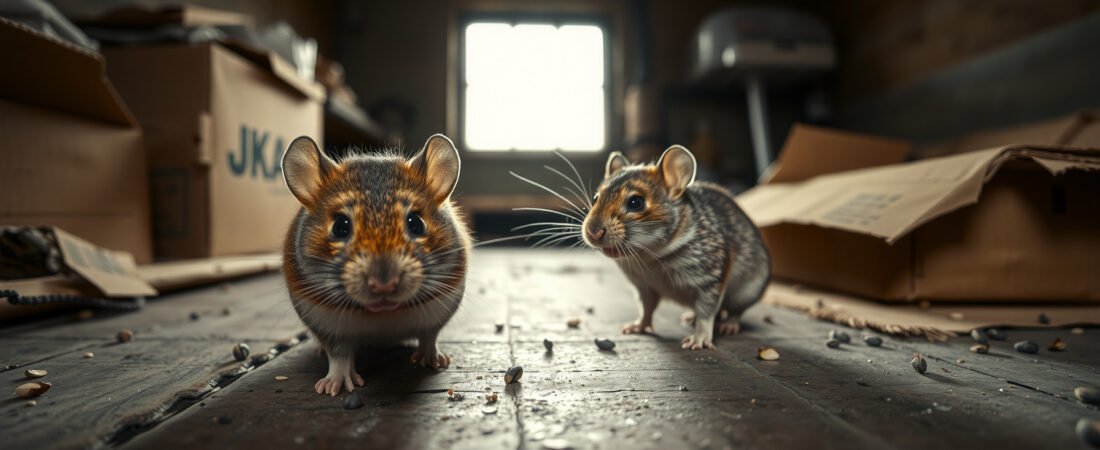
This side-by-side view shows the key physical differences — the deer mouse’s white belly and bicolored tail versus the house mouse’s uniform gray-brown coat — details that are easy to miss in a quick glance but critical for correctly identifying which species has moved in.
What Does a House Mouse Look Like and How Is It Different?
The house mouse (Mus musculus) is uniformly colored — typically dusty gray or light brown on both the back and belly, with no sharp color break between the two. The belly might be slightly lighter, but there’s no clean white contrast the way there is on a deer mouse. Its tail is long, nearly hairless, scaly, and the same color all the way around.
House mice are slightly smaller overall — adults average 2.5 to 3.75 inches body length — and their ears and eyes are proportionally smaller relative to their head. One telltale detail: house mice have a notched upper incisor when viewed from the side, though you’d need to be pretty close to see that. More practically useful is the smell — a house mouse infestation produces a distinct musky ammonia odor from scent gland secretions that deer mice simply don’t produce at the same intensity.
| Feature | Deer Mouse | House Mouse |
|---|---|---|
| Belly color | Bright white, sharply defined | Grayish or off-white, blends in |
| Tail | Bicolored (dark top, white bottom) | Uniformly dark, hairless, scaly |
| Ears | Large, prominent | Smaller, closer to head |
| Smell | Minimal odor | Strong musky ammonia scent |
| Typical habitat | Rural, wooded, outbuildings | Urban, suburban, inside walls |
Why Getting the ID Wrong Can Actually Be a Health Problem
This is the part most identification articles gloss over, and it’s the most important piece. Deer mice are the principal carrier of Sin Nombre virus, the strain of hantavirus responsible for Hantavirus Pulmonary Syndrome (HPS) in the US. The CDC has documented cases in nearly every state west of the Mississippi, with mortality rates historically around 35-40%. You don’t get infected by being bitten — you get infected by inhaling dried particles of deer mouse urine, droppings, or nesting material that becomes airborne when disturbed.
Picture this: you pull a storage bin out of your detached garage in early spring, the mouse nest inside crumbles as you lift the lid, and you breathe in the dust without thinking twice. That’s exactly how most HPS exposures happen — not dramatic encounters with live mice, but careless cleanups of old nesting sites. House mice can carry other pathogens like salmonella and lymphocytic choriomeningitis virus (LCMV), but the cleanup protocol for their droppings is far less urgent than for a confirmed deer mouse site. Knowing which species you have changes whether you’re grabbing paper towels or a respirator.
“Homeowners consistently underestimate the importance of species-level identification for small rodents. A deer mouse infestation in a cabin or outbuilding isn’t just a nuisance — it’s a biohazard cleanup situation that requires proper respiratory protection, not just gloves and a garbage bag. The tail coloring alone is often enough to make the call, and learning that one feature could genuinely protect someone’s health.”
Dr. Karen Voss, Urban Wildlife Extension Specialist, University of Nebraska-Lincoln
Where Each Mouse Nests and What Evidence They Leave Behind
Deer mice are outdoor-origin rodents that come inside opportunistically — especially in fall when temperatures drop. They strongly prefer low-traffic areas: wall voids, attic spaces, crawlspaces, garages, sheds, and cabins that sit empty part of the year. Their nests are soft and elaborate, built from shredded plant material, feathers, and fur, and they often cache seeds nearby. You’ll frequently find deer mouse nests in stored items, inside equipment, or tucked into insulation batts.
House mice, by contrast, are fully domesticated in the evolutionary sense — they need human structures to survive and breed year-round. They nest closer to food sources, inside walls near kitchens, inside appliance motor housings, behind cabinets, and inside drawer insulation. Their nests are constructed from whatever’s available: chewed cardboard, insulation foam, fabric scraps. Deer mouse droppings are pointed at both ends and measure about 3-6mm; house mouse droppings have a single pointed end and measure 1-2mm on average. Both are dark brown to black. Finding droppings in kitchen cabinets points strongly toward house mice; finding them in a detached garage or storage shed leans toward deer mice.
Pro-Tip: If you find a nest in a location you haven’t accessed in weeks or months — an old backpack in storage, inside a rarely-used appliance, or in a cabin that’s been closed up — treat it as a potential deer mouse site until proven otherwise. Wet the area with a 1-part bleach to 10-parts water solution and let it soak for 5 minutes before touching anything, and wear an N95 or better respirator while cleaning. This is the CDC-recommended protocol specifically because of hantavirus risk, not general caution.
How to Use Behavior and Entry Points to Confirm Which Species You Have
Both species can squeeze through remarkably small gaps — a hole as small as 1/4 inch is enough for either mouse to enter a structure. But the location and type of entry point often differs. Deer mice tend to enter through foundation gaps, crawlspace vents, gaps around utility pipes at ground level, and through exterior door sweeps. They’re more likely to be found in isolated parts of a home or building rather than actively foraging through the kitchen at night.
House mice are brazen in a way deer mice usually aren’t. They’ll establish regular foraging routes, leave grease smear marks along baseboards and wall edges from their oily fur, and you’ll often hear them scratching inside walls during evening hours. Deer mice are more likely to be discovered incidentally — found in a trap you forgot you set, spotted running along an exterior foundation, or discovered when you open something in storage. If you’re consistently finding droppings on kitchen counters or chew damage on food packaging, that pattern points toward house mice. Consistent activity in storage areas, outbuildings, or unconditioned spaces suggests deer mice.
- Check the tail first. Bicolored (dark top, white bottom with visible fur) = deer mouse. Uniformly dark and scaly = house mouse. This single feature is the fastest field ID.
- Look at the belly. A sharply defined bright white belly is almost exclusively a deer mouse trait. A blended grayish or off-white belly points to house mouse.
- Note where you found signs. Kitchen, pantry, and wall voids near food = house mouse territory. Garage, shed, cabin, attic insulation, or stored gear = much more likely to be a deer mouse.
- Smell the space. A heavy, persistent musky ammonia odor in an enclosed area is a house mouse signature. Deer mice don’t produce that same intensity of scent gland secretion.
- Look at nest construction. Deer mouse nests include plant matter, seeds, fur, and feathers. House mouse nests lean heavily on shredded paper, fabric, and foam insulation from the immediate surroundings.
- Consider your geography. Deer mice are abundant across most of the US but are far more common in rural and suburban-fringe environments. True urban environments — dense city apartments, high-rise buildings — are almost exclusively house mouse territory.
Does the Species You Have Change How You Should Treat the Problem?
For trapping, the approach is largely the same — snap traps baited with peanut butter or nesting material work for both species. Deer mice are sometimes more cautious around new objects in their environment, so leaving unset traps in place for 2-3 days before setting them can improve catch rates. Both species are neophobic to varying degrees, meaning they avoid unfamiliar objects initially. Bait stations with rodenticide work on both, though in areas where deer mice are active, you need to be extra careful about secondary poisoning risks to owls and other predators that naturally suppress rodent populations.
The bigger difference is in exclusion and cleanup. Because deer mice are primarily entering from outside, exterior exclusion — sealing foundation gaps, replacing damaged vent screens, caulking utility penetrations — is the most effective long-term strategy. House mice are already established inside and require interior exclusion work as well. It’s worth noting that if you’re a renter dealing with a rodent problem, the question of who’s responsible for identifying and treating the infestation isn’t always simple — a new tenant being blamed for a pre-existing pest infestation is a more common dispute than most people expect, and the species involved can actually matter in documenting the timeline of the problem. For ongoing control, some pest companies offer warranty-backed rodent programs, though whether a pest control warranty is worth paying extra for depends heavily on the specific terms and whether they cover re-treatment for new entry points.
- Deer mouse cleanup requires N95 respirator minimum, rubber gloves, and a bleach-water disinfectant solution applied before disturbance
- House mouse cleanup is less intensive but still warrants gloves and disinfectant — salmonella transmission via droppings is documented
- Deer mouse exclusion focuses on exterior foundation, crawlspace vents, and outbuildings
- House mouse exclusion requires interior wall void sealing, pipe gap caulking, and door sweep replacement
- Deer mice in rural cabins or vacation homes left empty seasonally warrant professional assessment if the infestation is established — the HPS risk makes DIY cleanup in heavily infested spaces genuinely risky
One honest caveat: in suburban areas on the edges of wooded or agricultural land, you can have both species present in the same property at the same time — deer mice in the detached garage and house mice inside the walls. That’s not rare. If you’re finding evidence in very different locations with different characteristics, don’t assume it’s all one species. Set traps in both areas and actually look at what you catch before deciding on an exclusion strategy.
Getting the identification right doesn’t just help you choose the right trap or the right cleanup gloves. It tells you whether you’re dealing with a nuisance pest or a genuine health risk — and that distinction is worth five minutes of careful observation before you reach for anything else.
Frequently Asked Questions
how do I tell the difference between a deer mouse and a house mouse?
The easiest way is to look at the tail and coloring. Deer mice have a two-toned tail — brown on top, white underneath — and a white belly with reddish-brown fur on their back. House mice are a uniform grayish-brown all over with a single-colored, scaly tail. Deer mice also have noticeably larger eyes and ears compared to house mice.
are deer mice dangerous to humans?
Yes, deer mice are significantly more dangerous than house mice because they’re the primary carrier of hantavirus in the US. You can get infected just by breathing in dust from their droppings, urine, or nesting material — you don’t need to be bitten. House mice don’t carry hantavirus, though they do spread other diseases like salmonella and leptospirosis.
what does deer mouse poop look like compared to house mouse droppings?
Both droppings are small and rod-shaped, but there are differences worth knowing. Deer mouse droppings are about 3–6mm long with pointed ends, while house mouse droppings are slightly smaller at around 3–4mm with a more uniform shape. If you find droppings in a rural or wooded area of your home like a garage or basement, there’s a higher chance it’s a deer mouse.
where do deer mice vs house mice nest in a home?
House mice prefer to nest close to food sources inside your walls, cabinets, or behind appliances — they rarely venture far from their nest. Deer mice tend to move in from outside and are more common in garages, sheds, crawl spaces, and less-trafficked storage areas. If you’re finding nests made of soft plant material, feathers, or fur rather than shredded paper, it’s more likely a deer mouse.
can you use the same traps for deer mice and house mice?
Yes, standard snap traps work on both species and are the most effective option for either. Use peanut butter or nesting material like cotton balls as bait, since both mice are attracted to them. If you suspect deer mice, wear gloves and a mask when handling traps or cleaning up, since disturbing their droppings can release hantavirus particles into the air.