
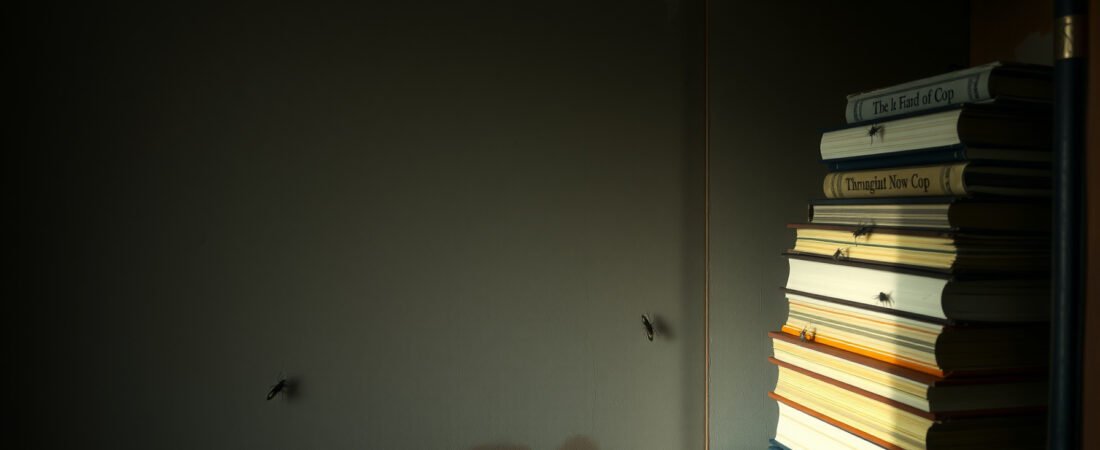
Psocids aren’t destroying your books — your humidity is. That’s the piece most people miss entirely. They scrub shelves, toss old paperbacks, even call an exterminator, and the bugs come back within weeks because nobody fixed the one thing that was feeding the population in the first place: moisture in the air. Get that wrong, and no spray on earth will solve your problem permanently.
What Are Psocids and Why Do They Show Up in Walls and Books?
Psocids — also called booklice, though they aren’t actually lice — are tiny soft-bodied insects, usually between 1 and 2 millimeters long, that feed on mold, mildew, and the paste used in book bindings. They don’t bite, they don’t spread disease, and they won’t damage structural wood. What they do is signal something: your home has a localized moisture problem, and mold is growing somewhere you probably can’t see.
Picture this — you pull a cardboard box out of a basement closet that’s been sealed for eight or nine months. The bottom is soft, the books inside smell faintly musty, and when you set it on the floor, a cloud of what looks like white dust scatters in every direction. Those aren’t dust particles. They’re psocids, and that box has likely been a self-sustaining habitat for hundreds of them. A single female can lay up to 100 eggs in her lifetime, and at 77°F with relative humidity above 75%, a new generation can develop in as little as 18 to 25 days.
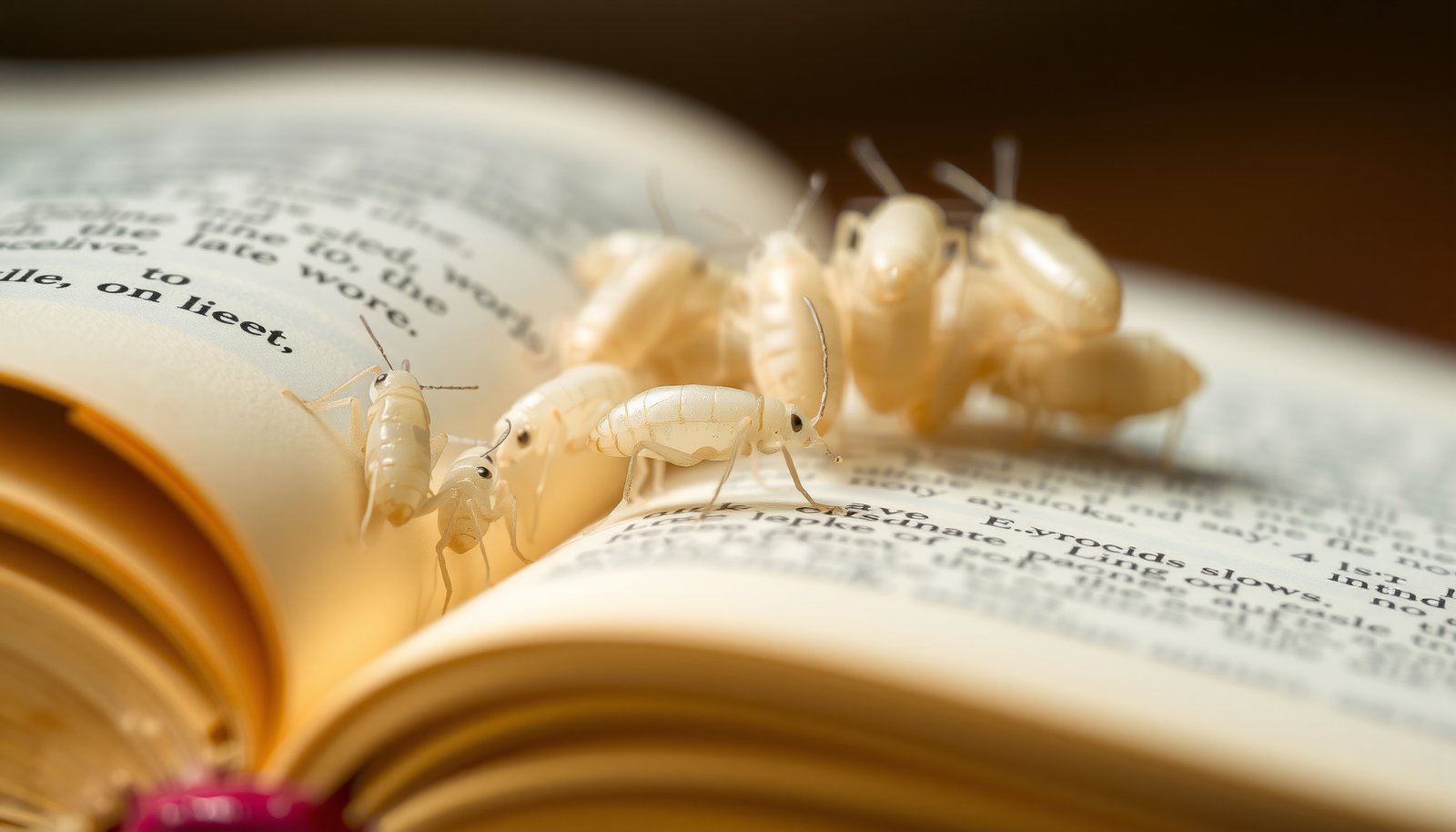
This close-up shows the translucent body, oversized head, and long antennae that distinguish psocids from other tiny household insects — knowing exactly what you’re looking at matters before you choose a treatment method.
Why Killing Psocids Without Fixing Humidity Is a Waste of Time
Here’s the counterintuitive part: psocids don’t hitchhike in on groceries or through cracks in the foundation the way rodents do. They’re already present in virtually every home at extremely low numbers, living in wall voids and paper products without you ever noticing. The infestation you’re seeing isn’t an invasion from outside — it’s an explosion of something that was already there, triggered by a humidity threshold being crossed. That’s a fundamentally different problem than dealing with, say, rats entering from a neighbor’s yard, which requires completely different thinking about entry points and how to identify Norway rats vs. roof rats to figure out where they’re coming from.
Spraying a shelf with insecticide and calling it done is like bailing a boat without plugging the hole. The spray may knock down the visible population, but if relative humidity in that area stays above 60% to 65%, surviving eggs — which are tucked into book spines, wall voids, and cardboard seams — will hatch within days. Residual pesticides don’t penetrate paper or cardboard deeply enough to reach those eggs. You need the environment to become hostile to them, not just the surface.
“Psocid outbreaks are almost always a humidity story, not a pest story. When I inspect a home with a booklice problem, I’m not looking for entry points — I’m looking for moisture sources: a slow pipe drip behind drywall, inadequate bathroom ventilation, or boxes stored on a concrete slab. Fix those first. The insects follow naturally.”
Dr. Marcus Ellery, Extension Entomologist, Urban Pest Management Program
How to Actually Get Rid of Psocids Step by Step
The treatment sequence matters here. Doing step four before step one is exactly why people end up frustrated and re-treating every few months. Follow this in order and you address the root cause before touching any product.
- Measure your humidity first. Get a cheap hygrometer (under $15 at any hardware store) and place it near the infestation. If it reads above 60%, that number needs to come down before anything else happens. Target 45% to 55% relative humidity in affected rooms.
- Remove and assess infested materials. Pull out every book, box, and paper item from the affected area. Check each one. If a book spine is soft, moldy, or has visible psocids on it, bag it in a sealed plastic bag immediately. Don’t shake infested material — you’ll scatter eggs.
- Run a dehumidifier continuously for 72 hours. This alone will cause dramatic die-off in adult populations. Psocids are extremely sensitive to low humidity and desiccate quickly when relative humidity drops below 50%. Empty the reservoir every 8 to 12 hours during this phase.
- Apply desiccant dust to wall voids and shelf surfaces. Diatomaceous earth or silica gel dust applied to cracks, back panels of shelving, and any wall void openings works mechanically — it damages the insect’s waxy cuticle and kills through dehydration. It has no residue breakdown timeline because it’s not a chemical pesticide. Reapply after any cleaning or moisture event.
- Heat-treat salvageable books and papers. Sealed items placed in a freezer at 0°F for at least 72 hours, or in a sealed black bag left in direct sun (which can hit 130°F to 140°F inside), will kill all life stages including eggs. Freezing is safer for fragile or antique books.
- Fix the moisture source permanently. Check pipe joints under sinks, bathroom exhaust fan effectiveness (run it for 30 minutes post-shower, not just during), crawlspace vapor barriers, and the insulation status of any exterior walls near the infestation. No fix here means the problem returns — guaranteed.
One honest note: if the infestation is inside wall voids — not just on surfaces — treatment gets significantly harder. You can’t dehumidify a wall cavity with a room dehumidifier. In those cases, a professional with thermal imaging can locate moisture pockets inside walls that are completely invisible from the outside, and that changes the repair approach entirely.
Pro-Tip: Store books and papers in plastic bins with silica gel desiccant packets rather than cardboard boxes, especially in basements or garages. Cardboard absorbs and holds moisture like a sponge, creating the exact microclimate psocids need to thrive. A $3 bin swap eliminates the habitat entirely.
What Do Psocids in Walls Actually Mean for Your Home?
Finding psocids inside wall voids — not just on shelves — is a yellow flag for a hidden moisture problem. Drywall that has experienced even minor water intrusion grows mold on its paper backing well before you’d see staining on the surface. Psocids will find that mold and colonize the wall cavity. You won’t see them during the day because they’re photophobic, but if you shine a flashlight along baseboards in an affected room at night, you may catch movement near gaps in the trim.
This matters beyond the pest itself. A psocid population thriving inside your walls means mold is also thriving inside your walls — and mold doesn’t stay quietly in one spot. If you’re a renter dealing with this, it touches on habitability questions that go well beyond bug spray. Understanding what a lease should say about pest control responsibility is worth reviewing before you spend your own money on remediation that may legally fall to your landlord.
Which Products Actually Work Against Psocids (and Which Don’t)?
Not all pest products are worth using here, and some common choices are actively counterproductive on paper-based materials. Here’s an honest breakdown of what works, what doesn’t, and why.
| Product Type | Effectiveness on Psocids | Works on Eggs? | Safe Near Books/Paper? |
|---|---|---|---|
| Desiccant dust (DE / silica gel) | High — kills through dehydration | Moderate (surface contact only) | Yes, keep away from book pages |
| Contact insecticide spray (pyrethrin) | Moderate — knocks down adults fast | No | No — can stain and damage paper |
| Residual chemical spray (permethrin) | Low — degrades quickly in humid areas | No | No — avoid on or near books |
| Dehumidifier (environmental control) | Very high — removes breeding condition | Yes — eggs desiccate below 50% RH | Yes — no chemical contact |
The one product category that’s genuinely underused for psocids is enzyme-based surface cleaners. Spraying a diluted enzyme cleaner on shelving surfaces before reinstalling books breaks down the mold spores and organic residue that psocids feed on — not the insects directly, but their food source. Eliminate the food, eliminate the reason to stay. It’s an unglamorous fix, but it works in a way that pesticides alone never will.
Here’s what you should have on hand before starting treatment:
- A calibrated hygrometer to monitor humidity continuously during and after treatment
- Food-grade diatomaceous earth or a silica gel-based desiccant dust with a hand duster for precise application in cracks
- A portable dehumidifier rated for the square footage of the affected room — undersized units won’t drop humidity fast enough
- Sealed plastic storage bins to replace any cardboard during the treatment period
- Enzyme cleaner for wiping shelf and closet surfaces before restocking them
- Silica gel desiccant packets to maintain low humidity inside sealed storage going forward
Skip the foggers entirely. Bug bombs don’t penetrate into wall voids, don’t reach eggs inside book spines, and leave a residue that can damage paper, artwork, and leather bindings. They’re genuinely not the right tool for this pest regardless of what the packaging implies.
How to Prevent Psocids From Coming Back
Long-term prevention is almost entirely an infrastructure problem. The insects themselves are harmless opportunists — they’re not plotting to re-enter your home. They’ll reestablish naturally if the environment invites them. Below 50% relative humidity, psocid populations can’t sustain themselves. Period. That’s the number to manage permanently, not to hit once and forget.
Two overlooked sources of chronic humidity that most people never connect to psocid recurrence: new construction and fresh drywall. Newly installed drywall can off-gas significant moisture for weeks or even months after installation. Homes that have had recent renovations — even a single bathroom remodel — sometimes develop psocid blooms in adjacent rooms because the drywall compound is still curing and releasing moisture into the wall cavity. If your psocid problem appeared shortly after any construction work, check humidity levels in the rooms directly next to the renovated space before assuming it’s a storage or ventilation problem.
Ventilation in closets is the other chronic offender. Closed closets with no airflow are dead air zones where humidity can run 10% to 15% higher than the adjacent room — even when the room itself feels comfortable. Adding a louvered door, leaving a small gap at the bottom of a closet door, or placing a small battery-powered fan inside a closet for a few hours each week makes a measurable difference in moisture buildup. It’s a low-effort, zero-chemical solution that actually addresses the mechanism rather than the symptom.
Psocids don’t need to be a recurring problem. Address the humidity, clean the food source, and store paper materials properly — and they’ll stop having a reason to exist in your home at detectable numbers. The infestation you’re seeing is a symptom of a solvable condition, and once you solve the condition, the bugs handle themselves.
Frequently Asked Questions
what kills psocids booklice instantly?
Diatomaceous earth and desiccant dusts like CimeXa kill psocids by destroying their exoskeleton, and they work within 24–48 hours of contact. You can also spray affected areas with a residual insecticide containing pyrethrin or permethrin, which kills them on contact. For books and paper, sealing items in a plastic bag and placing them in a freezer at 0°F for at least 72 hours will kill all life stages without damaging the materials.
why do I suddenly have booklice in my house?
Booklice show up when indoor humidity climbs above 60%, since they feed on mold and mildew that thrive in damp conditions. They’re most common after wet weather, in basements, bathrooms, or anywhere with poor ventilation. A sudden infestation usually means there’s a moisture problem you haven’t found yet — check behind walls, under sinks, and around window seals.
are psocids harmful to humans or pets?
Psocids don’t bite, sting, or transmit diseases, so they’re not a direct health threat to people or pets. The bigger concern is that their presence signals mold growth, which can cause respiratory issues if left unchecked. They can also damage books, stored grains, and wallpaper over time if the infestation isn’t dealt with.
how do I get rid of booklice in books without ruining them?
The safest method is to seal infested books in a zip-lock bag and freeze them at 0°F for 72 hours, which kills psocids without any chemicals or physical damage. After freezing, let the books return to room temperature slowly before opening the bag to prevent condensation. Store books in a low-humidity room — below 50% relative humidity — to prevent reinfestation.
how long does it take to get rid of a psocid infestation?
Most psocid infestations clear up within 2–4 weeks once you fix the underlying humidity problem and treat affected areas. Getting a dehumidifier to keep indoor humidity below 50% is the single most effective step — without that, any chemical treatment is just temporary. If you’re still seeing live bugs after 4 weeks of treatment and humidity control, check for hidden water damage or mold inside walls.
Disclaimer: This article is for informational purposes only and isn’t a substitute for professional pest control advice. Always read and follow the product label instructions exactly — label directions are legally binding and vary by brand and active ingredient. Keep all pesticides, baits and traps away from children and pets, ventilate treated areas as directed, and consider calling a licensed pest control professional if an infestation is large, recurring, or involves a structural pest like termites or carpenter ants.