
Roughly 40% of renters have never actually read the pest control clause in their lease — and the ones who have often misread what it actually promises them. Here’s the thing most renter-focused guides get wrong: a lease clause about pest control isn’t primarily about who pays. It’s about who acts, and when. The difference between those two things can determine whether you’re reimbursed for a hotel stay during fumigation or stuck footing the entire bill yourself. Reading your lease through the lens of responsibility timing, not just cost, changes everything about how you protect yourself.
What Does a Legally Solid Pest Control Clause Actually Look Like?
Most leases contain one of two types of pest control language: vague boilerplate that says something like “tenant shall maintain premises in a sanitary condition,” or specific language that assigns duties to both parties with timelines attached. The vague version is the one that gets renters into trouble. Without defined timelines, a landlord can claim they’re “addressing the issue” for weeks while you’re sleeping in a roach-infested apartment, and technically they haven’t violated anything.
A well-drafted clause will name the pest types covered, specify a response window (industry standard is 24–48 hours for urgent infestations like bed bugs or rodents), identify which party bears treatment costs under which conditions, and outline what happens if treatment fails after a set number of attempts. If your lease doesn’t have all four of those elements, you have gaps — and landlords who know their leases are vague will use every inch of that ambiguity.

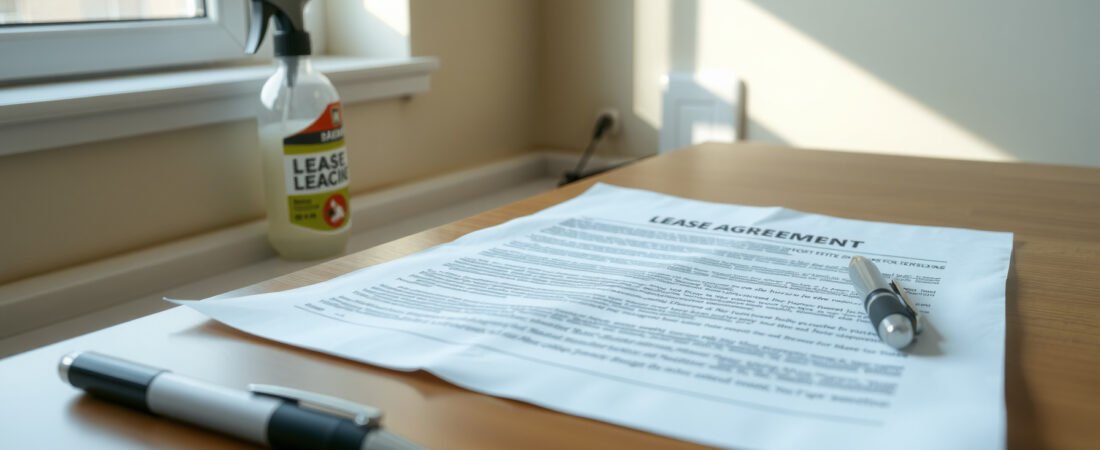
This close-up of a lease pest control clause illustrates exactly the kind of specific, itemized language that protects tenants — notice how the absence of such detail in your own lease is itself useful information before you sign.
Which Pest Problems Are Legally the Landlord’s Responsibility Regardless of What the Lease Says?
Here’s a counterintuitive fact that most lease guides skip entirely: in most U.S. states, certain pest infestations are the landlord’s legal responsibility under implied warranty of habitability law — even if your lease says otherwise. A lease clause that tries to shift all pest liability to the tenant can actually be unenforceable, depending on your state. Courts in California, New York, Illinois, and several other states have repeatedly ruled that rodent and cockroach infestations rise to the level of habitability violations, meaning a landlord can’t waive that responsibility with a lease clause.
What the lease can legitimately do is define tenant-caused infestations as tenant responsibility. Picture this: a tenant stores open dog food bags in a closet for six months, mice colonize the wall cavity between units, and the infestation spreads to a neighbor’s apartment. A mouse can squeeze through a gap as small as 1/4 inch, and once a colony is established indoors, females reproduce rapidly — up to 10 litters per year. In that scenario, a lease clause assigning cleanup costs to the negligent tenant is likely enforceable. The legal line isn’t about who pays for pest control — it’s about whether the pest problem was caused by the tenant’s behavior or by a pre-existing structural condition.
“The most common mistake I see tenants make is assuming their lease is the final word on pest responsibility. State habitability statutes frequently override lease language — especially for rodents and cockroaches — because legislators have already decided those conditions are incompatible with safe housing. A lease can narrow certain responsibilities, but it can’t extinguish statutory protections.”
Dr. Mara Ellison, Juris Doctor and Licensed Pest Management Consultant, National Pest Management Association Member
What Specific Language Should You Demand in a Lease Before Signing?
Most renters treat the lease signing like a formality. They skim it, sign it, and figure they’ll deal with problems if they come up. That’s a reasonable attitude for a lot of clauses — but not this one. Pest infestations are one of the few categories where the lease language you agreed to upfront will directly determine your legal options if things go wrong six months later.
Before signing, look for — or ask to add — the following specific provisions:
- Inspection clause at move-in: The landlord should certify in writing that the unit is free of pests at the time of occupancy. This is your baseline documentation and your first line of defense if an infestation appears in the first 30–60 days.
- Defined response timeline: The clause should state how many days the landlord has to respond after you submit a written pest complaint — 24–48 hours for urgent pests (rodents, bed bugs), 5–7 business days for less urgent issues.
- Treatment standard: “Pest control” is not a defined term. The clause should specify that treatment must be performed by a licensed pest management professional, not just a property manager with a can of Raid.
- Failure-to-treat remedy: If the landlord doesn’t meet the response timeline, the clause should specify what you can do — withhold rent into escrow, arrange your own treatment and deduct costs, or terminate the lease. Without this, you’re in legal no-man’s-land.
- Tenant notification period: Any landlord-initiated pest treatment requires adequate notice (typically 24–48 hours) so you can prep the unit, move pets, or arrange to be absent if chemicals are used.
- Neighboring unit language: In multi-unit buildings, the clause should address what happens if a pest problem originates in another unit. Cockroach populations can migrate through shared plumbing walls; a German cockroach produces 30–40 eggs per capsule, and a single egg case from a neighboring unit can restart an infestation in yours.
Pro-Tip: If a landlord refuses to add a response timeline to the pest control clause, ask for it as a separate written addendum to the lease. An addendum signed by both parties carries the same legal weight as the main lease document — and many landlords will agree to an addendum who would resist changing the lease itself.
How Do Lease Clauses Differ Between Single-Family Rentals and Multi-Unit Buildings?
The building type matters more than most renters realize. In a single-family rental, pest responsibility is relatively binary — either you caused it or the structure did. In a multi-unit building, the picture is genuinely more complicated, and lease clauses need to reflect that complexity or they’ll fail the moment they’re tested. A clause that works fine in a house becomes useless in a 40-unit apartment building where pests move freely between units through shared walls, utility chases, and HVAC systems.
The table below shows how lease clause language should differ depending on the property type — and what’s often missing in standard templates:
| Property Type | Key Clause Need | Most Commonly Missing |
|---|---|---|
| Single-family rental | Move-in inspection certification, structural exclusion responsibility | Definition of what constitutes a structural vs. tenant-caused infestation |
| Multi-unit apartment | Neighboring unit liability language, building-wide treatment protocol | Who pays when source unit is unknown or in a common area |
| Condo rental | HOA vs. landlord vs. tenant responsibility breakdown | Clarity on whether HOA pest policy overrides or supplements the lease |
Condo rentals are especially tricky because you may have three overlapping sets of rules — the HOA’s master pest policy, the landlord’s individual lease, and state habitability law — that can contradict each other. If you’re renting a condo, ask your landlord specifically whether the HOA covers any pest treatments, and get the answer in writing before you move in. If they don’t know, that’s useful information too. If you’re trying to figure out whether ongoing professional service or a pay-per-visit model makes more financial sense for your situation, understanding what the real cost difference is between quarterly and monthly pest plans can help you decide which option to push for in lease negotiations.
What Happens When the Lease Is Silent on Pest Control — Or Contradicts Itself?
Silence in a lease isn’t neutral. When a lease says nothing about pest control, responsibility defaults to whatever your state’s landlord-tenant statute says — and that’s a patchwork across the country. Some states, like Arizona and Georgia, give landlords more flexibility to shift pest responsibility to tenants through lease language. Others, like California and New Jersey, impose affirmative duties on landlords that can’t be contractually waived. If your lease is silent and your state has strong habitability protections, you may actually have more rights than a tenant whose lease spells out a weak pest clause — because the statute kicks in and it’s better than what the lease offers.
Self-contradictory leases are a different problem and more common than people think. A lease might say “landlord is responsible for pest control” in one clause and “tenant shall keep premises free of pests” in another, with no guidance on how to reconcile them. Here’s what those contradictions usually mean in practice:
- Ambiguous language is typically interpreted against the party who drafted the document — usually the landlord — in a dispute.
- A landlord trying to blame a tenant for an infestation bears the burden of proving tenant negligence caused it, not just that the tenant lived there.
- If a clause says the tenant must “maintain a sanitary environment,” that does not legally mean the tenant is responsible for treating a structural pest problem like termites. Termite colonies can exceed 1 million individuals and are driven by soil moisture and wood-to-ground contact — conditions no tenant controls.
- Courts look at the lease as a whole, not clause by clause — so a strong implied habitability argument can override a weak pest clause even if the tenant signed it.
- If you believe your lease contradicts itself on pest responsibility, document everything in writing before you escalate — texts, emails, and photos of the infestation all become evidence if the dispute reaches housing court.
One real-world scenario that illustrates all of this: a tenant in a mid-rise building discovers a drain fly problem in their bathroom — hundreds of them emerging from the sink drain over several weeks. The landlord claims it’s a cleanliness issue; the tenant’s lease says tenants are responsible for “keeping drains clear.” Drain flies breed in the organic film that builds up inside drain pipes — a process that happens in every building regardless of tenant behavior, and that a homeowner’s standard cleaning routine won’t prevent. The landlord’s claim doesn’t hold up. Drain flies are a plumbing and building maintenance issue, not a housekeeping one. If you’ve dealt with drain flies, you already know how persistent they are even in spotless kitchens — and understanding which fly traps actually work indoors can help you manage them while your landlord drags their feet on the real fix.
The bigger lesson isn’t just about drain flies — it’s that “sanitation” language in a lease is routinely overextended by landlords who want to avoid treatment costs. Pests like termites, subterranean ants, cockroaches migrating from building infrastructure, and rodents entering through foundation gaps are all structural issues. No lease clause that blames tenant cleanliness can honestly be applied to a pest whose entry point and breeding habitat exist entirely outside the tenant’s unit or control.
Read your lease with a specific question in mind before you sign: “If a cockroach came up through the drain tonight, what does this document tell me to do, and what does it tell my landlord to do?” If the answer is unclear, you’re looking at a lease with a gap — and gaps get filled by whoever argues harder in a dispute. The better your lease language is now, the less you’ll need to argue later.
Frequently Asked Questions
who is responsible for pest control in a rental property landlord or tenant?
In most states, landlords are responsible for pest control when an infestation exists at move-in or results from building-related issues like cracks, gaps, or poor sanitation in common areas. Tenants can become responsible if the infestation is directly caused by their own actions, like leaving food out or storing garbage improperly. Your lease should spell this out clearly — if it doesn’t, your state’s implied warranty of habitability usually puts the burden on the landlord.
what should a lease say about pest control?
A solid lease should name who pays for extermination, which pests are covered, how quickly the landlord must respond after a report (typically within 24 to 72 hours for severe infestations), and what happens if the tenant causes the problem. It should also include language about tenant cooperation, like allowing access for treatment and following prep instructions. Vague leases that just say ‘tenant maintains unit’ often lead to disputes, so the more specific the language, the better protected both parties are.
can a landlord make a tenant pay for pest control?
Yes, a landlord can legally shift pest control costs to the tenant through lease language in many states, but only if the tenant’s behavior caused the infestation. For example, if bedbugs are traced to furniture a tenant brought in, some leases allow the landlord to charge extermination costs back — sometimes $200 to $1,500 or more depending on the treatment. However, landlords generally can’t charge tenants for pre-existing infestations or problems tied to the building’s structure.
are landlords required to disclose pest infestations before signing a lease?
Several states require landlords to disclose known pest infestations before a tenant signs a lease, and a handful specifically require bedbug disclosure in writing. Even where it’s not legally required, failing to disclose a known infestation can expose a landlord to liability if the tenant discovers it shortly after moving in. Always ask the landlord directly about past infestations and request it in writing — if they lie, that documentation protects you later.
what happens if my lease is silent on pest control?
If your lease doesn’t mention pest control at all, your rights fall back on your state’s landlord-tenant laws and the implied warranty of habitability, which most states recognize. Under that standard, landlords must keep units free from conditions that threaten health and safety — and a significant infestation of rodents, cockroaches, or bedbugs typically qualifies. You should report the problem in writing, give the landlord reasonable time to fix it (usually 14 to 30 days depending on the state), and know that withholding rent or pursuing repairs-and-deduct remedies may be options if they don’t act.
Disclaimer: This article is for general informational purposes only and does not constitute legal advice. Landlord-tenant laws and pest-related disclosure or habitability requirements vary significantly by state and even by city, and they change over time. Before withholding rent, breaking a lease, or taking other legal action over a pest infestation, consult a licensed attorney or your local tenant rights organization familiar with the laws in your area.