
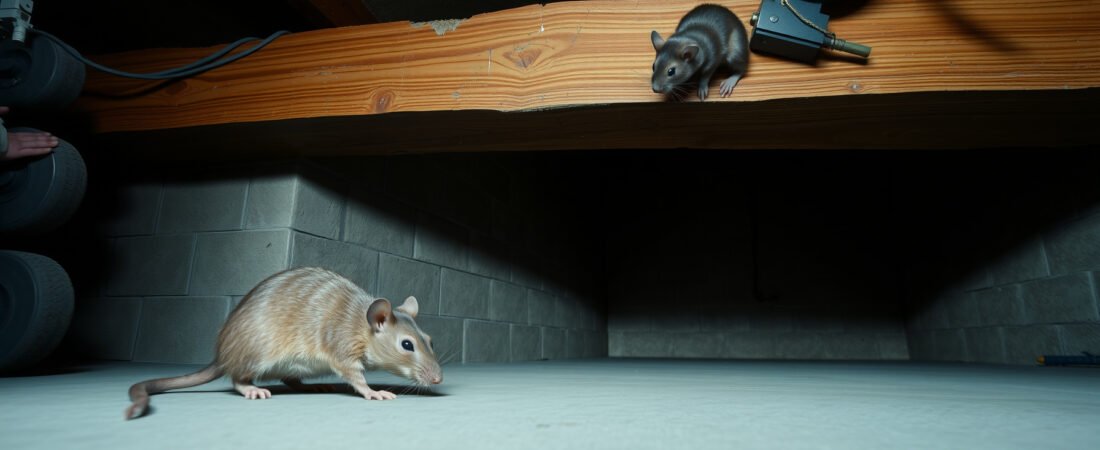
Both rats are in your house right now — and you’re probably treating for the wrong one. That single mistake explains why so many DIY rat control efforts fail completely: Norway rat bait placed up high goes untouched, roof rat traps set on the floor catch nothing, and the infestation keeps growing while you keep spending money. The difference between these two species isn’t just academic trivia. It dictates where you set traps, how you seal entry points, what bait works best, and whether your problem is coming from the ground up or the roof down.
What Does a Norway Rat Actually Look Like Up Close?
A Norway rat is a heavy, blunt animal — stocky through the body, with a broad, rounded snout and small ears that look almost too small for its head. Adults typically weigh between 7 and 18 ounces and measure 13 to 19 inches from nose to tail tip, with the tail noticeably shorter than the combined length of the head and body. The fur is coarse and usually a brown or grayish-brown on top, with a paler, sometimes gray-white underside.
One physical detail that most people don’t notice until they’re looking for it: the Norway rat’s tail is thick, scaly, and bicolored — darker on top, lighter underneath. The eyes are small and somewhat buried in the face, which gives the animal a blunt, almost aggressive look compared to the sleeker roof rat. If you’ve seen a rat in your basement, crawl space, or along a fence line near ground level, there’s a very high chance you were looking at a Norway rat.
This close-up comparison shows the key physical differences between Norway and roof rats side by side — the body shape, ear size, and tail length that tell you which species you’re actually dealing with before you ever set a single trap.
What Does a Roof Rat Look Like and How Is It Different?
Roof rats are built for climbing, and their body reflects it. They’re slender and almost elegant compared to Norway rats — lighter at 4 to 9 ounces, with a body length of around 6 to 8 inches, but a tail that’s longer than the body itself, often 7 to 10 inches. That long tail is their balance tool. The ears are large and nearly hairless, the snout is pointed, and the eyes are noticeably bigger and more prominent than a Norway rat’s.
Fur color varies more in roof rats than most people expect. The back is typically dark brown to black, but the underside can be white, gray, or even a creamy yellow depending on the population. “Black rat” is a common nickname, though many roof rats are closer to dark brown. If you’re finding evidence of rats in your attic, inside wall voids above the first floor, or running along power lines and tree branches near your roofline, you’re almost certainly dealing with roof rats.
“Homeowners almost always focus on the rat they can see, but the species you’re dealing with tells you everything about where the colony is living and how they’re getting in. A Norway rat burrowing under your foundation and a roof rat nesting in your attic require completely different exclusion strategies. Getting the ID wrong is the most common reason I see rat problems that have been ‘treated’ multiple times without success.”
Dr. Marcus Hale, Board-Certified Entomologist and Urban Pest Management Specialist, University Extension Program
Side-by-Side Comparison: Norway Rat vs Roof Rat at a Glance
The fastest way to confirm which rat you’re dealing with is to compare the physical markers against each other, not just read descriptions in isolation. The table below captures the most diagnostic differences — the ones that actually hold up in real identification rather than just in textbooks.
| Feature | Norway Rat | Roof Rat |
|---|---|---|
| Body shape | Heavy, thick, blunt | Slender, lean, athletic |
| Adult weight | 7–18 oz | 4–9 oz |
| Tail vs body length | Tail shorter than body | Tail longer than body |
| Ears | Small, close to head | Large, prominent |
| Snout | Blunt, rounded | Pointed, narrow |
| Typical fur color | Brown/gray-brown above, pale below | Dark brown/black above, variable below |
| Primary habitat | Ground level, burrows, basements | Attics, rafters, trees, upper walls |
One honest caveat here: young Norway rats and adult roof rats can overlap in size, which trips people up when they find a smaller rodent they weren’t expecting. In those cases, rely on the tail-to-body ratio and ear size — those two features are reliable across age groups in ways that body weight simply isn’t.
Why Does the Species ID Actually Change How You Treat the Problem?
Here’s the part that most rat identification articles skip entirely — the physical differences between these two species aren’t just interesting biology. They’re directly tied to behavior, and behavior determines everything about effective control. Norway rats are neophobic, meaning they’re suspicious of new objects in their environment, sometimes for 3 to 5 days before they’ll approach a newly placed trap. Roof rats are somewhat more cautious still in open spaces, but they naturally run along walls, beams, and pipes rather than across open floors.
Picture this: a homeowner in coastal Georgia spends three weeks setting snap traps along the baseboards in a kitchen with zero catches. An inspection finally reveals a roof rat colony nesting in the attic, running down inside the wall void and accessing a cabinet through a gap behind the dishwasher — never touching the floor at all. The traps weren’t in the wrong room. They were on the wrong surface entirely. Placing traps at elevation — secured to pipes, rafters, or along the tops of joists — is a non-negotiable step for roof rat control that simply doesn’t apply to Norway rat management.
Pro-Tip: If you’re unsure which species you have, check the droppings for clues beyond just size. Norway rat droppings are capsule-shaped with blunt ends, averaging about 3/4 inch long. Roof rat droppings are slightly smaller at about 1/2 inch and have pointed tips. Finding droppings in overhead cabinets or along the top of a wall plate strongly suggests roof rats even before you ever see the animal.
The behavioral difference also affects bait choice in ways that aren’t widely discussed. Roof rats have a strong preference for fruits, nuts, and plant-based materials — they’re essentially arboreal foragers by nature. Norway rats are more omnivorous and opportunistic, readily taking protein-based baits and grain. Using a peanut butter and fruit combination works reasonably well for both, but pure protein bait like sardines that a pest professional might recommend for Norway rats can be actively avoided by some roof rat populations.
Where Each Species Enters Your Home and What Signs They Leave Behind
Norway rats almost always enter at or below ground level. They’re exceptional diggers — a single Norway rat can excavate a burrow system 6 to 18 inches deep, and they’ll use the foundation perimeter, garage door gaps, utility line entry points, and floor drains as their preferred access routes. Gaps as small as 1/2 inch are enough for an adult to squeeze through, and they’ll gnaw openings wider if they need to. Look for grease smears, packed soil, and gnaw damage along the base of walls and around any pipe penetrations at slab level.
Roof rats come in from above. They’re capable climbers that can scale rough exterior walls, run across power lines, and drop onto rooftops from overhanging trees with branches within 18 inches of the structure. Their entry points are typically soffits, roof vents, gaps around HVAC lines, and any opening in the upper portion of the building envelope. Because they’re light and agile, the gnaw damage they leave at entry points tends to be smaller and cleaner-edged than the ragged chewing a Norway rat produces. If you’re finding smear marks and gnaw evidence at eave height rather than at foundation level, the species question answers itself.
Here are the specific signs to look for by location — organized by where in or around a home you’re finding evidence:
- Burrows in soil near foundation: Norway rat signature — look for 2- to 4-inch diameter holes with freshly packed dirt and gnaw debris nearby
- Gnaw damage at ceiling level, attic joists, or roof sheathing: Roof rat territory — often accompanied by greasy smear trails along rafters
- Droppings near floor-level cabinets, under appliances, or in crawl spaces: More consistent with Norway rats working ground-level routes
- Droppings in attic insulation, on top of wall plates, or inside overhead soffits: Roof rat activity — they deposit droppings along their regular travel routes at elevation
- Noise at night below floor level: Norway rats running in crawl spaces or sub-slab voids — activity typically peaks 30 to 60 minutes after sunset
- Noise at night above ceiling level: Roof rat movement in attic — often described as fast, light scurrying compared to the heavier sound of a Norway rat
How to Confirm Which Rat You Have When You’re Still Not Sure
Sometimes you genuinely can’t tell from signs alone — especially in multi-story homes where both species could theoretically be present at the same time, which does happen in infestations that have been established for months. A female Norway rat produces 3 to 6 litters per year with 7 to 14 pups each, while a roof rat produces 3 to 5 litters with 5 to 8 pups — meaning either species can build a large population inside a structure within 60 to 90 days of initial entry.
Use this step-by-step confirmation process before committing to a treatment plan:
- Collect a dropping sample from the hottest activity zone — measure the length and note whether the ends are blunt (Norway) or tapered (roof rat). Size alone isn’t reliable; shape is.
- Set a tracking station — place a 12-inch square of sheet metal dusted lightly with talcum powder or flour along a suspected travel route. Clear footprints will show you both the size and the claw spread. Norway rat prints are wider and heavier; roof rat prints are narrower with a lighter impression.
- Map where all evidence is concentrated — ground floor and below strongly suggests Norway rats, second floor and above strongly suggests roof rats. If evidence is spread across both, you may have both species.
- Check exterior entry points by height — physically inspect the foundation perimeter for burrows and the roofline for gnaw damage. The location of active entry points is often your most reliable confirmation.
- Set an unbaited trap in each zone — a trap placed correctly for the right species in the right location will typically see activity within 24 to 48 hours in an active infestation. A trap that sits untouched for a week is usually in the wrong location for that species.
Geography matters here too, and it’s an honest variable worth acknowledging. Norway rats dominate in colder northern climates and inland areas, while roof rats are more prevalent across the Gulf Coast, Florida, Pacific Coast states, and Hawaii. In the Southwest and mid-Atlantic states, you can genuinely find both species sharing territory — and occasionally sharing a structure. Your regional baseline shifts the probability, but it doesn’t eliminate either species from consideration, especially in port cities and anywhere with older building stock.
One thing worth knowing if you’re renting and dealing with an active rat infestation: what a lease should say about pest control responsibility matters a great deal in these situations, because the species and entry points can determine whether the problem originated from the tenant’s behavior or from structural deficiencies that predate your tenancy. That distinction affects who’s legally responsible for treatment costs.
If you’ve correctly identified your species and are considering whether to hire a professional or handle it yourself, understanding what recurring professional service actually costs is worth a hard look. The real cost difference between quarterly and monthly pest plans becomes particularly relevant when you’re dealing with rats, because ongoing monitoring after initial treatment is often what prevents reinfestation — especially in multi-unit buildings or homes with complex roof and foundation access points.
The counterintuitive reality most people never hear: successfully eliminating the rats you currently have is almost always easier than stopping the next wave. Both Norway and roof rats maintain territory ranges of 100 to 300 feet from their nest, which means neighboring properties, sewer systems, and surrounding vegetation are constantly producing new animals looking for harborage. Correct species identification gets you the right treatment today — but a sealed structure is the only thing that keeps the problem from starting over by next season.
Frequently Asked Questions
How big are Norway rats compared to roof rats?
Norway rats are noticeably larger, typically weighing 7–18 oz and measuring 13–18 inches from nose to tail tip. Roof rats are leaner and lighter, usually 5–9 oz and 13–15 inches total length. If you’re seeing a chunky, heavy-bodied rat, it’s almost certainly a Norway rat.
How can you tell a Norway rat from a roof rat by the tail?
The tail is one of the easiest ways to tell them apart. A roof rat’s tail is longer than its body, while a Norway rat’s tail is shorter than its body. Both tails are scaly and hairless, but that length difference is a reliable field ID every time.
What color are Norway rats vs roof rats?
Norway rats are usually coarse-furred and brownish-gray with a pale gray or white belly. Roof rats tend to have smoother fur that’s dark brown to black on top, sometimes with a lighter tan or gray underside. Color alone isn’t foolproof, but combining it with body shape and tail length gives you a solid ID.
Do Norway rats and roof rats live in different parts of the house?
Yes, and that location clue is hugely helpful for identification. Norway rats burrow and stay low — think basements, crawl spaces, and ground-level walls. Roof rats are climbers and prefer attics, upper walls, ceiling voids, and tree branches near the roofline. Where you spot the rat or find droppings tells you a lot about which species you’re dealing with.
What do Norway rat droppings look like compared to roof rat droppings?
Norway rat droppings are blunt-ended capsule shapes, about 3/4 inch long. Roof rat droppings are slightly smaller at around 1/2 inch and have pointed ends on both sides. Finding droppings near the floor or in a basement points to Norway rats, while droppings in the attic or along high shelves suggest roof rats.