
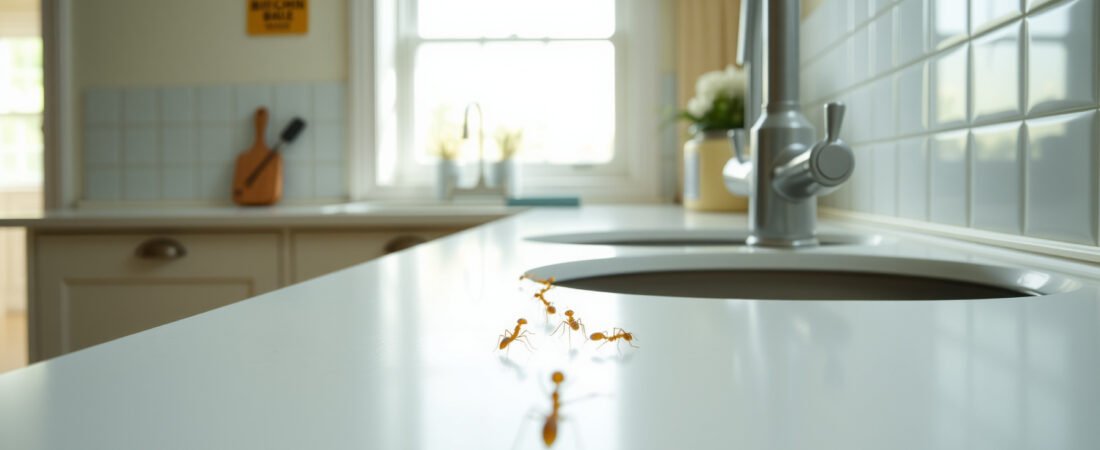
Spraying pharaoh ants makes the problem worse — not better. That’s the one thing most homeowners find out the hard way, after a can of Raid turns a manageable trail into four new colonies spreading across the kitchen and into the bathroom walls. Pharaoh ants don’t behave like other ants. When they sense a chemical threat, they “bud” — a survival mechanism where a single queen and a few workers break off and start a brand-new satellite colony somewhere deeper in your home. The fix requires a completely different strategy, and if you skip to the wrong step first, you’ll be fighting this pest for months instead of weeks.
Why Pharaoh Ants Keep Coming Back to Kitchens and Bathrooms Specifically
Pharaoh ants aren’t just hunting food — they’re hunting moisture. Kitchens and bathrooms offer the exact combination they need to thrive: warmth, water, protein, and fat sources within a few feet of each other. A leaky pipe under the bathroom sink, condensation around a toilet tank, or even residual moisture from a dishwasher cycle can sustain an entire colony. These ants are tiny, averaging just 1.5–2 mm in length, which means a gap around a pipe fitting that you wouldn’t even notice is a four-lane highway to them.
What makes them particularly hard to beat in these two rooms is their nesting behavior. Pharaoh ant colonies can contain anywhere from 10,000 to 300,000 workers with multiple queens — sometimes dozens of queens — all living within the wall voids, under flooring, or behind tile grout. You’ll see the workers out foraging, but the nests themselves are almost never visible. Treating what you can see, and ignoring what you can’t, is exactly why re-infestations happen within days of spraying.
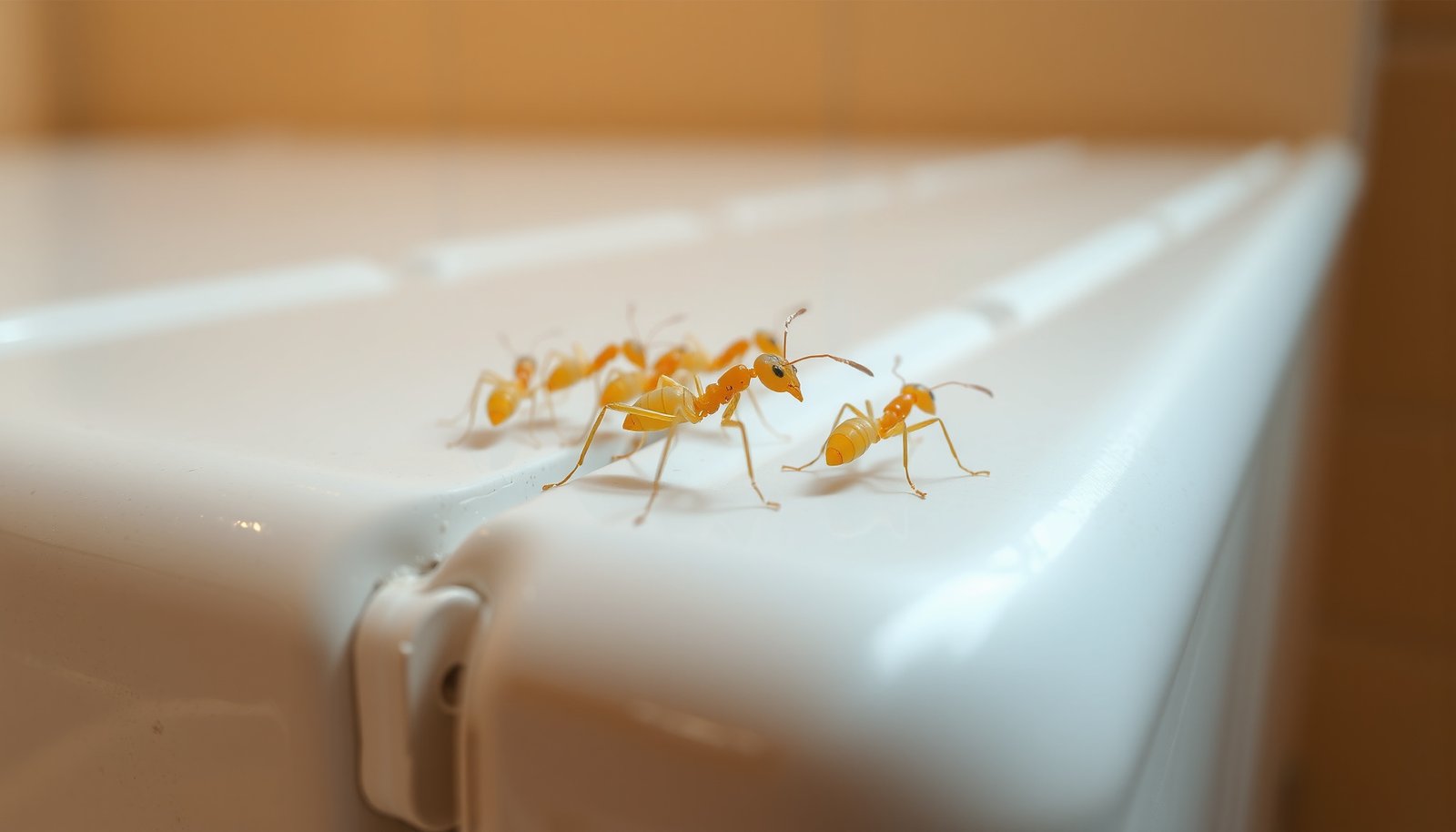
This close-up shows a typical pharaoh ant trail along a bathroom caulk line — the kind of subtle, narrow path that’s easy to mistake for debris until you watch it move, and exactly the reason why identifying the route matters before you do anything else.
How to Confirm You’re Actually Dealing With Pharaoh Ants (Not a Different Species)
Getting the identification right before you treat is non-negotiable, because the baiting strategy for pharaoh ants is different from what you’d use on odorous house ants or pavement ants. Pharaoh ants are pale yellow to light brown, almost translucent, with a darker abdomen. They’re so small that most people initially think they’re seeing baby ants from another species. One practical way to confirm: look at where they’re trailing. Pharaoh ants almost always follow the same fixed routes — along grout lines, behind appliances, and inside wall voids — rather than spreading randomly across open countertops.
Picture this: you notice a thin, steady line of nearly invisible ants moving from behind the refrigerator toward the base of the kitchen faucet every evening around dusk. You’ve cleaned the counters, wiped everything down, but the trail reappears within hours. That’s a pharaoh ant signature — consistent, repeated routes driven by pheromone trails that persist even after you clean the surface. Identifying that pheromone trail behavior is just as diagnostic as looking at the ant itself. If you’re uncertain and the ants you’re seeing are larger or darker, it’s worth double-checking — the same way you’d want to distinguish firebrats from silverfish before treating, since the products and methods differ significantly.
The Only Treatment That Actually Works: Slow-Acting Bait Done Right
Bait is the only reliable method for pharaoh ants, and the mechanism matters: slow-acting bait lets foragers carry the toxic food back to the nest, where it’s shared with the queens and larvae. If the bait kills the forager before it returns, nothing changes. You need a product with delayed action — specifically baits containing hydramethylnon, boric acid at low concentrations, or indoxacarb. Gel baits like Terro Liquid Ant Bait or professional-grade products like Optigard Ant Gel are formulated to be slow enough to reach the colony.
Placement is where most people fail. Don’t put bait out in the open where you see ants crossing — place it directly on the trail, as close to where the trail disappears into the wall or under an appliance as possible. The ants need to be able to find it immediately without detouring. Use multiple small placements rather than one large station. Replace bait every 3–5 days if it’s being consumed, and don’t disturb the trail while the bait is active. It typically takes 3–6 weeks to collapse a pharaoh ant colony this way, and that timeline is not a sign the bait isn’t working.
Pro-Tip: Pharaoh ants need both sugar and protein sources, and their dietary preference shifts over the course of a season. If a sugar-based bait isn’t getting picked up within 24–48 hours, swap to a protein-based or fat-based bait (peanut butter mixed with boric acid works surprisingly well) — they may simply not want sweets right now.
Here’s exactly how to set up an effective pharaoh ant bait program in your kitchen and bathroom:
- Map the trails first. Spend 10 minutes watching where the ants travel at their peak activity time (usually early evening) and mark the trail entry and exit points on a rough sketch of the room. Don’t skip this step — it tells you exactly where to place bait.
- Stop all competing food sources. Store all dry goods in sealed containers, fix any dripping faucets, and don’t leave standing water anywhere. If the ants have better food options than the bait, they’ll ignore the bait entirely.
- Apply bait in pea-sized drops directly on the trail. Use at least 4–6 placements per room, spaced about 12 inches apart along the active trail. More placements increase the chance of rapid uptake.
- Do not spray anything while bait is active. No surface sprays, no essential oils, no vinegar wipes near the bait. Repellents scatter the colony and trigger budding. This is the single most common mistake.
- Monitor and refresh. Check bait stations every 2–3 days. Heavy feeding is a good sign — it means the workers are carrying it back. Refresh stations that are depleted or dried out.
- Assess at the 4-week mark. If ant activity has reduced by 80% or more, continue with reduced bait placements. If activity is unchanged, switch to a bait with a different active ingredient — some colonies develop a preference aversion.
What to Fix Structurally So They Don’t Return After Treatment
Baiting handles the current colony, but it doesn’t seal the door. Pharaoh ants enter through gaps around plumbing penetrations, worn caulk at the base of bathroom tile, and openings behind kitchen appliances that connect to wall voids. These aren’t cosmetic issues — they’re active ant highways. Re-caulking the area around your toilet base, sink drain pipe, and where the stove gas line enters the wall takes about 30 minutes and meaningfully cuts off access routes that a new colony could exploit.
Moisture control is equally important, and it’s the structural fix most people overlook entirely. Pharaoh ants can survive in dry environments for only short periods — their colonies concentrate around reliable moisture. Fix any slow drips under the bathroom or kitchen sink, ensure the exhaust fan in the bathroom is actually venting moisture out (not just recirculating it), and check that the caulk around the bathtub and shower base isn’t cracked. These aren’t just good housekeeping tips — they actively make your home less hospitable to colony establishment.
| Structural Fix | Why It Matters for Pharaoh Ants | Difficulty |
|---|---|---|
| Re-caulk plumbing penetrations | Closes wall void access points ants use as nesting sites | Low — DIY in 30 min |
| Fix leaking pipes or dripping faucets | Eliminates the moisture source that sustains colonies | Low to moderate |
| Seal gap behind stove and refrigerator | Removes the sheltered, warm void ants nest in near food | Low — foam or caulk |
| Replace cracked grout in bathroom tile | Destroys established trail routes and potential nesting channels | Moderate — DIY weekend project |
When to Call a Professional (and What to Tell Them)
DIY baiting works for most pharaoh ant problems in single-family homes, but there are situations where it doesn’t cut it. Multi-unit buildings — apartments, condos, townhomes — are a different challenge entirely. Pharaoh ant colonies spread between units through shared wall voids, electrical conduit, and plumbing chases. You can eliminate your visible infestation and have a completely fresh one arrive from a neighbor’s unit within two weeks. In that scenario, a coordinated treatment across multiple units is the only thing that actually resolves it. If you’re renting and dealing with this situation, it’s worth knowing your rights around pest control — including whether you’re entitled to a rent adjustment for an unresolved infestation that’s affecting habitability, which is covered in detail in this guide on how to ask for a rent reduction due to an ongoing pest problem.
When you do call a professional, be specific about what you’ve already tried. Tell them exactly which bait products you used, where you placed them, and how long the bait ran. A good exterminator will use that information to choose a bait with a different active ingredient and a different attractant matrix — not just repeat what you already did. Ask specifically whether they’ll be treating wall voids with a non-repellent dust like Boric Acid or Diatomaceous Earth, since that’s the step that addresses hidden nesting sites the bait can’t always fully reach on its own.
“Pharaoh ants are one of the few pest species where I actively discourage clients from using any contact insecticide before calling me. Even a single application of a repellent spray can fragment a colony of 50,000 ants into ten smaller colonies spread across the building — and now you’ve got a problem that’s geometrically harder to solve. The bait-only approach isn’t just a preference; for this species, it’s the only thing that consistently works.”
Dr. Marcus Elwood, Board-Certified Entomologist and Urban Pest Management Specialist, University Extension Program
One honest nuance worth acknowledging: the timeline for full colony elimination varies significantly based on how large and how established the infestation is, and whether the building has ongoing moisture issues or shared wall voids. A pharaoh ant problem in a newly constructed single-family home with good caulking might resolve in three to four weeks of baiting. The same species in a 1950s apartment building with corroded plumbing and shared mechanical chases could take two to three months of coordinated treatment — and that’s not a failure, it’s just the reality of how pharaoh ant colonies scale with available nesting habitat.
Here’s a quick checklist of signs that you’ve moved past the DIY threshold and need professional help:
- Ant trails are appearing in multiple rooms simultaneously, not just the kitchen or bathroom
- You’ve run bait for 6+ weeks with no measurable reduction in activity
- Ants are visible inside electrical outlets or light switch boxes (a sign of deep wall void nesting)
- You live in a multi-unit building and adjacent units have also reported ant activity
- The infestation returns within 2 weeks of a bait program that appeared to be working
The counterintuitive thing about pharaoh ants — and it genuinely surprises people — is that the cleaner and more modern your kitchen is, the easier it sometimes is for them to take hold. Older kitchens have gaps and imperfections that actually disrupt trail formation. Seamless countertops, hidden appliance voids, and recessed plumbing in newer construction create exactly the kind of enclosed, temperature-stable microenvironments where pharaoh ant colonies quietly build out to tens of thousands before anyone notices a single forager. By the time the trail appears on your counter, the colony has been living in your walls for weeks. Start baiting the moment you see them, resist every instinct to spray, and give the process the full weeks it requires — that patience is what separates the people who solve this problem from the ones who fight it indefinitely.
Frequently Asked Questions
how do I know if I have pharaoh ants in my kitchen?
Pharaoh ants are tiny — only about 1/16 inch long — and pale yellow to light orange in color. You’ll usually spot them trailing along countertops, inside cabinet hinges, or near the back of appliances where it’s warm. Unlike carpenter ants, they don’t damage wood, but they do nest deep inside walls and under flooring, which makes them harder to eliminate.
what kills pharaoh ants in the kitchen fast?
Don’t reach for a spray — it’ll make the problem worse by causing the colony to split and spread. The most effective treatment is slow-acting bait like Terro Liquid Ant Bait or a protein-based gel bait placed along their trails. Worker ants carry the bait back to the colony, and it can take 1 to 3 weeks to wipe out the full nest.
why do pharaoh ants keep coming back in my bathroom?
Pharaoh ants are drawn to bathrooms because of the moisture, warmth, and easy access to water near sinks and toilets. If they keep returning, it’s likely because the colony is nesting inside the walls or under the flooring nearby and hasn’t been fully eliminated. Fixing leaky pipes and sealing gaps around plumbing are critical steps — otherwise, you’re just treating symptoms, not the source.
are pharaoh ants dangerous in the kitchen?
Pharaoh ants aren’t a direct physical danger, but they’re considered one of the more serious kitchen pests because they can contaminate food and spread bacteria like Salmonella and Streptococcus. They’re also known to get into sealed food packaging. In hospitals, they’ve been documented entering wounds and IV bags, so you definitely don’t want an active infestation near food prep areas.
can I get rid of pharaoh ants myself or do I need an exterminator?
You can handle a mild infestation yourself using slow-acting ant bait, but pharaoh ants are notoriously difficult to eradicate without professional help. If you’ve been baiting consistently for 4 to 6 weeks with no improvement, or you’re seeing trails in multiple rooms, it’s worth calling a pest control company. Professionals can use non-repellent insecticides like Taurus SC that penetrate wall voids where the colonies actually live.
Disclaimer: This article is for informational purposes only and isn’t a substitute for professional pest control advice. Always read and follow the product label instructions exactly — label directions are legally binding and vary by brand and active ingredient. Keep all pesticides, baits and traps away from children and pets, ventilate treated areas as directed, and consider calling a licensed pest control professional if an infestation is large, recurring, or involves a structural pest like termites or carpenter ants.