
Soap sprays kill aphids. So do neem oil, ladybugs, diatomaceous earth, and about a dozen other things you’ve already read about. The real problem isn’t finding a treatment — it’s that most people treat the aphids they can see and completely ignore the reason the infestation came back three weeks later. Aphid control fails almost every time because the colony is always bigger than it looks, and there’s almost always something on your property actively making the problem worse.
Why Aphid Infestations Keep Coming Back After Treatment
A single wingless aphid can reproduce without mating and produce up to 80 offspring in a week. By day 30, one aphid can theoretically become a colony of over 600 billion — though real-world conditions pull that number way down. The point is that even a handful of aphids left behind after treatment is enough to restart a full infestation within 10 to 14 days, which is exactly why people spray their roses in June and wonder why they’re infested again by July.
The part most articles skip entirely: ants. Certain ant species — particularly odorous house ants and fire ants — actively farm aphids for the sticky honeydew they excrete. They physically carry aphids to new plants, protect them from predators like ladybugs, and even remove aphid eggs into their underground colonies to overwinter them safely. If you’ve got ants in your garden, they may literally be reintroducing aphids to the same plant every few days. Treating aphids without addressing the ant connection is like bailing out a boat without plugging the hole.
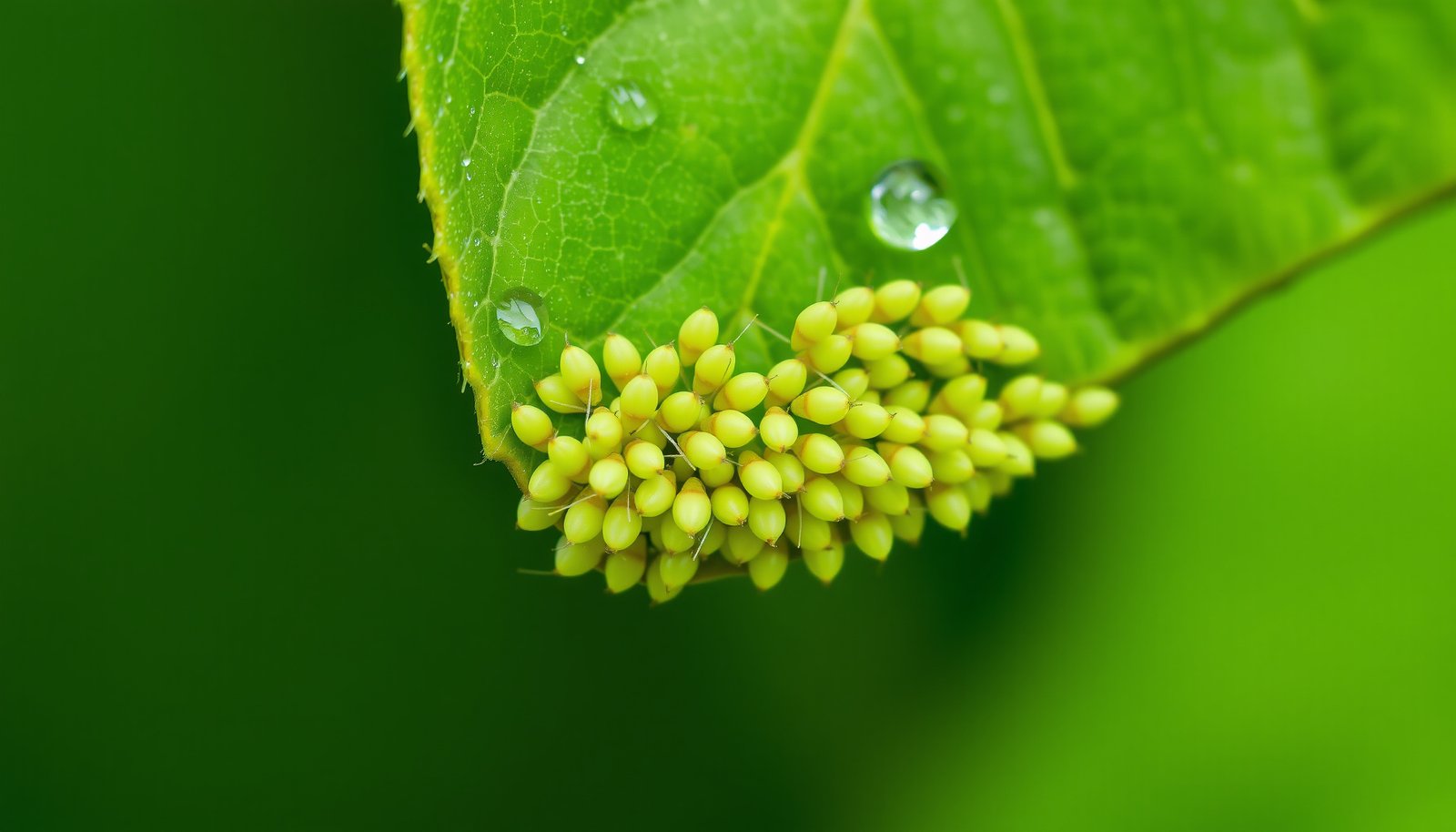
This close-up shows aphids clustered at the base of a new stem shoot — the soft, actively-growing tissue they prefer — which is exactly where most people forget to look when inspecting plants for early-stage infestations.
How to Actually Confirm You Have Aphids (Not Something Else)
Aphids are tiny — most species range from 1/16 to 1/8 inch long — but they’re not invisible. Flip over a leaf on a heavily infested plant and you’ll typically find clusters of soft-bodied, pear-shaped insects in green, black, yellow, white, or woolly gray depending on the species. The woolly aphid, for example, looks like a fluffy white mold when you first spot it on an elm or apple tree, and people routinely treat it with the wrong product because they misidentify it. Look for the cornicles — two short tubes projecting from the rear of the insect’s abdomen — which are unique to aphids and confirm ID instantly.
Beyond the insects themselves, check for three secondary signs: curled or puckered leaves (aphid feeding distorts new growth), a sticky residue on leaves or the ground below (honeydew), and black sooty mold growing on that honeydew. If you see ants actively traveling up and down the stems of a plant with no obvious food source, that’s a strong behavioral indicator of an aphid colony overhead. Whiteflies produce similar honeydew and sooty mold, so don’t confuse the two — the detailed breakdown on how to get rid of whiteflies on houseplants permanently can help you tell them apart if you’re dealing with indoor plants specifically.
How to Get Rid of Aphids Outdoors: The Right Sequence
Outdoor aphid control has to happen in the right order, or you’ll keep spinning your wheels. Skipping steps — especially the ant disruption step — is the single most common reason homeowners end up retreating the same plants three or four times in one season.
- Cut off ant access first. Apply a sticky barrier product like Tanglefoot around the base of affected shrubs and trees. No ants reaching the aphids means no more ant-assisted recolonization. Reapply every 4–6 weeks during peak aphid season.
- Knock off as many aphids as possible physically. A strong jet of water from a hose — directed at the undersides of leaves — dislodges 70–80% of aphids and doesn’t damage beneficial insects. Do this in the morning so foliage dries before evening.
- Apply insecticidal soap to what remains. Mix 1–2 tablespoons of pure castile soap per quart of water. It kills aphids on contact by dissolving their waxy outer coating, causing dehydration within minutes. It leaves no residue, so repeat applications every 3–5 days until the colony is gone.
- Follow with neem oil for residual protection. Unlike soap, neem oil — specifically the compound azadirachtin — acts as an insect growth regulator. It disrupts aphid molting and reproduction cycles, meaning survivors can’t breed normally. Apply in the evening to avoid burning foliage and harming bees.
- Introduce or attract natural predators. A single ladybug larva eats up to 400 aphids before it even reaches adulthood. Plant dill, fennel, and yarrow nearby to attract them naturally. Purchased ladybugs often disperse immediately — local breeding populations are far more effective long-term.
- Check for and address plant stress. Aphids target weakened or overly fertilized plants — especially those receiving too much nitrogen, which produces the lush, soft new growth aphids prefer. Back off high-nitrogen fertilizers and water consistently to reduce plant stress.
One honest nuance here: this sequence works well for moderate infestations on ornamentals, shrubs, and vegetable gardens. Severe infestations on large mature trees — especially with woolly aphids or aphids feeding on root systems underground — may require a licensed arborist applying systemic insecticides via soil injection. That’s a different situation entirely, and DIY surface sprays won’t reach a root aphid colony at all.
Pro-Tip: Before you spray anything on vegetables, check the label for pre-harvest intervals — neem oil products, for example, typically require you to wait 24 hours before eating treated produce, while some pyrethrin-based sprays require up to 1–3 days. Missing this step isn’t just a food safety issue; it can also destroy the beneficial insect population you’re trying to preserve.
How to Get Rid of Aphids on Indoor Houseplants
Indoor aphids are a different problem from outdoor ones — not because the insects are different, but because the environment is. There are no natural predators inside your home, no rain to knock colonies off leaves, and the controlled warmth means aphids breed year-round without the population resets that cold winters provide outdoors. Picture this: you bring home a new pothos from the nursery in October, notice the leaves looking slightly puckered by November, and by December you’ve got aphids spreading to three other plants on the same shelf — all because a single infested plant skipped quarantine.
Always quarantine new plants for 2 weeks before placing them near your existing collection. For active infestations, start with a Q-tip dipped in 70% isopropyl alcohol to manually remove aphids from stems and leaf nodes — this works well on succulents and cacti where spraying risks rot. For leafy houseplants, insecticidal soap spray applied every 4–5 days for 3–4 weeks is the most reliable method. Neem oil works indoors too, but use it sparingly — the smell is strong in an enclosed space, and some sensitive plants like ferns can react poorly to oil-based treatments.
“The most overlooked factor in indoor aphid control is the ant connection — indoors, this usually means the plant was already infested before it entered the home, not that ants brought it in. But outdoors, I’d estimate at least 40% of persistent aphid problems I see involve an active ant colony treating nearby plants like livestock. Address the ants first and the aphid problem often resolves faster than any spray program.”
Dr. Marcus Webb, Extension Entomologist, Texas A&M AgriLife Research
Which Aphid Treatments Actually Work — And Which Are a Waste of Time
Not every product marketed for aphids performs equally, and a few popular options are genuinely not worth your money or effort. Knowing what works at a mechanistic level — not just “it kills bugs” — helps you pick the right tool and avoid retreating the same plants repeatedly.
| Treatment | How It Works | Best Use Case | Honest Limitation |
|---|---|---|---|
| Insecticidal Soap | Disrupts aphid cell membranes on contact; kills within minutes | Active infestations on vegetables and ornamentals | No residual; must hit aphids directly, must reapply every 3–5 days |
| Neem Oil (azadirachtin) | Interferes with molting hormones and reproduction | Prevention and follow-up after knockdown treatment | Slow-acting; takes 3–7 days to show results; degrades quickly in sunlight |
| Pyrethrin Spray | Disrupts aphid nervous system; fast knockdown | Heavy infestations requiring rapid reduction | Kills beneficial insects including ladybugs and bees; use only as a last resort |
| Systemic Imidacloprid | Plant absorbs chemical; aphids ingest it while feeding | Large landscape trees with severe infestations | Toxic to pollinators; do not use on flowering edible plants |
Here’s the counterintuitive part that most pest control content glosses over: yellow sticky traps — which work well for fungus gnats and whiteflies — do almost nothing for aphids. Aphids spend the vast majority of their life cycle wingless and stationary on plant tissue, so they never fly into a trap. Winged aphids (called alates) do appear when a colony is stressed or overcrowded, but even then the traps catch only a fraction of the population while the bulk of the colony keeps feeding undisturbed. Don’t waste money on sticky traps for an aphid problem.
Similarly, companion planting with aphid-repelling plants like catnip, garlic, and chives genuinely does help — but only as a preventive measure, not a cure. Once you have a colony established, lavender planted nearby isn’t going to move them off your roses. These plants release volatile compounds that may deter aphid landing during initial colonization, but they have no effect on a colony that’s already embedded in a plant’s vascular tissue.
When to Stop DIY and Call a Professional for Aphids
Aphids rarely require professional intervention for garden plants or houseplants — the DIY methods above are genuinely effective when applied correctly and consistently. The exception is root aphids, which are an entirely different beast. Root aphids (particularly the rice root aphid and grape phylloxera) live and feed underground on root systems and are effectively invisible until the plant starts wilting and dying for no obvious reason. Surface sprays do nothing against them. If you’ve treated a plant multiple times with no visible aphid reduction and it’s still declining, pull it out of the pot and inspect the root ball — white, waxy clusters on the roots are a strong indicator.
Large-scale landscape infestations involving mature trees or entire hedgerows may also warrant a certified arborist or licensed applicator, especially if systemic soil injections are needed. The cost varies significantly by region and tree size, but for a single infested ornamental tree, expect to pay $150–$400 for a professional systemic treatment. Compare that to the cost of replacing a 20-year-old tree and it becomes obvious value. Worth noting: if you’re also dealing with moles or voles disturbing your garden beds and suspect they’re stressing your plants into aphid vulnerability, the best mole and vole repellents for lawn and garden covers that side of the problem separately.
The other signs that a professional call makes sense:
- You’ve done 4+ treatment cycles over 6–8 weeks with no lasting reduction
- The infestation spans multiple large trees or a significant portion of your landscape
- Plants show structural damage — heavily distorted growth, gall formations, or dieback — beyond what aphid feeding typically causes
- You’ve identified or suspect root aphids rather than foliar ones
- You’re dealing with a commercial property, orchard, or vegetable operation where crop loss has financial stakes
Get the ant situation handled first, apply treatments in the right order, and stay consistent for at least three weeks before deciding DIY isn’t working. Aphid control is less about finding a magic spray and more about disrupting the system that keeps bringing them back — fix that, and the rest follows.
Frequently Asked Questions
what kills aphids instantly?
A direct spray of 70% isopropyl alcohol diluted 1:1 with water kills aphids on contact by breaking down their soft bodies. Insecticidal soap sprays also work fast — most start killing within minutes of contact. Just make sure to coat the undersides of leaves, since that’s where aphids tend to cluster.
how do I get rid of aphids on indoor plants?
Start by isolating the affected plant so aphids don’t spread to your other houseplants. Wipe the leaves down with a damp cloth or cotton swab dipped in rubbing alcohol, then follow up with a neem oil spray every 5 to 7 days for 3 to 4 weeks. Indoors, you won’t have natural predators to help, so repeat treatments are usually necessary to break the cycle.
what causes aphids on outdoor plants?
Aphids are attracted to plants with soft, tender new growth, especially when nitrogen levels are high from over-fertilizing. Ant activity is also a big red flag — ants actively farm aphids for their honeydew secretions and will protect them from predators. Warm spring temperatures above 65°F tend to trigger rapid population explosions, sometimes going from a few aphids to thousands in under two weeks.
does dish soap kill aphids?
Yes, a mix of 1 to 2 teaspoons of plain dish soap per quart of water is an effective contact spray for aphids. It works by suffocating them and breaking down their protective coating. Avoid soaps with added degreasers, moisturizers, or bleach, since those can damage plant tissue — stick with basic formulas like Dawn original.
how long does it take to get rid of an aphid infestation?
Most infestations can be controlled within 2 to 4 weeks with consistent treatment every 5 to 7 days. The key word is consistent — skipping treatments lets surviving eggs and nymphs rebound quickly. Severe outdoor infestations may take longer if ants are protecting the colony, so you’ll want to deal with both problems at the same time.
Disclaimer: This article is for informational purposes only and isn’t a substitute for professional pest control advice. Always read and follow the product label instructions exactly — label directions are legally binding and vary by brand and active ingredient. Keep all pesticides, baits and traps away from children and pets, ventilate treated areas as directed, and consider calling a licensed pest control professional if an infestation is large, recurring, or involves a structural pest like termites or carpenter ants.