
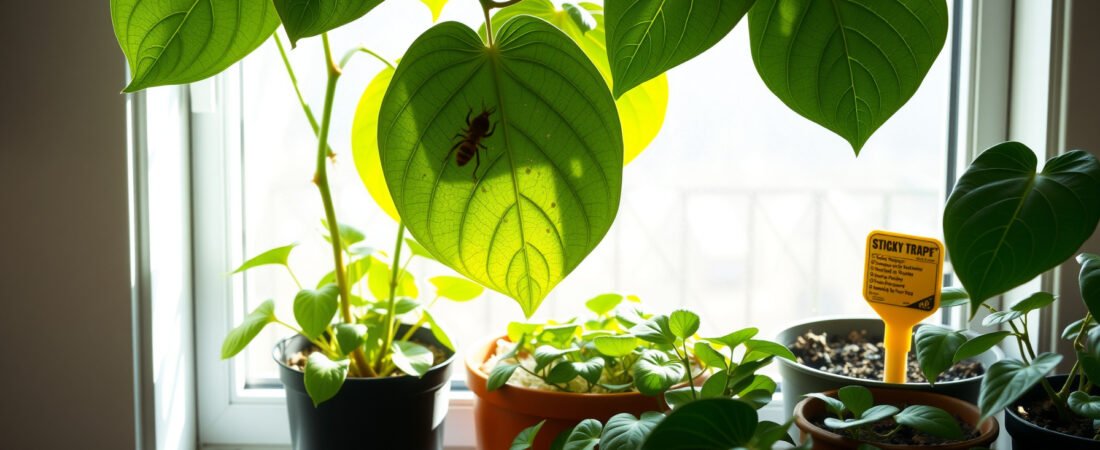
Spraying your whitefly-infested plant once and calling it done is exactly why whiteflies keep coming back. The real problem isn’t the adults you can see — it’s the eggs and nymphs already embedded in your plant that no standard spray touches. Most whitefly treatments fail not because the product doesn’t work, but because they’re timed wrong and targeted at the wrong life stage. That’s the mistake this article is going to fix.
Why Whiteflies Are So Hard to Get Rid of on Houseplants
A single female whitefly can lay between 200 and 400 eggs in her lifetime — and she deposits them in neat circular patterns on the undersides of leaves, where most people never think to look. Those eggs hatch into crawlers within 5 to 10 days, and those crawlers spend the next two to four weeks feeding invisibly as flattened, immobile nymphs that look more like scale insects than anything else. By the time you see adults flying up in a cloud when you brush the plant, you’re already weeks behind.
There’s also a waxy coating on both eggs and nymphs that makes many contact sprays completely ineffective unless the product specifically penetrates that layer. That’s not a detail you’ll find on most pesticide bottles. What’s counterintuitive here is that whiteflies actually protect their offspring more efficiently than most houseplant pests do — the adults are the disposable part of the population, not the vulnerable part. Targeting adults without addressing eggs and nymphs is like mopping the floor while the faucet is still running.
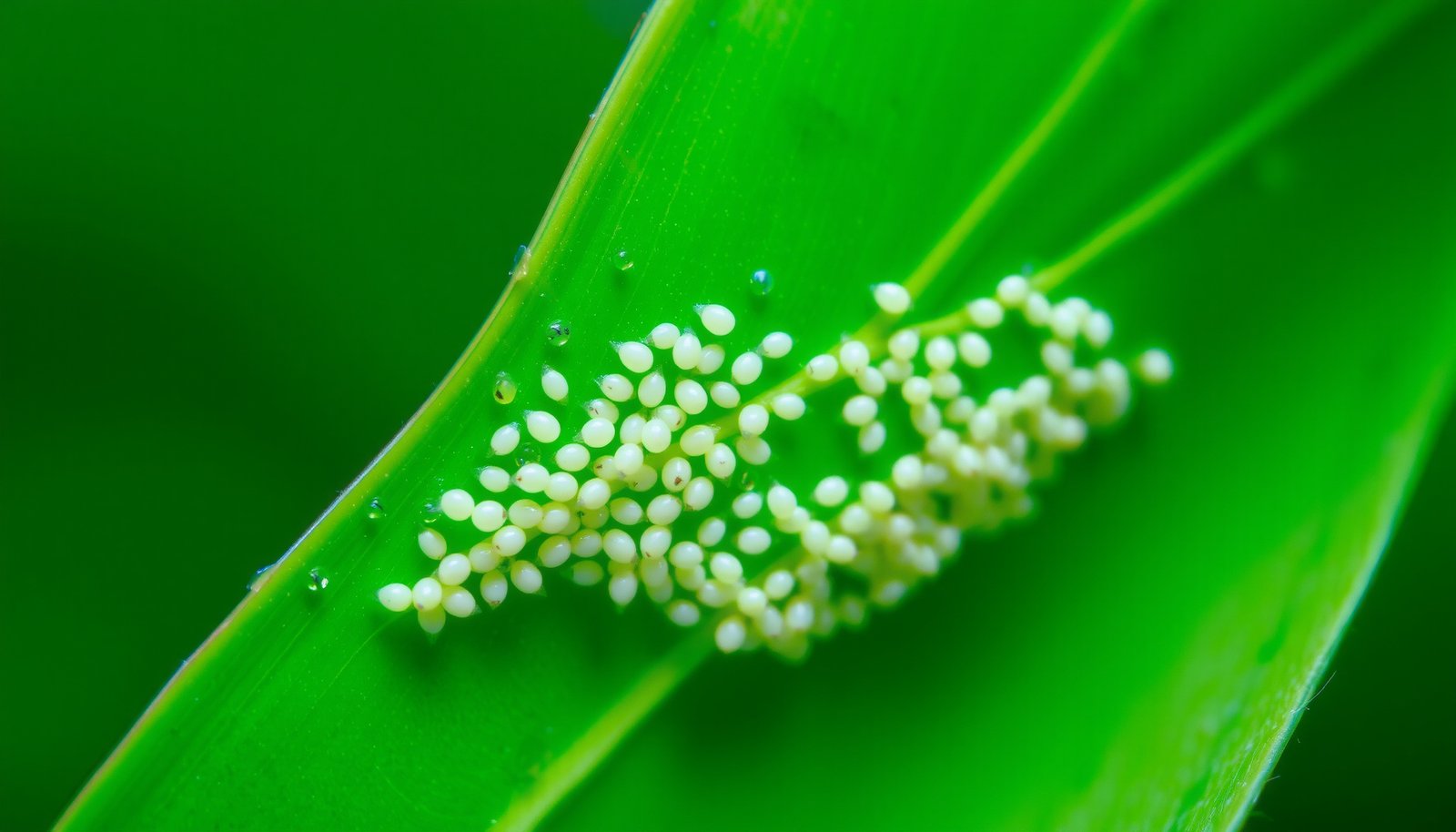
This close-up shows whitefly eggs and nymphs clustered on the underside of a houseplant leaf — the exact hiding spot that causes most treatment attempts to fail.
How Do You Know if Your Houseplant Actually Has Whiteflies?
The most obvious sign is what happens when you tap or jostle the plant: a small cloud of tiny white insects explodes upward, flutters around, then settles back down within about 30 seconds. Adults are roughly 1/16 inch long, soft-bodied, and coated in white waxy powder — they look like miniature moths. But catching that flight response is almost always how people first realize they have a problem.
Look underneath the leaves for the other signs: pale yellow speckling or stippling on the leaf surface (caused by the nymphs sucking out plant sap), sticky honeydew residue that makes leaves feel tacky, and eventually a black sooty mold that grows on top of the honeydew. Plants that seem to be yellowing for no reason despite good watering and light are worth checking leaf-undersides with a magnifying glass — what looks like tiny white or pale yellow bumps arranged in arcs or rings are almost certainly whitefly eggs or immobile nymphs. Misidentifying these as a nutrient deficiency is one of the most common delays that lets the population explode.
What Actually Kills Whiteflies at Every Life Stage?
This is where the life-cycle timing matters more than product choice. You need to interrupt the whitefly at three distinct stages: eggs, nymphs, and adults — and most single-product approaches only hit one or two of them. Here’s a treatment sequence that actually works when you follow it consistently:
- Remove heavily infested leaves first. Any leaf with visible egg clusters or thick nymph colonies should come off the plant entirely and go straight into a sealed bag — not the compost bin. This reduces the population load before you apply anything.
- Apply insecticidal soap or neem oil spray to leaf undersides. Focus entirely on the undersides of remaining leaves — that’s where 90% of the population lives. Use a concentration of about 2 tablespoons of neem oil per gallon of water with a few drops of dish soap as an emulsifier. Neem oil contains azadirachtin, which disrupts the hormonal development of nymphs and eggs, not just adults.
- Repeat every 5 to 7 days for at least 4 cycles. This timing is calculated to break the egg hatching cycle — eggs hatch in 5 to 10 days, so spraying on day 1 and day 7 means you’re catching new crawlers before they can develop into egg-laying adults. Skipping even one cycle lets the population rebound.
- Use yellow sticky traps for adult monitoring, not control. Yellow sticky traps do catch adults, but they won’t eliminate an infestation on their own. Their real value is as a monitoring tool — if you’re still catching large numbers of adults after two weeks of spraying, it tells you your spray coverage is incomplete.
- Apply a systemic insecticide as a last resort for severe cases. Imidacloprid, available as a soil drench or granular, is absorbed through the roots and makes the plant’s sap toxic to whiteflies. It’s effective but should not be used on edible plants, and it has documented impacts on pollinators — use it only indoors on ornamentals when other methods haven’t worked after 6 weeks.
Picture this: you’ve been spraying your hibiscus weekly for three weeks and the adults are still flying. The most likely explanation is that you’re coating the tops of the leaves and missing the undersides entirely, or your spray intervals are too far apart to catch newly hatched nymphs. Adjusting those two things alone usually turns the corner within 10 days.
Which Whitefly Treatments Work and Which Are a Waste of Money?
Not every product you’ll find marketed for whiteflies is worth your time or money. Some are effective at only one life stage, and some are essentially useless against the waxy-coated immature stages that cause the real damage. Here’s an honest comparison of the most common options:
| Treatment | Effective Life Stages | Best Use Case | Limitations |
|---|---|---|---|
| Neem oil (azadirachtin) | Eggs, nymphs, adults | First-line treatment, all infestations | Must coat leaf undersides thoroughly; degrades in sunlight |
| Insecticidal soap | Nymphs, adults (contact only) | Mild-to-moderate infestations | No residual effect; must make direct contact |
| Imidacloprid (systemic drench) | Nymphs, adults (via sap) | Severe infestations on ornamentals | Not for edibles; toxic to pollinators; slow to act (7–14 days) |
| Yellow sticky traps | Adults only | Monitoring; light adult reduction | Will not eliminate an infestation alone |
One thing most houseplant care guides get wrong is recommending dish soap spray as a standalone treatment. Plain dish soap without any active insecticidal agent can smother soft-bodied nymphs on contact, but it leaves no residual activity, breaks down within hours, and does nothing to eggs. It’s a useful additive to help emulsify neem oil, but it’s not a substitute for a proper treatment product. Using it alone and expecting results is a reliable way to watch your plant decline for another two months.
Pro-Tip: Spray neem oil treatments in the morning rather than midday — this gives the oil time to dry before direct sun hits the plant, which prevents leaf burn and also ensures the azadirachtin remains active longer before UV degrades it.
How Do You Stop Whiteflies From Coming Back After Treatment?
Whiteflies don’t spontaneously appear in a sealed indoor environment — they arrive on new plants, on cut flowers, or occasionally on clothing after time in an infested greenhouse. The single most effective long-term prevention strategy is a two-week quarantine period for every new plant before it goes anywhere near your existing collection. Keep it in a separate room, check the undersides of leaves twice during that window, and only then integrate it. This is boring advice, but it works consistently.
Beyond quarantine, there are several environmental and cultural practices that make whitefly reinfestations less likely:
- Avoid over-fertilizing with nitrogen. Lush, nitrogen-rich plant growth is exactly what whiteflies seek out — tender new leaves have higher amino acid concentrations in their sap, making them more attractive feeding sites. Moderate, balanced feeding reduces that appeal.
- Improve air circulation around plants. Stagnant, humid air near dense foliage creates ideal whitefly conditions. A small fan running a few hours daily around your plant groupings significantly disrupts adult activity and slows their ability to locate new hosts.
- Inspect leaf undersides monthly as a habit. Catching a new infestation at 10 adults is trivially easy to treat. Catching it at 10,000 means six weeks of work. Monthly visual checks take less than two minutes per plant.
- Remove yellow or dying leaves promptly. Stressed, yellowing plant tissue is a preferred egg-laying site for whiteflies — removing it eliminates both the attractive substrate and any eggs already deposited on it.
- Consider reflective mulch or reflective pot toppers for sun-loving houseplants. Whiteflies navigate partly by light cues, and reflective surfaces near the plant base have been shown to confuse and deter adults from landing, reducing colonization rates in greenhouse research settings.
It’s worth acknowledging an honest nuance here: if you live in a warm, humid climate and regularly bring plants in and out of outdoor spaces, your long-term whitefly pressure will be fundamentally higher than someone keeping plants exclusively indoors in a cooler, dryer environment. The prevention strategies above still apply, but your monitoring frequency should probably double — monthly checks become bi-weekly in those conditions. Just as with getting rid of spiders in your house naturally, the environment you’re working against matters as much as the method you choose.
“The most common mistake I see is people treating whiteflies as a one-and-done problem. The biology doesn’t allow for that — you have to match your treatment schedule to the egg hatching window, or you’re always chasing adults while the next generation is already developing on the leaf surface. Four to five timed applications will outperform one strong treatment every time.”
Dr. Renata Solano, Extension Entomologist and Integrated Pest Management Specialist, University of Florida IFAS
One thing that’s genuinely underappreciated in the whitefly conversation is the role of stressed plants in creating the problem in the first place. Whiteflies preferentially colonize plants that are already struggling — drought-stressed, root-bound, or light-deprived plants have altered sap chemistry that makes them more attractive to egg-laying females. Solving the underlying plant health issue doesn’t replace chemical or biological treatment, but it meaningfully reduces recolonization pressure once you’ve cleared an infestation. A plant growing well in the right conditions is a noticeably less desirable host.
Managing whiteflies long-term is less like winning a battle and more like maintaining a system — and that system includes your purchasing habits, your inspection routine, your fertilization schedule, and your treatment timing. If any one of those slips, whiteflies will find the opening. The good news is that once you understand the life cycle and stop targeting only the adults, the whole thing becomes much more manageable. Much like how outdoor pest pressure often requires layered strategies rather than a single silver-bullet product, whitefly control rewards consistent, staged effort over any single dramatic intervention.
Start with the treatment sequence, stay on the 5-to-7-day interval, and don’t declare victory until you’ve gone two full weeks with no new adults on your sticky traps and clean leaf undersides under a magnifying glass. That’s when you’ve actually won — and keeping that quarantine habit in place means you probably won’t have to fight this battle again.
Frequently Asked Questions
how do I get rid of whiteflies on houseplants fast?
Start by spraying the undersides of leaves with a strong stream of water to knock off adults and eggs, then follow up immediately with an insecticidal soap spray — repeat every 3 to 5 days for at least 3 weeks. Whiteflies go through multiple life stages, so one treatment won’t cut it. Consistency is what kills them off permanently.
what causes whiteflies on indoor plants?
Whiteflies usually hitch a ride indoors on new plants you bring home from a nursery or garden center — it’s the most common way they spread. They thrive in warm, humid conditions with temps between 70°F and 80°F, which is basically every home. Always inspect new plants carefully before putting them near your existing ones.
does neem oil kill whiteflies on houseplants?
Yes, neem oil is effective against whiteflies because it disrupts their ability to feed and reproduce. Mix 2 tablespoons of neem oil with 1 teaspoon of dish soap per gallon of water and spray the entire plant, especially the undersides of leaves where eggs are laid. You’ll need to reapply every 7 days for 3 to 4 weeks to break the life cycle.
how do I know if my houseplant has whiteflies?
The easiest tell is a small white cloud of tiny insects that fly up when you brush or shake the plant. You’ll also see yellowing or sticky leaves and tiny oval-shaped eggs or pale nymphs clustered on the undersides of leaves. If you spot even a few, act right away — whitefly populations can double within a couple of weeks.
can whiteflies from houseplants spread to other plants in my home?
Absolutely — whiteflies fly, so they can spread from one plant to another pretty quickly, especially in a room where your plants are grouped together. Isolate any infested plant immediately and keep it at least 3 to 4 feet away from healthy plants until you’ve gone at least two full weeks without seeing any new insects. Check neighboring plants daily during that time.
Disclaimer: This article is for informational purposes only and isn’t a substitute for professional pest control advice. Always read and follow the product label instructions exactly — label directions are legally binding and vary by brand and active ingredient. Keep all pesticides, baits and traps away from children and pets, ventilate treated areas as directed, and consider calling a licensed pest control professional if an infestation is large, recurring, or involves a structural pest like termites or carpenter ants.