

Interceptors don’t kill bed bugs — and that’s exactly the point most people miss when they buy them. A bed bug interceptor for a bed leg is a monitoring and trapping device, not a treatment. If you skip understanding that distinction, you’ll either trust a clean interceptor when you shouldn’t, or panic over a full one when you’re actually winning. Used correctly, interceptors are one of the most honest tools in a bed bug response: they don’t lie, they don’t guess, and they don’t require a pest control license to install.
The bigger problem is that most people deploy them wrong — wrong bed frame type, wrong placement, wrong interpretation of the catch data. A single interceptor under one leg tells you almost nothing. Four interceptors running simultaneously for two weeks tells you a great deal. That’s the difference between a tool and a strategy, and this guide is about the strategy.
What Are Bed Bug Interceptors and How Do They Actually Work?
Bed bug interceptors are shallow plastic dishes with two moats — an inner ring and an outer ring — designed to sit under each bed leg. The inner moat catches bugs trying to climb down from the bed to feed. The outer moat catches bugs traveling across the floor trying to climb up toward a sleeping host. Neither moat uses bait, poison, or pheromones; it’s pure physical entrapment using the insect’s own biology against it.
Bed bugs are lousy climbers on smooth surfaces. Their tarsal claws, which grip textured surfaces well, simply can’t get purchase on the polished interior walls of a well-designed interceptor. The inside of the device is often coated with talcum powder or has a slick finish to make escape even harder. Once a bug falls in, it’s stuck — sometimes for days before you check it, which gives you a real-time population count if you log your catches.
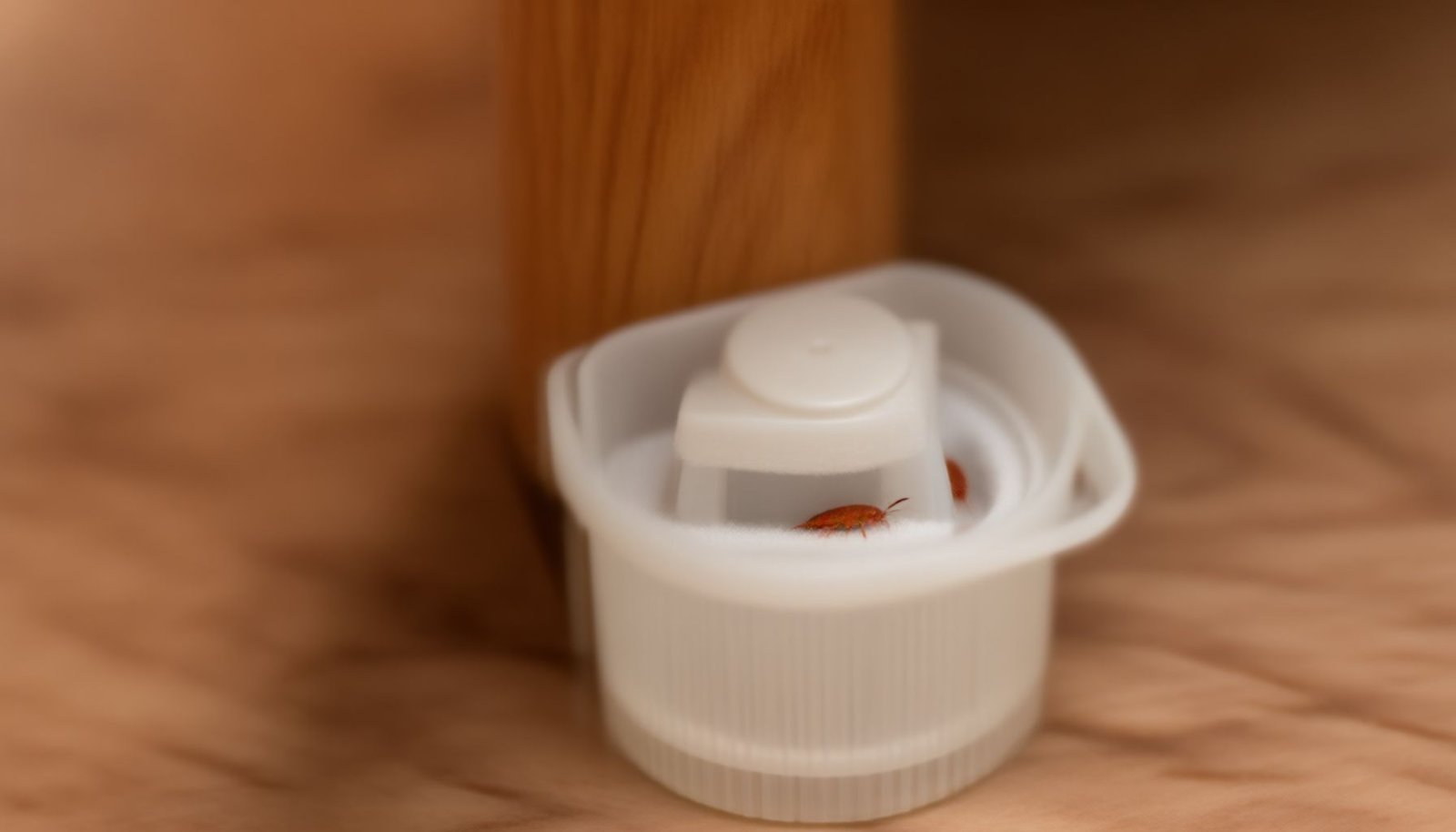
This close-up shows the dual-moat design in a typical interceptor — notice the inner well that holds the bed leg separate from the outer ring, giving you two distinct capture zones that tell you whether bugs are coming from the mattress or from the room.
Why Most People Set Interceptors Up in a Way That Makes Them Useless
Picture this: someone buys a four-pack of interceptors, installs one under the headboard leg, shoves the other three in a drawer, and declares the bed “protected.” Two weeks later the interceptor is empty and they conclude there are no bed bugs. That’s not monitoring — that’s wishful thinking with a plastic cup. For interceptors to mean anything, every single bed leg has to have one, bedding must be pulled away from the floor and walls, and nothing else can touch the ground from the bed frame.
Skirts, pillows touching walls, phone charger cords draped over the side rail — any of these create a bypass route that renders your interceptors invisible to the bugs. Bed bugs are not navigating randomly; they’re following carbon dioxide gradients toward a sleeping host. If there’s a path that doesn’t go through the interceptor, they’ll find it. The bed has to function as an island, and the interceptors are the only bridge.
Pro-Tip: Before you install any interceptor, run your hand along every edge of your bed frame to check for direct contact points with walls, nightstands, and bedding. Even a pillowcase corner hanging two inches off the mattress can serve as a bridge that completely bypasses your traps — and you’ll never catch a single bug despite having an active infestation.
Which Bed Bug Interceptors for Bed Legs Are Worth Buying?
Not all interceptors are designed equally, and the differences matter more than most review sites admit. The key specs to evaluate: inner well diameter (must accommodate your specific bed leg), wall height of the moat (at least 1.5 inches to prevent escape), and surface texture of the interior (smooth or talc-dusted, never rough). Some cheaper models have grooved interiors that accidentally give bugs enough grip to climb out, which defeats the entire purpose.
Here’s how the most commonly recommended options compare on the specs that actually matter for entrapment effectiveness:
| Product | Inner Well Diameter | Moat Wall Height | Interior Surface |
|---|---|---|---|
| ClimbUp Insect Interceptor (Original) | 3.5 inches | ~1.75 inches | Smooth plastic, talc-ready |
| Bed Bug Blocker (Pro Interceptor) | 4.5 inches | ~1.5 inches | Smooth with raised outer lip |
| SureSleep Bed Bug Traps | 3 inches | ~1.25 inches | Lightly textured — caution |
| Eco Defense Bed Bug Interceptors | 4 inches | ~1.6 inches | Smooth, talc included |
The ClimbUp original is the one most entomologists reference specifically because its smooth interior and dual-moat design have the most field-testing behind them. It’s not the cheapest, but it’s the one researchers actually use in controlled bed bug studies, which says something. For platform beds with wide, flat legs, the Bed Bug Blocker Pro’s larger inner well is worth the switch — a leg that doesn’t fit properly into the inner moat means the interceptor is sitting crooked and won’t function as designed.
How to Read Your Interceptor Catches — This Is Where the Real Information Lives
Here’s the counterintuitive part that almost no one talks about: where bugs are caught in the interceptor tells you more than how many you catch. Bugs in the inner moat came from the bed itself, meaning there’s an active harborage in the mattress, box spring, or frame. Bugs in the outer moat were traveling across the floor toward you, which suggests the infestation has spread beyond the bed into the surrounding room — baseboards, furniture, electrical outlets.
Adult bed bugs can survive over 300 days without feeding under cool conditions, so an empty interceptor doesn’t mean the problem is solved — it might just mean bugs found another route, or that the population is small and dispersed enough that they’re not triggering catches every night. Log your catches with dates and which leg they came from. A single nymph in the outer moat of the foot-of-bed leg is a very different signal than three adults in the inner moat of the headboard leg. One means you might be dealing with a broader room issue; the other tells you the mattress needs immediate attention.
“Interceptors are essentially a passive surveillance system. Homeowners who check them weekly and log catches by location are collecting the same data pest management professionals use to determine infestation severity and whether a treatment is working. An empty interceptor after treatment is meaningful — but only if the device was installed correctly and the bed was properly isolated first.”
Dr. Marcia Feldman, Board-Certified Entomologist and urban pest management researcher, University Extension Cooperative
Interceptors as Part of a Larger Plan: What They Can and Can’t Replace
One thing worth being direct about: interceptors alone will not eliminate a bed bug infestation, no matter how good the product is. They’ll slow the feeding cycle if the bed is properly isolated — a bed bug that can’t reach a host for weeks will eventually die — but any bugs already harboraged in the mattress, walls, or furniture are unaffected by what’s happening under the leg. Think of interceptors as the perimeter fence, not the eradication plan.
That said, they’re genuinely indispensable for two specific use cases: confirming whether an infestation is present in the first place, and verifying whether a treatment worked. After a chemical or heat treatment, interceptors become your early-warning system. If catches resume within 30 days post-treatment, you likely have surviving harborages that weren’t reached. This is the same logic behind using traps for rodent monitoring — you’re not trying to solve the problem with the trap alone, you’re getting information. (On that note, if you’re dealing with a multi-pest situation, the article on Best Mouse Repellent Plug-In Devices: Do They Work? covers a similar principle about whether passive devices can stand alone — worth reading before you assume any single tool handles everything.)
Here’s a step-by-step approach for using interceptors as a real monitoring system rather than just a purchase you make and forget:
- Install under all four bed legs simultaneously — partial installation gives you incomplete data and false confidence. All legs, all at once, before you do anything else.
- Isolate the bed completely — pull it away from the wall by at least six inches, remove bedskirts, and make sure no bedding, cords, or clothing touches the floor.
- Add a light dusting of talcum powder inside each moat — even smooth interceptors benefit from talc inside the moat to prevent any escape on humid days when bugs may have slightly more grip.
- Check and log catches every 3-4 days minimum — record the date, which leg, which moat (inner or outer), and whether what you found was an adult, nymph, or shed skin (exuvia).
- Leave interceptors in place for a minimum of 14 days before drawing conclusions — one week of data is not statistically meaningful given how irregularly bed bugs feed.
- Continue monitoring for 30 days after any treatment — post-treatment catches are your most valuable data and should inform whether a follow-up service is needed.
One honest nuance worth acknowledging: if you’re in a multi-unit apartment building, even a perfectly isolated bed with flawless interceptor installation has limits. Bed bugs can travel through wall voids, shared pipes, and electrical conduit from adjacent units. Your interceptors may catch bugs originating from a neighbor’s apartment that have nothing to do with your mattress. In that context, interceptors are still valuable — they confirm migration is happening — but the solution requires a building-wide response, not just what you do in your unit.
Here are the specific scenarios where bed bug interceptors for bed legs genuinely shine versus where they fall short:
- Best use — early detection in single-family homes: Small populations that wouldn’t otherwise be noticed are caught before they explode. A single nymph caught in week one is infinitely easier to address than a mature infestation caught at week twelve.
- Best use — post-treatment verification: No other passive tool gives you this level of confirmation that a treatment succeeded or failed.
- Best use — travelers returning home: Installing interceptors after any hotel stay and checking them for the next two weeks is genuinely practical early detection, not paranoia.
- Limited use — platform beds with no legs: Beds with solid bases or slat systems that rest directly on the floor cannot use leg interceptors at all. For those, mattress encasements and sticky tape barriers along the base perimeter are the functional alternative.
- Limited use — severe, multi-room infestations: Once bed bugs are established in walls, furniture, and baseboards throughout a home, interceptors under the bed legs are capturing a small fraction of the population and shouldn’t be the primary response tool.
Interceptors also have an indirect benefit that doesn’t get enough credit: they force you to think about your bed as a system rather than just a piece of furniture. The act of properly installing them — pulling the bed from the wall, removing the bedskirt, checking every contact point — is itself a kind of passive prevention. You’re making the habitat harder to navigate for any bug, not just bed bugs. It’s the same logic as good pantry organization for stored-product pests: changing the physical environment is often more durable than any product you spray or set. (If you’ve dealt with pantry pest issues at the same time, the piece on How to Get Rid of Grain Beetles in Pantry Permanently uses a similar habitat-modification approach that’s worth reading alongside this one.)
There’s also a completely overlooked population dynamic worth understanding: bed bug nymphs, which are the juvenile stage after hatching, are translucent and roughly the size of a sesame seed. First-instar nymphs are small enough to potentially escape a poorly designed interceptor with a shallow moat or textured walls. This is why moat depth matters — and why the specific products with at least 1.5-inch moat walls and smooth interiors aren’t just a marketing preference. If you’re catching only adults in your interceptors but still getting bites, check the interior carefully with a flashlight for tiny translucent nymphs that may have escaped, or switched to a device with better containment.
Deploy interceptors tonight if you have even a suspicion of bed bugs — you’ll have real, actionable data within a week, which is more than most pest control inspections give you on the first visit. The bugs do the work for you; all you have to do is read what they’re telling you.
Frequently Asked Questions
do bed bug interceptors for bed legs actually work?
Yes, they work — but only as part of a broader strategy. Interceptors trap and monitor bed bugs trying to climb up or down your bed legs, which helps you confirm an infestation and measure whether a treatment is working. Studies have shown they can catch bugs within the first 24 hours if bed bugs are present in the room.
what size bed bug interceptors do I need for my bed legs?
Most standard interceptors fit bed legs up to 3.5 inches in diameter, which covers the majority of bed frames sold in the US. Before buying, measure the widest point of your bed leg — if you have thick platform beds or furniture with wide posts, look for heavy-duty or large-capacity interceptors that accommodate legs up to 5 inches wide.
do I need to put anything in bed bug interceptors to make them work?
No, you don’t need to add any powder or chemical — the design does the work. The inner ring traps bugs climbing up from the floor, and the outer ring catches bugs coming down from the bed. Some people add a light dusting of talcum powder to the walls of the cup to make it even harder for bugs to climb out once they’re caught.
how long does it take for bed bug interceptors to catch bed bugs?
If bed bugs are active in your room, you can start seeing results within 1 to 3 nights. That said, if your infestation is light or bugs are already living in the mattress or box spring rather than traveling across the floor, interceptors may take longer to show results or catch very few. Check them every morning for the most accurate picture.
can bed bug interceptors prevent bed bugs from getting into my bed?
They can block bed bugs traveling up from the floor, but they won’t stop bugs that are already living in your mattress, box spring, or bed frame. For interceptors to actually protect you, your bed needs to be isolated — that means no bed skirts touching the floor, bedding not dragging on the ground, and the bed pulled away from the wall.