
Mice don’t care which trap you bought. They care whether it’s placed correctly. That’s the single most important thing most trap-buying guides won’t tell you — the difference between a snap trap that catches three mice in a night and one that sits untouched for two weeks usually has nothing to do with the trap itself. It’s placement, bait technique, and understanding how mice actually move through your home. Get those three things right, and almost any decent trap works. Get them wrong, and even the most expensive electronic unit will collect dust.
Why Most Mouse Traps Fail (And It’s Not the Trap’s Fault)
Here’s the thing about mice that changes everything: they’re not random wanderers. They run the same routes, hug the same walls, and squeeze through the same gaps every single night. A mouse can fit through an opening as small as 1/4 inch — roughly the diameter of a pencil — which means your kitchen, basement, and wall voids are a network of established highways you can’t see. Traps placed in the middle of open floor space get ignored not because mice are smart, but because that’s simply not where they go.
The second reason traps fail is trap shyness — a real behavioral phenomenon where mice avoid new objects in their environment for 24 to 48 hours after introduction. This is why experienced pest pros sometimes “pre-bait” traps: leave them unset with bait for a day or two so mice get comfortable eating from them before the mechanism is armed. Skip that step and you’re fighting instinct. Understanding this changes how you approach every trap type on this list.

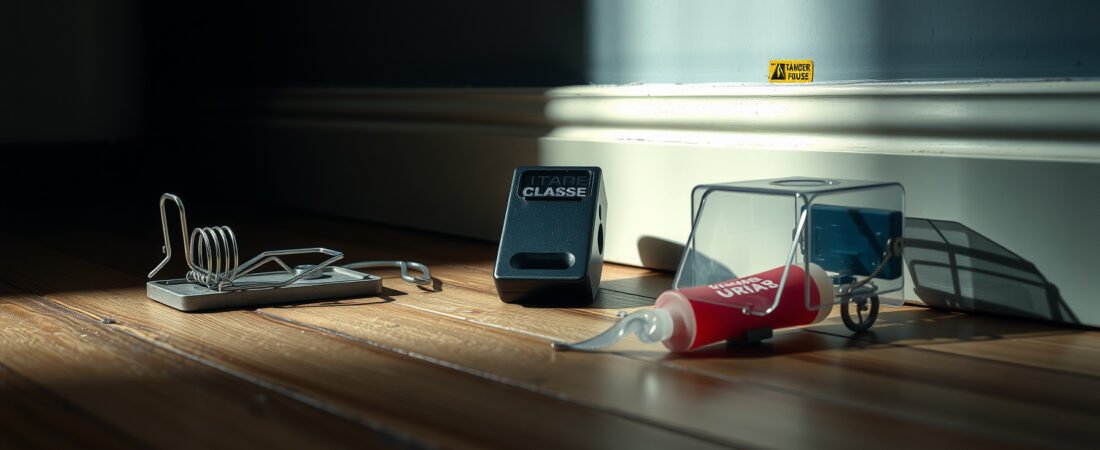
This close-up shows the trigger mechanism differences between snap, electronic, and live-catch traps — understanding how each mechanism activates helps you choose the right style for your specific infestation location and mouse traffic level.
Best Snap Traps: Which Ones Actually Trigger and Which Ones Mice Rob Clean
Snap traps are the oldest mouse control tool still in wide use, and for good reason — they’re fast, cheap, and when placed correctly, devastatingly effective. The Victor Original wooden snap trap has been manufactured since 1898 and remains a benchmark because of its sensitive trigger bar. What most people don’t realize is that the sensitivity of the trigger matters far more than the brand logo. Traps with stiff, hard-to-trip mechanisms allow mice to remove bait without activating the spring — and mice are remarkably good at doing exactly that.
For households that want a no-touch disposal option, the Victor Easy Set and the Tomcat Press ‘N Set are worth the slight price premium. Both use a pedal-style trigger that’s sensitive enough to fire from light contact, and the clamshell body means you never have to see the mouse. The Authenzo and Kat Sense plastic snap traps have also earned consistent results in controlled testing — their triggers are factory-set sensitive and the interlocking teeth hold a kill position well. Run at least four to six traps simultaneously in any active area, not one or two, because mice in a colony aren’t moving through your space one at a time.
Pro-Tip: Skip the cheese. Peanut butter is far superior as snap trap bait because mice have to work to lick it off, which means longer contact with the trigger plate. A pea-sized amount tucked into the back of the trigger cup is enough — overfilling lets them eat from the edges without ever stepping on the mechanism.
Best Electronic Mouse Traps: High Kill Rate, High Price — Are They Worth It?
Electronic traps kill by delivering a high-voltage shock — typically between 8,000 and 8,500 volts — in under two seconds when a mouse enters and completes the circuit. The Victor Electronic Mouse Trap (M2524) and the Rat Zapper Classic are the two most field-tested products in this category, and both deliver reliable kills with minimal mess. The Rat Zapper Ultra can handle multiple kills per battery load, which matters if you’re dealing with a larger infestation rather than a single stray mouse.
The honest trade-off with electronic traps is cost versus kill capacity. A single Victor electronic unit runs $25–$40, compared to $3–$8 for a six-pack of quality snap traps. For a mild infestation of two to five mice, the investment makes sense for people who are squeamish about traditional traps. But if you have evidence of a larger colony — droppings in multiple rooms, gnaw marks on food packaging, noise in walls — you’ll need significantly more trap coverage than most people budget for electronic units. In those cases, understanding how to get rid of mice in walls becomes just as important as which trap you choose, because traps alone rarely solve a wall-nesting population.
| Trap Type | Average Cost | Kill Speed | Best For |
|---|---|---|---|
| Snap Trap (wooden/plastic) | $0.50–$2 each | Instantaneous | High-volume placement, budget control |
| Electronic Trap | $25–$40 each | Under 2 seconds | No-mess kills, light to moderate infestations |
| Live Catch / Humane Trap | $8–$25 each | N/A (containment) | Single mouse, no-kill preference |
| Glue Board | $1–$3 each | Slow (not humane) | Monitoring only — not recommended as primary control |
Best Humane Mouse Traps: Do Live Catch Traps Actually Work, or Do You Just Relocate the Problem?
Live catch traps work — under one specific condition. You have to release the mouse at least two miles from your home, preferably across a natural barrier like a road or body of water. Research from the University of Florida Extension has documented that house mice (Mus musculus) have a strong homing instinct and will return to their original territory from distances under a mile with surprising regularity. Release one in your backyard and it may be back inside within 24 hours. Most people who try humane traps and report failure skipped this step entirely.
The Catcha Two-Piece Humane Smart Mouse Trap and the Authenzo Humane Mouse Trap are both well-regarded live catch options with see-through lids that let you confirm a catch without opening the trap. The Kness Tip Trap is a multi-catch design that can hold several mice at once, which is useful if you suspect more than one animal. Check live traps every four to six hours — mice can die from stress and dehydration faster than most people expect, especially in warm conditions. If you catch a mouse and feel conflicted about the two-mile release rule, just know: relocating it to your neighbor’s yard is not a solution, it’s a delay.
“The trap type is almost secondary to trap placement and pre-baiting. I’ve seen homeowners with top-of-the-line electronic units catch nothing for three weeks because they placed them in open floor space away from travel routes. Move a $2 snap trap flush against the baseboard, perpendicular to the wall, and you’ll outperform a $40 electronic trap every time if the travel route is right.”
Dr. Michael Waldvogel, Extension Specialist in Structural and Industrial Pest Management, NC State University
How to Place Mouse Traps So They Actually Catch Mice (The Setup Most People Get Wrong)
Placement is where most homeowners lose the battle before it starts. Mice exhibit thigmotaxis — a strong preference for moving along surfaces rather than crossing open space. That’s why a trap in the center of your kitchen floor will go untouched while one tucked into the corner where your stove meets the cabinet gets a catch on the first night. The trigger end of the trap should face the wall, not away from it, so a mouse running along the baseboard walks directly over the mechanism. This is counterintuitive to most people, who point the bait toward the open room.
Here are the specific placement rules that make the biggest difference in real-world results:
- Against the wall, perpendicular: Position traps so the trigger end touches the baseboard — mice will walk over it naturally without having to change direction.
- In pairs, back to back: Place two traps side by side, with triggers facing opposite directions. Mice can run either way along a wall, and this doubles your catch probability at each station.
- Where you see evidence, not where you guess: Fresh droppings (dark, soft, roughly 3–6mm long) tell you exactly which routes are active. Set traps there first, not in random locations throughout the house.
- Inside cabinets and enclosed spaces: Mice feel safer moving in enclosed, dark areas. A trap inside a cabinet under the sink often outperforms one in an open room even if the open room has more mouse traffic.
- Pre-bait before arming: For snap traps in areas where you know mice are feeding, leave the trap unset with bait for 24–48 hours first. This overcomes neophobia (fear of new objects) and results in significantly higher catch rates on the first triggered night.
- Check and reset within 24 hours: A sprung trap with no mouse, or a trap with a dead mouse left too long, will deter other mice from approaching. Fresh traps signal a clean, unthreatening environment.
One more thing worth knowing: a single female house mouse can produce 5 to 10 litters per year with 5 to 6 pups each. That’s up to 60 new mice annually from one breeding pair. If you’re catching mice daily for more than four or five days in the same area, you almost certainly have a breeding population rather than a few strays — and that changes both the scale of trapping required and whether you need to think about exclusion work alongside trapping. It’s also worth knowing that mice and the insects associated with their activity sometimes get misidentified; if you’re finding small winged insects near the same entry points, it’s worth checking whether what you’re seeing bears any resemblance to something else entirely — for example, termites versus flying ants can look similar near wood-framed entry points where mouse gnaw damage also occurs.
The right trap also depends on your specific situation in ways no single buying guide can fully account for. Households with small children or pets need to prioritize enclosed designs — either the clamshell snap traps or electronic units with child-resistant bait chambers — over exposed traditional wooden snap traps. Apartments with shared walls and crawl spaces present different challenges than detached homes with full basements. Climate matters too: in colder months, mice are under greater pressure to nest and move indoors, which typically means faster trap response times because they’re actively foraging rather than cautiously exploring.
What to Use When Traps Aren’t Enough: Combining Traps With Exclusion
Traps catch mice that are already inside your home. They do nothing to stop the next wave from entering. This is the part of mouse control that buying guides consistently underemphasize, and it’s the reason people buy trap after trap for months without ever solving the problem. The actual fix requires identifying and sealing entry points — foundation cracks, gaps around pipes, spaces under doors, unscreened vents — because mice will keep coming in as long as there’s food, warmth, and an opening they can fit through.
Steel wool stuffed into gaps and secured with caulk is a reliable first-line material for small openings because mice can’t chew through it the way they can through foam or rubber. Hardware cloth (1/4-inch mesh) works for larger vents and openings. The trapping phase and the exclusion phase need to happen simultaneously, not sequentially — seal while you’re trapping so you’re reducing the population inside and cutting off reinforcements at the same time. That combined approach is what actually ends an infestation rather than just managing it month after month.
- Steel wool + caulk: Best for pipe penetrations and small wall gaps — mice won’t gnaw through steel fibers
- 1/4-inch hardware cloth: Ideal for vents, weep holes, and any opening larger than a half inch
- Door sweeps: The gap under a typical exterior door is often wider than 1/4 inch — a tight-fitting door sweep eliminates it entirely
- Expand-and-seal foam (rodent-resistant formula): Standard spray foam alone is not rodent-proof; use specifically formulated pest-block foam that contains steel mesh
- Remove harborage: Stacked cardboard, cluttered storage areas, and birdseed kept in flimsy plastic bags all make your space significantly more attractive to mice — clearing these reduces competition for your traps
Picture this: a homeowner in a 1960s ranch house catches eight mice over two weeks using snap traps, declares victory, and stops trapping. Six weeks later the population is back to where it started — because the same gap behind the water heater that let in the first wave let in the next. The traps worked perfectly. The exclusion never happened. That’s the cycle most people stay trapped in, no pun intended, and it’s why the trap question and the entry-point question have to be answered together.
Once you’ve got active trapping underway and exclusion work started, give yourself about two to three weeks before evaluating whether what you’re doing is working. If catches drop to zero after the first week and you’ve sealed entry points, that’s a good sign. If you’re still catching mice at the same rate after two weeks, expand your trap coverage, look harder for entry points, and consider whether the population inside your walls is larger than surface evidence suggested. Mice living inside wall voids are a different challenge than mice running through open living spaces — and that’s a problem worth addressing on its own terms.
The trap you buy matters less than you think. Where you put it, how you bait it, and whether you’ve also addressed why mice are in your home in the first place — that’s what actually determines whether you’re done with this problem in two weeks or still dealing with it six months from now.
Frequently Asked Questions
what is the best mouse trap that actually works?
Snap traps are consistently the most effective option for most homeowners — they kill quickly, they’re cheap (usually under $5 for a pack of 4), and they work with minimal setup. The Victor Original Wood Snap Trap and the Tomcat Press ‘N Set are two of the most reliable picks you’ll find. If you’re dealing with a heavy infestation, set at least 6 to 10 traps in a single night rather than just one or two.
are electronic mouse traps worth it?
They’re worth it if you hate handling dead mice or dealing with mess — electronic traps kill with a high-voltage shock in under 5 seconds and the body stays inside the chamber. They cost more upfront, typically $25 to $50, but they’re reusable and the kill is cleaner than snap traps. The downside is they run on batteries and you’ll need to check them regularly, especially during active infestations.
what is the best bait to use in a mouse trap?
Peanut butter is the single best bait for mouse traps — it’s sticky, so mice can’t grab it and run, and the smell travels well through walls and tight spaces. A pea-sized amount is all you need; too much lets the mouse eat without triggering the trap. Hazelnut spread, chocolate, and nesting materials like cotton balls also work well if peanut butter isn’t getting results.
do humane mouse traps actually work?
Live catch traps do work, but they require more effort on your part — you need to check them every few hours because a trapped mouse can die from stress within 24 hours if left alone. Once caught, you need to release the mouse at least 1 mile from your home or it’ll find its way back. They’re a solid choice for light activity or if you just have one or two mice, but they’re not practical for a full infestation.
where should I place mouse traps in my house?
Place traps along walls, not in the middle of a room — mice almost always travel with their bodies touching a wall or baseboard, so that’s where you’ll get strikes. Focus on areas where you’ve seen droppings, grease marks, or chewed materials, like behind the stove, under the sink, and in the back corners of cabinets. Set traps perpendicular to the wall with the trigger end facing the baseboard for the best catch rate.