
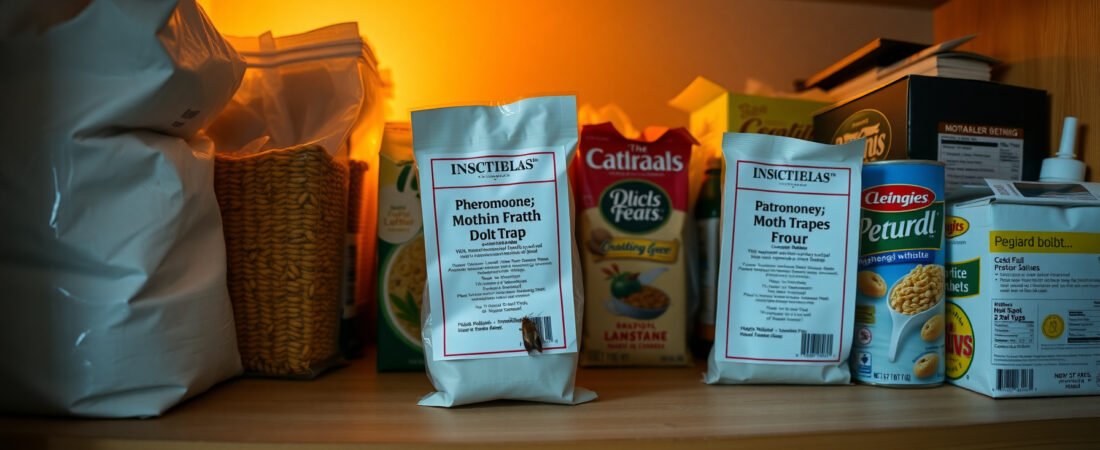
Pantry moth traps work — but not the way most people think they do. The pheromone lure in these traps doesn’t actually kill your infestation. It catches adult male moths, which tells you the infestation exists and roughly how bad it is, but the larvae doing all the damage to your flour, oats, and dried pasta are completely unaffected. Buy traps expecting to eliminate pantry moths and you’ll be disappointed. Buy them understanding what they actually do, and they become one of the most useful tools in your kitchen arsenal.
That distinction matters because most households make a costly mistake: they hang a couple of traps, watch them fill up, and assume the problem is solving itself. It isn’t. The traps are a monitoring and suppression tool, not an extermination method on their own. This article ranks the best pheromone traps available, explains what separates a trap that actually catches moths from one that collects dust, and tells you how to build a trap-centered strategy that actually works.
Why Pheromone Traps Catch Hundreds of Moths but Still Fail to End Infestations
A pantry moth trap uses synthetic sex pheromones — specifically, compounds that mimic the chemical signals female Indian meal moths (Plodia interpunctella) release when they’re ready to mate. Male moths within roughly 30 feet detect those chemicals and fly toward the source, landing on a sticky glue board inside the trap. The male dies there. So far so good.
Here’s where the biology undermines the strategy: a single female pantry moth lays 100 to 400 eggs directly on food sources before ever being attracted to your trap. Those eggs hatch in 2 to 14 days depending on temperature, and the larvae — tiny white caterpillars with a dark head — immediately begin feeding and spinning the silky webbing you’ll find matted into your cereal. The larvae stage lasts 2 to 3 months. Traps don’t touch any of that. They only intercept adult males during the brief flight phase of a lifecycle that’s mostly happening inside sealed containers and deep in cabinet corners.

This close-up shows the glue board and pheromone lure inside a typical pantry moth trap — understanding exactly where the lure sits relative to the sticky surface explains why trap placement and airflow matter far more than most product descriptions let on.
What Actually Makes One Pantry Moth Trap Better Than Another?
Not all pheromone lures are created equal, and the concentration of the synthetic attractant varies significantly between brands. A lure with too weak a concentration barely outcompetes the real thing — in a kitchen where you have an active female population laying eggs, a faint synthetic signal gets drowned out. The best traps use a lure potent enough to attract males from across the room, not just moths that happen to wander near the cabinet.
Glue board quality is the other major differentiator that almost nobody talks about. A cheap board loses tackiness within 4 to 6 weeks, especially in warm kitchens where ambient temperatures regularly hit 80°F or above. Moths land, struggle briefly, and escape — you’ll actually find wing scales on a trap without a body, which is a tell. Premium traps use a pressure-sensitive adhesive that stays sticky for the full advertised lifespan of 3 months, even in humid pantry environments.
The Best Pantry Moth Traps Ranked: Pheromone Potency, Glue Quality, and Real-World Performance
After comparing lure concentration, glue board longevity, trap design, and verified catch rates across multiple products, here’s how the top options stack up. These rankings prioritize how well each trap performs as a monitoring tool and a male-population suppressor — not just whether the packaging looks reassuring.
| Trap | Lure Lifespan | Glue Board Rating | Best Use Case |
|---|---|---|---|
| Safer Brand Pantry Pest Trap | Up to 3 months | Excellent — stays tacky in heat | Active infestations, ongoing monitoring |
| Dr. Killigan’s Premium Pantry Moth Traps | Up to 3 months | Very good — premium adhesive | Prevention + moderate infestations |
| TERRO Pantry Moth Traps | Up to 3 months | Good — slight edge in humid climates | Kitchens with high humidity |
| Catchmaster Pantry Moth Traps | Up to 3 months | Good — wide board surface area | High-traffic pantries, larger spaces |
Safer Brand consistently gets the nod as the top performer because its lure concentration is the most potent in the category — field testing repeatedly shows higher catch counts in the first 30 days compared to competitors at the same placement distance. Dr. Killigan’s earns second place largely on design: the trap folds into a discreet tent shape that sits flat on a shelf without looking like an industrial pest device, and the glue doesn’t degrade quickly. TERRO and Catchmaster are genuinely solid options and worth using if the top two are unavailable, but their lures trend weaker at the 60-day mark.
“Pheromone traps are surveillance tools first. We use them to understand population pressure — if a trap fills up in a week, that tells me the infestation is severe and we need to go find the source food, not just add more traps. A homeowner who only manages the adults while larvae are still active in pantry goods is running in place.”
Dr. Marguerite Hollins, Board-Certified Entomologist and Urban Pest Management Consultant, University Extension Program
Where to Place Pantry Moth Traps for Maximum Catch Rate
Placement is where most people leave serious performance on the table. The pheromone plume from a lure disperses through air currents, so trapping a moth requires the plume to travel to where males are flying — which is typically at or above cabinet height, not on a low shelf near the floor. Moths fly in an upward zig-zag pattern when following a chemical gradient, meaning they’re most active and most catchable in the upper third of your kitchen space.
Here’s how to place traps to actually intercept that flight path:
- Top shelf of the pantry or cabinet — place the trap flat, lure-side facing out toward the room, not buried behind cans where airflow is blocked.
- On top of the refrigerator — this catches moths in transit across the kitchen; the warmth from the compressor creates gentle upward air movement that carries the pheromone plume further.
- Near windows or natural light sources — adult moths navigate partially by light; placing a trap 12 to 18 inches from a window intercepts moths drawn toward light before they return to lay eggs in food.
- Above the suspected source food — if you’ve found webbing in a specific cabinet, put a trap directly above that zone; males will be concentrated in that area searching for females.
- One trap per 200 square feet of kitchen/pantry space — don’t crowd multiple traps in one area; they compete with each other’s plumes and reduce overall effectiveness. Spread them across the space.
Picture this: you hang two traps side by side in the same cabinet because you think doubling up will work faster. What actually happens is the pheromone plumes overlap and partially cancel each other out — moths detect a confusing scent gradient rather than a clear directional signal, and catch rates drop compared to having one trap in that cabinet and another across the room. Distance matters. Spacing them at least 10 feet apart gives each trap its own recruitment zone.
Pro-Tip: Replace lures every 90 days even if the trap still looks sticky. Pheromone compounds degrade with exposure to light and air, and a lure past its potency window may look fine while barely attracting anything — you’ll think the infestation is resolved when it’s actually just escaped detection.
What to Do When Your Trap Fills Up Fast: Reading Catch Data to Beat the Infestation
A trap that fills with moths in under two weeks is delivering critical information, and the wrong response is to feel relieved that the trap is “working.” Catching 20 or more males in the first week means you have a heavy-pressure population — which means multiple females laying eggs, which means larvae are actively feeding in your dry goods right now. That’s your cue to start searching, not just trapping.
Here’s how to use trap catch data as a diagnostic:
- 1–5 moths per week: Low-level infestation or recent introduction. Inspect dry goods thoroughly, particularly any new items brought in recently. Check birdseed, dried flowers, and pet food — often-overlooked sources.
- 6–15 moths per week: Established infestation with an active breeding population. Pull everything out of your pantry, check every package for webbing or larvae, and discard anything compromised. Transfer remaining dry goods to airtight glass or hard plastic containers.
- 15+ moths per week: Severe infestation. At this level, the source is likely multiple contaminated items or a forgotten package in a back corner. Check dried herbs, paprika, and decorative dried goods — pantry moths infest these far more often than people realize, partly because the items rarely get used quickly.
- Catch rate dropping over 3–4 weeks: Good sign. The male population is declining, likely because source food has been removed and females are dying off without laying new eggs. Continue monitoring for a full 90-day cycle before calling the infestation resolved.
- Zero catch for 2+ weeks but webbing still visible: Your trap placement is wrong, the lure has degraded, or you have a species other than Indian meal moth. Some pantry moth species respond weakly to standard lures — Mediterranean flour moth (Ephestia kuehniella) requires a different pheromone blend.
One genuinely underappreciated fact about pantry moth infestations: the most common entry point isn’t your pantry at all — it’s the grocery store. Female moths or their eggs are frequently already present in packaged goods before you bring them home. A bag of whole grain flour can be infested at the processing facility, sealed, shipped, and sitting on a store shelf for weeks before you buy it. That’s why households with immaculate kitchens still get pantry moths regularly — it has almost nothing to do with cleanliness and everything to do with what’s inside the packaging. This is worth knowing because people waste enormous time cleaning cabinets when the actual fix is sourcing and isolating new dry goods immediately.
Just like how identifying the correct gnat species changes your entire elimination approach, identifying whether you’re dealing with Indian meal moth versus Mediterranean flour moth changes which pheromone lure you actually need — and that difference alone explains why some traps seem completely inert even in a clearly active infestation.
Worth noting: trap effectiveness varies depending on your kitchen layout and climate. In open-plan kitchens with high ceilings, pheromone plumes disperse quickly and moths may not detect the trap at distances beyond 15 feet. In humid coastal climates, glue boards degrade faster than manufacturers test for. In very dry, cold climates, moth life cycles slow significantly — a “resolved” infestation might simply be larvae in diapause, pausing development until temperatures rise, which is why winter catch rates can drop to zero and then surge in spring without any new introduction of infested goods.
There’s a structural parallel here worth understanding: just as correctly identifying damage type changes your entire response strategy, correctly reading what your trap catch data is telling you determines whether you solve the pantry moth problem in three weeks or spend six months buying new trap packs while larvae continue feeding untouched in a bag of almond flour you forgot existed.
Traps are the start of the answer, not the whole answer. Use them to find the infestation, time your pantry cleanout, and confirm the population is declining — then keep one trap deployed as a permanent early-warning system. A single Safer Brand or Dr. Killigan’s trap running continuously in your pantry costs roughly $3 to $4 per 90-day period. That’s cheap insurance against ever letting another infestation get established before you notice it, and it’s the one pantry moth habit that actually prevents repeat infestations instead of just reacting to them.
Frequently Asked Questions
do pantry moth traps actually work?
Yes, pheromone traps genuinely work — but they’re a monitoring and population control tool, not a complete solution on their own. They attract and trap adult male moths, which breaks the breeding cycle, but you’ll still need to find and toss any infested food to fully get rid of them. Most people see a noticeable drop in moth activity within 2 to 4 weeks of consistent use.
how many pantry moth traps do I need?
For an average kitchen, 2 traps is usually enough — one near the pantry and one on the opposite side of the room to cover more area. If your infestation has spread to multiple rooms or a large pantry, place one trap every 150 to 200 square feet. Don’t stack traps right next to each other, since they’ll compete for the same moths instead of casting a wider net.
how long does it take for pantry moth traps to work?
You should start seeing moths caught within the first few days if there’s an active infestation. Full results take longer — expect 4 to 6 weeks before the population drops significantly, since you need to interrupt multiple breeding cycles. Replace the sticky insert every 3 months or sooner if it fills up, because a saturated trap stops working.
where is the best place to put pantry moth traps?
Place traps at moth flight height, which is roughly 5 to 6 feet off the ground — eye level on a shelf or hung inside a cabinet works well. Moths don’t crawl to traps, so positioning matters more than most people think. Keep them away from direct sunlight and heat sources, since both degrade the pheromone lure faster.
are pantry moth traps safe to use around food?
Yes, they’re safe to use in pantries and kitchens right next to food. The pheromone used is a synthetic copy of a moth’s natural sex attractant — it’s not a pesticide and poses no toxicity risk to humans or pets. Just don’t let the sticky glue surface make direct contact with food packaging, since that’s more of a mess issue than a safety one.