
Rat poison alone won’t solve your rat problem — and that’s the thing most product roundups won’t tell you upfront. If you skip the traps, you’ll end up with dead rats inside your walls, and if you skip the poison, trapped rats often get trap-shy after one close call. The homeowners who actually eliminate a rat infestation use both tools together, in a specific sequence, targeting rat behavior rather than just placing products and hoping for the best. That’s the real difference between products that work and $40 worth of hardware store purchases that sit untouched for six weeks.
Why Most Rat Control Fails Before You Even Open the Package
The most common rat control mistake isn’t choosing the wrong product — it’s placing the right product in the wrong location. Rats are neophobic, meaning they’re biologically wired to avoid new objects in their environment for anywhere from 3 to 10 days after introduction. A snap trap placed dead-center in an open floor space will be avoided for over a week while the rat runs circles around it. This is why so many homeowners conclude “rats are too smart for traps” when the real issue is placement.
Rats travel along walls, not across open spaces. They use the same routes — called runways — repeatedly, leaving grease marks and droppings as evidence. Place any trap or bait station flush against a wall, with the trigger mechanism facing the wall surface, and your catch rate climbs dramatically. Ignoring this single behavioral fact is responsible for more failed rat control attempts than any product quality issue.

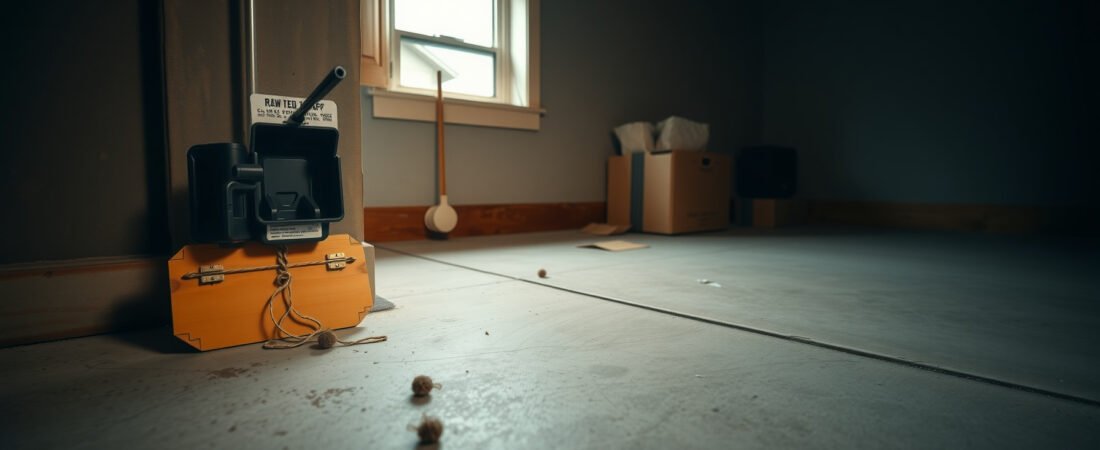
This image shows a bait station and snap trap positioned correctly along a baseboard runway — the wall-flush placement that makes the difference between a product that sits ignored and one that works within 48 hours.
Which Rat Poisons Actually Work — and Which Ones Create New Problems
Rodenticides fall into two categories that behave very differently: first-generation anticoagulants (like diphacinone and chlorophacinone) require rats to feed multiple times over several days before a lethal dose accumulates, while second-generation anticoagulants (like brodifacoum and bromadiolone) are single-feed lethal. That distinction matters enormously if you have pets, raptors, or neighborhood cats — because second-generation baits persist in rat tissue at much higher concentrations, creating a significant secondary poisoning risk for anything that eats the dead rat.
For most homeowners dealing with a contained indoor infestation, first-generation anticoagulant blocks — like those containing diphacinone — are genuinely effective and carry a substantially lower secondary poisoning profile. The tradeoff is patience: expect 5 to 7 days before you see results rather than 1 to 3. Picture this: you set out brodifacoum bait in your attached garage, a rat dies inside your wall cavity three days later, and your dog discovers it before you do. That scenario plays out more often than product labels suggest, and it’s worth factoring in before you default to the strongest available option.
| Rodenticide Type | Active Ingredient Examples | Feeds Required | Secondary Poisoning Risk |
|---|---|---|---|
| First-Generation Anticoagulant | Diphacinone, Chlorophacinone | Multiple (3–5 days) | Low to Moderate |
| Second-Generation Anticoagulant | Brodifacoum, Bromadiolone | Single feed | High |
| Non-Anticoagulant | Zinc Phosphide, Bromethalin | Single feed | Moderate (acute toxin) |
Pro-Tip: Always use tamper-resistant bait stations — not loose bait blocks set on the floor. The EPA restricts consumer use of loose second-generation anticoagulant baits to exactly this reason. A locked bait station keeps children, pets, and non-target wildlife away from the bait while still allowing rats full access.
Best Rat Traps by Type — What Each One Actually Does Well
Not every rat trap category performs the same job. The right choice depends on where the infestation is, how heavy it is, and whether you’re dealing with Norway rats (ground-dwellers, burrow outside, come in through foundation gaps) or roof rats (climbers, attic-dwelling, enter through rooflines). Norway rats, which can weigh up to 18 ounces and measure 16 inches including their tail, require larger, heavier snap traps than the standard mouse trap — using an undersized trap on a large rat is a near-guarantee of a wounded, trap-shy animal that never returns to that location.
Here’s a breakdown of what each trap type does best in real-world home use:
- Snap traps (classic and expanded trigger): Fastest kill, zero waiting, reusable, best for active runways. Victor’s Expanded Trigger rat trap is the benchmark — the wider trigger plate catches hesitant rats that step around a traditional pedal.
- Electronic traps (Rat Zapper, Victor Electronic): High-voltage kill in under a second, enclosed design reduces bait competition from insects, easy no-touch disposal. Best for garages, basements, and enclosed utility spaces where you check traps frequently.
- Glue boards: Effective for monitoring but not recommended as a primary kill method — trapped rats can survive for hours and self-injure attempting to escape, which is both inhumane and messy.
- Live-catch cage traps (Havahart-style): Genuinely useful if you need to identify rat species before treating, but require same-day release at least a mile from your home — rats released nearby will return. A female Norway rat can produce 5 litters of 6–12 pups per year, so catch-and-release at close range is essentially no solution.
- Multi-catch traps (Tomcat Spin Trap): Good for outbuildings and commercial-scale infestations; overkill for a typical household with a small active population.
How to Use Poison and Traps Together Without Wasting Either
Here’s the counterintuitive part that most product guides skip: you shouldn’t deploy poison and snap traps simultaneously at the start. Use traps first for 5 to 7 days to reduce the active population and get a read on which runways are genuinely active, then introduce bait stations for any survivors that have become cautious around the traps. This staggered approach prevents the neophobia problem from affecting both tools at once and gives you clear feedback on what’s working.
Once you’re at the bait station phase, follow this sequence to maximize effectiveness:
- Identify active runways first. Look for grease marks along baseboards, fresh droppings (dark and moist, roughly 3/4 inch long for Norway rats), and gnaw marks on food packaging or structural wood. These are your target zones.
- Pre-bait before loading snap traps. Set unloaded traps with bait for 2 to 3 nights before arming them. Rats will feed freely, lose their suspicion of the trap, and get caught on the first armed night at a much higher rate.
- Place bait stations every 15 to 30 feet along confirmed runways. Rats rarely travel more than 50 feet from their harborage, so tighter spacing within that radius out-competes other food sources.
- Check snap traps every 24 hours. A dead rat left in a trap deters other rats and attracts insects. Remove catches promptly, wearing gloves, and reset immediately.
- Monitor bait consumption, not kill count. With anticoagulants, you may not find bodies. Bait being consumed is your indicator of success — replenish until consumption stops completely for at least two consecutive weeks.
- Seal entry points only after confirming zero activity. Sealing too early can trap live rats inside your walls. Wait until traps and bait stations show zero activity for 14 days before closing gaps.
“The biggest missed step I see in DIY rat control is skipping harborage reduction. You can poison and trap indefinitely, but if rats have undisturbed nesting material — insulation, cardboard, clutter within 18 inches of the floor — you’re treating symptoms, not the infestation. Remove the harborage first and your product success rate doubles.”
Dr. Mara Jennings, Urban Rodentology Extension Specialist, Texas A&M AgriLife Research
What Changes If You’re Dealing With an Outdoor or Multi-Structure Problem
Indoor rat control is a fundamentally different problem from a yard infestation or a multi-building scenario — and this is where honest nuance matters. An apartment building or attached row of townhomes shares wall cavities and utility chases, which means a rat colony eliminated in your unit can be replenished from a neighboring unit within days. A female Norway rat can reproduce at 5 weeks of age and produce up to 72 offspring per year under ideal conditions. Treating only your space in a shared-structure situation is like bailing a boat without plugging the hole.
For outdoor Norway rat burrows — typically 3 inches in diameter, with fresh loose soil at the entrance and a secondary escape hole nearby — diphacinone-based bait blocks placed directly into active burrows (using a long-handled bait applicator so you don’t handle them directly) perform significantly better than traps set at the surface. Outdoor snap trap placement requires weather protection — use a covered bait station housing even for traps, since wet or sun-damaged traps lose trigger sensitivity and bait smell quickly. Just as understanding the signs of subterranean pest activity underground helps you target treatment accurately — a concept explored in detail in What Do Subterranean Termites Look Like Underground? — reading burrow and runway evidence before placing any product is what separates a targeted intervention from a guessing game.
One underappreciated factor in outdoor rat control: bird feeders, compost bins, and pet food left outside after dusk are frequently the primary food source sustaining the population. Eliminating or securing those attractants reduces bait competition and speeds up control, sometimes by 50% or more. The best trap or bait station on the market won’t outperform an unlimited buffet twenty feet away. Similarly, if you’re managing multiple pest pressures in and around the home simultaneously — say, carpet beetles indoors while rodents are active in the garage — it’s worth reading about How to Get Rid of Carpet Beetles Before They Destroy Your Clothes to ensure your treatment approaches don’t conflict with each other in shared spaces.
The bottom line is that rat control isn’t a product problem — it’s a sequence and placement problem. Get the sequence right, and even mid-range products perform exceptionally well. Get it wrong, and you can spend three times as much on premium bait blocks and electronic traps and still be hearing scratching in your walls six weeks later. Start with runway identification, pre-bait your traps, stagger the introduction of poison bait stations, and cut off harborage and food sources simultaneously. Do all four of those things and you’ll have a rat-free home faster than any single-product solution promises — and the results will actually hold.
Frequently Asked Questions
What is the best rat poison that actually works?
Brodifacoum-based baits like Tomcat with Bromethalin or Farnam Just One Bite are consistently the most effective options for homeowners. They’re second-generation anticoagulants, meaning rats usually die within 4-7 days after a single feeding. Always place bait inside a tamper-resistant bait station, especially if you have kids or pets.
What’s the fastest way to get rid of rats in your house?
Snap traps are your fastest option — they kill rats instantly and you can see results overnight. Set them along walls and baseboards where you’ve spotted droppings, since rats travel close to surfaces. Use peanut butter or nesting material like cotton balls as bait, and set multiple traps in the same area to increase your catch rate.
Is rat poison safe to use inside the house if you have pets?
Standard rat poison is genuinely dangerous for dogs and cats — even second-hand poisoning can happen if your pet eats a dead rat that consumed the bait. If you have pets, snap traps or electric rat traps placed inside enclosed bait stations are a much safer choice. If you do use poison, keep it strictly in areas your pets can’t access at all, like inside walls or in a locked crawl space.
How many rat traps do I need to get rid of an infestation?
For a moderate infestation, you’ll want at least 6-12 snap traps set up at the same time — more traps means faster results. Rats are neophobic, meaning they’re cautious around new objects, so leave unset traps in place for a day or two before triggering them. If you’re catching rats every single night, that’s a sign of a larger colony and you may need professional help.
What’s the difference between rat poison and mouse poison?
Most active ingredients — like brodifacoum, bromadiolone, and bromethalin — work on both rats and mice, but the bait formulations and station sizes differ. Rat bait blocks are larger and designed for Norway rats and roof rats, while mouse baits come in smaller portions. Using mouse-sized bait for rats isn’t very effective because rats may not consume a lethal dose, so always check the product label for the target pest.