
Rodent repellents don’t fail because homeowners pick the wrong product — they fail because most people use repellents as a standalone fix instead of a supporting layer in a real exclusion strategy. That’s the part the packaging never tells you. Sprays, pouches, and ultrasonic devices can absolutely reduce rodent pressure when used correctly, but “correctly” means understanding what each format actually does to a mouse’s nervous system, territory instincts, or navigation — not just trusting the picture of a crossed-out rat on the label.
The honest bottom line: peppermint oil pouches won’t evict an established colony, ultrasonic devices have serious range limitations, and the best repellents on the market are most effective when applied at entry points before rodents get comfortable inside. If you already have active signs of infestation — fresh droppings, gnawed wires, grease tracks — repellents alone won’t cut it. But if you’re trying to keep mice out of a garage, storage room, RV, or recently treated home, the right combination of repellent formats is genuinely useful. Here’s how to make them work.
Do Rodent Repellents Actually Work, or Is It All Marketing?
The answer depends entirely on what “work” means in your situation. No repellent product on the market will eliminate an infestation — full stop. What the better ones will do is exploit real rodent biology: mice rely heavily on scent-based communication and territorial marking, and certain compounds genuinely interfere with that. Capsaicin (the compound in hot peppers) irritates rodent mucous membranes on contact. Peppermint oil at high concentrations overwhelms olfactory receptors that mice use to navigate and locate food. These aren’t myths — they’re documented irritant responses. The problem is concentration, coverage, and duration.
Most DIY peppermint pouches lose effective potency within two to three weeks, especially in warm or humid spaces. A mouse that’s hungry enough — and mice need to eat every two to three hours — will push through mild olfactory irritation to reach a food source. Field research from university extension programs consistently shows that repellents delay entry and redirect traffic more than they block it outright. That’s a genuinely useful function if you deploy them at the right choke points, but it means your expectations need to match what the product actually does.
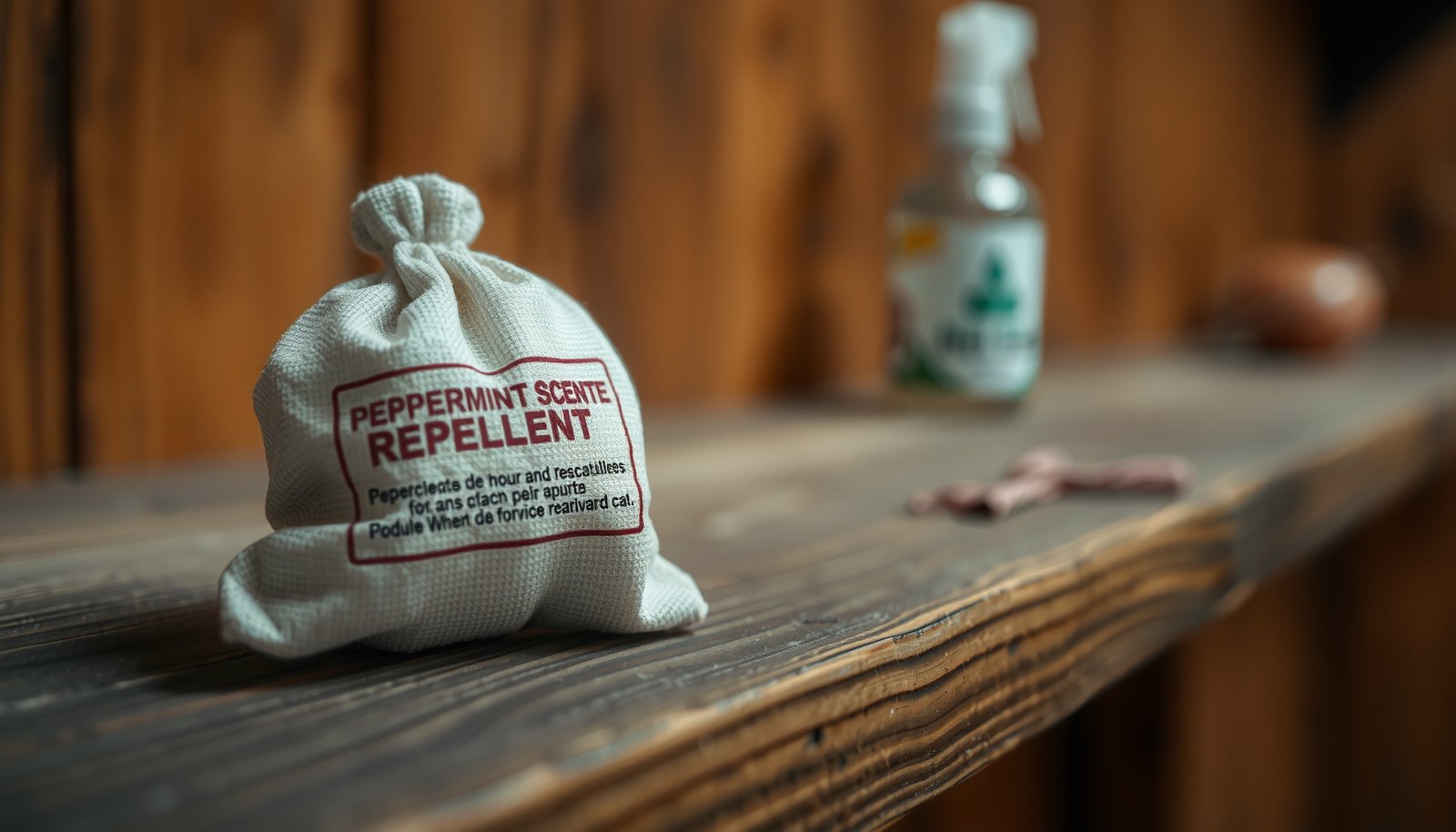
This close-up shows the three main repellent formats side by side — spray bottles, scent pouches, and an ultrasonic plug-in — illustrating why placement and format choice matter as much as the product itself.
Sprays vs. Pouches vs. Ultrasonic Devices: What Each Format Actually Does
Each repellent format works through a completely different mechanism, which is why mixing them up or choosing randomly tends to produce underwhelming results. Understanding the mechanism helps you place each product where it’ll do the most good instead of the most nothing.
Here’s a practical breakdown of all three formats:
| Format | Active Mechanism | Best Use Location | Realistic Duration |
|---|---|---|---|
| Repellent Sprays | Contact irritant or scent barrier (capsaicin, peppermint, cinnamon oil) | Entry points, baseboards, pipe gaps | 1–4 weeks depending on ventilation |
| Scent Pouches | Sustained olfactory disruption in enclosed spaces | Closets, drawers, under sinks, glove boxes | 30–90 days per pouch |
| Ultrasonic Devices | High-frequency sound pressure causing stress and disorientation | Open rooms, basements, garages (not behind walls) | Continuous while plugged in |
The counterintuitive detail that most product listings skip: ultrasonic sound does not travel through walls, furniture, or insulation. A single plug-in device covers one open room, not a whole floor. If you’ve plugged one into a corner outlet behind a couch and wondered why it “didn’t work,” that’s probably the entire answer. Mice living inside wall voids — which is exactly where they spend most of their time — hear nothing from that device at all.
Which Repellent Sprays Are Worth Buying and Which Ones Aren’t?
The repellent spray category is probably the most crowded and the most variable in quality. Some products are genuinely effective at deterring approach behavior; others are essentially diluted essential oils in a pump bottle with aggressive packaging. The difference usually comes down to concentration and formulation — specifically whether the active ingredient is present at a level that triggers an aversive response in rodents, not just a pleasant smell for humans.
These are the spray products that have the most consistent field performance based on independent testing and entomologist-reviewed data:
- Exterminators Choice Vehicle Defense — One of the few sprays designed specifically for engine compartments and wheel wells, where rodent nesting damage costs car owners hundreds in chewed wiring. Uses a capsaicin-based formula that irritates on contact. Reapply every 30 days or after rain exposure.
- Rodent Sheriff Pest Control Spray — A peppermint oil concentrate that works well in enclosed spaces (cabinets, drawers, behind appliances). The concentration is higher than most DIY mixes, though it still needs reapplication every two to three weeks in warm environments.
- Fresh Cab Botanical Rodent Repellent Spray — Made from balsam fir oil and other botanical extracts, this is EPA-registered for use in agricultural settings, which means it’s been through more rigorous efficacy testing than most over-the-counter options. Works best in enclosed or semi-enclosed spaces.
- Peppermint oil (DIY at 25–30% concentration) — Cheaper than branded options and comparably effective if you mix it correctly — roughly 25–30 drops of pure peppermint essential oil per ounce of water plus a few drops of dish soap as an emulsifier. Anything more dilute than that is essentially a room freshener. Reapply every seven to ten days on porous surfaces.
- Victor Scent-Away Natural Rodent Repeller Spray — Uses a blend of rosemary and mint oils. Effective as a perimeter deterrent when applied around door sweeps, pipe penetrations, and foundation gaps. Not strong enough on its own for active infestation areas.
Pro-Tip: Spray repellents work significantly better on clean surfaces. Mice navigate using pheromone trails they’ve already laid down, and those scent trails — deposited in urine — are remarkably persistent. If you’re applying a repellent spray over an existing rodent runway, clean the surface first with an enzyme-based cleaner to break down the urine markers, then apply. Layering repellent on top of an active scent trail is like putting a “no trespassing” sign in a language the mouse doesn’t read.
Are Scent Pouches Effective Enough to Justify the Cost?
Scent pouches — particularly those using peppermint, spearmint, cedar, or balsam fir — genuinely outperform sprays in one specific scenario: enclosed, low-ventilation spaces where the concentrated scent can build up and maintain saturation. Think RV storage compartments, kitchen drawer interiors, behind washing machines, in closets, or inside rarely-opened cabinets. In those environments, a quality pouch can maintain aversive scent levels for 60 to 90 days without reapplication. That’s a real advantage over sprays.
Picture this: a homeowner notices chewed cereal boxes in a pantry closet, cleans everything out, and places two Fresh Cab pouches on the lower shelf. Three months later, no new activity. That’s not because the pouches killed anything — it’s because the enclosed space held enough botanical concentration to make the area genuinely unpleasant for a mouse to linger in. The key word is “enclosed.” The same pouch sitting in an open garage will dissipate in two to three weeks and accomplish almost nothing.
“Botanical repellents are most effective as perimeter reinforcement tools — they help establish zones of deterrence around food storage or nesting-prone areas. The mistake I see consistently is homeowners using them reactively, after rodents are already established, rather than proactively at access points and vulnerable storage spaces. Used early and in the right format for the space, they’re a legitimate part of an integrated pest management plan.”
Dr. Monica Alvarez, BCE, Board Certified Entomologist and urban pest management consultant
The best scent pouch options right now are Fresh Cab (EPA-registered, balsam fir oil base), Grandpa Gus’s Extra Strength (peppermint and spearmint blend, stronger initial scent), and Victor Scent-Away pouches (good longevity in cool, dry conditions). All three outperform dollar-store alternatives because concentration matters — a faint mint smell isn’t an aversive stimulus, it’s décor.
Do Ultrasonic Rodent Repellers Actually Keep Mice Away?
Ultrasonic repellers occupy a weird middle ground: the underlying concept has biological support, but the consumer products delivering on that concept are wildly inconsistent. Rodents — especially mice — have hearing ranges that extend well above 20,000 Hz, into frequencies that are genuinely uncomfortable at sufficient intensity. High-frequency sound at the right decibel level does cause stress responses, disorientation, and avoidance behavior in lab settings. The Federal Trade Commission has sent warning letters to multiple ultrasonic device manufacturers over unsupported efficacy claims, which tells you something about the gap between theory and retail product.
Here’s the specific problem: effective ultrasonic deterrence requires sound pressure levels that most plug-in consumer devices simply don’t generate at useful range. The ones that do produce adequate frequency and intensity cover an open area of roughly 800 to 1,200 square feet — but only in that open area. Sound waves at these frequencies don’t bend around corners, don’t penetrate drywall, and are absorbed by soft furnishings. Mice living in wall voids — where a mouse can fit through a gap as small as 1/4 inch — are essentially in a sound-insulated chamber. If you’re going to use ultrasonic devices, use them in open garages, unfinished basements, or crawl spaces, and use one device per distinct area rather than expecting one unit to cover a whole floor. Brands with more consistent independent test performance include Pest Reject Pro and T3-R Triple High Impact Repeller, though results still vary considerably by space type. Similar logic applies to fly problems — the format of the solution has to match the actual biology of the pest you’re dealing with.
The honest nuance here: climate, building construction, and rodent species all affect how well any repellent works. Deer mice in a rural outbuilding behave differently than Norway rats in a basement, which behave differently than roof rats in an attic. A repellent strategy that works in a tightly sealed suburban ranch house may perform poorly in an older building with extensive wall void access, multiple entry points, and an established population. In those situations, repellents are genuinely a secondary tool, not the headline act.
There’s one more thing worth knowing about ultrasonic devices that almost no article mentions: rodents habituate to static ultrasonic frequencies. Studies on lab rodents show that within one to two weeks of consistent exposure, avoidance behavior diminishes significantly as the animal’s stress response adapts. Some higher-end devices address this with frequency-shifting technology that rotates through multiple wavelengths — that’s worth paying for if you’re committing to this format. A device that runs a single fixed frequency is likely to stop working in a matter of weeks even if it worked initially. If you’re ever worried about device placement near sensitive belongings or have had a pest control professional treat your space, it’s worth knowing what your rights are if pest control damages your belongings — that applies to electronic devices and stored items near treated areas.
The repellent formats that hold up best over time tend to share one characteristic: they make a space genuinely hostile to rodent comfort — through scent saturation, physical irritation, or acoustic stress — rather than just mildly inconvenient. The best approach for most homeowners is layered: a botanical spray at known entry points, scent pouches in enclosed storage areas, and a frequency-shifting ultrasonic device in open zones like garages or utility rooms. No single product covers all three functions, and the ones that claim to usually deliver none of them well. Start at your perimeter, treat the entry points first, and let repellents do what they’re actually good at — keeping clean spaces clean.
Here’s a summary of how to deploy the three repellent types together as a system:
- Entry points and gaps — Repellent spray (capsaicin or high-concentration peppermint) applied directly to and around any gap, crack, or pipe penetration. Reapply every two to three weeks. This is your first line.
- Enclosed storage zones — Scent pouches placed inside cabinets, closets, pantries, under sinks, and in drawers. Replace every 60 to 90 days or when the scent fades noticeably.
- Open interior zones — Frequency-shifting ultrasonic devices in garages, basements, and large open utility rooms. Place at rodent height (near the floor), not up high on a shelf.
- Vehicle engine compartments — Capsaicin-based spray on the undercarriage, wheel wells, and around cable bundles, especially if the vehicle sits unused for extended periods.
- After professional treatment — Repellents are most effective in the period immediately following a professional exclusion or trapping program, when rodent populations are reduced and you’re trying to prevent reinvasion rather than displace established animals.
If you take one thing from this article, make it this: the reason most repellents disappoint people isn’t that they’re ineffective — it’s that they’re used at the wrong stage of a rodent problem. They’re prevention tools and maintenance tools. Deploy them that way, and they genuinely earn their place in your pest control toolkit.
Frequently Asked Questions
what is the best rodent repellent that actually works?
The best rodent repellents combine multiple approaches — ultrasonic devices work well indoors in smaller rooms under 800 square feet, while peppermint oil sprays and predator-scent pouches are better for targeted spots like under a sink or inside a garage cabinet. No single product works everywhere, so most pest control pros recommend layering at least two types for reliable results.
how long do rodent repellent pouches last?
Most rodent repellent pouches are effective for 30 to 90 days depending on the brand and how well-ventilated the area is. High airflow spaces like attics or crawl spaces burn through the scent faster, so check the pouch every 4 weeks and replace it when you can barely smell it from about a foot away.
do ultrasonic rodent repellers really work?
Ultrasonic repellers can reduce rodent activity in enclosed spaces, but they don’t penetrate walls or furniture, so their effective range is limited to open areas in a single room. Studies and real-world reports show mixed results — they work better as a preventive measure than as a fix for an active infestation.
is rodent repellent spray safe to use around pets and kids?
Most plant-based sprays using peppermint oil or spearmint are considered low-risk around kids and pets once dry, but you should still keep animals away during application and let surfaces air out for at least 15 minutes. Avoid sprays with naphthalene — it’s toxic to cats and dogs even in small amounts and isn’t worth the risk.
where should I put rodent repellent in my house?
Focus on entry points first — along baseboards near exterior walls, inside cabinets under sinks, around pipe gaps, and in corners of garages or basements. For pouches and sprays, replace or reapply every 30 to 60 days and pay extra attention to areas where you’ve seen droppings, grease marks, or chewed materials.