
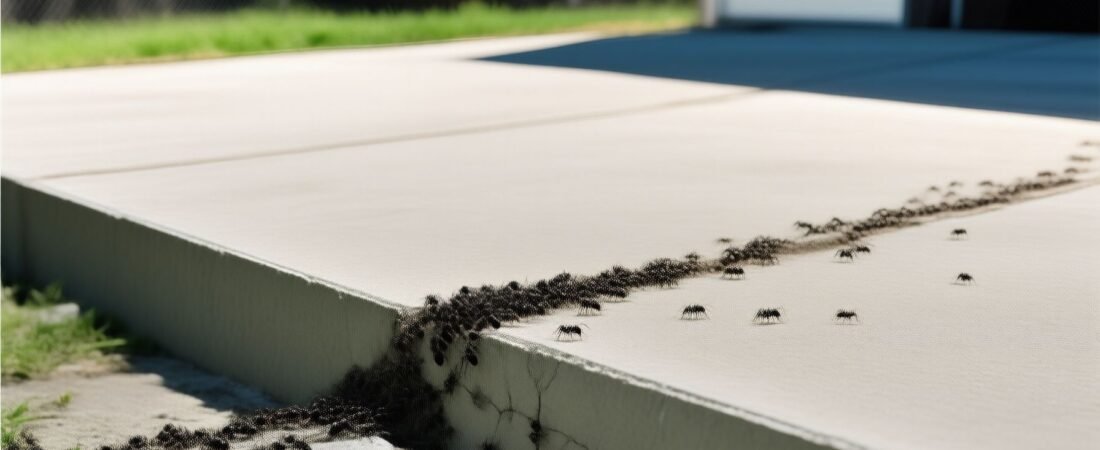
Spraying ant killer on the trail you see crossing your patio does almost nothing — because the colony isn’t there. It’s 12 inches below you, tucked into a void that forms naturally beneath a concrete slab as the ground shifts and settles over time. That’s the mistake most homeowners make with ants under concrete: they treat the surface symptom while the actual problem stays warm, dry, and completely untouched underground.
Why Do Ants Nest Under Concrete Slabs in the First Place?
Concrete slabs — driveways, patios, sidewalks, garage floors — are accidentally perfect ant real estate. The slab absorbs and holds heat from the sun, keeping the soil below warmer than the surrounding ground. That warmth matters enormously to ant colonies, because brood development (eggs hatching, larvae maturing) happens significantly faster at 80–90°F than in cooler soil, which means the colony grows faster and survives cold snaps better.
There’s also the moisture angle. Concrete isn’t perfectly waterproof, and condensation forms on the underside of slabs during temperature swings. That thin, consistent moisture layer attracts ants that need to regulate humidity for their eggs — pavement ants, odorous house ants, and fire ants are the most common culprits in sub-slab situations across the US. Soil erosion from rain or irrigation over time widens natural gaps between the slab and the ground, giving colonies more room to expand their galleries without ever needing to be visible from above.
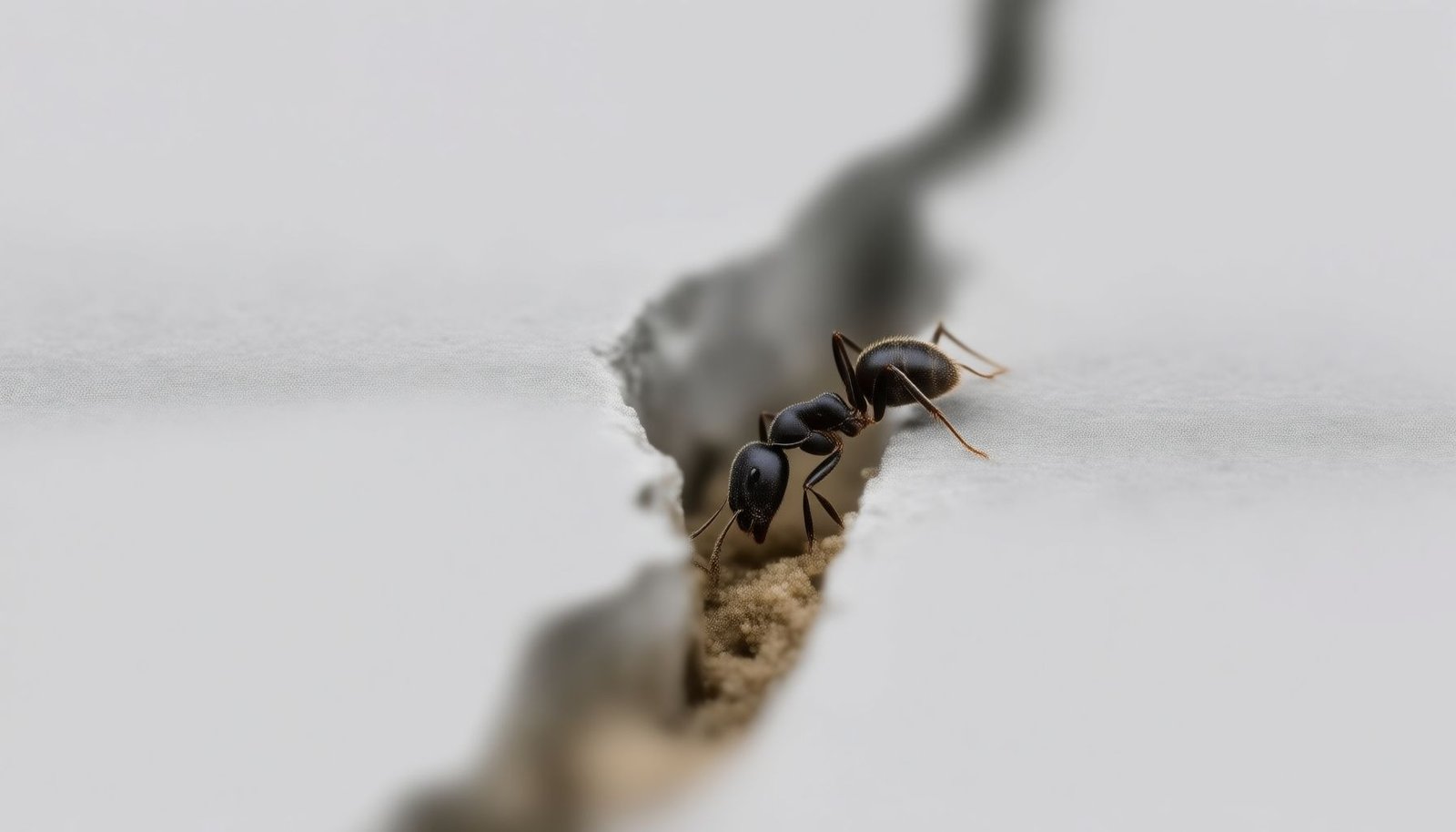
This close-up shows the characteristic fine-grain soil mounds pushed up through expansion joints — the most reliable sign that a colony has established galleries directly beneath the slab rather than simply foraging across it.
What Ants Under a Concrete Slab Actually Look Like (vs. Just Foraging)
Here’s a distinction that most pest control content completely skips: there’s a big difference between ants that nest under your slab and ants that are simply walking across it on the way somewhere else. Getting this wrong will cost you time and product. Picture this — you’ve got a thin, wandering line of small dark ants crossing your driveway every morning, disappearing into a crack near the garage door. That looks like a sub-slab nest. But if those ants are actually nesting in a mulch bed 20 feet away and using the crack as a shortcut to a food source in your garage, treating the slab void accomplishes nothing.
The tell-tale signs of an actual sub-slab colony are specific. You’ll see fine sandy or gritty soil pushed up through expansion joints or cracks — this is excavated material the workers are moving to make room for galleries. You may also notice multiple entry and exit points clustered within a 2–3 foot radius rather than a single ant highway. During hot, dry weather, activity increases dramatically at slab joints rather than decreasing, because the colony is pushing deeper and the workers are bringing more material up. Winged reproductives (swarmers) emerging from those same cracks in spring or early summer is essentially confirmation — a colony has to be mature, often 3–5 years old with thousands of workers, before it produces alates.
Why Surface Sprays and Granules Fail Against Sub-Slab Colonies
The counterintuitive truth about ants under concrete is that the most popular DIY products — perimeter sprays, granule broadcast treatments, even ant killer poured directly into cracks — are almost guaranteed to fail against an established sub-slab colony. And it’s not just about dosage. It’s about biology.
Ant colonies under slabs can extend 2–3 feet below grade in warm climates. Scouts that detect a chemical barrier near the surface simply reroute through deeper galleries that the spray never reaches. Worse, some broad-spectrum sprays cause “budding” in certain species — particularly odorous house ants and fire ants — where chemical stress triggers the queen to split the colony into multiple satellite nests, each with its own reproductive. One colony becomes three. That’s not a hypothetical: it’s a documented behavioral response in multi-queen ant species, and it’s one reason aggressive surface treatments occasionally make an infestation measurably worse within 2–3 weeks of application.
Pro-Tip: Before treating, press a piece of white cardstock over the crack openings for 60 seconds and examine what sticks under a magnifying glass. Worker size and color will help you confirm the species — pavement ants are brown with parallel head grooves, odorous house ants are dark and emit a rotten coconut smell when crushed, and fire ants are reddish-brown and will immediately sting the cardstock aggressively. Species ID changes your entire treatment approach.
How to Actually Eliminate Ants Under a Concrete Slab Step by Step
The only treatments that reliably work against established sub-slab colonies are those that exploit ant biology rather than fight it — specifically, slow-acting baits that workers carry back to the queen and brood before the colony detects a threat. This is not a spray situation. Patience is the actual active ingredient here.
Follow this sequence in order. Skipping steps — especially step 1 — is why most homeowner treatment attempts fail on the second or third try:
- Stop all surface disruption for 72 hours before baiting. No sprays, no granules, no boiling water poured into cracks. Any chemical or thermal disturbance signals danger to the colony and suppresses foraging activity, which means workers won’t find your bait stations.
- Place gel bait directly at active entry points in the slab. Use a gel formulation containing imidacloprid, indoxacarb, or fipronil. A pea-sized drop placed just inside the crack opening — not on top of it — is the right amount. Overapplication repels ants instead of attracting them.
- Add protein-based bait alongside sugar-based bait. Ant colonies cycle between carbohydrate and protein needs depending on their brood stage. Using only one type of bait can fail entirely if the colony is in a protein-hungry phase. Rotate or use both simultaneously.
- Do not disturb the bait for 5–7 days even if activity increases. An initial surge in ant activity around bait is a good sign — it means workers found it and are recruiting. Resist the urge to spray.
- Reapply every 5–7 days for 3–4 weeks. A single application is never enough for a mature sub-slab colony. Workers consume bait faster than you expect, and queens deep in the gallery won’t be reached until multiple generations of poisoned workers return and die.
- Seal expansion joints with polyurethane caulk after 4 weeks of zero activity. Don’t seal during active treatment — you’ll trap foragers outside and trap the queen safely inside. Seal only after the colony is eliminated to prevent reinfestation.
For fire ant colonies under slabs specifically — more common in the Southeast and Southwest — the mound drench approach using bifenthrin or spinosad solution injected directly into crack openings with a long-nozzle applicator bottle can supplement baiting. Fire ant colonies can contain over 250,000 workers in mature mounds, and bait alone may take 6–8 weeks to reach a complete kill on large colonies.
“The number one error I see homeowners make is treating the foraging trail instead of the nest. Sub-slab colonies can maintain satellite galleries 18 to 36 inches below the concrete surface, completely isolated from anything applied topically. Slow-acting baits that get physically transported by workers are the only practical mechanism for reaching those depths without drilling. And when you use a repellent spray first, you’ve essentially told the colony to stay underground — exactly where you can’t reach it.”
Dr. Marcus Tilley, Board-Certified Entomologist and Urban Pest Management Specialist, University of Florida IFAS Extension
When the Problem Is Bigger Than Ants: What Sub-Slab Colonies Signal About Your Foundation
This is the part almost nobody writes about, and it’s genuinely worth your attention. Ant colonies don’t create voids under concrete slabs — they exploit voids that already exist. If you have a mature, thriving ant colony under your driveway or patio, the soil below that slab has already settled, eroded, or washed out enough to create livable space. That’s a structural data point, not just a pest problem.
Sub-slab erosion — sometimes called “void formation” — is what leads to slab cracking, settling, and eventually the kind of trip-hazard lip on a sidewalk or driveway that costs thousands to repair. Ants are efficient at moving soil (a single pavement ant colony moves an estimated 40 pounds of soil per year in active gallery construction), and over multiple seasons they can actually accelerate the natural settling process. Honest answer: if you’re seeing ant exit holes at multiple points across a slab that’s more than 10–15 years old, it’s worth having a concrete contractor assess for voids with a simple tap-test before you invest in pest treatment alone. Treating the ants without addressing the void means the next colony moves into a ready-made home within a season or two. Dealing with ants is a lot like managing other persistent household invaders — the source conditions matter as much as the pest itself, similar to how getting rid of house flies without chemicals ultimately depends more on eliminating breeding sites than on the fly itself.
Here’s a quick comparison of the most common sub-slab ant species and how their treatment needs differ:
| Ant Species | Colony Size | Best Bait Type | Treatment Timeline |
|---|---|---|---|
| Pavement Ant | 3,000–5,000 workers | Sugar + protein gel | 2–3 weeks |
| Odorous House Ant | 10,000–100,000 workers (multi-queen) | Sugar gel bait only | 4–6 weeks |
| Fire Ant | 100,000–250,000 workers | Protein bait + drench | 6–8 weeks |
| Argentine Ant | Supercolony (millions) | Sugar gel, slow-acting | 8–12 weeks |
Argentine ants deserve a special mention because they’re genuinely different from every other species on this list. They form interconnected supercolonies — separate nests that share workers and queens freely — which means eliminating one entry point under a slab does nothing if the broader colony network extends across multiple properties. In coastal California, Florida, and parts of the Gulf Coast, Argentine ant supercolonies can span entire city blocks. That’s not hyperbole; it’s been documented in residential neighborhoods where the “colony” under one homeowner’s driveway is biologically continuous with nests under three neighbors’ patios. In those situations, coordinating treatment with adjacent homeowners is far more effective than treating solo.
How to Keep Ants From Coming Back Under the Slab
Sealing cracks and expansion joints with polyurethane caulk (not silicone — it’s too flexible and ants can push through it) is the single most effective long-term prevention step. Do this after confirmed colony elimination, not before. Expansion joints wider than 1/4 inch should be filled with backer rod foam first, then capped with caulk, otherwise you’re just wasting product in a gap that’s too wide to seal properly.
Beyond sealing, the conditions that made your slab attractive in the first place need attention. Here’s what actually reduces reinfestation risk over the long term:
- Redirect irrigation away from the slab edge. Sprinkler heads that wet the base of a concrete slab create the moisture gradient that makes sub-slab soil attractive. Move heads at least 18 inches back from slab edges.
- Remove organic debris from slab surfaces and adjacent soil. Leaf litter, mulch piled against the slab edge, and decaying wood within a few feet of the concrete give ant colonies both a food source and an alternative nesting option that’s dangerously close to your slab.
- Apply a non-repellent perimeter treatment annually. Products containing imidacloprid or fipronil applied as a 12-inch band around the slab perimeter won’t kill scouts instantly — they’ll carry the active ingredient back to the colony over several days, which is exactly what you want. Repellent pyrethroid sprays create a barrier but don’t eliminate colonies.
- Check for plumbing leaks under the slab annually. A slow leak from irrigation lines or supply pipes under a concrete slab creates a persistent moisture source that’s almost impossible for ants to resist. If you’ve treated repeatedly and the same area keeps re-infesting, call a plumber before you call pest control again.
- Address tree roots near old slabs. Mature tree roots that grow beneath concrete slabs create natural channels and voids as they expand and contract seasonally. Those root channels become ant highways and eventually nesting sites. This is a long-game problem, but it’s worth noting when deciding whether to treat the same slab for the third time or invest in resurfacing.
One thing worth mentioning that applies specifically to older homes — concrete slabs poured before the mid-1980s frequently used a coarser aggregate mix and have more micro-cracking throughout the surface than modern poured concrete. That means more entry points, more moisture infiltration, and frankly more ant opportunity regardless of how well you seal the visible joints. If your slab is 30+ years old and you’re fighting a recurring ant problem, you’re dealing with a structural variable that no amount of pest treatment fully corrects. The honest answer in that situation might be slab replacement or overlay — which is a conversation worth having with a contractor even if it’s not what any pest control article typically tells you. Just like persistent kitchen pest problems sometimes trace back to structural gaps rather than hygiene — the same principle that makes getting rid of larder beetles in the kitchen surprisingly difficult when food storage gaps go unaddressed — sub-slab ant problems are often a building issue wearing a pest issue’s clothing.
The colony under your concrete isn’t going to surface on its own, and it isn’t going to respond to anything you can spray on top of the slab. But slow-acting bait placed at the right points, left completely alone long enough to work, and followed up with real structural sealing will eliminate even large established colonies. Start with what’s below the surface — because that’s where the actual problem lives.
Frequently Asked Questions
what kills ants under concrete slab?
Granular insecticide baits like those containing hydramethylnon or fipronil work best because ants carry the bait back to the colony and kill the queen. Apply the bait around the perimeter of the slab and near visible entry cracks. For severe infestations, a liquid termiticide injected directly into the soil beneath the slab through drilled holes is the most effective option.
how do I know if ants are living under my concrete slab?
The most obvious signs are small mounds of fine dirt or sand appearing along the edges of the slab or pushing up through cracks. You’ll also notice consistent ant trails leading under the concrete, often in the early morning or evening. Carpenter ants specifically may leave behind small piles of wood shavings if there’s any wood framing nearby.
can ants damage a concrete slab?
Most ants, like pavement ants and fire ants, don’t damage the concrete itself but they do excavate the soil underneath it, which can cause the slab to settle unevenly over time. A heavily infested area can develop voids large enough to make the slab crack or sink. If you notice your concrete shifting or cracking near ant activity, it’s worth addressing the infestation sooner rather than later.
how do exterminators treat ants under concrete?
Pest control professionals typically use one of two methods: drilling small holes through the slab every 12 inches or so and injecting a liquid insecticide directly into the soil below, or applying a perimeter treatment with a non-repellent product like fipronil. Non-repellent insecticides are preferred because ants can’t detect them and unknowingly carry the chemical back to the nest. The whole process usually takes about an hour depending on the size of the slab.
what kind of ants nest under concrete slabs?
Pavement ants are by far the most common species found under concrete slabs in the US — they’re the small, dark ants you often see pushing tiny piles of dirt up through sidewalk cracks. Fire ants are a major problem in the Southeast and will aggressively colonize beneath slabs, especially in warm soil. Carpenter ants occasionally nest near slabs when moisture and decaying wood are present nearby.
Disclaimer: This article is for informational purposes only and isn’t a substitute for professional pest control advice. Always read and follow the product label instructions exactly — label directions are legally binding and vary by brand and active ingredient. Keep all pesticides, baits and traps away from children and pets, ventilate treated areas as directed, and consider calling a licensed pest control professional if an infestation is large, recurring, or involves a structural pest like termites or carpenter ants.