
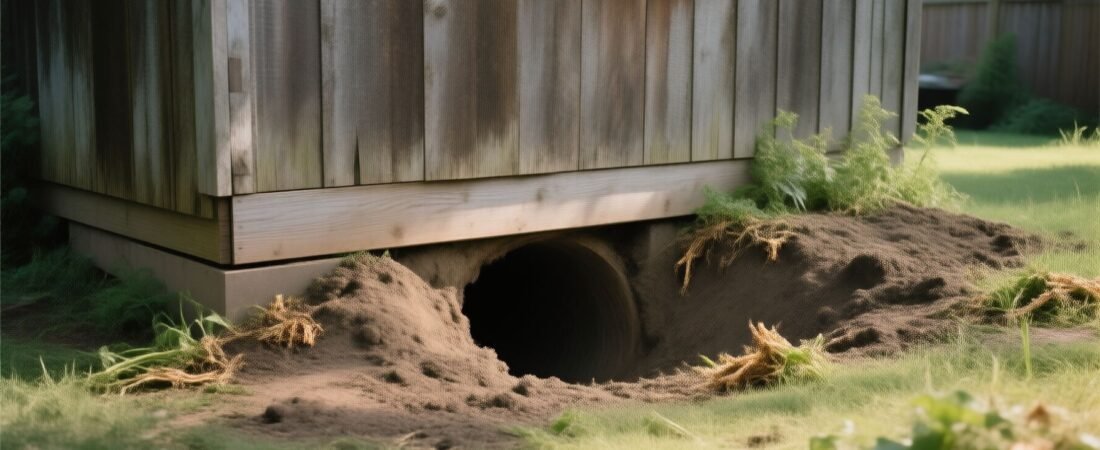
A groundhog that moves under your shed isn’t just a nuisance — it’s an engineering problem. The burrow it digs can remove 35 pounds of soil or more, and within a single season, that excavation can undermine concrete footings, collapse wooden skirting, and compromise the structural integrity of the entire structure above it. Chasing the animal out is the easy part. What almost nobody talks about is what happens after it leaves — and why doing nothing about that part almost guarantees a new groundhog (or three) moves in within weeks.
Why Chasing the Groundhog Out Isn’t Enough
Here’s the thing most removal guides skip entirely: groundhog burrows don’t disappear when the animal does. A vacated burrow under a shed is a fully furnished rental unit — dry, insulated, with established entry points and compacted tunnels that can run 5 feet deep and 25 feet long. Other groundhogs in the area can smell the old scent markings and move in within days. You haven’t solved the problem; you’ve just created a vacancy.
The real goal isn’t eviction — it’s permanent exclusion combined with burrow disruption. That two-part approach is what separates homeowners who deal with this once from homeowners who deal with it every spring. Every method in this article is chosen with that outcome in mind, not just short-term removal.
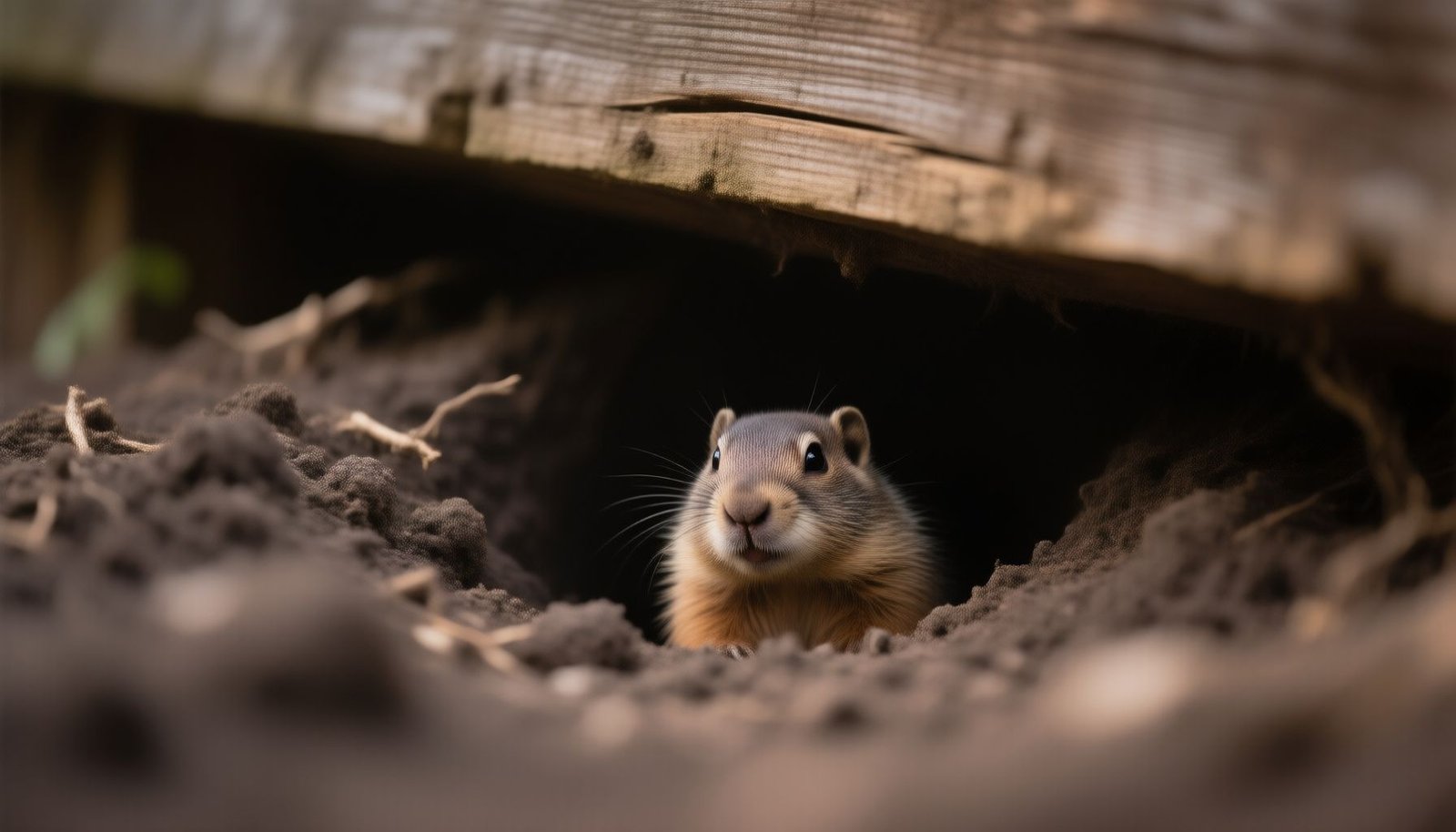
This close-up shows the tell-tale mound of freshly excavated soil at a shed burrow entrance — that loose dirt pile is one of the clearest signs a groundhog is actively digging, not just passing through.
How Do You Know It’s Actually a Groundhog Under There?
Before you do anything, confirm what you’re dealing with. Skunks, opossums, and feral cats also shelter under sheds and porches, and the right approach differs significantly depending on the animal. Groundhog burrow entrances are distinctive: they’re typically 6–10 inches in diameter, nearly perfectly round, and surrounded by a fan-shaped mound of fresh dirt. There’s almost always a secondary “spy hole” entrance a few feet away with no dirt mound — groundhogs dig it as an escape route from the inside.
Skunk dens tend to have a musky odor even when the skunk isn’t present, and the entrance is messier, less defined. Opossum dens show fur and nesting debris near the opening. Groundhog burrows are clean, almost tidy — these animals are meticulous diggers. If you’re seeing damage to nearby garden plants too, particularly chewed leafy vegetables like hostas, beans, or squash, that’s a strong secondary confirmation.
Should You Trap, Repel, or Exclude? Understanding the Real Options
This is where most DIY plans fall apart — people pick one method without understanding what it’s actually designed to do. Trapping removes the current animal but does nothing to prevent the next one. Repellents can discourage a groundhog from staying but rarely move one that’s already established a burrow. Exclusion physically prevents re-entry. Used alone, each method has a meaningful failure rate. Used in sequence, they work.
Here’s the order that actually produces lasting results:
- Confirm the animal is currently using the burrow. Loosely stuff the entrance with newspaper or dry leaves. If it’s disturbed within 24–48 hours, the groundhog is active. If it stays undisturbed for 3–4 days, the burrow may already be abandoned — especially in late fall or winter when they hibernate.
- Use a live trap to remove the current occupant. A wire cage trap (at least 10″x12″x32″) placed directly over the main burrow entrance, baited with cantaloupe, sweet corn, or apple slices, is the most reliable removal method. Check the trap every 12 hours — leaving a trapped groundhog unattended in summer heat is inhumane and illegal in some states.
- Disrupt the burrow itself. Once the animal is gone, partially fill the tunnel with soil and then flood it with a garden hose for several minutes. This collapses side chambers and removes the scent profile that attracts new groundhogs. Don’t skip this step — it’s the most overlooked part of the process.
- Install a physical exclusion barrier. This is the permanent fix. Hardware cloth (not chicken wire — it degrades too fast) buried 12 inches deep at a 90-degree outward-facing “L” shape at the bottom prevents re-digging. The barrier should extend at least 3 feet above ground along the shed’s perimeter.
- Apply a deterrent around the perimeter as a secondary layer. Castor oil-based granular repellents, or pure castor oil mixed with dish soap and water sprayed around the foundation, irritate a groundhog’s sense of smell and make the area unattractive to new arrivals. Reapply after heavy rain.
One honest caveat here: if your shed sits on a concrete slab with no gap at ground level, your exclusion options are much simpler — a basic L-shaped barrier is usually sufficient. But sheds on piers or with open skirting require more thorough perimeter work, because there are simply more access points.
What Groundhog Repellents Actually Work — and Which Are a Waste of Money
Picture this: a homeowner spends two weekends and $80 on ultrasonic spike repellers pushed into the ground around a shed, leaves for a work trip, and comes back to find the groundhog has excavated a new secondary tunnel entrance 18 inches from one of the devices. That’s not a rare story. Ultrasonic ground stakes are heavily marketed for wildlife deterrence, but peer-reviewed field studies consistently show that burrowing animals habituate to ultrasonic frequency within days, sometimes hours, of first exposure. They’re not a solution for established groundhogs.
Repellents with a documented track record fall into a shorter list than most product pages will admit. Here’s a realistic comparison of what’s actually worth trying:
| Repellent Type | Effectiveness | Best Use Case | Limitations |
|---|---|---|---|
| Castor oil granules (e.g., Mole Max, Sweeney’s) | Moderate | Perimeter deterrence after removal | Must reapply after rain; won’t move entrenched animal |
| Predator urine (fox, coyote) | Low–Moderate | Open yard areas near burrow zone | Loses potency quickly; urban groundhogs often unbothered |
| Ultrasonic ground stakes | Very Low | Not recommended for established burrows | Animals habituate rapidly; no field evidence for groundhogs |
| Hot pepper spray (capsaicin) | Moderate | Applied to burrow entrance and surrounding soil | Requires frequent reapplication; washes away in rain |
Repellents work best as a follow-up tool, not a primary strategy. Think of them as a way to make a freshly cleared area less attractive to the next groundhog looking for real estate — not as a way to convince a groundhog that’s already raising a litter under your deck to voluntarily relocate.
“The most common mistake I see is homeowners trapping and relocating a groundhog without addressing the burrow structure itself. That site has already proven itself as viable habitat — it’s warm, protected, and has established drainage. Another groundhog will find it, often within two to three weeks. Permanent exclusion at the foundation level is the only fix that holds across seasons.”
Dr. Marcus Holt, Wildlife Damage Management Specialist, Penn State Extension
How to Install Groundhog Exclusion Fencing That Actually Holds
The L-shaped hardware cloth barrier is the single most effective long-term solution, but the installation details matter more than most guides let on. Use 1/4-inch or 1/2-inch galvanized hardware cloth — not chicken wire, which rusts through within 2–3 years underground. You’ll need a roll at least 24 inches wide to get the geometry right: 12 inches buried vertically, with the bottom 12 inches bent outward at a 90-degree angle (facing away from the shed) before backfilling.
That outward-facing L-bend is the critical detail. A groundhog digging down at the fence line hits the horizontal section and instinctively stops — they don’t dig sideways to get around an obstacle they can’t see. It’s a behavioral quirk you can exploit without harming the animal at all. Secure the above-ground section to the shed skirting with galvanized staples or fencing screws every 6 inches, and seal any gap where the cloth meets the structure with construction foam before the groundhog season peaks in early spring.
Pro-Tip: Before burying the hardware cloth, lay the horizontal L-section in the trench and then pour a thin layer of gravel over it before backfilling with soil. The gravel layer discourages digging even further and helps the cloth stay flat over time as soil settles — a detail that significantly extends the lifespan of your barrier without adding much cost.
Groundhogs are also surprisingly good climbers for animals that spend most of their time underground — they can scale a vertical fence up to 3 feet high with little trouble. If your shed has open lattice skirting rather than solid panels, the above-ground section of your hardware cloth barrier should extend at least 3 feet and ideally have the top 6 inches bent outward to discourage climbing. It sounds like overkill until you’ve watched one walk straight up a decorative lattice panel.
What to Do About the Damage the Groundhog Already Caused
This section rarely appears in groundhog removal guides, and it probably should lead most of them. A single groundhog can remove 700 pounds of soil per year through active burrowing — that’s not a typo. Under a shed or porch, that volume of displaced soil creates voids beneath concrete footings, slabs, or wooden support posts that don’t immediately look dangerous but can cause significant settling or structural failure over time, particularly in clay-heavy soils that shift with moisture changes.
After eviction and exclusion are complete, probe the soil around and under the structure with a metal rod or rebar. If it sinks easily in spots where it shouldn’t — more than 8–10 inches with light pressure — you’ve found a void. Small voids can be filled with dry concrete mix or foam sealant injected through the surface. Larger voids, or any situation where you’re seeing visible sloping or cracking in the structure above, warrant a call to a foundation contractor before you close everything up. The groundhog is gone, but its work product isn’t.
On a related note — if you’ve also been noticing surface runnel damage in your lawn nearby, it’s worth ruling out whether voles are compounding the problem. Groundhogs and voles sometimes share territory, and while their damage looks different up close, both can get misidentified. A good breakdown of what vole damage actually looks like, and how to deal with it non-toxically, is covered in this guide on how to get rid of voles in the garden without poison.
Here’s a checklist of post-removal steps that often get skipped:
- Probe the soil perimeter of the structure for voids before installing exclusion fencing
- Flush and partially backfill all visible burrow entrances — even ones that appeared inactive
- Check wooden support posts for moisture damage at the base, since burrowing disrupts drainage and accelerates wood rot
- Inspect nearby garden beds for secondary feeding damage that may have been ongoing while you focused on the burrow
- Remove any food attractants within 30 feet — birdseed spilled under feeders, low-hanging fruit, or garden crops without protection are active recruitment tools for the next groundhog
- Re-check the exclusion barrier after the first heavy rain and after the first hard freeze, as soil movement can open gaps at the burial line
And if your yard has been taking a beating beyond the shed — discolored turf patches, chewed plant stems, other unexplained surface damage — it may be worth cross-checking whether another pest is layered into the problem. A guide like how to get rid of chinch bugs in the lawn is useful for ruling out grass-level insect damage that sometimes gets attributed to digging mammals.
The groundhog under your shed isn’t really a pest control problem in the traditional sense — it’s a structural habitat problem. The animal moved in because the space was accessible, protected, and undisturbed. Fix those three conditions permanently, and you won’t be setting traps again next spring. Every dollar and hour you spend on the exclusion barrier now is work you won’t have to repeat, which is a better return than any repellent on the market can offer.
Frequently Asked Questions
What is the fastest way to get rid of groundhogs under a shed?
The fastest method is live trapping with a wire cage trap set directly at the burrow entrance. Bait it with cantaloupe, sweet corn, or peanut butter, and check it every 12 hours. Most homeowners catch a groundhog within 1 to 3 days using this approach.
How do I keep groundhogs from coming back under my shed after I remove them?
Once the groundhog is gone, install an L-shaped wire mesh barrier around the shed’s perimeter. Bury it at least 12 inches deep and bend the bottom 6 inches outward underground so they can’t dig under it. Without this step, a new groundhog will almost always move into the empty burrow within a few weeks.
Will mothballs or ammonia get rid of groundhogs under a porch?
These repellents rarely work for more than a day or two — groundhogs quickly get used to the smell and return. Mothballs are also a pesticide, and using them in an unapproved way like this is technically illegal in the US. Stick with exclusion fencing or live trapping for results that actually last.
Can I flood a groundhog burrow under my shed to get rid of them?
Flooding a burrow with a garden hose is unlikely to evict a groundhog and can cause moisture damage to your shed’s foundation or subfloor. Groundhog burrows have multiple chambers and can extend 5 feet deep or more, so water usually just drains away. It’s not worth the risk to your property when trapping and exclusion work much better.
Is it legal to relocate a trapped groundhog in my state?
Groundhog relocation rules vary by state — some require you to release them on your own property, and others allow relocation at least 5 miles away. A handful of states classify groundhogs as nuisance wildlife and let you trap and kill them without a permit. Check your state’s fish and wildlife agency website or call your local animal control office before you trap to make sure you’re following the rules.
Disclaimer: This article is for informational purposes only and isn’t a substitute for professional pest control advice. Always read and follow the product label instructions exactly — label directions are legally binding and vary by brand and active ingredient. Keep all pesticides, baits and traps away from children and pets, ventilate treated areas as directed, and consider calling a licensed pest control professional if an infestation is large, recurring, or involves a structural pest like termites or carpenter ants.