
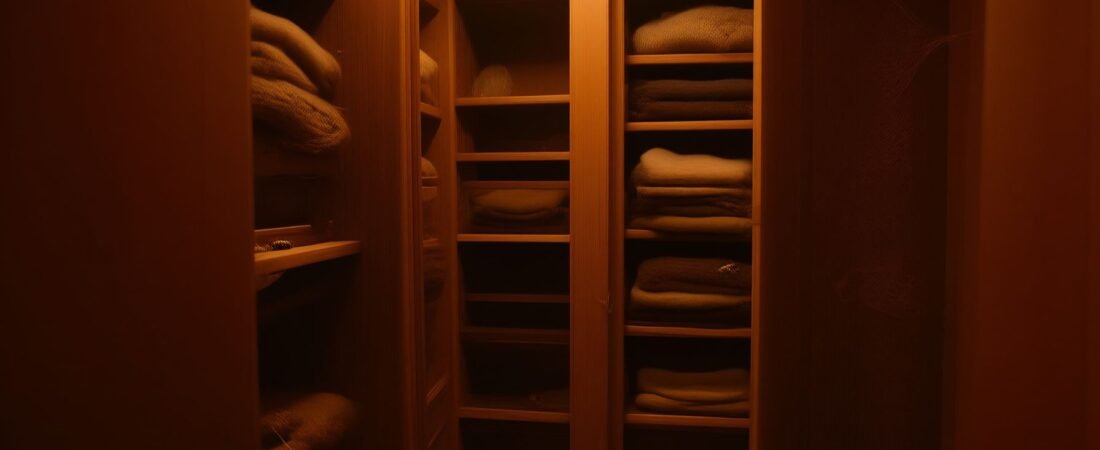
Cedar blocks don’t kill moth larvae — they only repel adult moths, and only when the cedar is fresh enough to still smell strong. That distinction matters a lot when you open your closet in spring and find ragged holes chewed through your favorite wool sweater. Most people reach for cedar or lavender sachets, declare victory, and then wonder why the damage keeps happening. The real problem is almost always larvae that were already there before you did anything, quietly feeding on your clothes while the adults flew around looking decorative.
Why Cedar and Lavender Aren’t Actually Solving Your Moth Problem
Here’s the part nobody wants to hear: the larvae doing the damage don’t care about cedar. Adult clothes moths — specifically Tineola bisselliella, the webbing clothes moth — avoid light and strong smells, which is why cedar and lavender have some deterrent effect on them. But a female clothes moth lays between 40 and 50 eggs over her lifetime, and those eggs hatch into larvae that are entirely focused on eating keratin-rich fibers like wool, cashmere, and mohair. The larvae don’t respond to smell the way adults do. They’re feeding, not flying.
Cedar’s repellent effect also degrades within a few months as the volatile oils evaporate — which means that cedar block you put in two years ago and forgot about is doing essentially nothing. Lavender, dried herbs, and similar natural remedies are even weaker repellents and have zero killing power at any life stage. If you already have an active infestation in a closet full of wool sweaters, these tools are decorative at best. The thesis of this entire article is simple: you have to kill what’s already there before prevention means anything at all.
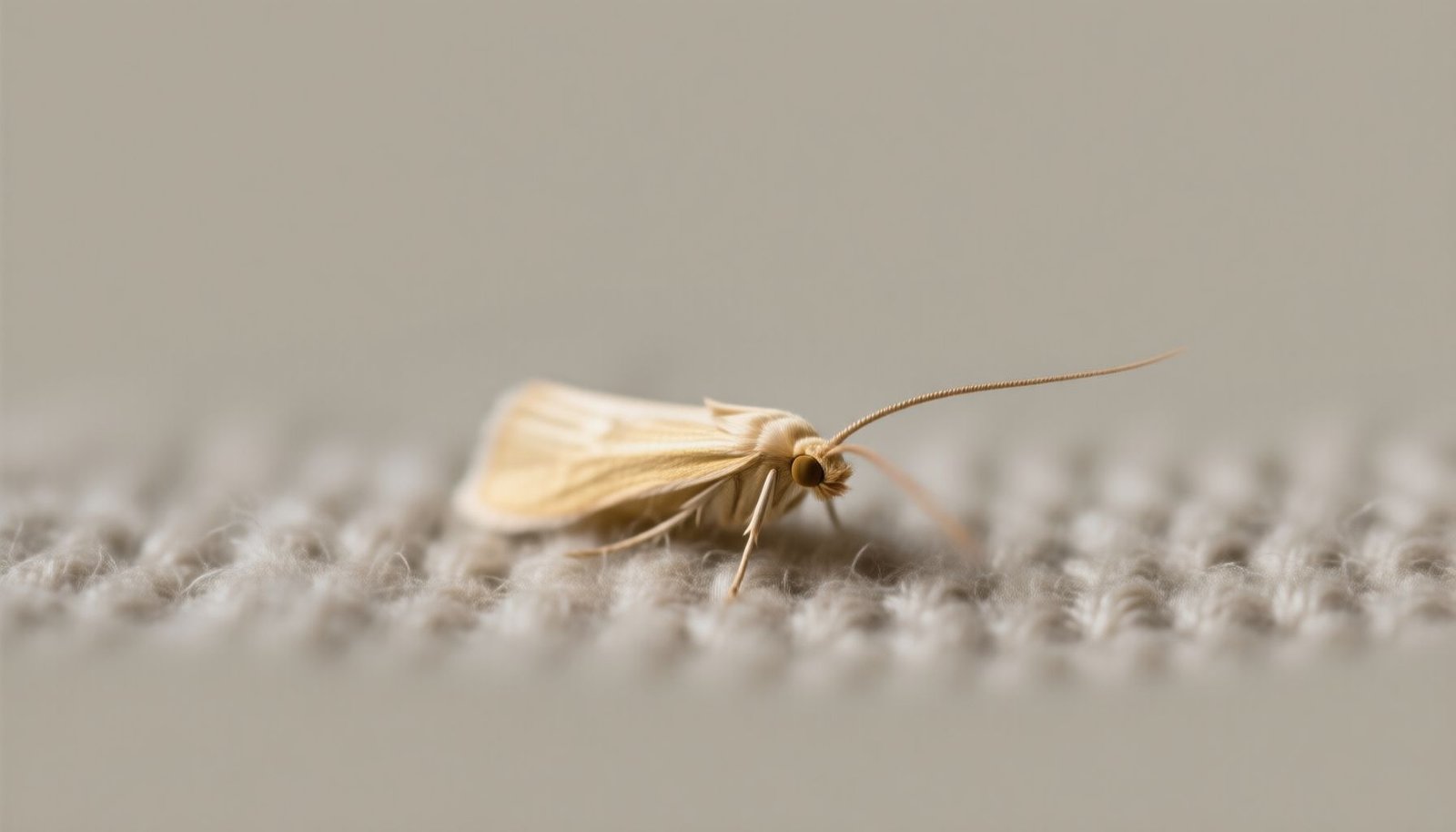
This close-up shows the telltale webbing and frass left behind by clothes moth larvae on wool fabric — damage that’s already done by the time most people even realize moths are present in their closet.
How to Confirm You Actually Have Clothes Moths (Not Pantry Moths)
Before you treat anything, you need to confirm what you’re dealing with. Clothes moths and pantry moths (Indian meal moths) look similar at a glance, but they’re completely different insects with completely different habits. Clothes moths are small, buff-colored, and they hate light — if you disturb them, they run and hide rather than fly toward a window. Indian meal moths are slightly larger with a distinctive reddish-brown wing tip and will readily fly toward light sources. Treating for the wrong species wastes time and money.
Clothes moth damage has a specific signature: irregular holes in natural fiber clothing (wool, cashmere, silk, fur, feathers), often accompanied by silky webbing or small tubular cases attached to the fabric. You might also spot tiny cream-colored larvae, about 1/2 inch long, on the garments themselves or in the corners of shelves. If you’re seeing damage only in your closet and not in your pantry, and the holes are in natural fibers rather than synthetic blends, you’re almost certainly dealing with clothes moths. Pheromone traps sold specifically for clothes moths (not pantry moths) can confirm the species within 24 to 48 hours of placement.
The Right Order of Attack When Your Wool Sweaters Are Already Infested
Order matters here more than most people realize. Jumping straight to repellents without clearing the existing population is exactly how infestations drag on for years. Work through these steps in sequence — skipping any one of them is how larvae survive and restart the cycle.
- Pull everything out of the closet. Every garment, every bin, every shoe box. You cannot treat what you can’t see, and larvae hide in folded fabric, in the seams of storage bags, and in the corners of shelves where debris accumulates.
- Sort by fiber content immediately. Set aside all natural fiber items — wool, cashmere, silk, mohair, angora, fur. Synthetics are not at risk and don’t need treatment, but don’t assume a blended fabric is safe; even a 20% wool content is enough to attract larvae.
- Freeze or heat-treat every affected garment before washing. Seal infested items in plastic bags and freeze at 0°F for at least 72 hours — this kills eggs, larvae, and adults at all life stages. Alternatively, a clothes dryer set to high heat (above 120°F) for 30 minutes achieves the same result for items that can handle the heat.
- Vacuum the closet thoroughly before applying any product. Use a crevice tool along every baseboard, corner, shelf edge, and wall seam. Empty the vacuum outside immediately afterward — larvae can survive inside the canister and re-infest.
- Apply a labeled insecticide to closet surfaces. A residual pyrethroid spray (permethrin or cyfluthrin, found in products like Reefer-Galler or professional-grade concentrates) applied to closet walls, shelves, and baseboards — not directly to clothing — provides lasting kill power that cedar never will. Let it dry completely before returning garments.
- Deploy pheromone traps to monitor, not just catch. Place species-specific clothes moth pheromone traps in the closet after treatment. These catch adult males, which tells you whether the population is declining. If traps are still catching moths after three to four weeks, you likely missed a source.
Picture this: you do the wash cycle, hang everything back up, add some cedar balls, and close the door. Three months later, another sweater has holes. That’s almost always because one step in the sequence above was skipped — usually the freezing step or the vacuuming of the closet itself. Larvae pupate in debris and in cracks in the wall, not just on your clothes.
What Temperature and Humidity Actually Do to Clothes Moths
Clothes moths thrive in a very specific environment: warm, dark, undisturbed spaces with moderate humidity. A closet that sits around 65–80°F with relative humidity above 50% is essentially an ideal breeding ground. Understanding this changes how you think about long-term prevention — it’s not just about repellents, it’s about making your closet a hostile environment for the insect’s biology.
Here’s a counterintuitive fact that most closet moth articles skip entirely: clothes moths are dramatically less active in dry conditions. At relative humidity below 25%, larvae struggle to develop and eggs have a much lower hatch rate. Running a small dehumidifier in a walk-in closet, or using moisture-absorbing products in a smaller closet, genuinely suppresses moth activity in a way that cedar doesn’t. Cold storage — keeping your best wool pieces in a breathable garment bag inside a cool room — does the same thing by slowing larval metabolism. Heat and dry air are your actual weapons. Cedar is a pleasant smell.
| Condition | Effect on Clothes Moth Larvae |
|---|---|
| 70–80°F, humidity above 50% | Ideal development; larvae feed actively and mature in as few as 35 days |
| Below 40°F (refrigerator range) | Development stalls; larvae become dormant but don’t die immediately |
| At or below 0°F for 72+ hours | Kills all life stages including eggs |
| Above 120°F for 30+ minutes | Kills all life stages; safe for most wool if combined with moisture |
Pro-Tip: Before storing your wool sweaters for the season, wash or dry-clean every single piece — even items that look clean. Clothes moth larvae are particularly attracted to wool that has body oils, food residue, or sweat worked into the fibers. A “clean” sweater that was worn once without washing is still a food source. Never store wool unwashed, no matter how clean it looks.
Long-Term Prevention That Actually Holds Up Season to Season
Once you’ve eliminated the active infestation, the goal shifts to making reinfestation unlikely — and that requires a different mindset than most prevention advice suggests. The biggest re-entry point for clothes moths isn’t a gap in your window screen; it’s secondhand clothing, vintage rugs, thrift store finds, and inherited items brought into the home without inspection or treatment. A single infested cashmere sweater from a thrift store can seed an entire closet within one season.
Sustainable prevention comes down to a few consistent habits, not a product you buy once and forget:
- Quarantine and freeze all secondhand wool items before they enter your closet. Seal in plastic bags and freeze at 0°F for 72 hours without exception — this is the single most effective entry-point control available to a homeowner.
- Store off-season wool in airtight containers or vacuum-seal bags, not open shelves or cardboard boxes. Cardboard absorbs moisture and provides hiding spots; clear plastic bins with locking lids do neither.
- Replace cedar blocks annually or sand them with fine-grit sandpaper to expose fresh wood — but use them only as a supplemental repellent, never as your primary control method.
- Check pheromone traps monthly during spring and summer, which is peak activity season for clothes moths. A sudden spike in trapped males is an early warning system that lets you act before larvae are already at work.
- Inspect natural fiber rugs, upholstered furniture, and piano felts at least once a year. Clothes moths don’t live only in closets — they’ll feed on any keratin-rich material in a dark, undisturbed location, including under heavy furniture where vacuuming rarely reaches. This is similar to how getting rid of carpenter ants without finding the nest requires thinking beyond the obvious hotspot to hidden activity zones you haven’t checked yet.
“The mistake I see most often is people treating adult moths as the problem. Adults don’t eat — they don’t even have functional mouthparts for feeding. By the time you’re seeing adult moths flying around your closet, the larvae have already been feeding for weeks or months. Killing adults does almost nothing to stop ongoing damage. You have to interrupt the larval stage, and that means heat, cold, or a residual insecticide applied to surfaces, not repellents aimed at adults.”
Dr. Ellen Marsh, Board-Certified Entomologist and Textile Pest Specialist, University Extension Program
One honest nuance worth flagging: the severity of a clothes moth infestation in your specific home depends a lot on how the closet is built and used. A densely packed, poorly ventilated closet in a humid climate creates far worse conditions than a sparse, dry one in an arid region. If you’re in the southeastern United States during summer, for example, ambient humidity alone makes re-infestation significantly more likely, and you’ll need to be more aggressive about dehumidification and storage protocols than someone in a dry climate. There’s no one-size-fits-all answer to how often you need to treat or inspect — it scales with your environment.
One more thing worth knowing: clothes moths and the approach to eliminating them share something structurally with other persistent hidden-damage pests. Just as getting rid of gnats around houseplants requires addressing the breeding environment rather than just the adults you can see, getting rid of clothes moths means disrupting the larval habitat, not just swatting the occasional fluttering adult near your sweater shelf.
The sweaters you save this season are a direct result of what you do to the closet environment right now — before you fold anything and close the door. Get that part right, and you won’t be doing this again next year.
Frequently Asked Questions
how do I know if moths are eating my wool sweaters?
Look for irregular holes in the fabric, especially in less-disturbed areas like folds, armpits, or along seams. You might also spot silky webbing, small cream-colored larvae, or tiny case-like tubes stuck to the wool. Adult clothes moths are small and golden-tan — if you see them fluttering around your closet, there’s almost certainly an active infestation nearby.
what kills moths in a closet fast?
Start by pulling everything out and vacuuming the closet thoroughly, including corners, cracks, and shelves — then seal and toss the vacuum bag immediately. Cedar blocks, mothballs, or lavender sachets can repel moths, but they won’t kill an active infestation on their own. For a fast kill, use a pyrethrin-based spray on closet surfaces and consider freezing infested sweaters at 0°F for at least 72 hours to kill eggs and larvae.
can I save a wool sweater that has moth holes?
Yes, you can save it — but you need to treat it before the damage spreads. Seal the sweater in a plastic bag and freeze it for at least 72 hours to kill any remaining larvae or eggs, then wash it according to the care label. Small holes can often be repaired by a tailor or through reweaving, but if the fabric is heavily damaged across multiple areas, it may not be worth salvaging.
how long does it take to get rid of a moth infestation in a closet?
A full moth infestation can take 2 to 4 months to fully eliminate because clothes moth eggs are hard to spot and the life cycle keeps producing new larvae. You’ll need to clean, treat, and monitor your closet consistently throughout that period. Using sticky pheromone traps helps you track whether moth activity is decreasing — if you’re still catching adult males after 8 weeks of treatment, the infestation isn’t under control yet.
do cedar blocks actually work to protect wool sweaters from moths?
Cedar repels moths but only when the wood is fresh and still releasing its natural oils — once the scent fades, it’s essentially useless. You’ll need to sand cedar blocks lightly every few months to reactivate them, or replace them once a year. Cedar works best as a preventive measure in an already-clean, moth-free closet, not as a treatment for an active infestation.
Disclaimer: This article is for informational purposes only and isn’t a substitute for professional pest control advice. Always read and follow the product label instructions exactly — label directions are legally binding and vary by brand and active ingredient. Keep all pesticides, baits and traps away from children and pets, ventilate treated areas as directed, and consider calling a licensed pest control professional if an infestation is large, recurring, or involves a structural pest like termites or carpenter ants.