
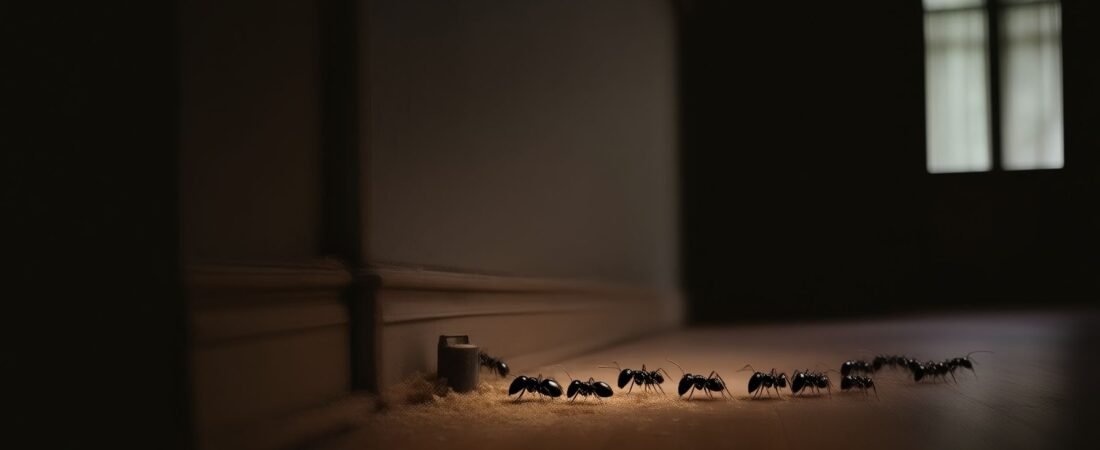
You don’t need to find the nest to get rid of carpenter ants — and that’s actually the part most pest control advice gets backward. Every blog post, every forum thread, every exterminator FAQ tells you the same thing: “locate the nest first.” But if you could locate the nest, you wouldn’t be here. The real question is what to do when the ants keep showing up and you have zero idea where they’re living.
Here’s what those articles don’t tell you: carpenter ants are slow-moving through a home’s structure, and they leave a foraging trail every single time they move between the nest and their food source. That trail is your actual weapon — not the nest location. With the right bait strategy and a few targeted treatments, you can collapse a carpenter ant colony without ever tearing into a wall or hiring someone with an endoscope camera.
Why Carpenter Ants Are Hard to Find Even When You’re Looking
Carpenter ants don’t nest the same way most people picture. A colony doesn’t pick one spot, move in, and stay put. Mature colonies — which can contain anywhere from 3,000 to 10,000 workers — often maintain multiple satellite nests spread across different parts of a structure. The main colony might be 40 feet away in a dead tree in your yard, and what you’re seeing inside your house is just a satellite nest using your wall void as an outpost.
This is the detail that changes everything. You could drill into every soft spot in your wall and still miss the primary nest entirely because it isn’t in your house at all. Carpenter ants forage up to 300 feet from the main colony, which means the ants crossing your kitchen counter at midnight may have walked through your foundation, up through a pipe sleeve, and across 50 feet of subfloor to get there. Knowing that changes how you approach treatment.
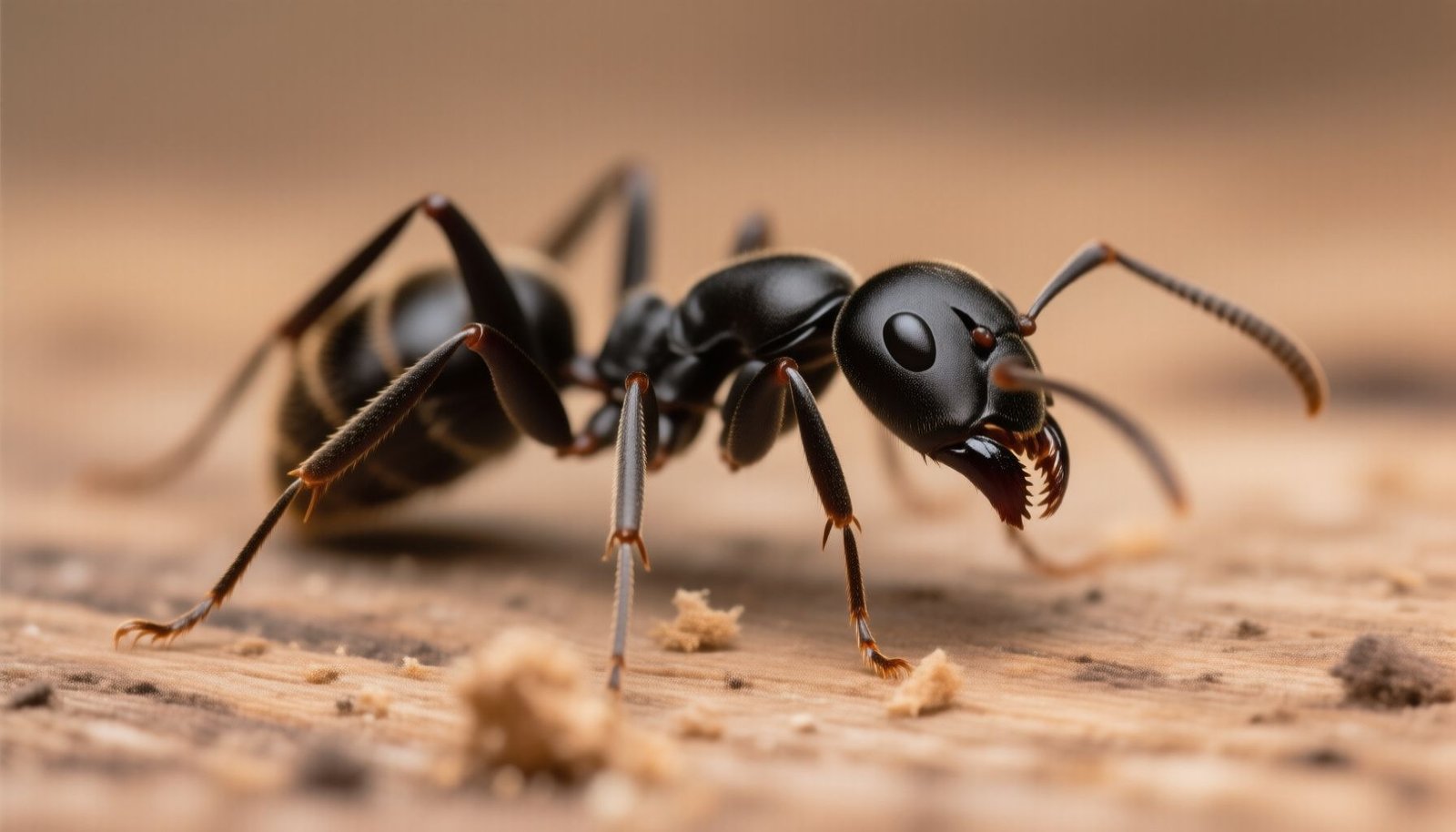
This close-up shows a carpenter ant foraging trail along a wood beam — the kind of activity that tells you exactly where to place bait even when the nest itself remains hidden behind walls or outside the structure entirely.
How to Use Their Foraging Behavior Against Them (Without the Nest)
Picture this: it’s 11pm, you flip on the basement light, and you watch a single large black ant disappear under the utility sink. That ant didn’t wander in randomly. It’s following a pheromone trail laid down by scouts — the same trail it’s been using every night, probably for weeks. That trail is more useful to you than any nest location, because it tells you exactly where to intercept the colony’s food chain.
Slow-acting bait is the mechanism that makes nest-free treatment work. When a forager picks up bait and carries it back, it doesn’t just feed itself — it feeds larvae, workers, and ideally the queen. Carpenter ants are omnivores, so they alternate between protein-based food and sugar-based food depending on the colony’s needs. This is why using only one type of bait often fails. You need to put out both a protein bait (like a gel formulation with abamectin) and a sweet bait simultaneously, because you can’t always predict what the colony is actively craving at any given point in their cycle.
Pro-Tip: Check the bait every 24-48 hours for the first week. If one type is being ignored and the other is being aggressively consumed, pull the ignored bait and double down on what they’re eating. Forcing them to accept bait they don’t want right now is a waste of time — and it trains them to avoid that spot.
What Products Actually Work When You Can’t Treat the Source
Not every product that kills ants on contact is useful here. Repellent sprays — including many common pyrethrin-based products — will scatter foragers, break up the trail, and push the colony deeper into the structure. You’ll see fewer ants for a few days and think you’ve won. Then they reroute and come back through a different gap two weeks later. Repellents are the wrong tool when you can’t find the nest.
What you want instead are non-repellent insecticides — products the ants can’t detect and will walk through without changing direction. Fipronil and imidacloprid are the two most commonly available active ingredients that work this way. A non-repellent spray or dust applied to entry points, along baseboards, and around plumbing penetrations creates an invisible transfer zone. Ants pick up the active ingredient on their bodies, carry it back, and spread it through grooming behavior to nest-mates they’ll never physically contact with your spray bottle. This “transfer effect” is how you reach a nest you can’t see.
| Product Type | Active Ingredient | Best Use Case | Nest-Reach Potential |
|---|---|---|---|
| Slow-acting gel bait (protein) | Abamectin | Along foraging trails, inside wall gaps | High — carried directly to colony |
| Sweet liquid bait | Borax / boric acid | Near food sources, counters, sinks | High — trophallaxis transfer |
| Non-repellent spray | Fipronil or Imidacloprid | Entry points, perimeter, pipe sleeves | Medium — transfer via grooming |
| Insecticidal dust | Diatomaceous earth or deltamethrin | Wall voids, electrical conduit, attic | Low-Medium — contact kill only |
How to Treat the Likely Entry Points Systematically
Treating without the nest location requires a different mental model. Instead of trying to eliminate the colony in one shot, you’re setting up a gauntlet — a series of treatment zones that the ants have to pass through every time they forage, accumulating lethal or sub-lethal doses over days or weeks. Done right, this approach can collapse a colony within 4-6 weeks without ever knowing where they live.
Here’s a systematic way to set it up — work through these in order, because each layer reinforces the next:
- Map the trails first. Spend two evenings (carpenter ants are most active at night) watching where ants enter and exit. Note every gap, crack, and plumbing penetration they use. You’re not trying to plug these yet — you’re building your treatment map.
- Apply non-repellent spray to all identified entry points. Use a product with fipronil or imidacloprid and treat every gap the ants are using. Let it dry completely before moving on — at least 30-60 minutes.
- Place dual bait stations along active trails. Set both a protein bait and a sweet bait within 2-3 inches of the trail but off the main walking path. Ants won’t detour far, so placement precision matters.
- Dust accessible void spaces. Any wall void you can access via an electrical outlet or pipe gap — use a hand duster to puff insecticidal dust (delta dust works well) into the cavity. A thin coating inside the void is enough; heavy application actually repels them.
- Create an exterior perimeter barrier. Apply a non-repellent liquid treatment around the foundation, paying particular attention to where wood contacts soil, utility penetrations, and any wood mulch within 12 inches of the house. This cuts off the main highway between an outdoor parent colony and your interior satellite nest.
- Monitor and adjust weekly. Carpenter ant colonies don’t collapse overnight. Check bait consumption, reapply the exterior spray after rain, and look for frass (the sawdust-like ejected wood material) to see if nest activity is shifting location within the structure.
If you’re seeing ants trailing along your baseboards in addition to the larger carpenter ants, treat them as separate problems — small trailing ants are almost certainly a different species and will need different bait formulations to address effectively.
How to Know if You’re Actually Making Progress (Or Just Moving the Problem)
One of the most disorienting things about treating carpenter ants without finding the nest is that success doesn’t always look like success at first. In weeks one and two, you may actually see more ants — not fewer. That’s not necessarily a bad sign. When a colony’s foraging efficiency gets disrupted by treatment, they often send out additional scouts to find new food sources, which temporarily increases the number of workers you see in the open.
The real indicators that treatment is working are more subtle:
- Bait consumption slows noticeably after 10-14 days — fewer workers means less food being retrieved
- You stop finding frass (the coarse, sawdust-and-insect-fragment material carpenter ants push out of galleries) in places where you were finding it before
- Night-time sightings drop to zero for several consecutive days — not just occasional nights
- You stop hearing the faint crackling or rustling sound inside walls that active galleries sometimes produce (this is easier to detect on quiet nights with your ear to the wall near the suspected area)
- If you had winged reproductives (swarmers) appearing inside the home earlier in the season, they stop appearing entirely — swarmers only emerge from established colonies, and a failing colony stops producing them
It’s worth noting that results genuinely vary by situation. A satellite nest in a wall void of a heated home with soft, moisture-damaged wood is faster to treat than a sprawling outdoor colony with multiple satellite nests distributed across a large structure. Climate matters too — in warmer regions, colonies stay active year-round, which actually makes bait more effective since workers are always foraging. In northern climates, treating in late spring through early summer, when colonies are most actively expanding, gives you the best window for bait uptake.
“The biggest mistake I see homeowners make is reaching for a contact spray the moment they see a carpenter ant. They kill the forager, break the trail, and feel like they did something — but the colony is completely unaffected. Non-repellent baiting takes patience, but it’s the only approach that reliably reaches the reproductive core of the colony without knowing exactly where that core is located.”
Dr. Marcus Hale, Board-Certified Entomologist and Urban Pest Management Specialist, University Extension Program
When the Problem Keeps Coming Back Despite Treatment
Recurring carpenter ant activity after a full treatment cycle — meaning you did the bait, the non-repellent spray, the perimeter, and waited six or more weeks — usually points to one of two things. Either there’s a moisture problem in the structure that’s actively drawing the colony in, or the primary outdoor colony is large enough and close enough to keep re-establishing satellite nests faster than you can collapse them.
Carpenter ants don’t choose wood randomly. They need wood that’s already softened by moisture — they excavate galleries in it, but they don’t eat it the way termites do. If you have a chronic leak around a window frame, a section of subfloor that stays damp, or wood-to-soil contact anywhere around your foundation, that’s a structural condition the ants will exploit repeatedly regardless of how often you treat. Fixing the moisture issue isn’t just a long-term maintenance recommendation — it’s pest control. Dry wood is physically harder for them to excavate and far less attractive as a nesting site. If you’re unsure whether you’re dealing with ants or something else, it’s worth ruling out termites — termite swarmers indoors can look surprisingly similar to winged carpenter ants, and the treatment approach is completely different.
If structural moisture isn’t the issue and the colony just keeps regenerating, the parent nest is almost certainly outdoors in a stump, a dead tree section, or a piece of firewood stored against the house. Carpenter ant colonies can contain a queen that lives 10-25 years and produces thousands of workers annually — an established outdoor parent colony isn’t going to burn out on its own. At that point, treating the perimeter aggressively and locating that outdoor source becomes genuinely worth the effort, even if it means walking your property at dusk with a flashlight looking for high-traffic ant activity in mulch or near deadwood.
The counterintuitive reality about carpenter ants — one most treatment guides gloss over — is that the ants you see inside your home are almost never the problem. They’re the symptom. The problem is the structural or environmental condition that made your home attractive in the first place. Fix that condition, and your treatment results last. Ignore it, and you’ll be back to setting bait every season indefinitely.
Frequently Asked Questions
can you get rid of carpenter ants without finding the nest?
Yes, you can control carpenter ants without ever locating the nest by using bait stations and residual sprays along their foraging trails. Slow-acting baits like boric acid or fipronil-based gels work best because the workers carry the poison back to the colony before dying. It takes longer than direct nest treatment — usually 2 to 4 weeks — but it’s effective when done consistently.
what kills carpenter ants instantly without a nest?
Direct-contact sprays containing pyrethrin or deltamethrin will kill carpenter ants on the spot, but they won’t eliminate the colony. For faster colony kill without finding the nest, use a bait with a slow-acting active ingredient like boric acid at 1% concentration — anything stronger kills workers too fast before they reach the queen. Combine contact spray for immediate control with bait for long-term elimination.
how long does carpenter ant bait take to work?
Most carpenter ant baits take between 2 and 6 weeks to fully knock down a colony, depending on how large it is and how well workers are picking up the bait. You should see a noticeable drop in ant activity within 10 to 14 days if the bait is placed correctly along active foraging trails. Don’t spray insecticide near the bait stations — it repels ants and stops them from taking it back to the nest.
where do you put carpenter ant bait if you can’t find the nest?
Place bait stations along baseboards, window sills, door frames, and any area where you’ve spotted carpenter ant trails or frass — the sawdust-like debris they leave behind. Focus on spots near moisture sources like under sinks, around water heaters, and along exterior walls, since carpenter ants prefer damp wood. Check and refresh bait every 3 to 5 days until activity drops off completely.
does diatomaceous earth work on carpenter ants without knowing where the nest is?
Diatomaceous earth works as a barrier and contact killer, but it’s slower and less reliable than chemical baits for carpenter ant control when you don’t know where the nest is. Apply food-grade DE in a thin layer along trails, entry points, and wall voids where ants are active. It’s best used as a supplemental treatment alongside bait rather than a standalone fix, especially for large or well-established colonies.
Disclaimer: This article is for informational purposes only and isn’t a substitute for professional pest control advice. Always read and follow the product label instructions exactly — label directions are legally binding and vary by brand and active ingredient. Keep all pesticides, baits and traps away from children and pets, ventilate treated areas as directed, and consider calling a licensed pest control professional if an infestation is large, recurring, or involves a structural pest like termites or carpenter ants.