

Seeing winged insects pouring out of your walls or windowsills is alarming — but here’s the thing most people get completely wrong: killing the swarmers you can see is almost completely pointless. Termite alates (the winged reproductives you’re watching right now) are not the ones eating your house. They never were. They’re scouts leaving an already-established colony, and vacuuming them up while ignoring what sent them does nothing to protect your home’s structure. The swarm is a symptom, not the problem itself.
Why Are Termite Swarmers Appearing Inside Your Home Right Now?
Swarmers don’t choose to emerge indoors by accident. A termite colony typically needs to reach a population of at least 60,000 to 100,000 workers before it produces reproductives — and that process takes anywhere from 3 to 5 years of undetected feeding activity inside your structure. So when you’re watching dozens of winged termites crawl toward your window on a warm spring afternoon, you’re looking at the end of a very long, very quiet story that started years ago inside your walls, subfloor, or framing.
Swarmers emerge in response to two triggers: warmth and light. They’re strongly attracted to sunlight, which is exactly why you’ll find them piling up on windowsills or near sliding glass doors — they’re trying to escape outside to mate and start new colonies. An indoor swarm almost always means the source colony is somewhere inside or directly underneath the building, not approaching from outside. That distinction matters enormously for how you treat the problem.
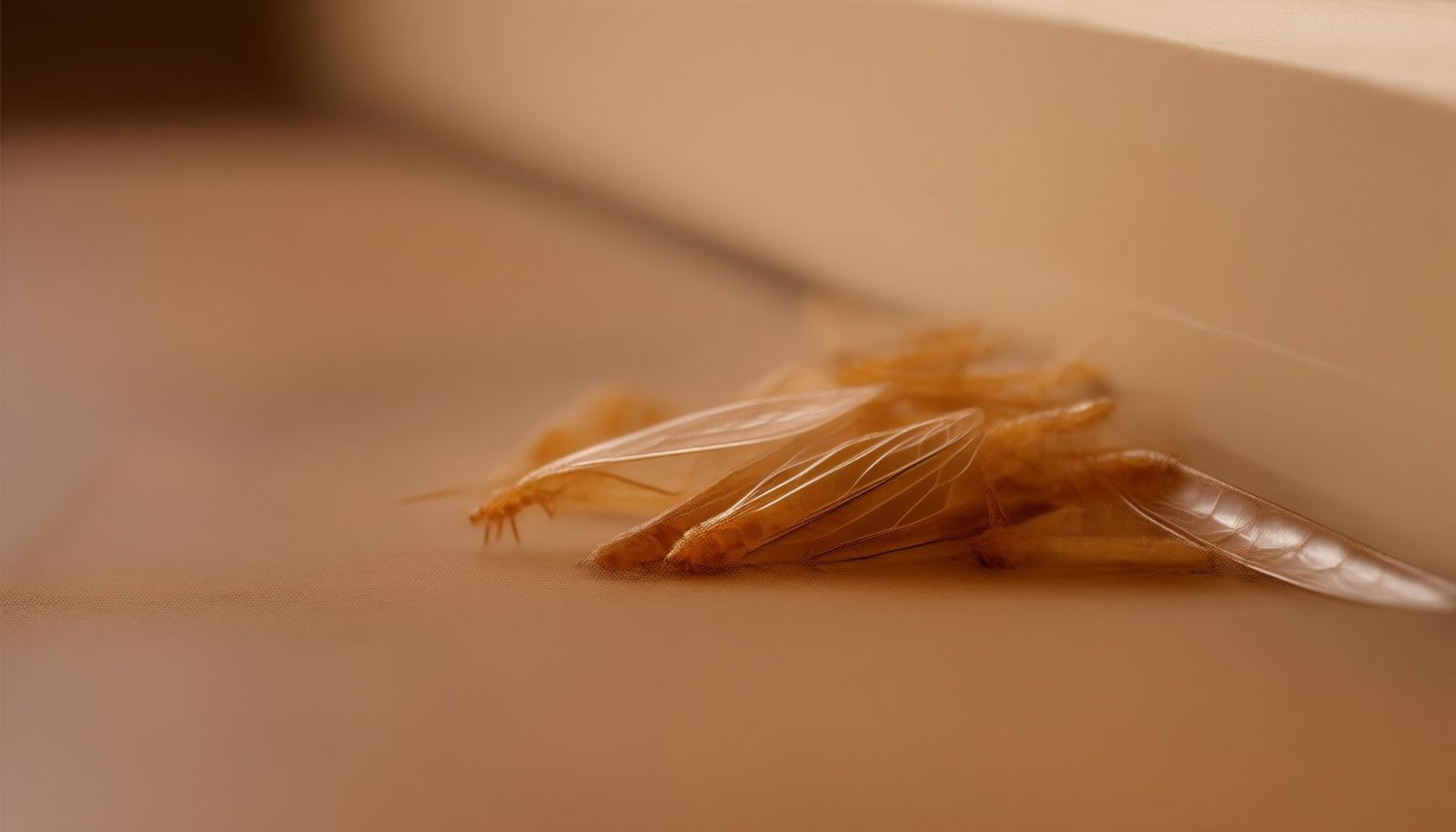
This close-up shows the distinctive double set of equal-length wings that identify termite alates — unlike flying ants, whose wings are unequal in size — and spotting this difference correctly is what determines whether you call a termite specialist or deal with a much simpler problem.
How Do You Tell Termite Swarmers Apart From Flying Ants Indoors?
This is where homeowners lose the most time. Flying ants swarm seasonally too, and a panicked Google search at 7pm on a Tuesday isn’t always the most reliable diagnostic tool. Getting the ID wrong means either ignoring a real termite infestation or throwing money at a problem that doesn’t exist. Take 60 seconds and look carefully at what you’ve caught.
| Feature | Termite Swarmer | Flying Ant |
|---|---|---|
| Wings | Two equal pairs, same length | Front wings longer than rear wings |
| Waist | Thick, no pinch between thorax and abdomen | Narrow, pinched waist |
| Antennae | Straight, beaded | Elbowed (bent at a sharp angle) |
| Wings after landing | Shed quickly — you’ll find piles of loose wings | Wings stay attached to the body |
The shed wings are your single most reliable clue. Termite swarmers drop their wings almost immediately after landing — it’s a biological reflex, not something they do gradually. Finding a windowsill covered in small, translucent wings with no dead insects nearby is essentially a confirmed termite swarming event, even if you never saw the actual swarm. Ant wings don’t detach on their own like this.
What Should You Actually Do in the First 24 Hours?
Here’s the counterintuitive advice that almost nobody gives you: don’t spray the swarmers with insecticide. It feels satisfying, but it contaminates the area and can make it harder for a pest control professional to accurately assess the source colony afterward. The swarmers themselves will die within 24 to 48 hours on their own — they can’t survive indoors without soil contact, and the ones that don’t escape outside quickly dehydrate and die. Your job in the first 24 hours is documentation and containment, not extermination.
Do these things in order, and don’t skip the documentation step — it directly affects how a termite professional assesses your situation and what treatment they recommend.
- Photograph everything immediately. Get shots of the insects themselves (alive if possible), the pile of shed wings, the exact location in the room, and any nearby wood surfaces. Date-stamp the photos if your phone allows it.
- Collect a specimen in a zip-lock bag. A pest control inspector or university extension office can confirm species from a single intact insect. A dead one works fine — just don’t crush it.
- Mark the emergence point on the wall or floor. Use a sticky note or painter’s tape. Swarmers exit through tiny cracks, and within an hour you may not be able to find the exact spot again.
- Vacuum up dead swarmers and shed wings. Use a vacuum with a bag or HEPA filter, then dispose of the bag outside immediately. This isn’t treatment — it’s cleanup.
- Turn off interior lights and open exterior doors. Living swarmers are drawn toward the brightest light source. Redirecting them outside reduces the mess and gives you a cleaner environment to inspect.
- Call a licensed termite inspector within 24 hours. Not a general pest control company — specifically someone who does termite work. Many offer free inspections, and the emergence point you’ve marked is exactly what they need to locate the colony.
Where Is the Colony Actually Located, and Can You Find It Yourself?
Picture this: a homeowner spends a weekend sealing every visible crack around their windows after a swarming event, feeling good about the fix. Three months later, swarmers appear again from a different spot in the same room. The colony was in the subfloor directly below, and sealing surface cracks did nothing except delay the obvious. Finding the colony — not the emergence point — is the whole game here.
You can do a reasonable preliminary search yourself before the inspector arrives. Subterranean termites (the most common species that swarms indoors in the US) leave specific signs beyond the swarmers themselves. Tap along baseboards, door frames, and windowsills with a screwdriver handle — hollow-sounding wood is a red flag. Look for mud tubes running up foundation walls, inside crawl spaces, or along floor joists in the basement. Check where wood meets concrete: expansion joints, porch supports, and garage door frames are favorite entry points. Drywood termites are a different situation — they nest inside the wood itself with no soil connection, and their frass (tiny, pellet-shaped droppings) often appears near the emergence site.
Pro-Tip: If you find mud tubes on a foundation wall, don’t break them open right away. An intact mud tube tells an inspector a lot about the colony’s travel patterns. Photograph them first, then gently probe one section with a screwdriver to check for live termites inside — active mud tubes will have workers inside, older abandoned ones will be dry and empty.
Which Treatments Actually Work Against Indoor Termite Swarmers — and Which Don’t?
This is where honest nuance matters: the right treatment depends heavily on the species, the location of the colony, and how long the infestation has been active. There is no single answer that applies to every situation, and any article that tells you otherwise is oversimplifying. A drywood termite colony localized to one piece of framing can sometimes be treated with targeted foam or heat. A subterranean colony that has spread under a concrete slab is a completely different situation requiring either liquid soil treatment or a bait station system — and sometimes both.
Here’s what the evidence actually supports for indoor swarmer situations specifically:
- Liquid termiticide barrier (e.g., Termidor SC with fipronil): Applied to soil around the foundation, this creates a treated zone subterranean termites must pass through. Termites carry the active ingredient back to the colony via contact transfer, affecting workers they never directly touched — colony mortality typically occurs within 90 days.
- Termite bait stations: Installed in the ground around the perimeter, these use slow-acting insect growth regulators that foraging workers carry back to the colony. Slower than liquid treatment (several months), but useful when soil treatment isn’t possible near wells or water features.
- Targeted foam injection (drywood termites only): Products containing spinosad or pyrethrin foam can be injected directly into galleries through small drill holes. Only effective if the colony is localized — not appropriate for widespread infestations.
- Orange oil / botanical treatments: Marketed aggressively, especially in California, but evidence for colony elimination is weak. These may kill termites on direct contact in accessible galleries but don’t reach the deeper colony.
- What doesn’t work: Surface sprays on swarmers, fogger “bug bombs,” essential oil diffusers, and ultrasonic devices have zero effect on an established termite colony. They address the swarmers, not the source.
“Homeowners focus entirely on the swarm event itself, which is understandable — it’s dramatic and visible. But the swarm is the colony’s way of expanding, not its way of feeding. By the time a colony is large enough to produce swarmers, it has typically been causing structural damage for three to five years. The swarm is actually the first real visible warning sign most homeowners ever get, and they shouldn’t waste it by just vacuuming up the insects and moving on.”
Dr. Raymond Kolbe, Board-Certified Entomologist and Urban Pest Management Specialist, former consultant to the National Pest Management Association
One fact that genuinely surprises most people: a termite colony can contain over 1 million individual insects, but the swarmers you see inside your home may number only in the dozens to hundreds. That tiny visible fraction is the only part of the colony you’ll ever see with the naked eye under normal circumstances — the rest are sealed inside wood or soil. That invisibility is precisely why termites cause an estimated $6.8 billion in property damage annually in the United States, most of it not covered by standard homeowner’s insurance policies.
It’s worth noting that just because swarmers appeared indoors doesn’t automatically mean the infestation is catastrophic. A young colony that swarmed early, or one confined to a non-structural area like a window frame or baseboard, may have caused limited damage. A professional inspection with moisture meters and acoustic detection tools will tell you the real scope. The situation is completely different if swarmers are emerging from a load-bearing wall, a floor joist, or a structural beam — that needs professional assessment fast, not in a few weeks.
Just as you’d take a methodical approach to a problem like roaches coming from a neighbor’s unit — where the visible problem isn’t the actual source — the same logic applies here: chasing the symptom wastes time and money. The visible swarmers are a distraction from the colony that produced them.
One more thing worth saying plainly: don’t let a swarming event panic you into signing a rushed treatment contract the same day. Some pest control companies will respond to an emergency call with a same-day hard sell on fumigation — the most expensive option — before you’ve had a full inspection or gotten a second opinion. Get the inspection, get a written assessment of the species and infestation extent, and compare at least two treatment proposals before committing. The colony has been there for years already; waiting 48 hours to make a good decision won’t change the structural outcome, but a bad treatment choice might mean you pay twice.
Dealing with a pest problem that seems to be coming from somewhere you can’t see or access is a familiar frustration — similar to tracking spiders hiding behind furniture and in corners where the real harborage is out of reach. The principle is the same: address where the pest lives, not just where it shows up.
If the inspection confirms an active colony, ask your pest control professional specifically about a monitoring and bait system even after liquid treatment is complete. Termite pressure doesn’t necessarily end with one treatment — particularly in the southeastern US, coastal California, Hawaii, and other high-risk regions where multiple colonies can be active on a single property simultaneously. Setting up ongoing monitoring is the difference between solving the problem once and actually staying ahead of it.
Frequently Asked Questions
how do I get rid of termite swarmers indoors fast?
Vacuum them up immediately — a standard vacuum cleaner kills them on contact and removes them fast. Then seal any cracks around windows, doors, and baseboards where they’re getting in. This won’t solve the underlying colony problem, so you’ll want to call a licensed pest control company within 24 to 48 hours to inspect for an active infestation.
does seeing termite swarmers indoors mean I have an infestation?
Yes, it’s a strong sign — swarmers don’t appear indoors by accident. They emerge from an established colony that’s typically been growing for 3 to 5 years before it produces swarmers. Finding them inside, especially near windowsills or light sources, means there’s almost certainly an active colony somewhere in or very close to your home’s structure.
what attracts termite swarmers inside the house?
Light is the biggest draw — swarmers are naturally attracted to windows, lamps, and light fixtures. They also move toward warmth and moisture, so leaky pipes, humid crawl spaces, and damp wood near your foundation can pull them in. Reducing indoor humidity and fixing moisture problems can help, but it won’t eliminate swarmers if a colony is already established nearby.
how long do termite swarmers live indoors?
Termite swarmers typically die within 24 to 48 hours if they can’t find soil to start a new colony. Without moisture and a mate, they dry out and die quickly, so you’ll often find dead wings on windowsills even if you never saw the swarmers themselves. Don’t let the short lifespan fool you into thinking the problem is gone — the source colony is still very much alive.
are termite swarmers dangerous to humans or pets?
Termite swarmers don’t bite, sting, or carry disease, so they’re not a direct threat to people or pets. The real danger is what they signal — a mature termite colony can cause thousands of dollars in structural damage if it’s left untreated. Treat a swarm indoors as a serious warning sign, not just a nuisance.
Disclaimer: This article is for informational purposes only and isn’t a substitute for professional pest control advice. Always read and follow the product label instructions exactly — label directions are legally binding and vary by brand and active ingredient. Keep all pesticides, baits and traps away from children and pets, ventilate treated areas as directed, and consider calling a licensed pest control professional if an infestation is large, recurring, or involves a structural pest like termites or carpenter ants.