
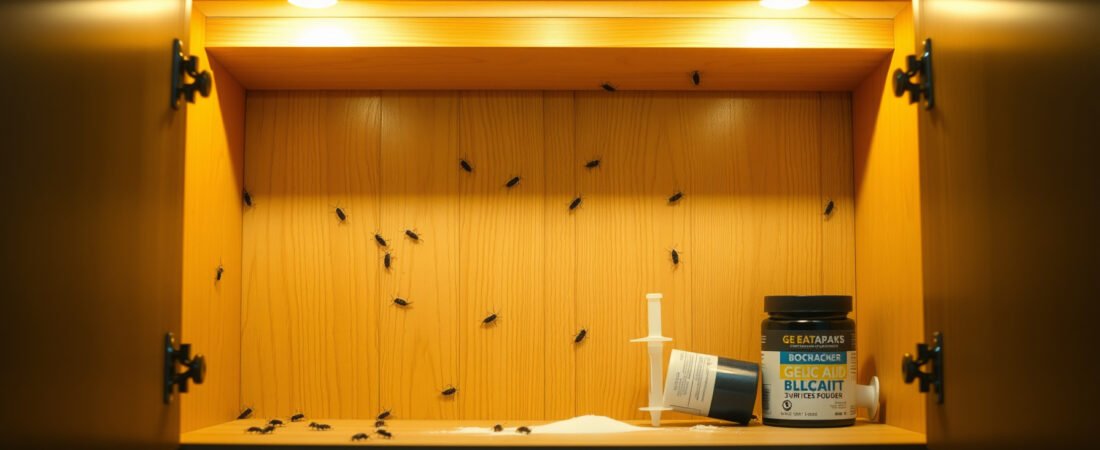
You flip on the kitchen light at 2am and three roaches scatter under the stove — but the real problem isn’t under the stove. It’s inside your cabinets, and it’s been there longer than you think. Here’s what most people get completely wrong: spraying the roaches you can see does almost nothing. Roaches live in tight, dark voids inside cabinet walls, behind drawer slides, and underneath shelf liners, and they only come out when the colony is so large it can’t stay hidden anymore. By that point, a single female German cockroach has already produced multiple egg capsules, each carrying 30–40 eggs. You’re not dealing with a few stragglers — you’re dealing with a population that’s been compounding for weeks.
Why Roaches Colonize Kitchen Cabinets Specifically (Not Just Your Kitchen)
Cabinet interiors are a near-perfect roach habitat, and it has nothing to do with how clean your kitchen is. The hinges, mounting screws, and hollow-core particleboard panels create dozens of micro-voids that stay warm, humid, and dark around the clock. Roaches are thigmotactic — they instinctively press their bodies against tight surfaces on multiple sides — and the narrow gap between a cabinet back panel and the wall is basically a five-star hotel for them. A pipe chase running behind your sink cabinet makes it even better, because it connects that warm void to a permanent moisture source.
The food doesn’t even have to be obvious. Roaches will feed on the grease film on the inside of a cabinet door, adhesive from shelf liner, or the glue binding a cardboard cereal box sitting in the back corner. Picture this: a homeowner scrubs their kitchen top to bottom every week, sees a roach near the spice cabinet, and assumes they must have missed something. They haven’t. The cabinet itself — the structure, not the contents — is what’s attracting the colony. That distinction matters enormously for how you treat it.
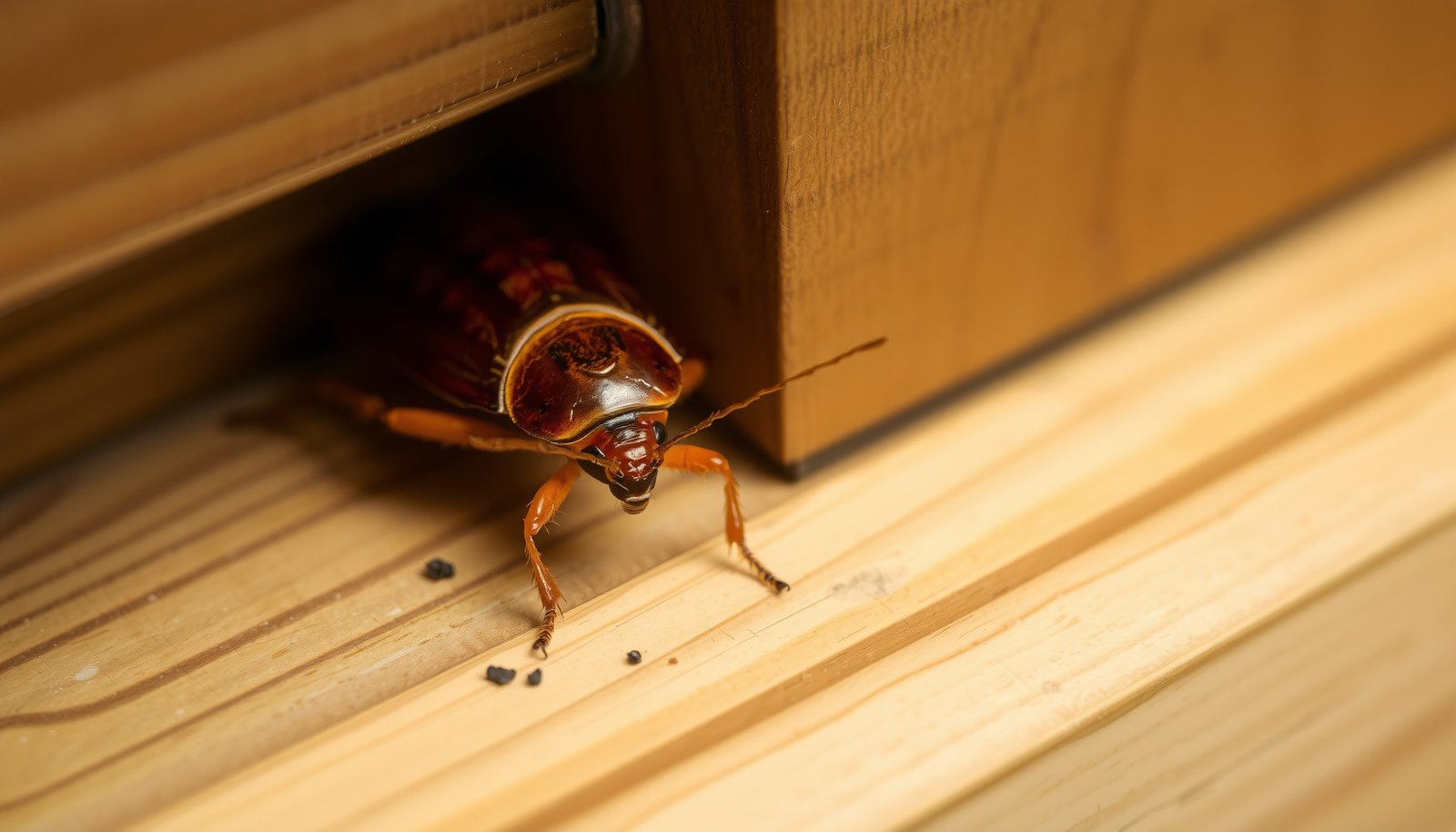
This close-up view shows roaches clustered in the corner joint of a cabinet — exactly where wall panels meet shelf brackets — which illustrates why surface sprays miss the colony entirely and targeted gel bait placement is the only method that reaches them.
What Actually Kills Roaches in Cabinets vs. What Just Moves Them Around
Aerosol sprays feel satisfying, but they’re arguably the worst thing you can do inside a cabinet. Spraying a repellent insecticide in one section of a cabinet doesn’t kill the colony — it scatters it. Roaches flee the treated area and relocate deeper into the wall void or into adjacent cabinets, which spreads the infestation rather than collapsing it. Professional pest control operators call this “flushing,” and it can turn a localized problem in one cabinet bank into a whole-kitchen situation in 48–72 hours.
The products that genuinely collapse a roach population in cabinets work through two mechanisms: ingestion and secondary kill. Gel baits like those containing indoxacarb or fipronil are carried back to the harborage and eaten by roaches that never left the void. Insect Growth Regulators (IGRs) like hydroprene don’t kill adults directly — they prevent nymphs from reaching reproductive maturity, which breaks the breeding cycle over 60–90 days. Used together, gel bait handles the active population and the IGR ensures the next generation never takes over. That’s a complete treatment strategy, not just a reaction.
“The single biggest mistake homeowners make is reaching for a spray can first. Repellent sprays create a chemical barrier that drives cockroaches into untreated voids — you end up with a larger, more distributed infestation that’s harder to treat than the one you started with. Gel bait placed precisely at harborage sites, combined with an IGR, is what the science consistently supports for German cockroach control in enclosed spaces.”
Dr. Michael Bentley, Entomologist and Director of Training and Education, National Pest Management Association (NPMA)
How to Apply Gel Bait in Kitchen Cabinets the Right Way
Placement is everything with gel bait, and most people use it wrong. They apply too much in too few spots, usually in the middle of a shelf where roaches don’t actually travel. Roaches run along edges — the junction where the shelf meets the cabinet wall, the back corners, the underside of shelves near hinges. Small bait placements of roughly pea-sized dots every 6 inches along these pathways are far more effective than a few large globs in the open.
Here’s the step-by-step process that actually works:
- Empty the cabinet completely — remove all food, shelf liner, and loose items so you can see and access the corner joints, back panel edges, and hinge areas.
- Vacuum first, don’t wipe — use a crevice attachment to pull out droppings, egg cases, and debris from corners. Wiping spreads roach feces, which contains aggregation pheromones that attract more roaches to the area.
- Apply gel bait in pea-sized dots — target the back two corners of each shelf, the underside of each shelf near the rear wall, and directly on or around any visible drill holes or gaps where pipes enter the cabinet.
- Apply an IGR spray lightly to the cabinet interior — a light mist (not a saturating spray) of an IGR like hydroprene to the cabinet walls and underside of shelves will disrupt nymph development over the following weeks. Let it dry completely before replacing items.
- Place a sticky monitoring trap inside each affected cabinet — this tells you within 48–72 hours whether the bait is being taken and confirms your harborage locations are correct.
- Refresh gel bait every 2–3 weeks until monitoring traps show zero activity — dried or contaminated bait is ignored by roaches, so fresh placements matter.
Pro-Tip: Don’t place gel bait within 12 inches of any surface you’ve treated with an IGR spray or any other insecticide. Chemical contamination from sprays repels roaches from the bait and renders the entire treatment ineffective. Keep bait and spray products physically separated inside the cabinet.
Which Products Work Best — and the Ones Worth Skipping
Not all roach products are equal for a cabinet-specific infestation. The table below breaks down the main treatment types by how they work, where they’re effective, and what to realistically expect from each one.
| Treatment Type | Best Use in Cabinets | Expected Timeline | Skip If… |
|---|---|---|---|
| Gel Bait (indoxacarb/fipronil) | Corner joints, shelf undersides, pipe entry points | Noticeable reduction in 7–14 days | You’ve recently sprayed repellent inside the cabinet |
| Insect Growth Regulator (IGR) | Light mist on cabinet walls and undersides | Breeding disruption over 60–90 days | You want immediate knockdown — IGRs don’t kill adults |
| Boric Acid Dust | Behind cabinet backing, wall voids via drill holes | Slow kill over 1–3 weeks via grooming | Humid environments — moisture clumps dust and makes it ineffective |
| Aerosol Spray (repellent) | Not recommended inside cabinets | Flushes and scatters infestation | Always — for enclosed cabinet voids, this makes things worse |
Boric acid dust applied behind the cabinet back panel — either through existing gaps or a small drill hole — is a genuinely underused tactic for severe infestations. Roaches walking through a thin layer of boric acid pick it up on their legs and antennae, then ingest it during grooming. The key is applying it lightly: a barely-visible film is more effective than a thick layer, because roaches avoid walking through heavy dust accumulations. This works especially well in the void between the cabinet back and the wall, an area gel bait can’t reach directly.
What to Fix Structurally So Roaches Don’t Come Back
Killing the current population without addressing why they got in is how people end up retreating the same cabinets three months later. Cabinet-area roaches almost always enter through two routes: the gap where drain or supply lines pass through the cabinet floor or back wall, and the spaces behind drawer boxes where cabinets are mounted directly against an exterior or shared wall. Both of these connect to wall voids that can extend through an entire floor of a building — and in apartments especially, a neighbor’s infestation can keep reseeding yours indefinitely regardless of how well you treat.
Here’s what to seal or fix after your treatment phase is complete:
- Pipe penetrations in cabinet floor and back wall — fill gaps around supply and drain lines with fire-rated silicone caulk or steel wool packed tightly before caulking. Expanding foam alone is chewable and not a reliable barrier.
- Gaps between cabinet units and the wall — run a bead of paintable silicone caulk along the back edge where each cabinet contacts the wall, especially at the toe kick and top rail.
- Open screw holes and fastener points — roaches use mounting screw holes as entry and exit points between cabinet interiors and wall voids. Dab a small amount of caulk over unused holes.
- Cabinet door seals — if cabinet doors have a visible gap at the bottom when closed, roaches can enter freely from the kitchen floor. Self-adhesive foam weatherstripping along the interior of the door frame closes this off.
- Under-sink drain collar — the escutcheon plate around sink drain pipes is often loose or missing in older kitchens. A tight-fitting plate with caulk behind it eliminates one of the most common roach entry highways in any kitchen.
If you’re in a rental unit and the infestation is coming through structural gaps your landlord controls, sealing these yourself may help temporarily but it won’t solve a building-wide problem. For apartment situations where the infestation keeps returning despite proper treatment, you may have legal options — a case involving property conditions severe enough to constitute a habitability violation could qualify for small claims court for pest infestations, which is worth understanding before you keep paying for treatments on a problem your landlord should be addressing.
One honest caveat here: exclusion alone won’t eliminate a roach colony that’s already established inside your cabinet walls. You have to treat the existing population first, then seal. Sealing before treatment can trap roaches inside the void where they continue to breed, and it can also block the pathways they’d use to find and consume bait. The order of operations matters — treat, monitor, confirm activity has dropped, then seal.
For homeowners dealing with cabinets on an exterior wall or near a garage entry, it’s also worth considering whether you have an exterior pressure point feeding the interior. German cockroaches are almost exclusively indoor pests and rarely come from outside, but American cockroaches and smoky brown roaches absolutely can migrate in from the exterior through foundation gaps and door sweeps. If your monitoring traps are catching large roaches (over an inch) rather than small German cockroach nymphs, your perimeter is the issue — and a well-chosen perimeter spray applied around the foundation entry points is part of the solution. The best pest control sprays for perimeter defense can create a chemical barrier that stops exterior roach species before they reach your cabinets.
The counterintuitive reality of roaches in kitchen cabinets is that speed comes from precision, not aggression. A targeted gel bait program started today will produce visible results faster than any spray-everything approach — because it works with roach behavior instead of against it. Get the bait into the right spots, add an IGR to shut down reproduction, seal the entry points once activity drops, and you’ll have a clean cabinet in a few weeks instead of a recurring problem that never fully goes away. The roaches that scatter when you turn on the light are just the ones the colony couldn’t hide anymore — fix the conditions inside the cabinet, and the colony has nowhere left to go.
Frequently Asked Questions
What kills roaches in kitchen cabinets fast?
Gel bait like Advion or Combat works fastest — roaches typically die within 24 to 72 hours of eating it. Place small pea-sized dots in the back corners of cabinets, near hinges, and along any cracks or gaps. For a faster knockdown on a heavy infestation, combine gel bait with a boric acid powder applied lightly behind drawers and under cabinet liners.
How do I know if roaches are living in my kitchen cabinets?
The clearest signs are small dark droppings that look like black pepper or coffee grounds, a musty oily smell, and brown egg cases (oothecae) tucked into corners or along shelf edges. You might also spot shed skins or grease smear marks near cabinet hinges and door frames. If you’re seeing even one or two roaches during the day, that usually means the infestation is already sizeable since they’re nocturnal by nature.
Is it safe to use roach spray inside kitchen cabinets where food is stored?
Most aerosol roach sprays aren’t safe to use directly inside food-storage cabinets — the residue can contaminate surfaces and packaging. It’s better to empty the cabinets completely, use gel bait or boric acid instead, and wipe everything down before putting food back. If you do use a spray, choose one labeled safe for indoor kitchen use, let it dry completely for at least 30 minutes, and never spray near food, dishes, or utensils.
Why do I have roaches in my kitchen cabinets even though my house is clean?
Cleanliness helps, but it doesn’t guarantee a roach-free kitchen — they’re drawn to moisture and warmth just as much as food. A leaky pipe under the sink, a dripping faucet, or even condensation behind cabinet walls can attract roaches even in spotless homes. They also hitchhike in through grocery bags, cardboard boxes, and second-hand appliances, so your home doesn’t have to be dirty for an infestation to start.
How long does it take to get rid of roaches in kitchen cabinets?
With consistent treatment, most minor to moderate infestations clear up within 1 to 3 weeks. Gel baits typically start showing results in a few days, but it’s important to reapply every 1 to 2 weeks until you stop seeing activity. Severe infestations or those involving German cockroaches — the most common kitchen cabinet species — can take 4 to 8 weeks and may need a professional exterminator to fully resolve.
Disclaimer: This article is for informational purposes only and isn’t a substitute for professional pest control advice. Always read and follow the product label instructions exactly — label directions are legally binding and vary by brand and active ingredient. Keep all pesticides, baits and traps away from children and pets, ventilate treated areas as directed, and consider calling a licensed pest control professional if an infestation is large, recurring, or involves a structural pest like termites or carpenter ants.