

Cedar blocks don’t kill clothes moths. That’s the real problem with most advice online — it’s built around deterrents and natural remedies that slow moths down at best, while the larvae quietly keep eating through your wool sweaters and cashmere coats. By the time you notice ragged holes in your favorite garments, a clothes moth infestation is usually three to four generations deep. Getting rid of them for real means targeting all three life stages — eggs, larvae, and adults — at the same time, in the right order, or you’ll be right back here in six months.
Why Clothes Moths Are Harder to Kill Than You Think
Here’s what catches most people off guard: adult clothes moths don’t eat fabric at all. It’s the larvae that do every bit of the damage, and they can feed in darkness, inside sealed closets, for weeks before you ever see a single adult flutter past a light fixture. A female clothes moth lays between 40 and 50 eggs over two to three weeks, and those eggs hatch in as little as 4 to 10 days under warm conditions. That reproductive pace means one overlooked cashmere sweater at the back of your closet can seed an infestation that spreads across an entire room.
People tend to confuse clothes moths with pantry moths because both are small and beige-ish, but clothes moths are notably skittish — they avoid light and hide in dark undisturbed corners, which is exactly why they thrive in storage areas, under furniture, and in the folds of rarely worn clothing. They’re not dramatic or obvious the way a cockroach is. They do their damage slowly, silently, and in places you almost never look until it’s too late.
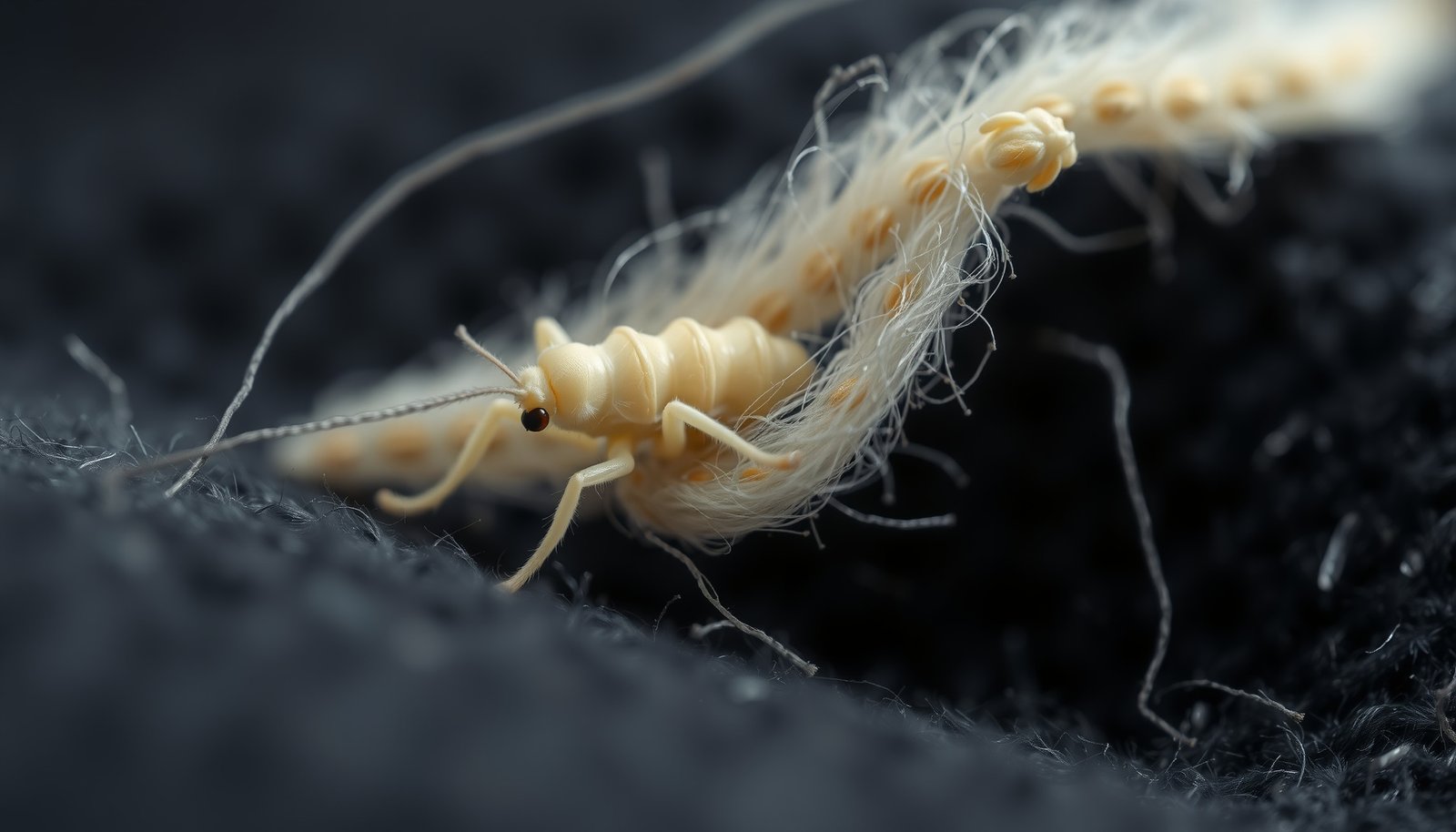
This close-up shows clothes moth larvae on a wool fiber — that creamy, worm-like stage is what you’re actually hunting, because it’s the only one that damages your clothing and the one most treatments miss entirely.
How to Confirm You Actually Have Clothes Moths (Not Carpet Beetles)
Misidentifying the pest is one of the most expensive mistakes you can make, because the treatment for clothes moths and carpet beetles is almost entirely different. Carpet beetles leave irregular, fuzzy-edged damage and tend to eat along seams; clothes moth larvae typically create larger, more uniform holes and often leave behind silky webbing or small tubes made from fibers and their own droppings. If you find tiny cream-colored casings that look like grains of rice stuck to wool, that’s almost certainly a clothes moth cocoon.
To confirm clothes moths specifically, pick up a few pheromone monitoring traps — the ones designed for webbing clothes moths or casemaking clothes moths, the two species most common in US homes. Stick them in your closet, under a bed, or near storage boxes and check them after 48 hours. If you catch adults, you have your answer. These traps also tell you which areas are most actively infested, which saves you from treating the whole house when the problem is concentrated in one room.
“The biggest mistake homeowners make is treating only the visible adults with a spray and calling it done. Adult moths are almost irrelevant to the damage — the larvae can survive deep in textile fibers for months, and eggs are essentially invisible to the naked eye. Without a multi-stage approach that includes heat, cold, or an insect growth regulator targeting larval development, re-infestation within one season is practically guaranteed.”
Dr. Linda Kasowski, Extension Entomologist, University Cooperative Extension Program
How to Kill Clothes Moth Eggs, Larvae, and Adults at Every Stage
You need a different weapon for each life stage, and the order matters. Start with your textiles before you treat the space — because spraying a closet while infested clothing hangs inside is like mopping around a leaking pipe. Pull everything out of closets, drawers, and storage bins. Anything made from wool, silk, cashmere, fur, or feathers needs to be assessed and treated directly before it goes back.
Here’s the sequence that actually works, covering all three life stages in the right order:
- Heat-treat infested items first. Clothes moth eggs and larvae die when exposed to temperatures above 120°F for at least 30 minutes. A home dryer on high heat works well for items that can handle it — run the full cycle, not just a quick tumble. For delicate wool, a sealed black garbage bag left in a hot car on a sunny day can reach the same temperatures.
- Freeze what can’t be heated. Seal items in airtight plastic bags and put them in a freezer set at 0°F or below for a minimum of 72 hours — though 7 days is safer and more reliable for fully killing eggs in thicker textiles. Don’t pull them out immediately; let them return to room temperature inside the sealed bag to avoid moisture condensation damaging the fabric.
- Dry-clean or hand-wash remaining garments. The mechanical action of washing, combined with heat, dislodges and kills larvae. Dry-cleaning solvents kill all life stages. This is non-negotiable for heavily infested items, and for anything you’re not sure about.
- Vacuum the space thoroughly. Use a crevice tool along every baseboard, under drawer runners, in closet corners, and along carpet edges. Clothes moth larvae are often living in carpet fibers or in the dust accumulation under heavy furniture — not just in clothing. Vacuum slowly and deliberately. Empty the vacuum bag or canister outside immediately after.
- Apply an insecticide or insect growth regulator to the space. Once the clothing is out and the space is vacuumed, treat closet walls, baseboards, shelving, and carpet edges with a residual spray containing permethrin or bifenthrin, or an IGR (insect growth regulator) like methoprene. IGRs don’t kill adults but they prevent larvae from maturing into reproductive adults — which is exactly what breaks the cycle. Spray and let dry fully before returning items.
- Set pheromone traps for ongoing monitoring. Replace them every 8 to 12 weeks. A trap that catches no moths over three consecutive cycles is a good sign the infestation has been resolved. Keep trapping — it’s cheap insurance and the only reliable way to detect a re-infestation early.
Pro-Tip: Don’t put treated or heat-killed clothing back into a closet that hasn’t been fully vacuumed and sprayed. Re-contamination from eggs sitting in carpet fibers or along baseboards is one of the most common reasons DIY clothes moth treatments fail after the first round.
What Actually Works vs. What’s Just Marketing
Cedar is the most oversold clothes moth product in existence. Cedar wood and cedar oil do repel adult moths weakly when the scent is fresh and concentrated — but that effect fades within weeks as the oils evaporate, and cedar does essentially nothing against larvae already present in fabric. A cedar block sitting in a closet where larvae are actively feeding is not doing anything useful. That’s not a knock on cedar as a supplement to real treatment, but if you’re relying on it as your primary defense, you’re going to keep finding holes.
Here’s a quick breakdown of common clothes moth products by actual effectiveness:
| Product Type | What It Actually Does | Verdict |
|---|---|---|
| Cedar blocks / cedar oil | Mild adult deterrent only, no effect on larvae or eggs | Supplement only — not a treatment |
| Pheromone sticky traps | Catches adult males, confirms infestation, monitors progress | Genuinely useful — use throughout |
| Permethrin / bifenthrin spray | Kills larvae and adults on contact, residual effect on surfaces | Effective — use on closet surfaces, not directly on clothing |
| Insect Growth Regulators (methoprene) | Disrupts larval development, prevents adults from reproducing | Highly effective as part of a multi-stage approach |
Lavender sachets, mothballs, and cedar share the same marketing category: they smell like something is being done. Mothballs (naphthalene or paradichlorobenzene) do actually kill moths and larvae but only in sealed, airtight containers at sufficient concentration — open closets with air circulation don’t maintain the concentration needed to do anything. And the fumes are toxic enough that most pest control professionals stopped recommending them for general closet use years ago.
How to Stop Clothes Moths From Coming Back
Picture this: you spend a weekend treating your closet, washing everything, running the dryer. Three months later you find another hole in the same sweater. That’s not bad luck — that’s almost always one of two things: a surviving egg cache you didn’t reach, or a re-introduction from a new secondhand purchase or dry-cleaned garment that came back with eggs already on it. Thrift store finds and vintage clothing are the single most common vector for introducing clothes moths into a previously clean home.
Long-term prevention comes down to storage habits more than any spray or repellent. Natural fibers like wool, cashmere, silk, and leather need to be stored clean — larvae are most attracted to fabric that has body oils, food residue, or perspiration on it, not just raw fiber. A clean wool sweater in a sealed container is far less vulnerable than a slightly worn one hanging loosely in an open closet. Use these habits to stay ahead of them:
- Store off-season woolens in airtight zippered bags or hard-sided containers — not cardboard boxes, which provide no barrier
- Wash or dry-clean all natural fiber garments before storing for the season, even if they seem clean
- Freeze any secondhand natural fiber purchases for 7 days before bringing them into your closet
- Vacuum closet floors, baseboards, and the underside of shelving at least once a season — larvae live in carpet and dust, not just in clothing
- Keep at least one pheromone trap active year-round in each closet that holds natural fiber clothing
One honest nuance worth mentioning: how aggressive your prevention needs to be depends heavily on your climate and your home. Clothes moths thrive in warm, humid environments — a climate-controlled apartment in the South is at much higher ongoing risk than a dry basement storage room in the northern Midwest. If you live somewhere warm and humid, year-round vigilance with active traps isn’t overkill. In drier climates with cold winters, a thorough annual clean-out of storage areas may be sufficient. The pest doesn’t follow a single playbook, and your prevention strategy shouldn’t either.
It’s also worth knowing that clothes moths occasionally show up in unexpected places — not just closets. How to Identify Termite Mud Tubes: What They Look Like and Where is a reminder that different pests leave different physical evidence, and training your eye to recognize what doesn’t belong in a space is genuinely useful for any pest problem. The same logic applies here: if you know what clothes moth webbing, frass, and casings look like, you’ll catch an infestation at week two instead of month six.
And if you’ve gone through a full treatment round and the moths came back anyway, that’s worth examining more carefully. Re-infestation after professional treatment raises different questions — and if you’re renting, the conversation about who’s responsible for follow-up treatments gets complicated fast. Tenant Rights When Pest Control Doesn’t Actually Work covers that specific scenario in detail, because sometimes the issue isn’t the treatment — it’s whether the treatment was ever adequate to begin with.
Clothes moths are a solvable problem, but only if you treat the right target — the larvae — with the right tools, in the right sequence. Fix the storage habits afterward and you’re unlikely to see them again. Keep using cedar blocks as your main line of defense and you’ll be back here, holding another ruined sweater, wondering what went wrong.
Frequently Asked Questions
how do I know if I have clothes moths or just regular moths?
Clothes moths are small — about 1/2 inch long — and buff or golden-tan colored. Unlike common house moths, they avoid light and tend to hide in dark areas like closet corners, under furniture, and inside folded fabric. If you’re seeing tiny holes in wool, cashmere, or silk along with silky webbing or small tubes on the fabric, it’s almost certainly clothes moths, not a random moth that flew in.
what kills clothes moth larvae in fabric?
Heat and cold are your two most reliable options. Washing items at 120°F or higher for at least 30 minutes kills larvae and eggs, and tumble drying on high heat for 30 minutes does the same. For delicate items you can’t wash, sealing them in a plastic bag and placing them in a freezer at 18°F or below for at least 72 hours will also kill larvae at all life stages.
do moth balls actually work for clothes moths?
Mothballs do work, but only in an airtight space — they release fumes that need to concentrate to be effective, so an open closet won’t cut it. They contain either naphthalene or paradichlorobenzene, both of which are toxic and have a strong odor that soaks into fabric. Cedar blocks and lavender sachets are popular natural alternatives, but they repel moths rather than kill them, and they need to be refreshed every few months to stay effective.
how long does it take to get rid of a clothes moth infestation?
Expect the process to take at least 2 to 3 months, because the clothes moth life cycle from egg to adult can stretch that long depending on temperature and humidity. You’ll need to treat fabrics, deep clean your closet, and use sticky pheromone traps to monitor adult moth activity. If you’re still catching more than 3 to 4 moths per week on traps after 6 to 8 weeks of treatment, you likely haven’t found and addressed all the infested items.
can clothes moths live in carpet?
Yes, and this is one of the most overlooked hiding spots. Clothes moth larvae feed on wool carpets and wool-blend rugs, especially in low-traffic areas like under furniture or along baseboards where they won’t be disturbed. Vacuuming those areas thoroughly at least once a week and treating with a residual insecticide labeled for carpet beetles and clothes moths — like one containing permethrin or deltamethrin — can help break the infestation.
Disclaimer: This article is for informational purposes only and isn’t a substitute for professional pest control advice. Always read and follow the product label instructions exactly — label directions are legally binding and vary by brand and active ingredient. Keep all pesticides, baits and traps away from children and pets, ventilate treated areas as directed, and consider calling a licensed pest control professional if an infestation is large, recurring, or involves a structural pest like termites or carpenter ants.