

Throwing out infested food doesn’t end a pantry moth problem — it barely dents it. That’s the part most people get completely wrong, and it’s exactly why they’re back in the same cabinet two months later, finding moths in a brand-new bag of rice. The larvae and eggs are almost certainly still in your kitchen. They’re just not where you’re looking.
Here’s the bottom line: pantry moths spread in a cycle that most cleaning efforts interrupt only halfway. A female Indian meal moth — the species responsible for the vast majority of US pantry infestations — lays between 100 and 400 eggs directly on or near food sources. Those eggs hatch in as little as 2 to 14 days depending on temperature, and the larvae can survive for weeks in tiny cracks, under cabinet liner paper, inside a jar lid thread, or tucked into the corner of a shelf bracket. You can empty every shelf in your kitchen and still miss 90% of the problem if you don’t know where the eggs actually live.
Why Pantry Moths Keep Coming Back After You’ve Cleaned Everything
The single most common reason pantry moth infestations cycle back is that people treat the food as the source rather than the symptom. The moths you see fluttering near your ceiling or around light fixtures at night are adults — they don’t eat at all. They exist purely to mate and lay eggs. The damage is done entirely by the larvae, which look like small off-white caterpillars with a dark head, about 1/2 inch long when fully grown. By the time you notice a webby, clumped-together mess in your flour bag, those larvae are already weeks into their life cycle.
The other half of the reinfestation problem is that pantry moths frequently enter your home through store-bought products — not through gaps in your walls or windows. A single contaminated bag of birdseed, a bulk grain from a grocery bin, or an unsealed bag of dog food is enough to introduce dozens of eggs into your kitchen. This happens more often than most people expect, because moth eggs at the warehouse or store level are invisible to the naked eye. You didn’t fail to keep a clean kitchen — the eggs were already there before you unpacked your groceries.
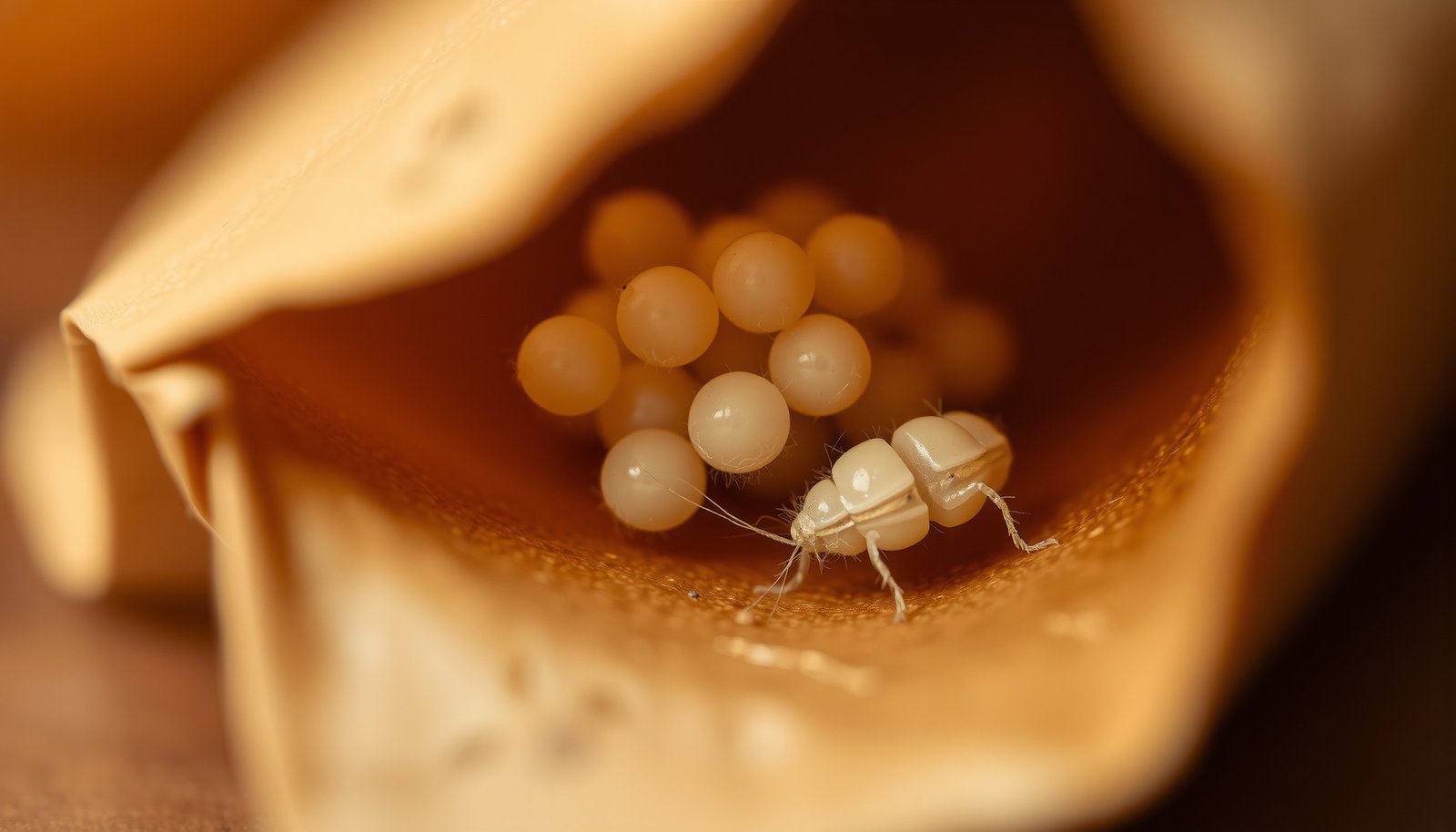
This close-up shows pantry moth larvae webbing and frass inside a grain product — the texture and clumping is what to look for when inspecting packages, because eggs themselves are nearly invisible without magnification.
Where Pantry Moth Eggs Are Actually Hiding (It’s Not Just in the Food)
Picture this: you’ve thrown out every open package, wiped down every shelf, and put everything back in sealed containers. Three weeks later, you spot another moth. The culprit is almost always a location you didn’t treat — and the eggs are remarkably good at hiding in places that feel clean. Pantry moth larvae can wedge themselves into spaces as thin as a credit card before pupating, which means they’re often not in your food at all by the time you start cleaning.
These are the places most homeowners miss during a pantry moth cleanout — and where eggs and larvae are most likely to be hiding:
- The underside of cabinet shelves and the seam where the shelf meets the back wall
- Inside drawer tracks and the gap between drawers and the cabinet frame
- Beneath old shelf liner paper (larvae spin cocoons underneath it regularly)
- In the threaded grooves of jar lids, especially if the jar ever held grain, flour, or dried fruit
- Inside wall cracks or caulk gaps at the back of upper cabinets
- Around the hinge hardware of cabinet doors, where larvae often pupate in the small gap
This is why a vacuum with a crevice attachment is one of the most useful tools in a pantry moth cleanout — not bleach, not sprays. You need to physically remove eggs and larvae from surfaces before any chemical treatment has a chance to work. Spraying a shelf that still has eggs tucked into the back corner seam won’t break the cycle.
The Right Order to Eliminate Pantry Moths Without Missing a Step
Doing these steps out of order is almost as bad as not doing them at all. Putting down pheromone traps before cleaning, for example, just tells you moths are still present — it doesn’t reduce the population. And treating with sprays before you’ve physically removed larvae means you’re treating over a live infestation. Here’s the sequence that actually works, in the order it needs to happen:
- Empty every cabinet completely. Don’t just pull out suspicious items — pull everything out. Eggs can be on the shelf surface underneath a can that’s been sitting there for six months.
- Inspect and discard all at-risk food. This includes anything stored in its original paper or thin plastic packaging — flour, cornmeal, oats, rice, pasta, dried beans, nuts, spices, dried fruit, pet food, and birdseed. When in doubt, throw it out. A $4 bag of almond flour isn’t worth a second infestation.
- Vacuum every interior surface thoroughly. Use the crevice tool in every seam, corner, drawer track, and hinge gap. Immediately seal and dispose of the vacuum bag or canister contents outside.
- Wipe all surfaces with white vinegar. Vinegar doesn’t kill eggs outright, but it dissolves the pheromone trails that larvae and adults use to navigate — which interrupts their ability to locate food and mates. Use it on every shelf surface, wall, and cabinet door interior.
- Apply a food-safe residual treatment to cracks and crevices. Diatomaceous earth (food-grade) applied into caulk gaps and corner seams is effective without requiring you to empty the cabinet repeatedly. It works by damaging the exoskeleton of larvae passing through it. Bay leaves placed on shelves can also deter re-establishment since moths avoid the scent of linalool, a compound in bay leaf oil.
- Place pheromone traps and monitor for two full months. Indian meal moth pheromone traps (like Safer Brand or TERRO) attract and trap adult males, breaking the mating cycle. If you’re still catching moths after 8 weeks, you missed a breeding site somewhere in the kitchen.
One honest nuance here: the timeline for elimination depends heavily on how advanced the infestation is and how warm your kitchen runs. In a warm kitchen (above 80°F), the Indian meal moth life cycle from egg to adult takes as little as 25 days — meaning a missed egg cluster can produce a new adult population before you’ve even finished monitoring. In cooler conditions, that same cycle stretches to 50 days or more, which gives you more time but also makes it harder to tell if treatment is working.
Pro-Tip: After cleaning, freeze any shelf-stable pantry items you’re not ready to discard — including unopened packages — for at least 4 days at 0°F. This kills both eggs and larvae in items that might be contaminated but don’t show visible signs yet. A chest freezer works better than a fridge-top freezer for reaching the right temperature reliably.
How to Tell If What You’re Seeing Is Really a Pantry Moth (And Not Something Else)
Not every small brown moth fluttering around your kitchen is an Indian meal moth — and misidentification leads to wasted effort. The Indian meal moth (Plodia interpunctella) has a very specific appearance: its outer wing is split into two colors — a pale grayish-cream at the base near the body, and a reddish-copper or bronze color on the outer two-thirds. That two-tone wing pattern is the fastest way to confirm you’re dealing with a pantry moth rather than a clothes moth or another common household species. Clothes moths, by contrast, are solid tan or golden throughout, and they’re typically found near wool or fabric — not food.
Here’s a quick comparison of what you’ll actually see in the home:
| Feature | Indian Meal Moth | Clothes Moth |
|---|---|---|
| Wing pattern | Two-tone: cream + reddish-copper | Solid pale golden/tan |
| Where found | Kitchen, pantry, near dry goods | Closets, drawers, near wool/fabric |
| Larvae damage | Webbing in food, clumped grains | Irregular holes in fabric |
| Adult wingspan | About 5/8 inch | About 1/2 inch |
Just like identifying cockroach egg cases correctly before treatment is the difference between eliminating the problem and just displacing it, getting the species right with moths saves you a lot of time and money going after the wrong source. If you find the moths near your bedroom closet and see no food-related damage, you may be dealing with clothes moths — an entirely different problem that requires a completely different approach.
How to Store Food So Pantry Moths Can Never Establish Again
The counterintuitive truth about long-term pantry moth prevention is that the solution isn’t more cleaning — it’s better containment from the moment you get home from the store. Moths can’t lay eggs in food they can’t access. A container that’s airtight to humans is also airtight to a moth trying to deposit eggs. Hard-sided glass or thick plastic containers with gasket-sealed lids — not the ones that just press on — are your best long-term defense. Thin plastic bags, even sealed ones, are not reliable; Indian meal moth larvae can chew through low-density polyethylene in under 24 hours.
“The most overlooked prevention step is what you do at the point of purchase,” says Dr. Karen Vail, extension entomologist at the University of Tennessee. “Inspecting dry goods before you buy them — looking for webbing, clumping, or small larvae near the packaging seams — prevents you from introducing eggs into a kitchen you just cleaned. Bulk bins in grocery stores are especially high-risk, because the turnover makes it difficult to detect early infestations before the product reaches the shelf.”
“The most overlooked prevention step is what you do at the point of purchase. Inspecting dry goods before you buy them — looking for webbing, clumping, or small larvae near the packaging seams — prevents you from introducing eggs into a kitchen you just cleaned. Bulk bins in grocery stores are especially high-risk, because the turnover makes it difficult to detect early infestations before the product reaches the shelf.”
Dr. Karen Vail, Extension Entomologist, University of Tennessee
One thing worth knowing that most guides skip: pheromone traps are monitoring tools, not eradication tools. They catch adult males, which does reduce mating, but a single trap won’t eliminate a population on its own. Their real value is telling you whether your cleanout worked — if you’re still catching 5 or more moths per week after 6 weeks of using a trap, something in your kitchen is still actively breeding. That’s your signal to go back and look harder, not to buy more traps. And if you’re renting and suspect the infestation originated in an adjacent unit through shared wall voids — which does happen in apartment buildings — that’s worth a separate conversation about who’s responsible for treatment. How often a landlord is required to provide pest control depends on your state and lease, but recurring infestations sourced from shared spaces often fall on the property owner to address.
Getting rid of pantry moths completely takes about 8 to 12 weeks of consistent monitoring after your initial cleanout — not because the treatment is slow, but because that’s long enough to catch any eggs you missed before they become a new adult population. If your trap count is hitting zero and staying there, you’re clear. That’s the finish line: not empty shelves, not a spotless cabinet, but a pheromone trap with nothing in it for four consecutive weeks.
Frequently Asked Questions
how do you get rid of pantry moths completely
Start by throwing out every infested food item, then vacuum all shelves and wipe them down with a 50/50 white vinegar and water solution. Wash the area with hot soapy water and let it dry fully before restocking. Don’t skip the corners and cracks — that’s where eggs and larvae hide.
what do pantry moth eggs look like
Pantry moth eggs are tiny, grayish-white, and barely visible to the naked eye — they’re usually less than 0.5mm long. You’ll often find them in clusters directly on food packaging, in flour, or stuck to shelf surfaces near a food source. They can look like fine gritty dust, which makes them easy to miss.
how long does it take to get rid of a pantry moth infestation
It typically takes 2 to 4 weeks to fully eliminate pantry moths if you’re thorough, since their life cycle runs about 4 to 7 weeks depending on temperature. You’ll need to do a deep clean, remove all infested food, and use pheromone traps to catch any remaining adults. If you’re still seeing moths after 4 weeks, check for a food source you may have missed.
can pantry moths live in the walls
Yes, pantry moth larvae can crawl surprisingly far from the original food source and pupate in wall cracks, baseboards, and even ceiling corners. This is why infestations can seem to come back even after you’ve cleaned out your pantry. Sealing cracks with caulk and vacuuming along baseboards near your kitchen helps prevent them from hiding there.
do bay leaves really keep pantry moths away
Bay leaves can help deter pantry moths because they contain compounds that repel many insects, but they’re not a reliable solution on their own. Place dried bay leaves on shelves or tuck them inside dry goods containers as a supplement to other methods, not a replacement. For real prevention, store all dry goods in airtight glass or hard plastic containers with secure lids.
Disclaimer: This article is for informational purposes only and isn’t a substitute for professional pest control advice. Always read and follow the product label instructions exactly — label directions are legally binding and vary by brand and active ingredient. Keep all pesticides, baits and traps away from children and pets, ventilate treated areas as directed, and consider calling a licensed pest control professional if an infestation is large, recurring, or involves a structural pest like termites or carpenter ants.