
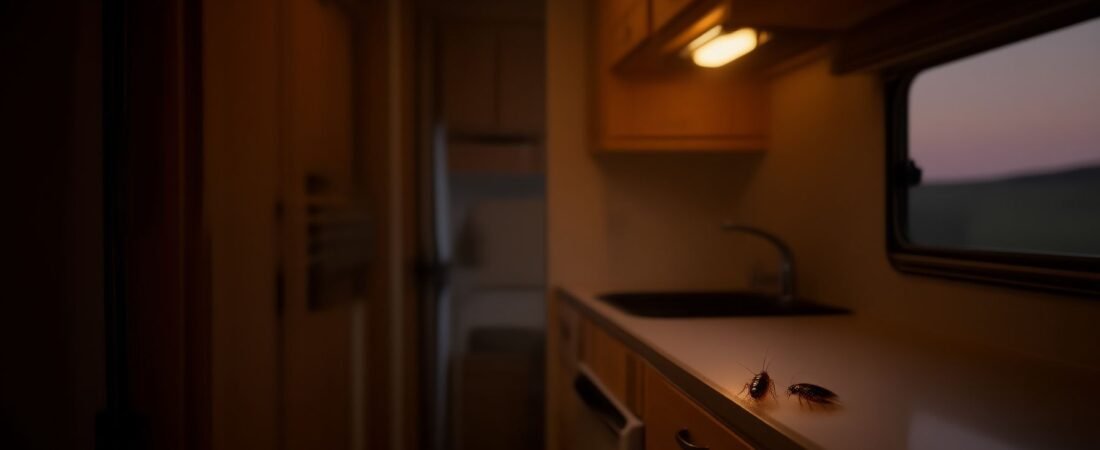
A spotless RV can still get roaches — and that’s the part nobody warns you about before your first cross-country trip. The real problem isn’t mess or crumbs. It’s the structure of the vehicle itself: sealed wall cavities, hidden wiring channels, floor insulation, and tight cabinet backs that hold heat and moisture. Roaches don’t need a dirty kitchen. They need warmth, a water source, and a crack to hide in. Your camper has all three, in abundance, and once they’re established inside a rig, they reproduce faster than they would in a house because the contained environment has almost no natural predators and very little airflow to dry things out.
Why RVs Are the Worst-Case Scenario for a Roach Infestation
Standard houses have one thing working in your favor: they’re big. Dilution matters when you’re dealing with roach populations, because a large space with multiple entry points also has more routes for treatments to spread and fewer areas of concentrated harborage. An RV is essentially a roach hotel that you’ve compressed into 200 square feet. Every wall void is a highway. Every appliance back is a nesting site. The underside of the slide-out alone can harbor hundreds of roaches that never once venture into the living area where you’d spot them.
There’s also the heat factor. An RV parked in sun can reach interior temperatures of 130–150°F in summer, but the wall cavities and under-cabinet spaces tend to stay significantly cooler — right in the preferred range for German cockroaches, which thrive between 70°F and 95°F. That thermal gradient actually draws roaches deeper into the structure during hot days, which is why many RV owners only notice the infestation at night when temperatures equalize and the roaches come out to forage. By that point, you may already have a colony of 200 or more individuals from a single female who hitched a ride in a grocery bag three weeks earlier.
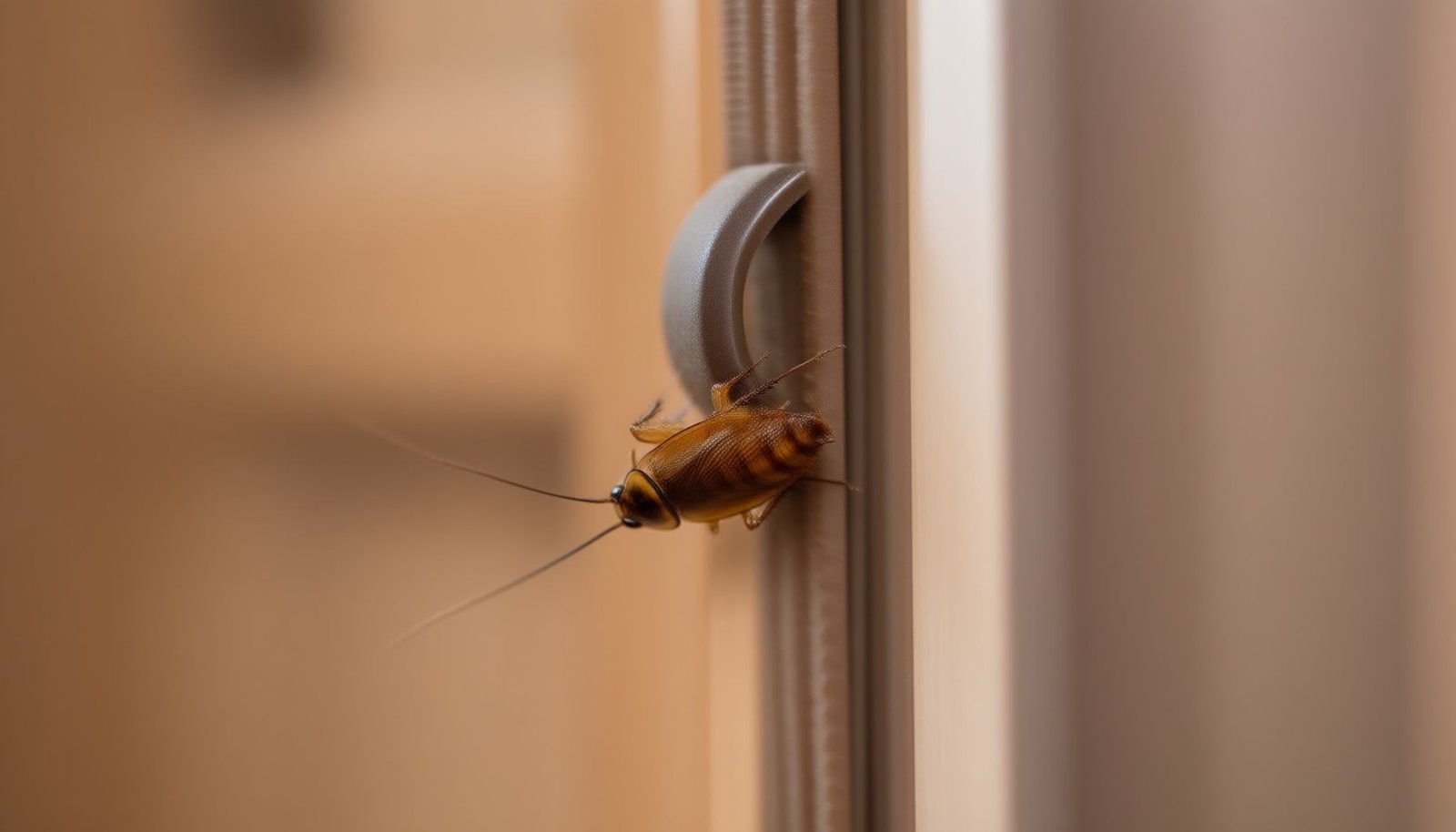
This close-up shows roach harborage along a typical RV cabinet hinge gap — one of the most overlooked entry and nesting points in any camper, and exactly where gel bait needs to be placed to be effective.
How Roaches Get Into an RV in the First Place
The answer is almost never that you drove into a roach-infested campsite and they walked aboard. That happens, but it’s the minority case. The most common entry route is hitchhiking — roaches or their egg cases (oothecae) come in tucked inside cardboard boxes, paper grocery bags, secondhand furniture, or even new appliances that sat in a roach-positive warehouse. A female German cockroach produces an egg capsule containing 30–40 eggs roughly every three to four weeks, and she carries that capsule until just before it hatches. One hidden oothecae in a grocery bag is all it takes.
RVs also get roaches through utility connections. The shore power cord entry point, fresh water inlet, and sewer connection are all gaps in the vehicle’s exterior shell. If you’re parked at a campground where neighboring rigs or permanent structures have roaches, those gaps are open invitations. Roaches can squeeze through a gap as small as 1/16 of an inch — comparable to the thickness of a credit card edge — so standard weatherstripping that looks intact from the outside may be more than adequate for them to pass through. Think of your connections the same way you’d think about an apartment building: your unit shares a wall, and if the neighbors have a problem, it becomes your problem.
The Treatment Order That Actually Works for RVs
Most roach treatment guides give you a list of products without telling you the order matters enormously — especially in a small space. Spray a repellent pyrethroid first and you’ll scatter roaches deeper into wall voids, making bait placement useless because the roaches won’t cross the chemical barrier to reach it. In an RV, the wrong treatment sequence can actually extend your infestation by months. Do it in the right order and you can clear a moderate infestation in two to three weeks.
Here’s the sequence that works, specifically for campers and RVs:
- Remove everything from cabinets and inspect every item. Check the undersides of boxes, behind labels on canned goods, and inside any bags. Discard cardboard packaging — roaches nest in corrugated cardboard specifically because the flutes are exactly the right size for them to wedge into.
- Place gel bait first, before any spray or dust. Syngenta Advion or Rockwell CimeXa gel work well. Apply pea-sized dots every 6–12 inches along cabinet hinge areas, behind the stove, inside the refrigerator motor compartment, and along any visible wiring runs. Don’t spread it in a line — small dots get consumed faster and signal to you when to reapply.
- Apply boric acid or CimeXa dust to voids. Use a hand duster to puff dust into wall voids through outlet covers, around pipe penetrations, and under the slide-out lip. Dust lasts months and works by mechanical abrasion of the roach’s exoskeleton — it’s not repellent, so roaches will walk through it repeatedly.
- Set sticky monitoring traps in high-traffic areas. Place them under the sink, behind the toilet, inside lower cabinet corners, and near the refrigerator. These tell you whether your bait is working and where the population is concentrated.
- Apply an IGR (insect growth regulator) as a final layer. Gentrol Point Source IGR discs placed inside cabinets disrupt the roach reproductive cycle. A juvenile roach exposed to an IGR cannot develop into a breeding adult, which breaks the population cycle without requiring you to kill every individual. This is the step most people skip, and it’s often the reason they get re-infested six weeks later.
- Seal exterior penetrations after treatment is established. Wait until you’ve seen a significant drop in trap catches (usually 10–14 days in) before sealing gaps, so you’re not trapping active roaches inside where they’ll die in the walls and create odor problems. Use silicone caulk for gaps under 1/4 inch and expanding foam for larger penetrations around utility lines.
Pro-Tip: The refrigerator motor compartment is the single most overlooked roach harborage in any RV. It runs warm, stays humid from condensation, and is almost never inspected. Pull the access panel on the back or underside of your RV refrigerator and inspect it directly — you may find the epicenter of your infestation right there. Apply gel bait and dust inside that compartment specifically before treating anywhere else.
What Products Are Safe to Use in an Enclosed Living Space?
This is where RV treatment diverges most sharply from house treatment. A house has 1,500–3,000 square feet and continuous fresh air exchange. An RV has 150–400 square feet, thin walls, and ventilation that’s mostly under your control. Products that are technically safe in a house can concentrate to uncomfortable or harmful levels in a camper, especially if you’re sleeping in it the same night you treat. Aerosol contact killers and foggers are the two categories that cause the most problems.
Foggers — also sold as “bug bombs” — are particularly counterproductive in RVs. The pesticide aerosol they release settles on flat surfaces but doesn’t penetrate wall voids, which is exactly where the roaches are living. You’ll kill what’s foraging in the open, but the colony in the walls will be unaffected and repopulate within days. The residual chemical on surfaces also contaminates food prep areas and can be difficult to fully clean from upholstery and soft goods — the same concern that applies to getting moths out of a closet full of wool sweaters, where residual treatment on fabric is a real consideration. Stick with gels, dusts, and IGRs. They work where roaches actually live.
| Product Type | Effectiveness in RV | Safety in Enclosed Space |
|---|---|---|
| Gel Bait (Advion, Vendetta) | High — targets harborage directly | Safe — localized application |
| Silica/Boric Acid Dust | High — long residual in voids | Safe — applied to voids, not surfaces |
| IGR Discs (Gentrol) | High — breaks breeding cycle | Safe — slow-release, low vapor |
| Aerosol Contact Spray | Low — surface only, repels from bait | Use with caution — ventilate fully |
| Foggers / Bug Bombs | Very Low — doesn’t reach voids | Not recommended — poor air exchange |
“German cockroaches in a recreational vehicle present one of the most difficult treatment scenarios in residential pest control, precisely because the structure concentrates them in inaccessible voids while limiting the applicator’s chemical options. Gel bait rotation — switching active ingredients every 60 to 90 days — is essential to prevent bait aversion, which develops surprisingly fast in isolated RV populations. An IGR layered on top of that bait program is what actually collapses the colony rather than just suppressing the adults you can see.”
Dr. Marcus Bellew, Board-Certified Entomologist and NPMA-certified pest management consultant with 18 years of experience in structural pest control
Keeping Roaches Out of Your RV Long-Term
Prevention in an RV is a different mindset than in a house, because your environment is always changing. A stationary home can be treated and sealed once with reasonable confidence. An RV moves between campgrounds, storage facilities, and neighborhoods — each location presenting a new exposure risk. Your prevention strategy has to travel with you, not just protect a fixed perimeter. Think of it as an ongoing protocol rather than a one-time fix.
The habits that matter most:
- Eliminate cardboard inside the RV completely. Transfer pantry items to sealed hard containers immediately after purchase. Never bring a cardboard box inside the living area — unpack it outside and leave the box out. This single change removes the most common introduction vector.
- Inspect used or borrowed gear before it enters the RV. Camp chairs, coolers, and storage bins that have sat in a garage or storage unit can harbor roaches or egg cases. Shake them out and inspect the undersides before loading.
- Keep one sticky trap under the sink and check it monthly. You’ll catch roaches before you see them — early detection in a small space is what separates a three-week eradication from a three-month nightmare.
- Fix any water leaks immediately. Roaches can survive weeks without food but only about a week without water. A dripping faucet fitting or a condensation-prone pipe under the sink is actively sustaining any roaches already aboard. The same logic applies to pet water dishes left out overnight.
- Treat the exterior utility connections seasonally. Apply a thin bead of silicone around your shore power inlet, water connection, and any cable TV or coax entry points. This is less work than it sounds and dramatically reduces the route by which campground roaches can wander in.
One honest nuance worth flagging: if you store your RV in an outdoor lot or unconditioned storage facility for months at a time, the calculus changes significantly. Roaches in a stored, unheated RV in a cold climate will die off over winter — German cockroaches cannot survive extended temperatures below 45°F. But in warm-storage states like Florida, Texas, or Arizona, a stored RV is essentially a luxury apartment for any roaches that find their way in while you’re not there. If you’re in a warm climate and leaving the rig for a season, place IGR discs and fresh gel bait inside before you close it up — don’t come back in spring to a colony that’s been breeding undisturbed for four months.
There’s a parallel here to dealing with pests in any confined vehicle — eliminating fleas from a car after a pet ride follows the same principle of using targeted, non-aerosol treatments in an enclosed space where heavy chemical application creates more problems than it solves. The size of the space demands precision, not volume.
Picture this: you’re prepping for a two-week trip and you pull the cushions off the dinette to store some gear, and there are roach droppings — tiny black specks that look like ground pepper — clustered along the back wall seam. That’s not a random scout. That’s a harborage site. At that point, you have maybe a two-week head start before that site becomes a full colony. Place bait along that seam the same day, add an IGR disc to the cabinet above it, and check the sticky trap in 48–72 hours to see what’s active. That response time is the difference between a problem you solve over a weekend and one that follows you on your trip.
The RV roach problem most people never fully solve isn’t the infestation itself — it’s the re-introduction cycle. You treat, you eliminate, you leave the rig for a month, and the next campground brings a new batch. Building the prevention protocol into how you use the vehicle — the cardboard rule, the monthly trap check, the pre-trip inspection — is what actually keeps you permanently clear. Roaches in a camper are a management problem as much as a treatment problem, and the people who understand that distinction stop fighting the same battle over and over.
Frequently Asked Questions
how did roaches get into my RV?
Roaches most often get into an RV through cardboard boxes, grocery bags, or secondhand furniture you bring inside. They can also crawl in through gaps around plumbing lines, slideout seals, and vents. Even a single egg case tucked into a bag of chips or a case of soda can start an infestation fast.
what kills roaches in an RV fast?
Gel bait like Advion or Maxforce is one of the fastest and most effective options for RVs because you can apply small dots in tight spaces without spraying chemicals everywhere. Combat or Raid roach bait stations work well too and are safe to leave out while you travel. Most people start seeing dead roaches within 24 to 72 hours of placing bait correctly.
can I bug bomb my RV for roaches?
You can use a fogger in an RV, but it’s usually not the best move — foggers don’t penetrate the wall voids and cabinet corners where roaches actually hide. They also leave a chemical residue on every surface inside your living space, which is a real concern in a small enclosed area. Gel bait and boric acid powder tend to work better and are safer for an RV environment.
how do I keep roaches out of my RV while in storage?
Before storing your RV, remove all food, empty the trash, and wipe down every surface to eliminate grease and crumbs. Place roach bait stations inside and use diatomaceous earth around entry points like water hookup holes and slideout seams. If you’re storing it long-term, moth balls or cedar blocks near the entry points can also help deter roaches from moving in.
are roaches in RVs dangerous?
Yes — cockroaches carry bacteria like Salmonella and E. coli on their bodies and can contaminate your food prep surfaces and dishes. Their shed skins and droppings are also known to trigger asthma and allergies, which is a bigger issue in a small RV than in a full-size home. Even a small infestation should be dealt with quickly because roaches reproduce fast — a single female German cockroach can produce up to 300 offspring in her lifetime.
Disclaimer: This article is for informational purposes only and isn’t a substitute for professional pest control advice. Always read and follow the product label instructions exactly — label directions are legally binding and vary by brand and active ingredient. Keep all pesticides, baits and traps away from children and pets, ventilate treated areas as directed, and consider calling a licensed pest control professional if an infestation is large, recurring, or involves a structural pest like termites or carpenter ants.