

About 25 million Americans have asthma, and cockroach allergens are directly linked to a significant chunk of those cases — yet most people dealing with a roach problem are only worried about the roaches themselves. Here’s what almost nobody tells you: the roaches don’t have to still be alive, or even present, to keep making you sick. Dead cockroaches, shed skins, and especially their dried droppings can keep triggering respiratory symptoms for months after an infestation ends. That’s the part most homeowners completely miss, and it’s the angle this article is built around.
Why Cockroach Droppings Specifically Are a Respiratory Threat — Not Just a Hygiene Problem
Most pest health coverage focuses on what cockroaches carry — bacteria, pathogens, the general gross factor. But the respiratory connection is different, and it works through a completely separate mechanism. Cockroach droppings contain proteins that your immune system can mistake for a dangerous invader. The body launches an inflammatory response, and that inflammation in your airways is exactly what produces asthma symptoms, chronic coughing, and nasal congestion.
These proteins don’t stay put on a dropping either. As droppings dry out, they crumble into microscopic particles that become airborne — small enough to stay suspended in household air for hours. You can breathe them in while doing nothing more suspicious than walking through your kitchen. It’s not a smell you’d notice, and it’s not something you’d see floating in a sunbeam. It’s invisible, which is exactly why so many people never connect their persistent winter coughs or worsening asthma to the roach problem in the apartment downstairs.
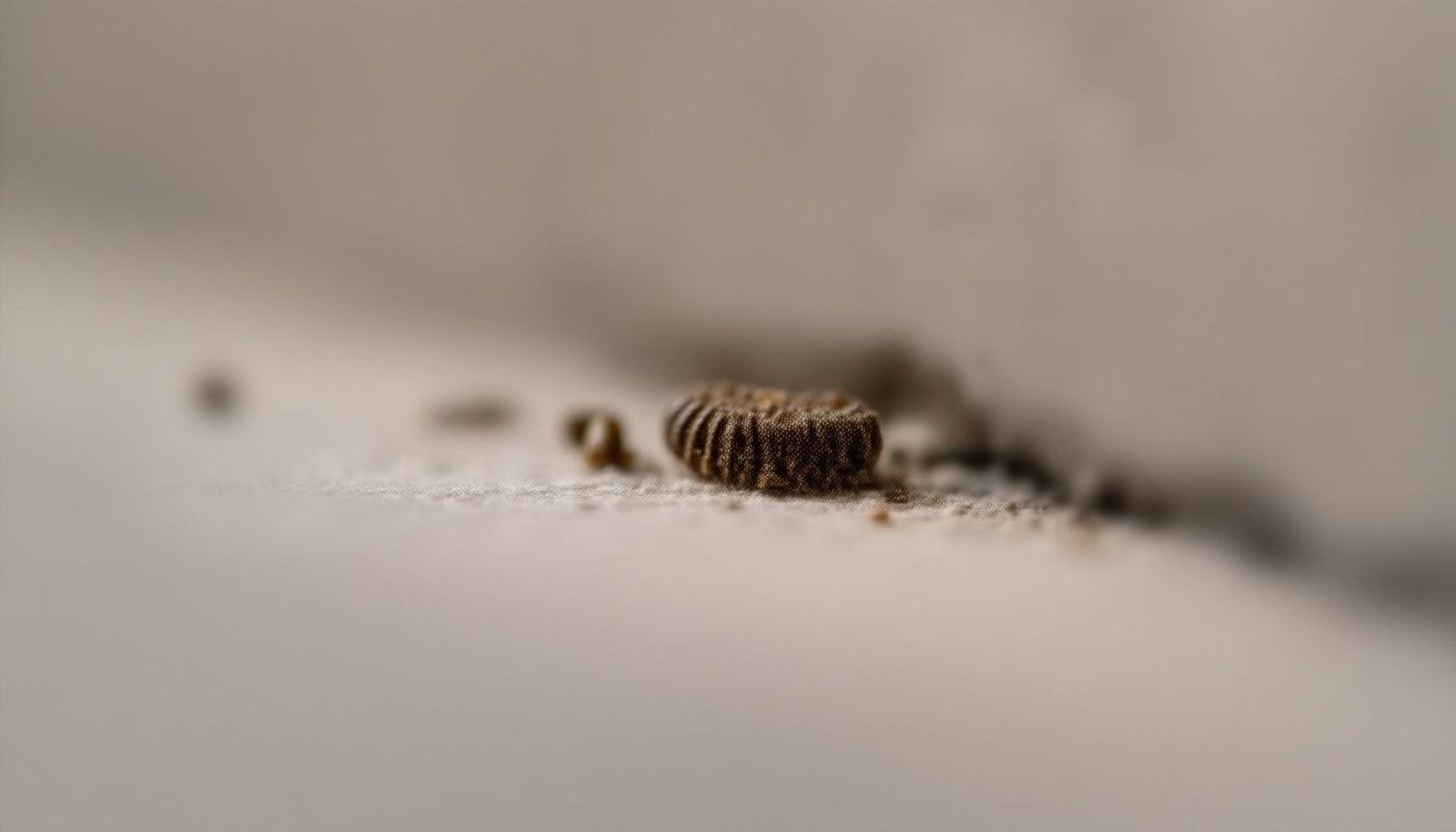
This close-up view shows the dark, granular texture of cockroach droppings in a cabinet corner — the kind of deposit that dries out and fragments into airborne particles that most people never realize they’re inhaling.
What Exactly Is in Cockroach Droppings That Triggers Breathing Problems?
Cockroach droppings aren’t just waste — they’re a concentrated mix of biological material. The key allergens identified in roach droppings are proteins, most notably ones labeled Bla g 1 and Bla g 2 (in German cockroaches) and Per a 1 (in American cockroaches). These proteins are also present in cockroach saliva, shed exoskeletons, and body fragments, but droppings are particularly problematic because they accumulate in high concentrations in enclosed spaces: inside cabinet hinges, behind appliances, under the refrigerator motor, inside wall voids.
Here’s the counterintuitive part: Bla g 2, one of the most potent roach allergens, was originally identified as a digestive enzyme — something the cockroach produces to break down food. Your immune system, encountering a molecule built for digesting organic matter, treats it like a threat and overreacts. That overreaction is asthma. That overreaction is chronic rhinitis. That overreaction is the reason a kid in a roach-heavy apartment building can have more severe asthma than a kid living next to a highway, according to urban air quality research from the past two decades.
“The allergen load from cockroach droppings doesn’t disappear when you eliminate the infestation. Those particles embed in carpets, settle into mattress fabric, and accumulate in HVAC dust. Unless you’re aggressively cleaning and filtering the air after treatment, sensitized individuals will keep reacting — sometimes for a full year or more after the last cockroach is gone.”
Dr. Renata Ochoa, PhD, Board-Certified Entomologist and Indoor Environmental Quality Specialist, University Extension Program
Who Is Actually at Risk, and How Serious Can the Symptoms Get?
Not everyone who lives in a roach-infested home will develop respiratory problems — and that’s an honest nuance worth understanding. Sensitivity to cockroach allergens depends on genetics, pre-existing immune function, duration of exposure, and the sheer volume of allergen particles in the air. Someone who moves into a heavily infested apartment and stays for three years is at far greater risk than someone who spots two roaches in a vacation cabin and leaves after a weekend.
Children are disproportionately affected, and the data is striking. Studies funded by the National Institute of Allergy and Infectious Diseases found that children in high-allergen roach environments were 3.6 times more likely to be hospitalized for asthma than children in low-allergen environments. Adults with pre-existing asthma, elderly individuals, and people with compromised immune systems face the most serious risk — but sensitization can develop in healthy adults too, especially in low-ventilation spaces where allergen concentrations stay high. Picture this: an otherwise healthy person moves into a ground-floor apartment with a history of German cockroach infestations, and six months later they’re using an inhaler for the first time in their life. That scenario happens more often than most people would guess.
| Risk Factor | Effect on Respiratory Sensitivity |
|---|---|
| Pre-existing asthma or allergies | Significantly amplifies reaction to cockroach allergens; can convert mild asthma to severe |
| Age (children under 12) | Developing airways more vulnerable; sensitization can become permanent |
| High indoor allergen concentration | Threshold for immune sensitization reached faster; symptoms appear sooner |
| Poor ventilation / sealed windows | Airborne particles stay suspended longer; exposure duration increases dramatically |
Where Do Cockroach Droppings Accumulate Without You Realizing It?
The places cockroaches actually deposit droppings are almost never where people look when they’re cleaning. Roaches prefer harborage areas — tight, dark, warm spots close to food and water — and that’s exactly where droppings pile up. The visible stuff you find in a cabinet corner is just the tip of it. The real accumulation happens in places most people never touch during a standard kitchen clean.
German cockroaches in particular tend to stay close to their harborage and leave droppings in dense, localized clusters. A single German cockroach produces approximately 1 milligram of fecal material per day — which sounds trivial until you consider that a moderate infestation can involve hundreds of individuals, depositing waste in the same enclosed spaces every day for months. The areas you need to inspect and thoroughly clean aren’t just the obvious ones.
- Behind and underneath the refrigerator — the motor generates warmth that roaches love, and the compressor area collects years of undisturbed droppings
- Inside cabinet hinges and the undersides of drawer rails — roaches tuck into narrow gaps along hardware; droppings accumulate in the hinge recess itself
- Inside wall voids near plumbing — pipe chases are prime harborage, and droppings in walls can off-gas allergens through gaps into living spaces
- Behind switch plates and outlet covers — roaches travel electrical conduits; frass collects around outlets in infested walls
- Inside the motor housing of dishwashers and stoves — these warm appliance interiors can hold concentrations of frass that get dispersed by heat when the appliance runs
- HVAC return vents and filter housings — if roaches are in the ductwork or near vents, droppings enter the air distribution system and spread throughout the home
This is a useful comparison point: just as mouse damage inside walls and insulation is often far more extensive than what’s visible on the surface, cockroach frass deposits go far deeper than what a surface wipe-down uncovers — and the health risk hides in exactly those deeper pockets.
How Do You Actually Reduce Cockroach Allergen Exposure in Your Home?
Eliminating the roaches is step one, but it’s not the finish line — and treating it as the finish line is the mistake that keeps people symptomatic long after an exterminator’s visit. The allergen load has to be physically removed and the air filtered. That’s a separate project from pest control, and it requires specific steps that most pest elimination guides don’t cover.
The cleaning protocol matters as much as the method. Dry sweeping or vacuuming without a HEPA filter can actually make things worse by aerosolizing the fragmented frass particles you’re trying to remove. Damp wiping with an enzymatic cleaner is far more effective at capturing and neutralizing the allergen proteins than dry removal. Here’s the step-by-step approach that actually addresses the respiratory risk, not just the visual evidence:
- Confirm and treat the infestation first — allergen reduction is pointless if roaches are still actively depositing new frass. Use bait stations or a licensed pest control service to eliminate the population before cleaning.
- Vacuum all harborage areas with a HEPA-filtered vacuum — standard vacuums exhaust fine particles back into the air; only a true HEPA filter traps allergen-sized particles (0.3 microns and up).
- Damp-wipe all surfaces in affected areas with an enzymatic cleaner — enzymatic formulas break down the protein structure of the allergens, not just move them around. Pay special attention to the hidden accumulation points listed above.
- Replace or deep-clean HVAC filters immediately — use MERV 11 or higher-rated filters going forward; they capture the particle sizes associated with cockroach allergens more effectively than standard fiberglass filters.
- Run a HEPA air purifier in the primary affected rooms — allergen particles can stay airborne for 4 to 6 hours after disturbance; continuous air filtration reduces the inhaled dose significantly during and after cleanup.
- Wash or steam-clean soft furnishings — cockroach allergens settle into upholstered furniture, rugs, and bedding. Steam at 130°F or above denatures the proteins; washing with hot water achieves a similar effect on washable items.
Pro-Tip: If anyone in your household has asthma or known allergies and you’re doing post-infestation cleanup, have them leave the home for several hours during the vacuuming and wiping phase. Even with HEPA equipment, the initial disturbance of frass deposits kicks up a short-term spike in airborne allergen concentrations that’s genuinely risky for sensitized individuals.
It’s also worth thinking about cross-contamination from pets and their bedding — allergen particles travel on clothing, fur, and soft surfaces throughout a home. If you’re dealing with pest-related allergens in one area of the house, similar particle transfer can carry them to unexpected locations, not unlike how bugs and biological debris in a dog’s bed can end up spread across multiple rooms through normal pet movement.
One more thing worth knowing: the severity of post-infestation allergen exposure varies significantly by building type. Apartment dwellers in older buildings have it harder — concrete and plaster construction holds cockroach frass in wall voids and subfloor gaps in ways that single-family homes with better access points for deep cleaning simply don’t. If you’re in a multi-unit building, a clean apartment surrounded by infested neighbors can still have elevated cockroach allergen levels from shared walls, especially if the HVAC system is centralized. That’s not a problem a vacuum and enzyme cleaner can fully solve — it’s a conversation to have with building management about treating the entire structure, not just individual units.
Your respiratory symptoms are worth taking seriously as data points, not just discomforts. If coughing, wheezing, or congestion consistently improves when you’re away from home and worsens when you return, that pattern is telling you something about your indoor air quality that a doctor’s appointment alone won’t fix. Get the infestation confirmed, get it treated, clean aggressively, filter the air — and if symptoms persist, ask your doctor specifically about cockroach allergen sensitivity testing. It’s a straightforward blood or skin test that can give you a definitive answer and finally connect the dots between your building and your breathing.
Frequently Asked Questions
Can cockroach droppings cause respiratory problems?
Yes, cockroach droppings are a well-documented trigger for respiratory problems, especially asthma and chronic allergies. The droppings contain proteins called allergens that become airborne when disturbed, and inhaling them can cause wheezing, coughing, and airway inflammation. Studies have found that cockroach allergens affect roughly 26% of the U.S. population and are one of the leading indoor asthma triggers for children in urban areas.
what do cockroach droppings look like that could get into the air
Small cockroach droppings from species like German cockroaches look like tiny black or dark brown specks, similar in size to ground coffee or black pepper. Over time, these droppings dry out and crumble into fine dust particles that mix with household air and get inhaled without you even noticing. You’ll usually find them in clusters along cabinet edges, behind appliances, or inside drawers.
how long does it take for cockroach droppings to cause asthma symptoms
There’s no single timeline — it depends on how sensitive you are and how much exposure you’ve had. Some people develop symptoms after weeks of low-level exposure, while those with existing asthma or allergies can react within minutes of inhaling cockroach allergens. Prolonged exposure over months or years is what typically leads to chronic respiratory issues or newly developed asthma, particularly in children under 5.
how do I clean cockroach droppings without spreading allergens
Don’t dry-sweep or vacuum cockroach droppings with a standard vacuum — that just blasts allergens into the air. Instead, dampen the area first with a paper towel or wear an N95 mask, then wipe the droppings up and seal them in a plastic bag before tossing. Use a HEPA-filter vacuum for any residual dust, and wash the area with soap and water to break down the allergen proteins.
can cockroach droppings make you sick even if you don’t see cockroaches anymore
Absolutely — cockroach allergens can linger in dust, furniture, and flooring for months or even years after an infestation is gone. The proteins in dried droppings don’t just disappear once the cockroaches are eliminated, which is why people still experience respiratory symptoms long after extermination. Deep cleaning, HEPA vacuuming, and washing soft surfaces like curtains and upholstery are essential steps to actually reduce your exposure.
Disclaimer: This article is for general informational purposes only and does not constitute medical advice. How a pest-related exposure, bite, or contaminant affects you can depend on age, pre-existing conditions, allergies, and the extent of exposure. If you’re experiencing symptoms you believe are linked to a pest problem in your home, please consult a licensed healthcare provider rather than relying on this article alone.